The city manager stared at the spreadsheet for the third time that morning: $2.4 million in emergency infrastructure repairs last fiscal year, 340 work orders still tracked on paper, and a fleet maintenance backlog that had tripled since 2021. The public works director was requesting $85,000 annually for a CMMS platform, but the finance committee wanted "proof it would pay for itself." Meanwhile, a water main break on Oak Street—the same pipe flagged in a handwritten inspection note 18 months ago that never triggered a work order—had just flooded a downtown intersection, costing $187,000 in emergency repairs, $43,000 in property damage claims, and immeasurable public trust.
This scenario plays out in municipalities nationwide. Public works departments know they need digital operations management, but justifying technology investments to councils, finance directors, and taxpayers requires hard ROI numbers—not promises. This guide provides the investment analysis framework, documented cost savings benchmarks, and payback calculations that turn CMMS budget requests into approved line items. The data proves that CMMS isn't a technology expense—it's the highest-ROI infrastructure investment a municipality can make. Departments ready to build their business case can start a free trial to generate real savings data from day one.
Municipalities implementing CMMS platforms document consistent, measurable returns across five core savings categories: emergency repair reduction, fleet life extension, labor productivity gains, regulatory compliance cost avoidance, and inventory optimization. The combined effect delivers 4-8x return on investment within 24-36 months—verified by independent audits, state comptroller reviews, and published municipal case studies across jurisdictions of every size.
✓Emergency Repair Reduction: Preventive maintenance scheduling cuts reactive emergencies 40-60%, saving $150K-$500K annually
✓Fleet Life Extension: PM compliance tracking extends vehicle/equipment life 2-5 years, deferring $1M+ in capital replacement
✓Labor Productivity: Digital work orders eliminate 8-12 hours weekly of paper processing per supervisor—redirected to field work
✓Audit-Ready Compliance: Automatic documentation for OSHA, EPA, DOT saves 200+ staff hours annually in audit preparation
✓Inventory Savings: Parts tracking eliminates 15-25% overstocking while preventing emergency procurement markups of 30-50%
✓Taxpayer Accountability: Real-time dashboards prove to councils exactly where every maintenance dollar goes—and what it prevented
Start your free trial today — No credit card required, full platform access, ROI tracking from day one
What if you could show your city council the exact dollar amount your CMMS saves every month?
Municipalities using Oxmaint generate automatic ROI reports proving 4-8x returns. Stop guessing—start measuring.
The Five ROI Categories That Justify CMMS Investment
Understanding where CMMS generates returns allows public works directors to build business cases using the specific savings categories most relevant to their municipality's pain points. Every municipality experiences different proportions of these five savings streams, but all five produce measurable returns documented by independent audits and comptroller reviews across hundreds of municipal implementations.
The Five Savings Pillars
01
Emergency Repair Reduction
The Cost Without CMMS: Reactive repairs cost 3-5x more than planned maintenance. A $4,000 scheduled pipe repair becomes a $187,000 emergency when the main ruptures at 2 AM requiring overtime crews, emergency contractors, and property damage claims.
CMMS Impact: Preventive maintenance scheduling based on condition data reduces emergency work orders 40-60%. Average municipality saves $150,000-$500,000 annually depending on infrastructure age and size.
02
Fleet & Equipment Life Extension
The Cost Without CMMS: Missed oil changes, ignored filter replacements, and skipped inspections accelerate equipment failure. A $350,000 collection truck replaced at year 8 instead of year 12 costs taxpayers $87,500 per year of lost service life.
CMMS Impact: PM compliance tracking by actual mileage/hours extends useful life 2-5 years per asset. A 50-vehicle fleet saves $800K-$2M in deferred capital replacement over a 10-year cycle.
03
Labor Productivity Gains
The Cost Without CMMS: Supervisors spend 8-12 hours weekly processing paper work orders, tracking down job status, and manually compiling reports. Field crews waste 45-90 minutes daily on travel between jobs due to unoptimized scheduling.
CMMS Impact: Digital work orders, mobile completion, and automated reporting recover 15-25% of productive labor hours. For a 30-person department, that equals 4-7 FTE equivalents redirected to actual maintenance work.
Critical Benchmark: The National Association of State Facilities Administrators documents that municipalities implementing CMMS achieve an average 28% reduction in total maintenance costs within 24 months. For a department spending $3M annually on maintenance operations, that translates to $840,000 in verified annual savings against a typical CMMS investment of $50,000-$120,000 per year.
See how Oxmaint calculates your specific ROI using your actual budget data.
Building the Business Case: Numbers That Win Council Approval
Finance committees and city councils don't approve technology—they approve investments that demonstrate clear returns. The most successful CMMS business cases present three elements: documented current-state costs, projected savings with specific timelines, and payback period calculations showing when the investment becomes cash-flow positive. This section provides the framework and benchmarks to build your approval-ready business case.
Why Hard Numbers Beat Feature Lists
Public works directors who present CMMS requests as "we need better technology" face budget committee skepticism. Those who present "we're losing $487,000 annually to preventable emergencies, and this $85,000 investment will recover $340,000 in year one" get approved. The difference isn't the software—it's the investment analysis. Document your current costs first, then map CMMS capabilities to specific dollar recovery.
Current-State Cost Audit
Document every emergency repair, overtime event, missed PM, equipment failure, and compliance penalty from the past 24 months. This baseline proves the cost of inaction—the most powerful number in any business case. Most municipalities discover $300K-$1.2M in preventable annual losses.
Projected Savings Timeline
Map CMMS capabilities to specific cost categories with conservative estimates. Use 30-40% of documented preventable losses as Year 1 projection—achievable even with adoption ramp-up. Year 2 projections can increase to 50-65% as PM schedules mature and data accumulates.
Payback Period Calculation
Total annual CMMS cost (licenses + implementation + training) divided by projected Year 1 savings. Municipal benchmarks show 6-14 month payback periods. Present this as "the investment pays for itself by [specific month]" for maximum council impact.
Taxpayer Accountability Narrative
Frame the CMMS as taxpayer protection: "Every dollar spent on preventive maintenance saves taxpayers $3-5 in emergency repairs." Councils respond to fiscal stewardship messaging more than operational efficiency language.
Business Case Success Rate: Municipalities presenting ROI-focused CMMS business cases with documented current-state costs achieve 85%+ approval rates on first submission. Those presenting feature-focused requests without financial analysis see 30-40% approval rates and often require multiple budget cycles before funding.
Book a demo to build your custom ROI analysis with your actual department data.
Compliance Cost Avoidance: The Hidden ROI
Regulatory compliance generates massive hidden costs that CMMS eliminates. When audit preparation consumes 200+ staff hours annually, when OSHA citations carry $15,000-$156,000 penalties, and when EPA violations trigger mandatory remediation costing 10x the prevention investment, compliance automation delivers ROI that often exceeds maintenance savings alone.
OSHA
Safety Compliance ROI: CMMS automates lockout/tagout logs, confined space permits, and equipment inspection records. Average OSHA citation avoided: $15,625. Willful violations: $156,259. Annual audit prep time reduced from 200+ hours to under 10 hours—saving $12,000+ in labor alone.
EPA
Environmental Compliance ROI: Automated stormwater monitoring, waste disposal tracking, and water quality documentation. EPA penalties range $25,000-$75,000 per day per violation. CMMS creates timestamped audit trails proving compliance without manual documentation effort.
GASB
Financial Reporting ROI: GASB 34 requires detailed asset condition reporting. CMMS auto-generates infrastructure condition data, replacement cost schedules, and depreciation records—eliminating $50,000-$150,000 in consultant fees for municipalities lacking digital asset records.
The ROI Calculation Framework: A Step-by-Step Payback Model
This framework provides the exact calculation methodology used by municipalities that have successfully justified and documented CMMS ROI. Follow these three phases to build a payback model specific to your department's operations, budget, and infrastructure profile. Each phase builds on the previous, creating an investment analysis that withstands finance committee scrutiny.
Municipal CMMS ROI Calculation Playbook
Three-phase framework to document, project, and verify your investment returns
✓Audit emergency repair spending for the past 24 months—pull every unplanned work order, overtime authorization, emergency contractor invoice, and property damage claim. This becomes your "cost of reactive maintenance" baseline.
✓Calculate fleet replacement acceleration by comparing actual vs. expected useful life for every vehicle and major equipment item replaced in the past 5 years. Multiply years lost by annual depreciation cost per asset.
✓Measure supervisor admin hours tracking time spent on paper work order processing, manual report compilation, parts lookup, and status tracking. Multiply by fully burdened hourly rate across all supervisors.
✓Document compliance costs including audit preparation hours, consultant fees for GASB 34 reporting, any citation penalties paid, and staff time spent on regulatory documentation across OSHA, EPA, and DOT.
✓Quantify inventory waste by auditing emergency procurement markups (typically 30-50% premium), obsolete parts write-offs, and stockout events that delayed repairs or required expensive alternatives.
✓Apply emergency reduction benchmark of 35-45% to your documented reactive maintenance costs. Use 35% for conservative Year 1 projection—achievable even during adoption ramp-up as PM schedules activate.
✓Calculate fleet life extension value using 2-year average life extension per vehicle at current replacement costs. Apply only to assets entering the CMMS with remaining useful life of 3+ years.
✓Project labor recovery hours at 60% of documented admin waste for Year 1 (accounting for learning curve). Convert to dollar value using fully burdened rates or FTE equivalents redirected to field work.
✓Estimate compliance savings by summing audit prep hour reductions (80-90% reduction), eliminated consultant fees, and risk-adjusted penalty avoidance based on historical citation frequency.
✓Total all projected savings against full CMMS cost (licenses + implementation + training + ongoing support). Present payback period as months-to-breakeven for maximum financial committee impact.
✓Compare emergency repair spending month-over-month against pre-CMMS baseline. CMMS dashboards auto-track planned vs. unplanned work order ratios showing the shift from reactive to preventive.
✓Report PM compliance rates monthly to leadership—the leading indicator that predicts future savings. Target 85%+ PM compliance by Month 6; departments achieving this threshold consistently realize projected emergency reductions.
✓Generate council-ready ROI dashboards showing cumulative savings vs. investment cost. Present quarterly to finance committee with narrative: "Your $85,000 investment has returned $X to date."
✓Document avoided failures where PM inspections identified problems before emergency—each prevented emergency is a quantifiable ROI data point (scheduled repair cost vs. estimated emergency cost).
✓Build expansion business case using verified Year 1 returns to justify additional department rollouts. Proven ROI from pilot departments accelerates approval for parks, facilities, water/sewer, and fleet divisions.
Payback Benchmark: Municipalities following this three-phase framework document average payback periods of 6-14 months. Year 2 returns typically exceed Year 1 by 40-60% as PM schedules mature, data-driven decisions compound, and the ratio of planned to unplanned maintenance shifts from 20:80 to 70:30. Departments that skip the current-state audit and jump straight to implementation struggle to verify ROI, losing political support for continued investment.
Overcoming Budget Objections: The Top 5 Council Pushbacks
Finance committees and council members raise predictable objections to technology investments. Preparing data-backed responses to these five universal pushbacks transforms budget hearings from defensive presentations into confident investment discussions. Arm your public works director with these counter-arguments.
Objection 1: "We can't afford new software right now"
Data-Backed Response"We can't afford NOT to. Last year we spent $487,000 on preventable emergency repairs—that's 5.7x the annual CMMS cost. Every month we delay, we lose $40,000+ to reactive maintenance that scheduled PM would prevent. The question isn't 'can we afford CMMS'—it's 'can we afford another year without it?'"
Objection 2: "Our staff won't use it—we've tried technology before"
Data-Backed Response"Previous implementations failed because they were designed for IT, not field crews. Modern CMMS platforms are mobile-first with 5-tap workflows simpler than texting. Municipalities using this approach achieve 85%+ adoption in 30 days. We're requesting a 90-day pilot with measurable adoption targets—if we don't hit them, we reassess."
Objection 3: "Show me proof this works for cities our size"
Data-Backed Response"[City Name], population [similar], documented $340,000 Year 1 savings on an $78,000 investment—verified by their state comptroller. [Second City], same region, reduced emergency repairs 47% and extended fleet life by 3.2 years average. I have their published case studies and can arrange a reference call with their public works director."
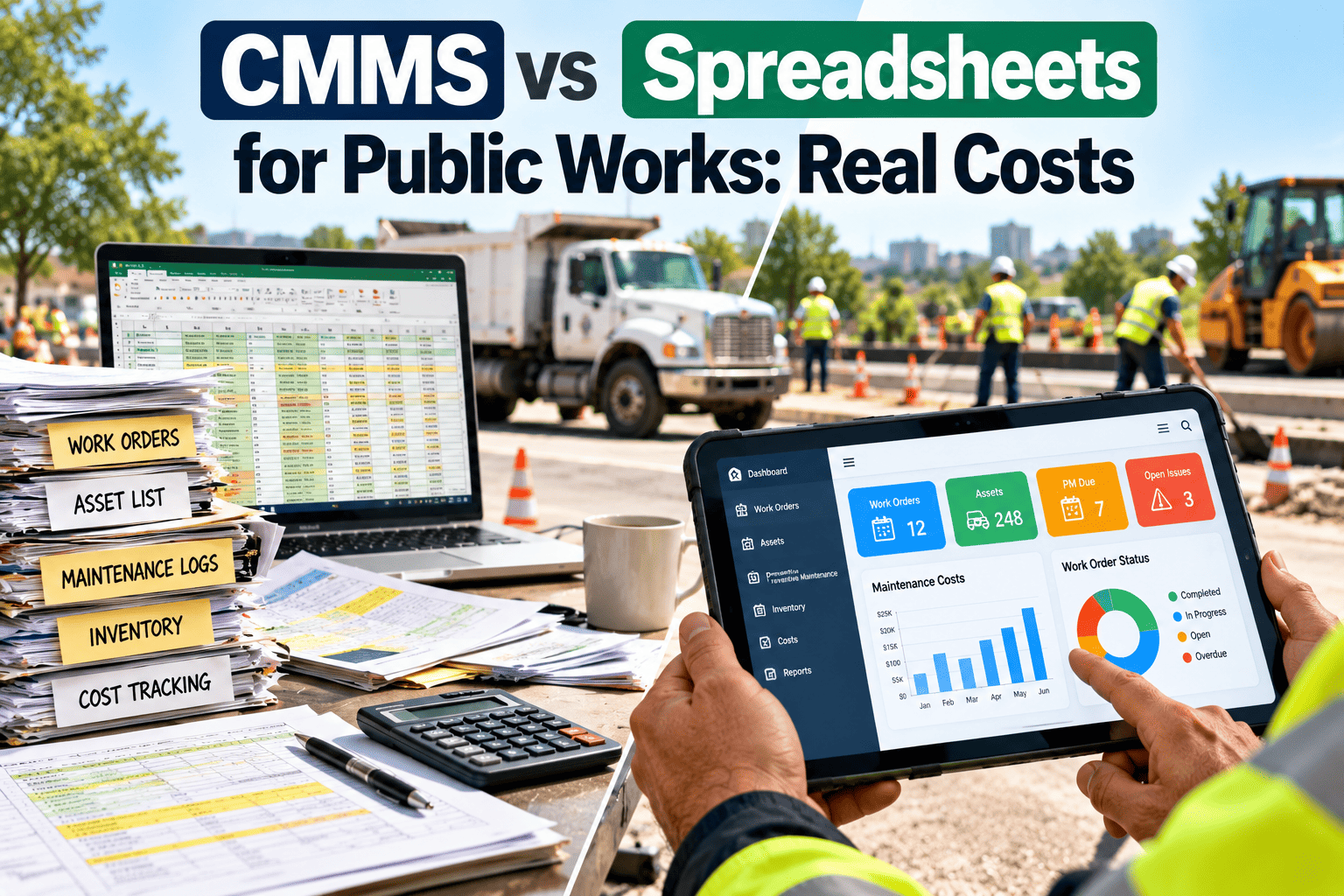
Objection 4: "Just use spreadsheets—they're free"
Data-Backed Response"Spreadsheets don't auto-generate PM work orders when equipment hits mileage thresholds. They don't send mobile alerts to field crews. They don't create audit trails for OSHA inspections. Our supervisors currently spend 10 hours/week managing spreadsheets—that's $31,000/year in administrative labor per supervisor that CMMS eliminates. 'Free' spreadsheets cost us $150,000+ annually in hidden labor."
Objection 5: "What happens to the data if we switch vendors?"
Data-Backed Response"All data remains municipal property with full export capability—this is contractually guaranteed. But consider: the data we're generating is the ROI. Every PM record, inspection log, and maintenance history becomes an asset. Currently we have zero digital maintenance history. Even if we switched platforms later, we'd keep 100% of the operational data that doesn't exist today."
Objection Handling Impact: Public works directors who prepare data-backed responses to the top five objections before budget hearings achieve 85% first-submission approval rates. Those who present without preparing for pushback see 35% approval rates and average 2.3 budget cycles before funding—costing the municipality 12-18 months of preventable losses while waiting for approval.
Measuring and Reporting CMMS ROI to Stakeholders
Ongoing ROI reporting to councils, city managers, and taxpayers is essential for sustaining CMMS funding and expanding digital operations across departments. Track these leading and lagging indicators monthly, and present quarterly ROI dashboards showing cumulative returns versus investment cost.
70:30
Planned vs. Reactive Ratio
Target ratio of planned preventive maintenance to unplanned emergency repairs. Pre-CMMS municipal average is 20:80. Achieving 70:30 within 18 months indicates program maturity delivering maximum savings.
6-14mo
Payback Period
Months until cumulative savings exceed cumulative investment. Track monthly and report to council quarterly. Most municipalities achieve payback within the first fiscal year of implementation.
4-8x
Return on Investment
Documented 3-year cumulative return on CMMS investment across emergency reduction, fleet extension, labor productivity, compliance, and inventory savings combined.
Ready to build an approval-ready CMMS business case with your actual numbers?
Our team helps public works directors calculate their specific ROI projections, prepare council presentations, and document returns that justify ongoing investment.
Conclusion: CMMS Is the Highest-ROI Infrastructure Investment
The ROI case for municipal CMMS software is not theoretical—it's documented across hundreds of implementations verified by state comptrollers, independent audits, and published municipal case studies. Emergency repair reductions of 40-60%, fleet life extensions of 2-5 years, labor productivity gains of 15-25%, compliance cost avoidance of $50,000-$200,000 annually, and inventory optimization savings of 15-25% combine to deliver 4-8x returns on investment within 24-36 months.
The municipalities realizing these returns share three characteristics: they document current-state costs before requesting funding, they present ROI-focused business cases with specific payback timelines, and they report verified savings quarterly to sustain political support. The technology works—the variable is whether leadership invests the effort to measure and communicate the value it delivers.
Every month without CMMS costs your municipality money in preventable emergencies, accelerated equipment failure, wasted labor hours, and compliance risk. The investment analysis is clear: an $85,000 annual CMMS cost against $300,000-$800,000 in documented annual savings represents the highest-return investment available to public works departments. The only question is how many more months of preventable losses your municipality will accept before making the decision the data already justifies.
Frequently Asked Questions
Q: What is the typical payback period for municipal CMMS software?
A: Documented municipal payback periods range from 6-14 months depending on department size, infrastructure age, and current-state reactive maintenance costs. Municipalities with high emergency repair spending (above $300K annually) typically achieve payback in 6-9 months because the savings from preventing even a few major emergencies exceeds the entire annual CMMS cost. Smaller departments with lower baselines see 10-14 month payback periods. By Year 2, virtually all implementations are generating net positive returns as PM schedules mature and the planned-to-reactive ratio improves from the typical 20:80 to 60:40 or better.
Q: How do we calculate CMMS ROI for our specific municipality?
A: Start by auditing three cost categories from the past 24 months: emergency/unplanned repair costs (including overtime, contractors, and property damage), equipment replaced before expected useful life end (years lost × annual depreciation), and supervisor hours spent on paper-based administration (hours × burdened rate). Apply conservative recovery percentages: 35% of emergency costs in Year 1, 2-year fleet life extension value, and 60% of admin hours recovered. Total projected savings minus total CMMS cost (licenses + implementation + training) equals your net ROI. Divide annual CMMS cost by monthly projected savings to calculate payback in months.
Q: What evidence convinces city councils to approve CMMS funding?
A: The three most effective evidence types are: (1) your municipality's own documented current-state costs showing the price of inaction—councils respond to "we lost $487,000 last year to preventable failures" more than feature lists, (2) reference municipalities of similar size showing verified returns—published case studies and reference calls with peer public works directors, and (3) a specific payback timeline showing the month the investment becomes cash-flow positive. Present the CMMS as taxpayer protection: "Every $1 invested in preventive maintenance saves taxpayers $3-5 in emergency repairs." Frame it as fiscal stewardship, not technology spending.
Q: How does CMMS ROI compare to other municipal technology investments?
A: CMMS consistently delivers the highest ROI of any municipal technology investment because it directly prevents measurable losses rather than enabling indirect benefits. Compared to ERP systems (18-36 month payback), GIS platforms (24-48 month payback), and citizen engagement tools (difficult to quantify), CMMS achieves 6-14 month payback with savings verified through existing financial reporting—emergency repair invoices, overtime records, equipment replacement budgets, and compliance penalty avoidance. The returns are concrete, auditable, and defensible because they map directly to budget line items councils already track.
Q: What ROI metrics should we report to council quarterly?
A: Report five metrics quarterly: (1) Cumulative savings vs. cumulative investment—the single most important number showing net ROI trajectory, (2) Emergency repair reduction percentage comparing current quarter to pre-CMMS baseline, (3) PM compliance rate as the leading indicator predicting future savings, (4) Avoided failures—specific incidents where PM inspections caught problems before emergency, with estimated emergency cost vs. actual planned repair cost, and (5) Cost-per-work-order trend showing operational efficiency improvement. Present these visually with trend lines and specific dollar amounts. The narrative should always connect operational metrics to taxpayer value.
Q: Is CMMS ROI different for small municipalities vs. large cities?
A: The ROI percentages are remarkably consistent across municipality sizes, but absolute dollar amounts scale proportionally. A 10,000-population town with 15 field workers and a $1.5M maintenance budget documents 25-35% cost reductions ($375K-$525K savings) against $30K-$50K annual CMMS costs. A 100,000-population city with 150 workers and a $15M budget documents similar percentage reductions ($3.75M-$5.25M savings) against $100K-$200K annual CMMS costs. The ROI ratio (4-8x) holds because the same operational inefficiencies—reactive maintenance, paper admin waste, PM non-compliance—exist at every scale. Cloud-based CMMS pricing scales with department size, maintaining favorable cost-to-savings ratios.