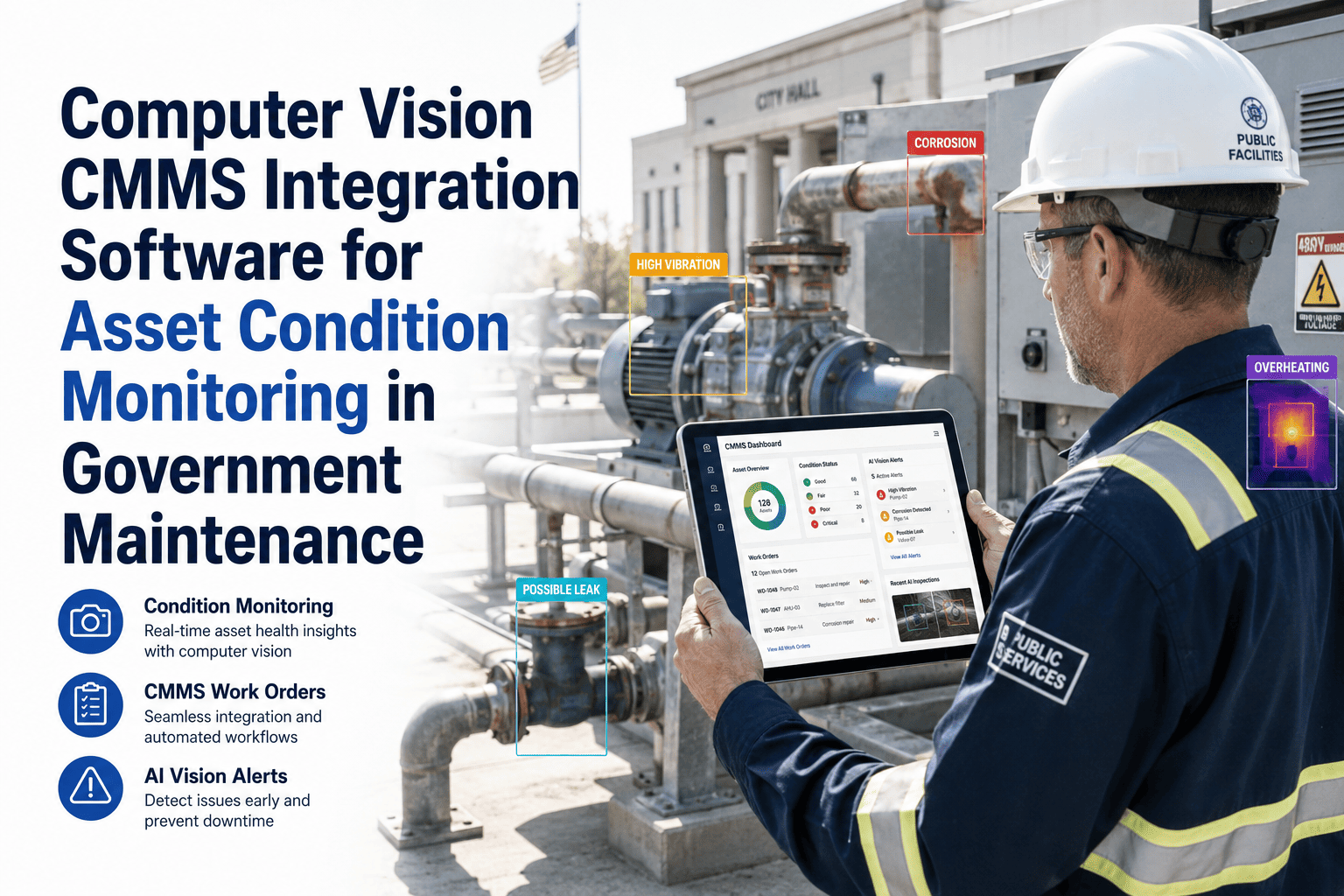
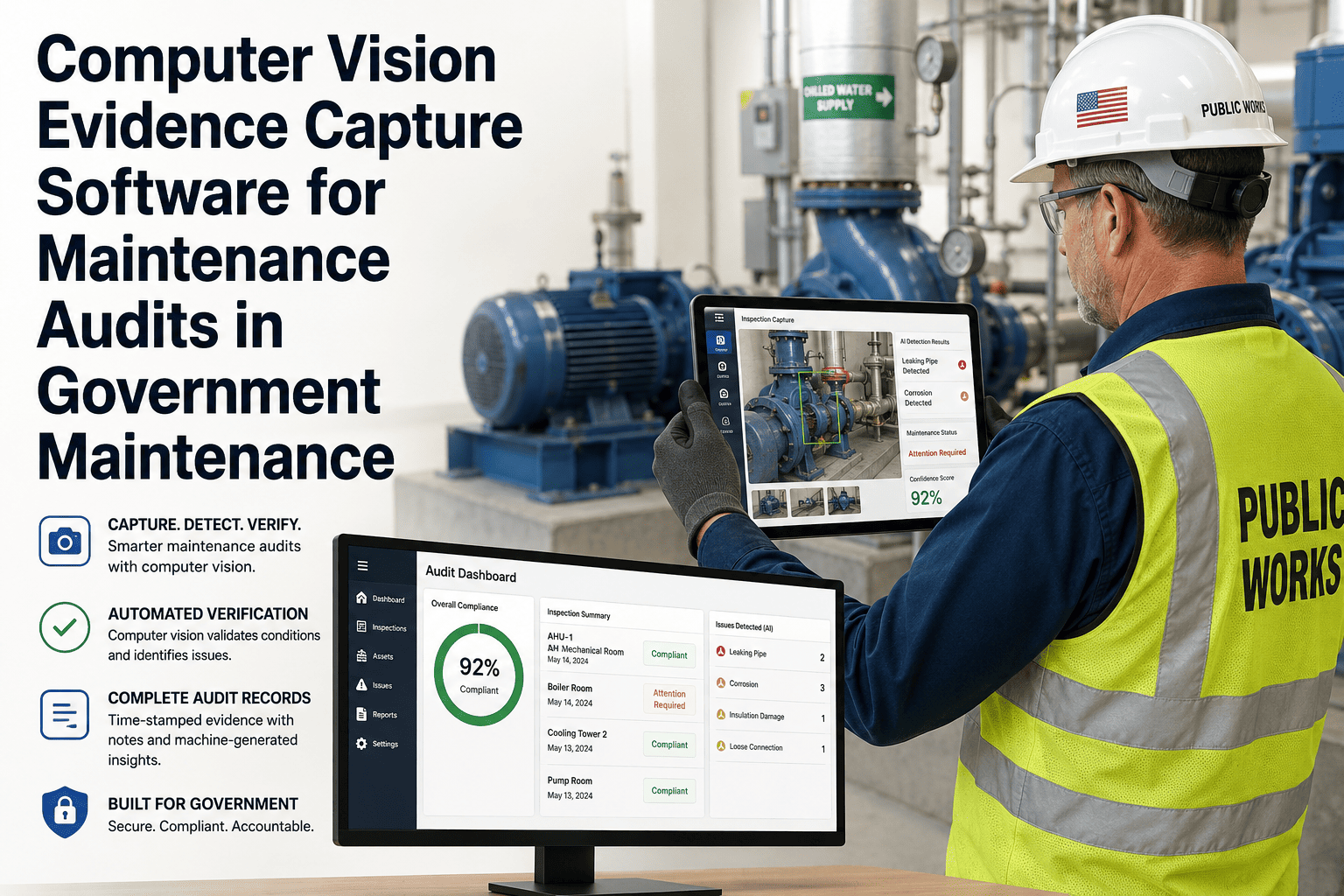
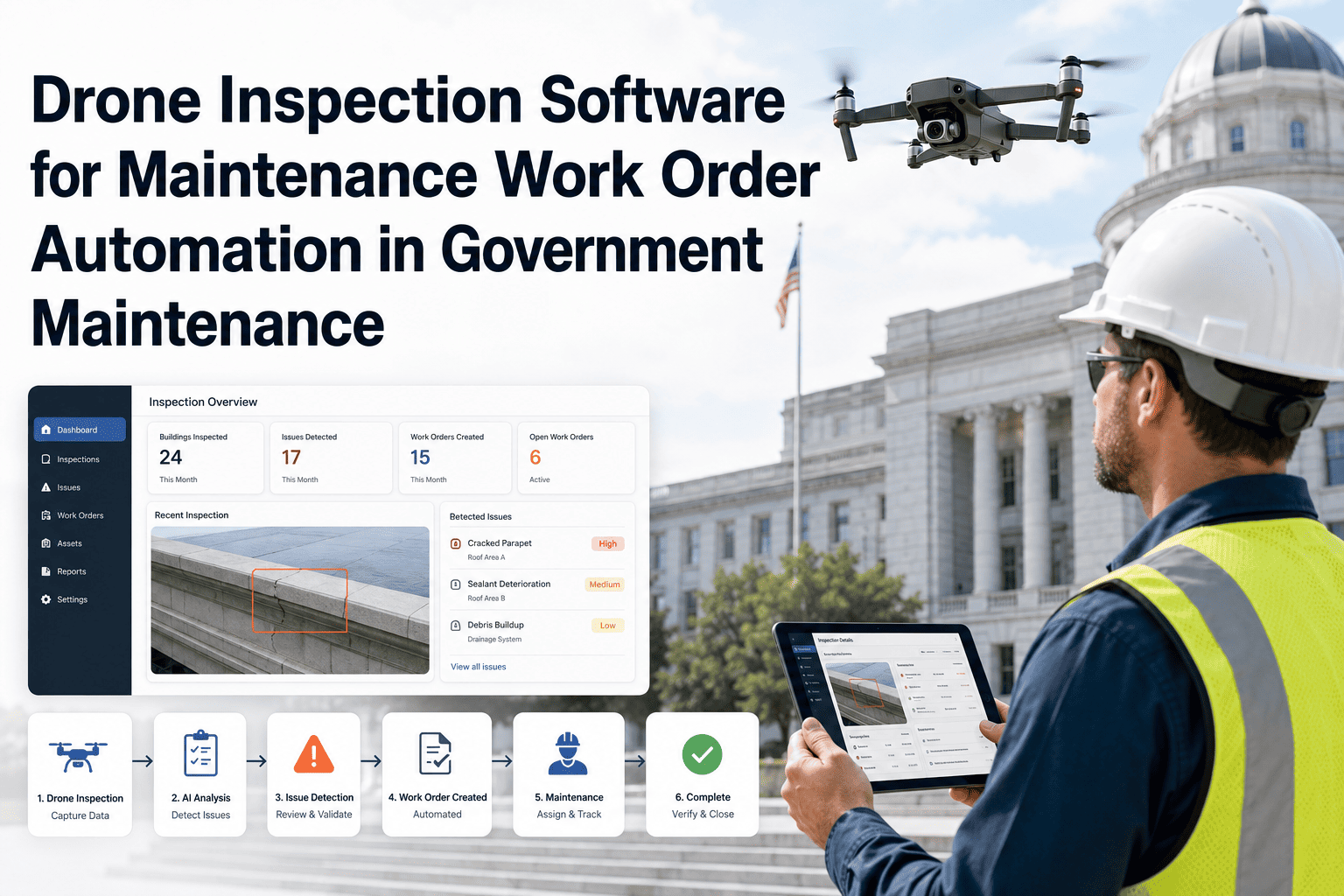
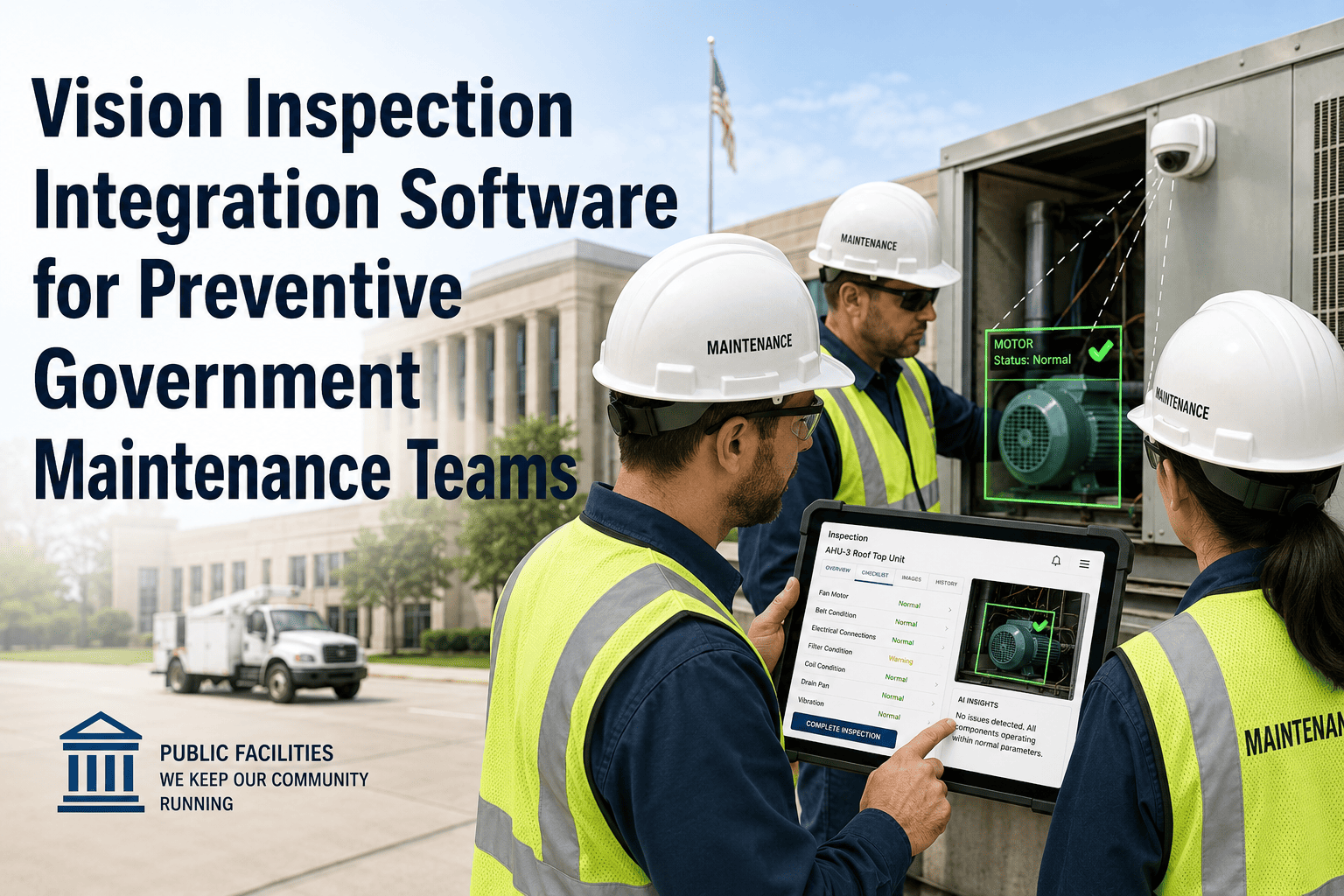
Government maintenance teams across public works, municipal infrastructure, and utilities are under growing pressure to do more with less — fewer inspectors, tighter budgets, and aging assets that demand attention before they fail. Computer vision CMMS integration is changing how public-sector teams monitor asset condition: cameras capture visual evidence automatically, AI detects degradation before it becomes a failure, and OxMaint converts every detected anomaly into a work order — routed, documented, and traceable without manual entry. This guide explains exactly how computer vision integrates with CMMS for government asset condition monitoring, what it detects, and what public works directors are seeing in real deployments.
AI Vision · Government Maintenance · CMMS Integration
Computer Vision CMMS Integration for Government Asset Condition Monitoring
Stop discovering infrastructure failures after they happen. Connect cameras to your CMMS and let AI watch every asset, every shift — turning visual evidence into automatic work orders and compliance records.
60–70%
false alert rate in legacy motion-detection systems — eliminated by purpose-built AI vision
under 2s
AI processing time per image — anomaly classified, severity scored, work order triggered
41%
reduction in unplanned downtime reported in facilities using AI-integrated CMMS inspection
What Government Maintenance Teams Actually Lose Without Vision Integration
Manual inspection rounds cover a fraction of your asset inventory. A technician walking a route can inspect 20–40 assets per shift. A camera network monitored by AI inspects every asset continuously — 24 hours, every day, without fatigue or missed shifts.
Inspection Gaps
Assets go uninspected for days between manual rounds. Corrosion, cracks, and leaks develop undetected in that window.
No Visual Evidence
Without photographic documentation, inspection findings are verbal reports — unverifiable, non-auditable, and legally weak.
Delayed Work Orders
A technician detects a defect, returns to the office, manually enters a work order. Hours pass. Urgent issues wait in the queue.
Compliance Exposure
Government assets require documented inspection histories. Manual logs have gaps that auditors and oversight agencies flag during reviews.
How Computer Vision Connects to Your CMMS: The 4-Stage Flow
1
Camera Capture
Fixed cameras, drone surveys, or mobile devices capture asset images continuously. OxMaint works with existing ONVIF/RTSP camera infrastructure — no hardware replacement required.
2
AI Anomaly Detection
Vision models compare every frame against healthy baselines. Defects — corrosion, cracks, spalling, leaks, missing components — are classified by type and severity in under 2 seconds.
3
Automatic Work Order Creation
Severity above your configured threshold instantly generates a CMMS work order with the annotated image, defect type, asset ID, location, and recommended action — already routed to the right crew.
4
Compliance Record Generation
Every detection event is timestamped, logged, and stored as an immutable audit record. Government reporting requirements and oversight reviews are answered with searchable, verifiable evidence.
Government Asset Types: What Vision AI Detects
| Asset Category |
Defects Detected by AI Vision |
Work Order Trigger |
| Bridges and Overpasses |
Surface cracking, spalling, rebar exposure, joint separation |
Severity score 3+ |
| Water / Sewer Infrastructure |
Pipe corrosion, visible leaks, manhole cover displacement |
Immediate (critical) |
| Public Buildings and Facilities |
Roof membrane tears, facade deterioration, window seal failure |
Severity score 2+ |
| Fleet and Vehicle Yards |
Body damage, fluid leaks, tire wear, light system anomalies |
Pre-shift detection |
| Electrical Infrastructure |
Insulation damage, connector corrosion, cabinet seal gaps |
Severity score 3+ |
| Parks and Recreation Assets |
Equipment wear, vandalism, surface degradation |
Severity score 2+ |
See how OxMaint connects your cameras to automatic work orders — built for government maintenance.
Existing camera infrastructure, no custom development, full audit trail from detection to work order close.
Performance Comparison: Manual Inspection vs. AI Vision CMMS
Manual Inspection Only
20–40 assets inspected per technician shift
Findings recorded as text — no photo evidence
Work order entry takes 15–45 minutes after detection
Inspection logs manually maintained — gaps common
Defect severity rated by individual technician experience
AI Vision + OxMaint CMMS
Every camera-covered asset monitored continuously, 24/7
Annotated image automatically attached to each work order
Work order created and routed in under 2 seconds
Immutable audit log — every detection timestamped and stored
Consistent AI severity scoring — same standard every inspection
Expert Perspective
The shift from manual rounds to AI-assisted continuous monitoring is the biggest productivity leap in public-sector maintenance in a decade. The bottleneck has never been labor — it has been visibility. Government teams that integrate computer vision with their CMMS stop reacting to failures and start intercepting them. The audit trail alone justifies the investment for any agency under oversight review.
Infrastructure Maintenance Technology Analyst, Public Works Advisory Group
Frequently Asked Questions
Do we need to replace our existing cameras to use OxMaint's vision integration?
No. OxMaint integrates with existing ONVIF/RTSP-compatible cameras already deployed across most government facilities and infrastructure sites. The AI vision layer connects to your current camera network without hardware replacement. For zones with no coverage, standard IP cameras can be added at low cost.
Book a demo to review your current infrastructure setup with our team.
How does the system handle false alerts — we cannot have technicians responding to noise all day?
Legacy motion detection systems generate 60–70% false positive rates. OxMaint's purpose-built AI vision uses defect-specific models trained on infrastructure imagery — not generic motion detection. False alert rates drop below 5% in active deployments. Severity thresholds are configurable per zone and asset type, so crews only receive work orders that meet the bar you set.
Start a free trial and set your own thresholds during onboarding.
Does this meet government documentation and compliance requirements?
Yes. Every detection event generates a timestamped, tamper-resistant record with annotated image, asset ID, defect classification, and work order history. This audit trail satisfies documentation requirements for federal oversight reviews, state infrastructure inspections, and local government asset reporting. Records are searchable and exportable for any audit request.
How long does it take to deploy and start seeing results?
Most government deployments complete integration in 14–30 days without custom model training, depending on existing camera infrastructure coverage. AI models are pre-trained on infrastructure defect types, so detection begins as soon as cameras are connected to the OxMaint platform. First confirmed early detections typically appear within the first two to three weeks of operation.
Book a demo to get a deployment timeline estimate for your agency.
Every defect in your public assets is visible right now — to a camera that is already watching. The question is whether your CMMS is listening.
OxMaint connects your camera network to automatic work orders, full audit records, and the maintenance team that can act — before infrastructure fails and the public notices.