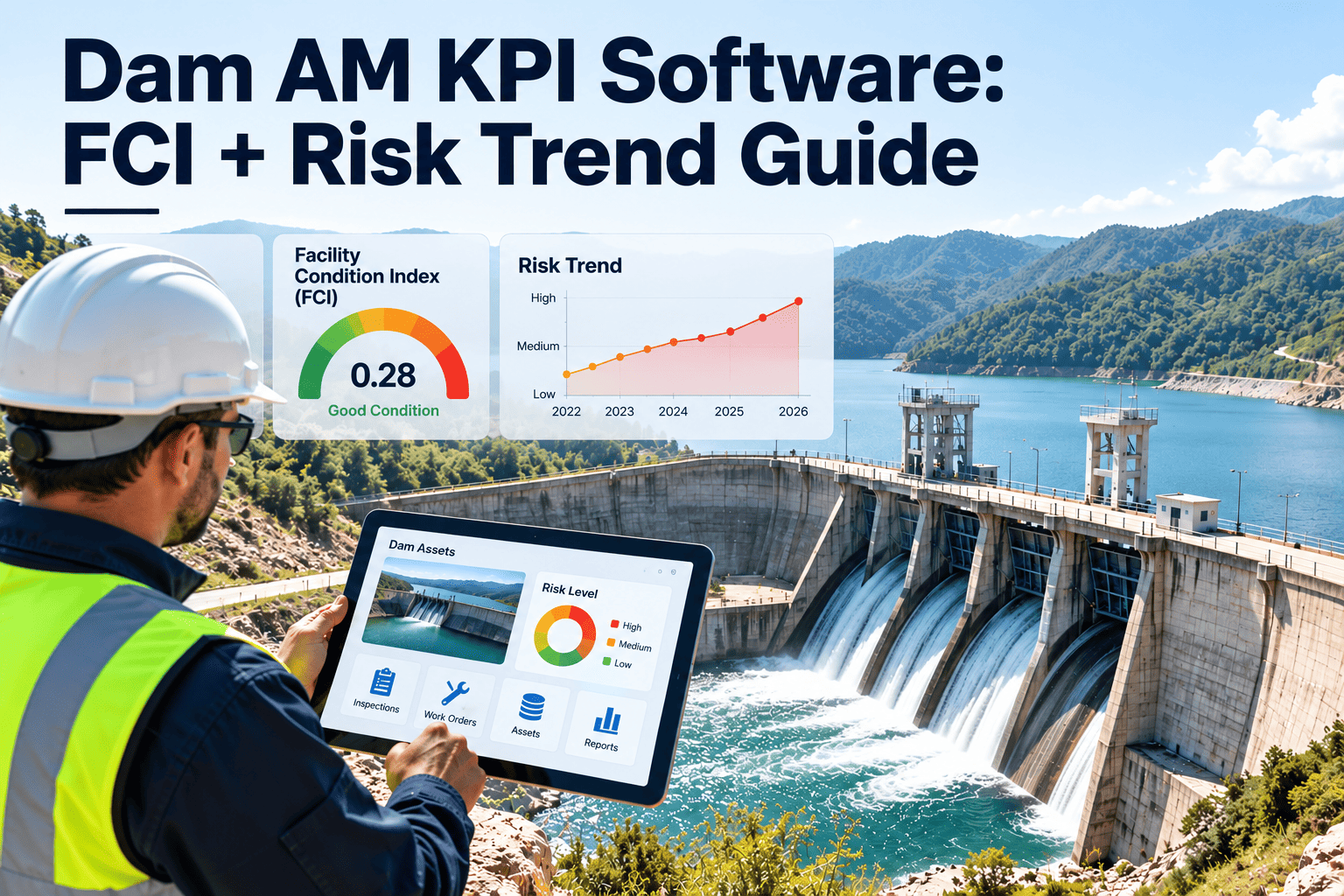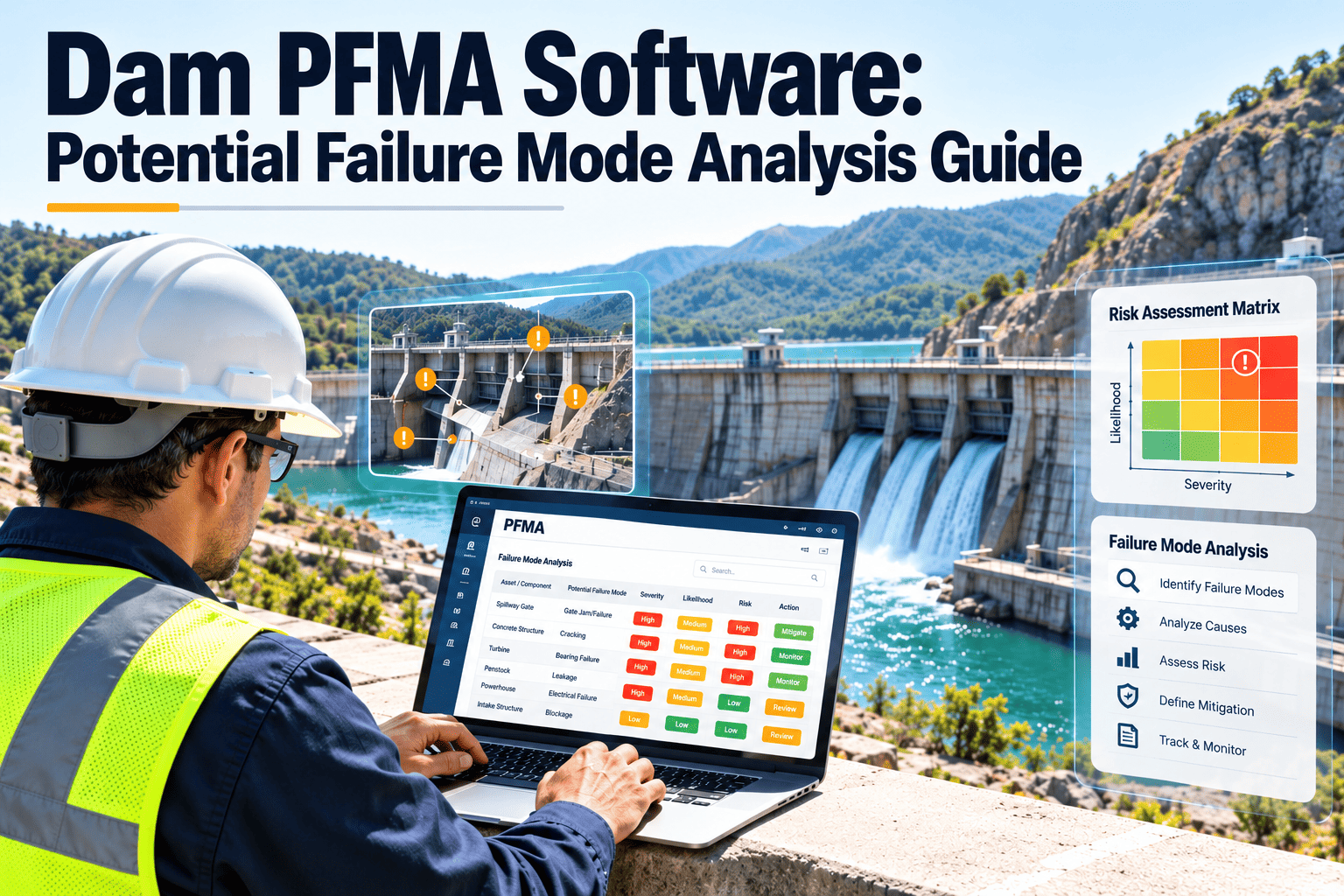
A potential failure mode analysis is only as useful as what happens after the session ends. Teams spend days identifying how a dam could fail, then file the results in a report that inspectors and maintenance crews never see. Connecting each failure mode to monitoring, inspections, and work orders keeps the analysis alive between reviews. This guide covers the PFMA process, the federal guidance behind it, and how Oxmaint maintenance management software carries the results into daily dam safety work.
Dam PFMA Software: Potential Failure Mode Analysis Guide
Dam owners following USACE, Reclamation, and FERC practice need more than a PFMA report. They need each failure mode tied to the instruments, inspections, and repairs that watch for it. Here is how to make that connection.
What a potential failure mode analysis actually is
A PFMA is a structured, facilitated review in which engineers, operators, and inspectors describe credible ways a dam could fail. The goal is understanding, not paperwork.
- It describes a complete chain of events, from initiating condition to loss of the reservoir.
- It uses the team's knowledge of the specific dam, including construction history and past performance.
- It highlights which failure modes deserve monitoring, investigation, or risk reduction.
- It also documents what was considered and set aside, with reasoning.
Federal practice, including USACE and Reclamation guidance and the FEMA Federal Guidelines for Dam Safety risk management, treats it as a foundation for risk-informed decisions.
Typical failure mode families to examine
The specific list depends on dam type, foundation, and history. These families appear in many analyses.
Overtopping
Flood inflow exceeds spillway and freeboard capacity, or gates fail to open when needed.
Internal erosion
Soil particles migrate through the embankment, along a conduit, or through the foundation.
Slope or foundation instability
Sliding or deformation caused by pore pressure, loading, or weak materials.
Spillway and gate failures
Structural damage, mechanical malfunction, or erosion of the spillway or its discharge channel.
Seismic loading
Ground shaking leading to cracking, liquefaction, or loss of stability.
Concrete structure issues
Sliding, overturning, or uplift in concrete dams, and deterioration of aging concrete.
How failure modes are commonly categorized
After the session, each failure mode is generally placed in a category that drives follow-up. Wording varies by agency, so confirm against your own guidance.
| Category | Meaning | What it should trigger in the maintenance system |
|---|---|---|
| I Highlighted | Credible and significant, receives the most attention | Dedicated monitoring tasks, frequent inspection items, risk reduction work orders |
| II Considered, not highlighted | Reviewed and judged lower priority | Routine inspection coverage with documented rationale |
| III More information needed | Evidence is incomplete | Investigation tasks, data collection, and an owner and due date |
| IV Ruled out | Not credible based on current knowledge | Reference record so the reasoning is not lost |
The PFMA lifecycle: before, during, and after the session
Most value is lost in the weeks after the facilitated meeting. Plan the lifecycle as three connected phases.
Before
- Compile design records, inspection history, and instrument data
- Identify participants from operations, engineering, and inspection
- Assemble recent photos and field observations
- List open deficiencies and deferred repairs
During
- Walk each feature of the dam
- Describe failure chains step by step
- Challenge assumptions with site knowledge
- Record categories and rationale
After
- Assign each highlighted mode to monitoring tasks
- Create investigation work for modes needing data
- Update inspection checklists
- Schedule periodic PFMA updates
Keep failure modes connected to field work
Try building one dam, its failure modes, and its monitoring tasks in a single maintenance record.
Why a PFMA report alone does not change field behavior
Reports are written for reviewers. Field staff need tasks.
Without that translation, an inspector may walk past the exact spot the analysis flagged.
Tracing a failure mode to a work order
Each highlighted failure mode should have a visible trail from analysis to action. This is what the trace looks like in practice.
Agency context: USACE, Reclamation, and FERC
Practices overlap but are not identical. Treat this table as orientation, not as a compliance statement.
| Agency or framework | Where PFMA fits | What the maintenance record should support |
|---|---|---|
| USACE | Informs risk assessments and dam safety action classification for its portfolio | Documented monitoring and inspection tied to identified failure modes |
| Bureau of Reclamation | Supports risk analysis and its recurring facility review program | Records showing that review findings and recommendations were addressed |
| FERC licensed projects | Used in risk-informed approaches and in periodic safety evaluations | Evidence of surveillance, inspection follow-up, and closure of items |
| State dam safety programs | Varies by program and hazard class | Inspection, O&M, and emergency planning records that match state rules |
What dam PFMA software should do
Look for these capabilities when evaluating any CMMS for dam safety work.
Hold failure modes as records
Failure modes should live beside the asset, with category, rationale, and review date.
Link to scheduled tasks
Preventive maintenance and inspection schedules should reference the failure mode they address.
Capture field evidence
Mobile inspections with photos, notes, and readings recorded where the work happens.
Raise and close corrective work
Findings should create work orders with owners, dates, and completion notes.
Report on status
Dashboards for open items by failure mode, category, and age.
Building a PFMA-driven maintenance program step by step
- Load the asset hierarchy. Break each dam into features that match how the PFMA discussed them: embankment zones, spillway, outlet works, gates, and instruments.
- Enter failure modes. Record the chain of events, category, and rationale against the relevant features.
- Assign monitoring. Create recurring tasks for instruments and visual checks that watch for each highlighted mode.
- Rewrite inspection checklists. Add specific prompts that reflect the failure modes, rather than generic questions.
- Define triggers. Document which readings or observations require engineer notification or a corrective work order.
- Track investigations. Give every category III item an owner, a method, and a due date.
- Review and update. Revisit the records after major floods, repairs, inspections, or changes to dam condition.
Which instruments and observations watch which failure modes
Monitoring is most useful when it is chosen for a reason. This mapping is a starting point for discussion with your engineer, not a design standard.
| Failure mode family | Instruments and data often used | Field observations worth a checklist item |
|---|---|---|
| Overtopping | Reservoir level, rainfall and inflow records, gate position | Gate operation tests, debris at the spillway, freeboard condition |
| Internal erosion | Piezometers, seepage weirs, turbidity observations | Wet areas, sinkholes, boils, clarity of seepage, conduit exits |
| Slope or foundation instability | Inclinometers, survey monuments, piezometric levels | Cracks, bulges, scarps, movement at the toe |
| Spillway and gate failures | Gate test logs, hoist and motor records | Corrosion, seal condition, concrete damage, channel erosion |
| Seismic loading | Post-event inspection records, strong motion data where installed | Cracking, settlement, or displacement after an event |
| Concrete structure issues | Uplift pressure, drain flows, joint and crack monitoring | Efflorescence, leakage, spalling, and drain blockage |
Writing a failure mode description that field staff can use
Clear descriptions make the later monitoring tasks obvious. Vague ones produce vague inspections.
- Name the location, such as a feature, station, or component.
- State the initiating condition, such as pool level or an event.
- Describe how the problem progresses and what would be visible along the way.
- Note what evidence supports or weakens the credibility of the mode.
Operational impact when follow-up is weak
The analysis itself does not reduce risk. Follow-up does. These are the consequences teams most often report when the link is missing.
- Inspectors repeat generic checks while the specific failure paths receive no extra attention.
- Instrument readings are collected but not compared against a stated trigger.
- Investigation items remain open across several periodic inspections.
- Budget requests lack a clear record connecting a repair to an identified failure mode.
- New staff cannot tell which features the team considers most critical.
An annual rhythm that keeps the analysis current
A simple recurring cycle keeps failure modes visible without adding heavy administration.
Routine, ongoing
- Scheduled instrument readings
- Visual inspections with failure mode prompts
- Gate and outlet exercises
- Corrective work orders as findings appear
Annual
- Review open category III items
- Compare readings against triggers
- Confirm checklists match current failure modes
- Report open items to management
Periodic or event-driven
- Update the PFMA after major change
- Reassess after floods or seismic events
- Prepare for formal safety reviews
- Document decisions and rationale
How Oxmaint fits into a dam PFMA workflow
Oxmaint is a maintenance management platform, so its role is to carry analysis results into daily operations.
- Asset management holds the dam, its features, and its instruments in a single hierarchy.
- Preventive maintenance schedules generate recurring readings, inspections, and gate exercises.
- Mobile inspections capture photos, notes, and checklist responses at the structure.
- Corrective work orders record who responded to a finding, when, and how.
- Reports and dashboards summarize open items and overdue tasks for owners and engineers.
- Inventory tracking supports critical spares for gates, hoists, and pumps.
Inputs to gather before your next PFMA
Better inputs lead to a better session. Assemble these in one place beforehand.
| Input | Why it matters |
|---|---|
| Design and construction records | Reveal materials, zoning, foundation treatment, and construction issues |
| Instrument history | Shows long-term behavior and responses to pool changes |
| Inspection findings and photos | Provide visual evidence of change over time |
| Repair and modification history | Explains why conditions differ from the original design |
| Operator observations | Capture knowledge that never reaches a formal report |
| Flood and seismic event records | Identify loading that may have affected the dam |
Common pitfalls that undermine PFMA follow-up
The report sits unread
If only the engineer of record has seen it, inspectors and operators cannot apply it.
Investigation items stall
Category III items need owners and due dates or they remain open for years.
No update after changes
Repairs, floods, and new data can change the credibility of a failure mode.
Generic inspection forms
Standard checklists miss site-specific failure paths the team identified.
Measuring whether your PFMA program is working
Choose a handful of measures and review them at least quarterly.
Managing items that need more information
Category III items are where PFMA programs most often stall, because no single inspection closes them. Treat each one as a small project.
- State the question. Write what must be learned, such as whether a wet area is seepage from the reservoir or surface runoff.
- Choose the method. Options may include added instruments, flow measurement, a targeted inspection, or a geotechnical investigation.
- Assign an owner and date. Without both, the item will wait until the next periodic inspection.
- Record the result. Attach data and the engineer's conclusion, then change the category with a documented reason.
Questions to ask when evaluating dam PFMA software
Use these questions to separate genuine dam safety workflows from generic asset lists.
Can a failure mode reference several assets?
Failure chains often span a conduit, an embankment zone, and an instrument.
Can inspections reuse checklists by dam type?
Standard templates save time, but they must allow site-specific prompts.
How are photos stored and found?
Photos should be tied to the asset and the inspection date, not buried in folders.
What audit trail exists for closed items?
You should be able to show who closed an item, when, and with what evidence.
Frequently asked questions
Does software run the PFMA session?
No. The session is a facilitated engineering exercise. Software records outcomes and turns them into monitoring and work.
How often should failure modes be revisited?
Follow your agency guidance, and revisit after floods, major repairs, or new inspection findings that change conditions.
Can Oxmaint store instrument readings?
You can record scheduled readings against the instrument asset. Book a demo to review how your data would map.
Is this suitable for small private dams?
Yes. Scale the detail to hazard class and complexity. You can sign up and start with one structure.
Does this guarantee regulatory compliance?
No tool does. It provides organized evidence, while requirements come from your regulator and engineer of record.
Turn every failure mode into scheduled, documented work
Give inspectors and operators the tasks that the PFMA says matter most, and keep the evidence ready for your next review.