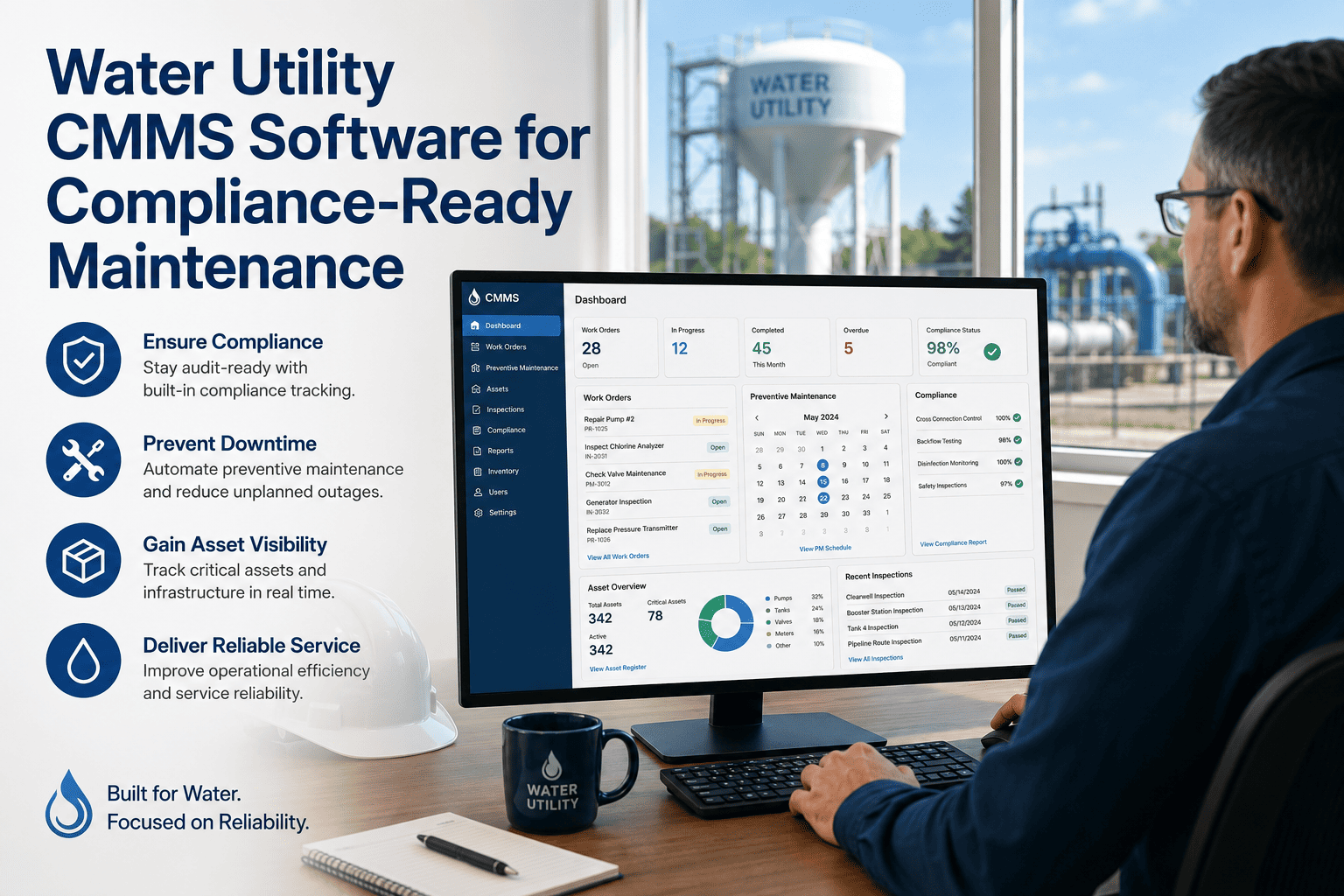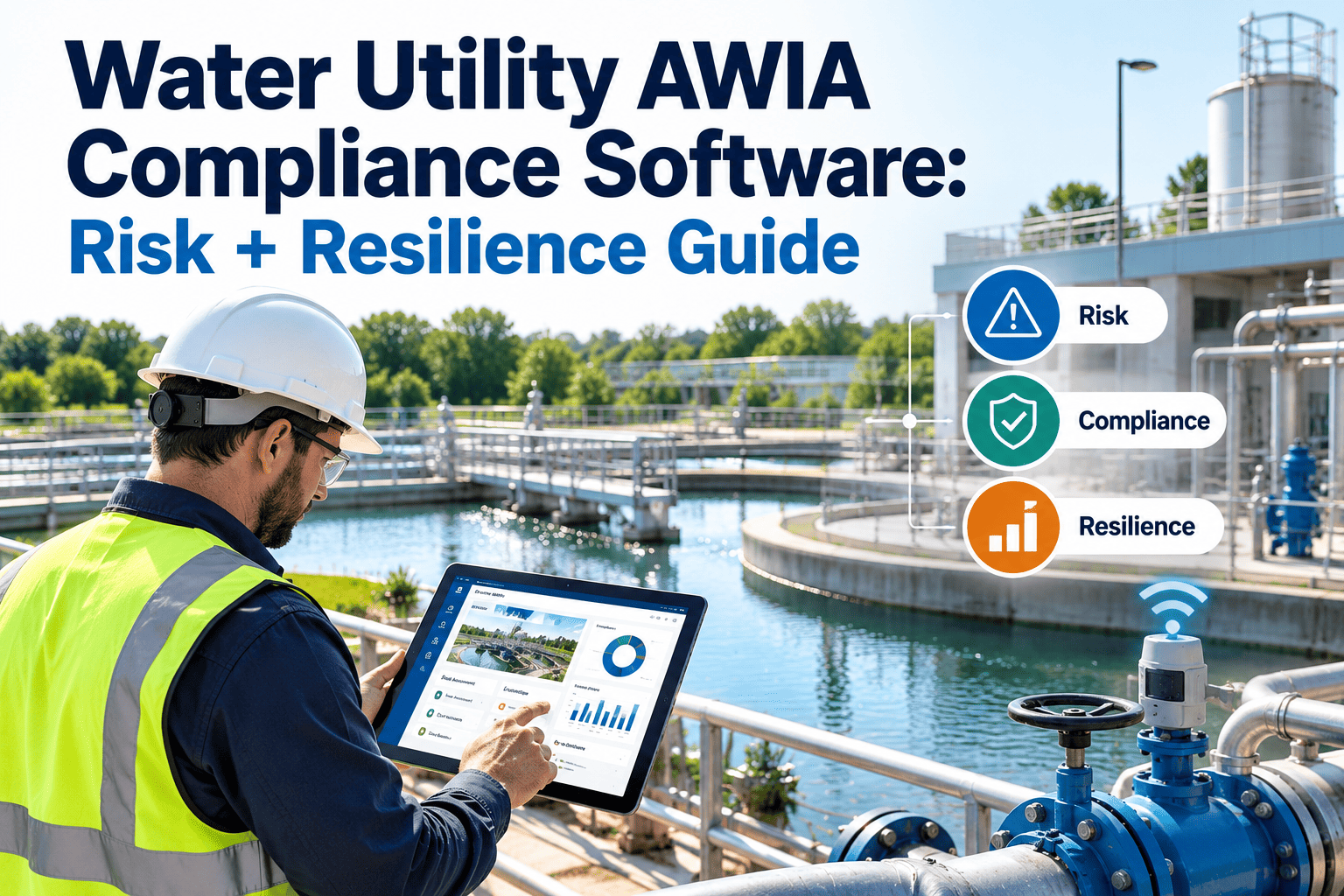
America's Water Infrastructure Act asks community water systems to prove they understand their risks and can keep delivering water when something goes wrong. The law is short on prescriptions and long on documentation. Utilities must assess risk and resilience, build an emergency response plan, certify both to EPA, and repeat the cycle every five years. Most of the evidence behind those documents lives in maintenance records, which is why many utilities now manage the work in a CMMS built for water utility maintenance rather than in binders.
Water Utility AWIA Compliance Software: Risk + Resilience Guide
Keep the risk and resilience assessment, emergency response plan and five-year certification cycle supported by live maintenance records, not last-minute document hunts.
Who Must Comply and When Certifications Fall Due
AWIA Section 2013 amended the Safe Drinking Water Act and applies to community water systems serving more than 3,300 people. Deadlines depend on population served, and the second cycle is now running.
| Population served | First RRA | First ERP | RRA recertification | ERP recertification |
|---|---|---|---|---|
| 100,000 or more | March 31, 2020 | September 30, 2020 | March 31, 2025 | September 30, 2025 |
| 50,000 to 99,999 | December 31, 2020 | June 30, 2021 | December 31, 2025 | June 30, 2026 |
| 3,301 to 49,999 | June 30, 2021 | December 30, 2021 | June 30, 2026 | December 30, 2026 |
What the Risk and Resilience Assessment Must Cover
The statute names threats and asset categories to evaluate. A maintenance system holds evidence for most of them.
- Natural hazards such as floods, drought, wildfire and severe storms
- Malevolent acts, including physical and cyber threats
- Ability to keep operating and recover quickly
- Dependence on power, chemicals, staff and communications
Asset categories and the maintenance evidence behind them
| Assessment component | Evidence the CMMS can supply |
|---|---|
| Pipes and constructed conveyances | Break history, valve exercise logs, condition inspections |
| Physical barriers | Fence, gate, lock and lighting inspections |
| Source water and intake | Intake screen, pump and gate maintenance |
| Pretreatment and treatment | Equipment PM history, calibration and failure records |
| Storage and distribution | Tank inspections, cleaning and repair history |
| Electronic and automated systems | Instrument, PLC and panel maintenance, with security handled by IT |
| Monitoring practices | Sensor calibration and sampling equipment records |
| Chemical use, storage and handling | Feed system, containment and safety equipment inspections |
| Operation and maintenance | PM compliance, backlog and corrective work trends |
| Financial infrastructure | Held mainly in finance systems, with cost history from work orders |
How Maintenance Data Feeds the Risk Picture
Risk is commonly framed as threat, vulnerability and consequence. Maintenance history sharpens the vulnerability and consequence sides.
Illustrative prioritization grid
| Asset criticality | Sound condition | Aging or unreliable |
|---|---|---|
| Critical to service | Maintain and test on schedule | Priority resilience action |
| Important | Routine preventive maintenance | Plan repair or redundancy |
| Supporting | Run to plan | Monitor and schedule |
Back Every AWIA Statement With Maintenance Evidence
Building the Emergency Response Plan on Real Capability
The plan must incorporate findings from the assessment. It is only credible if the equipment it relies on is maintained and tested.
Cybersecurity and Automated Systems in the Assessment
The assessment must cover electronic, computer and other automated systems, including their security. Maintenance does not own cybersecurity, but it owns much of the equipment those systems control.
- Keep an asset register of controllers, panels, instruments and communications equipment by site
- Schedule calibration and inspection for field devices that feed monitoring and alarms
- Track critical spares for controllers and communications hardware
- Record equipment failures that affect remote monitoring or control
- Limit access to sensitive security details in maintenance records and keep security decisions with IT and operations leadership
Natural Hazards and Asset Readiness
Hazards matter only when tied to assets. This table shows how common hazards translate into maintenance work.
| Hazard | Assets exposed | Readiness tasks |
|---|---|---|
| Flooding | Low-lying pump stations and electrical gear | Barrier checks, sump pump tests, review of equipment elevation |
| Wildfire | Watershed, intakes, power supply and treatment sites | Defensible space inspections, generator tests, spares for pumps and filters |
| Drought | Sources and intake structures | Low-level intake operability, interconnection valve exercise |
| Freezing weather | Exposed piping and chemical feed | Heat trace and insulation inspections |
| Power loss | Pumping and treatment sites | Generator, fuel and transfer switch testing |
| Extreme heat | Chemical storage and motors | Cooling and ventilation checks |
Who Owns What in an AWIA Program
AWIA work crosses departments. Clear owners keep tasks from falling between operations, IT and leadership.
| Function | Typical responsibility | Record produced |
|---|---|---|
| Leadership | Approves the assessment, plan and certification | Signed certification and review notes |
| Operations | Describes process dependencies and response steps | Procedures and exercise results |
| Maintenance | Keeps critical equipment ready and tested | Work orders, inspections and test logs |
| IT and controls | Manages cybersecurity and automated systems | Security reviews and system inventories |
| Finance | Assesses financial infrastructure and funding for actions | Budgets and cost summaries |
Documentation Gaps That Surface at Recertification
These gaps appear repeatedly when utilities prepare for the next cycle.
- Assessment recommendations with no owner and no completion record
- Critical asset lists that no longer match the installed equipment
- Emergency equipment with no recent test or inspection evidence
- Contact lists and vendor agreements that are out of date
- Different departments holding different versions of the same plan
Trends shaping the second cycle
- More frequent severe weather is raising pressure on backup power and flood protection
- Longer lead times for electrical and treatment equipment make critical spares more important
- Experienced staff retiring takes procedural knowledge with them unless it is recorded
- Dependence on the electric grid and communications networks ties utility resilience to outside providers
- Growing attention to cyber threats is drawing operational technology into asset management
Recurring Resilience Work Worth Scheduling
Preventive maintenance turns resilience claims into evidence. Typical recurring tasks for AWIA-relevant assets are below, with intervals set by your own engineers and manufacturers.
| Resilience asset | Recurring task | Evidence to retain |
|---|---|---|
| Standby generators | Load testing, fuel checks, transfer switch inspection | Test results, runtime, fuel levels |
| Intake gates and screens | Exercise, clean and inspect | Completion notes and defects found |
| Chemical feed and storage | Containment, alarm and safety equipment checks | Inspection forms and repair orders |
| Fences, gates and locks | Perimeter walks and lock checks | Photos and corrective tasks |
| Isolation valves | Exercise program by zone | Valve status and failed valves |
| Instrumentation and alarms | Calibration and alarm testing | Calibration results and dates |
Five Years Without the Scramble
Most recertification stress comes from treating the deadline as a project rather than a cycle.
Testing the Plan: Exercises and After-Action Tracking
A plan that has never been exercised is a hypothesis. Exercises show which equipment, contacts and procedures fail under pressure.
| Exercise type | Focus | Maintenance output |
|---|---|---|
| Tabletop | Decisions, roles and communication | Action items logged with owners |
| Functional | Specific equipment such as generators and portable pumps | Test records and repair work orders |
| Full-scale | Coordinated field response with partners | Gaps converted to tracked work |
Supply and mutual aid readiness
- List critical chemicals, fuel and parts with minimum on-hand levels
- Record vendor contacts and delivery assumptions for emergency orders
- Track mutual aid agreements and the equipment they cover
- Review the list after every exercise or real event
Scoring Critical Assets for the Assessment
Criticality should reflect what the system loses if an asset fails, not just replacement cost. Agree on factors first, then score each asset the same way.
- Population or key customers served, such as hospitals and fire protection
- Availability of a redundant asset or alternate supply
- Time needed to restore service after a failure
- Dependence on power, chemicals, communications or specialized parts
- Regulatory or public health consequences of an outage
The operational impact of weak records
- Staff spend weeks reconstructing test history for each recertification
- Leadership certifies without clear evidence that actions were completed
- Critical equipment fails in an emergency because testing lapsed unnoticed
- Staff turnover leaves nobody who knows where records are kept
A Practical First 90 Days
A utility does not need every asset loaded before it sees value. Sequence the work around the assets that matter most.
Binder Preparation Versus a Maintenance-Backed Cycle
- Staff gather records weeks before the deadline
- Test results are scattered across notebooks
- Action items from the last cycle are hard to find
- Critical asset lists age quietly
- Records accumulate as work is completed
- Test results sit on the asset history
- Actions are tracked until closed
- Criticality is reviewed with live failure data
Where Oxmaint Fits in a Water Utility AWIA Program
Oxmaint maintenance management software organizes the operational evidence AWIA work depends on. Assessment methods, security decisions and certification stay with your leadership.
KPIs That Show AWIA Readiness
Reporting Views Leadership Needs Before Certifying
The person signing the certification should see evidence, not just assurances. Build a short set of standing reports and review them well before the deadline.
Retention reminders
- Keep the certified assessment and plan for five years after certification
- Store supporting maintenance evidence in a way that can be retrieved by asset and date
- Restrict access to sensitive security information while keeping operational records usable
Certification Readiness Checklist
- Confirm your population tier and current due dates
- Review the critical asset list for new or retired assets
- Check that hazard and threat assumptions are current
- Confirm recommendations from the last cycle are closed or justified
- Verify resilience equipment tests are recorded
- Update emergency contacts and mutual aid agreements
- Coordinate with local emergency planning contacts
- Store the final documents and plan for five years