Dams rarely fail on the day an evaluation report is signed. Trouble builds quietly through seepage that was noted once and never trended, instrument readings that sit in a personal spreadsheet, and recommendations that nobody closed. A Standard Engineering Evaluation of Dams, shortened here to SEED, only protects downstream communities when its findings become tracked field work. This guide shows how dam owners and operators can connect evaluation cycles to maintenance records, and where a digital twin approach to CMMS software for dam safety programs fits in.
Dam SEED Software: Standard Engineering Evaluation Guide
Tie every evaluation finding to a dam feature, an inspection record and a work order, so Reclamation, USACE and other federal review cycles end in closed actions instead of shelved reports.
What a Standard Engineering Evaluation Actually Covers
A SEED-style evaluation asks whether a dam still meets current engineering criteria for the loads it must safely pass. Answering that takes more than a walk-around. Evaluators weigh design records, inspection history, instrument trends, operating experience and hydrologic and seismic loading.
Why Evaluation Findings Stall After the Report
The report is rarely the weak point. The weak point is the stretch between a recommendation and a verified repair, where responsibility is spread across engineers, operators and contractors.
- Recommendations sit in a PDF appendix that nobody reopens until the next cycle
- Instrument readings live in separate spreadsheets kept by one technician
- Inspection photos are filed by date instead of by dam feature
- Repairs are closed informally with no link to the original finding
- Staff turnover erases the reason a seep was being watched
- Each recommendation becomes a tracked item tied to a named feature
- Readings and observations accumulate under the same asset record
- Photos and notes follow the feature across years of inspections
- Work orders carry the finding reference and closure evidence
- New staff read the full history of any feature in one place
Operational impact of an open finding backlog
- Reviewers ask for proof of closure and staff spend days reconstructing it from email and field notebooks
- Deferred minor repairs grow into funded projects with longer lead times
- Repeat findings across cycles weaken credibility with oversight bodies
- Emergency repairs cost more and disrupt operations more than planned ones
Federal and Regulatory Review Frameworks Around Dam Evaluations
Different owners answer to different reviewers, but the evidence they expect looks similar: dated observations, trended data and proof that deficiencies were addressed.
| Program context | Review rhythm | Evidence reviewers expect | Record to keep in the CMMS |
|---|---|---|---|
| Bureau of Reclamation facilities | Formal examinations and periodic and comprehensive facility reviews on set cycles | Examination findings, operating records, instrumentation data, recommendation status | Feature-level inspection history and closure status of each recommendation |
| USACE projects | Periodic inspections and assessments under risk-informed dam safety policy | Condition findings, risk classification inputs, prior remediation | Deficiency records linked to repair and monitoring work orders |
| FERC-regulated projects | Regular safety inspections plus independent consultant reviews on a multi-year cycle | Surveillance and monitoring plan data, failure mode follow-up | Instrument readings, inspection forms and a corrective action log |
| State-regulated and other dams | Cycles set by the state dam safety program | Inspection reports, emergency action plan updates, maintenance proof | Annual inspection records, exercise logs and repair history |
See Your Evaluation Findings as Tracked Work
A Digital Twin Built From Dam Features, Not Dashboards
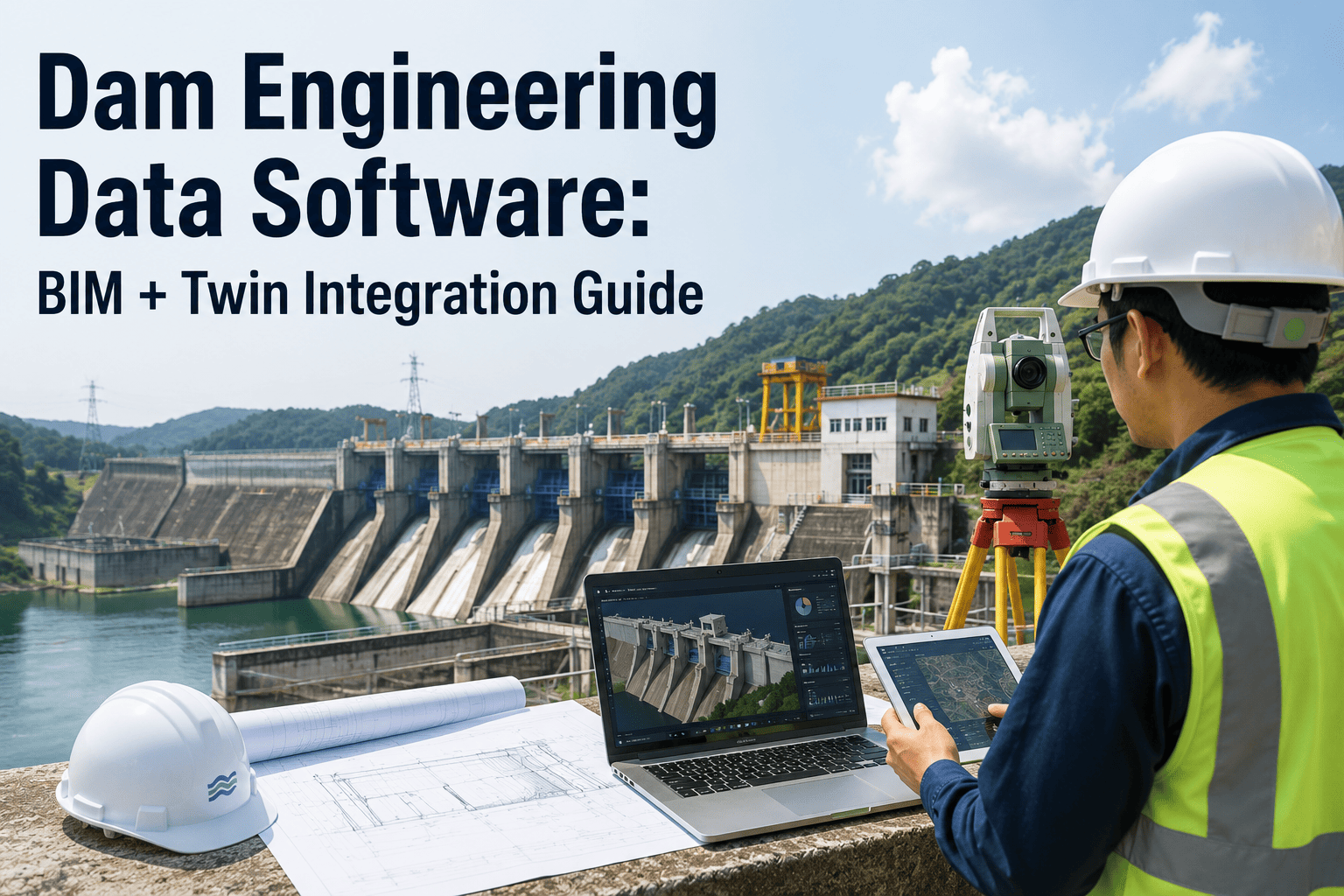
Here a digital twin is not a 3D model. It is a structured asset record that mirrors how engineers think about the dam, with each feature holding its own history.
What each feature record should hold
- Drawings, specifications and as-built changes attached to the feature
- Every inspection observation with date, inspector and photos
- Instrument readings and the reservoir level at the time
- Linked evaluation findings, with status and owner
- Completed work orders, parts used and verification notes
From Recommendation to Closed Work Order
A repeatable path keeps urgent items from competing with routine ones. The same six steps work for a seep, a gate hoist defect or a spillway concrete repair.
Illustrative triage matrix
| Consequence of failure | Minor finding | Significant finding | Critical finding |
|---|---|---|---|
| High | Schedule in the next maintenance cycle and track | Prioritize and engage the engineer | Immediate action and notify the dam safety officer |
| Moderate | Routine work order | Plan repair and monitor until complete | Urgent engineering review |
| Low | Routine work order or note | Schedule repair | Engineer review and repair plan |
Surveillance and Instrumentation Records Reviewers Read
Instrument data is only useful when it is trended against reservoir level and tied to the inspection that explained it. Reading frequencies come from your surveillance plan, not from software.
| Instrument or check | What it indicates | Log with the reading | Typical follow-up trigger |
|---|---|---|---|
| Piezometers | Pore pressure and phreatic surface trends | Reading, reservoir level, date, observer | Trend leaving the established range |
| Seepage weirs | Flow volume and clarity | Flow, turbidity note, rainfall | Rising flow or cloudy water |
| Inclinometers and survey monuments | Movement and settlement | Survey values and benchmark reference | Movement beyond the engineer's threshold |
| Drain outlets and relief wells | Drainage performance | Flow, blockage notes, cleaning dates | Reduced flow or clogging |
| Gate and hoist exercise | Operability under load | Exercise date, travel, anomalies | Slow, noisy or failed operation |
| Reservoir and tailwater gauges | Loading conditions | Level at the time of reading | Gauge fault or missing data |
Condition-based triggers worth configuring
- Alert thresholds set by the responsible engineer, not by the software vendor
- Flags for missed or incomplete readings before they become data gaps
- Automatic creation of an inspection task when an anomaly is logged
- Escalation to the engineer when the same anomaly repeats across visits
Loading Conditions Evaluators Test Against Your Records
Evaluations check a dam against floods, earthquakes and long-term reservoir operation. The records that matter most differ for each loading case, which is why feature-level history helps.
Trends changing evaluation work
- Shifts in rainfall and runoff are pushing owners to revisit hydrologic assumptions, which raises the value of long, clean reservoir and spillway operating records
- Risk-informed decision making is common across federal dam safety programs, so reviewers want documented reasoning for how defects were ranked and handled
- Aging gates, hoists and conduits mean more owners manage metal components near the end of their service life
- Drone imagery and survey tools generate more photos and point data, which need a home in the feature record instead of a shared drive
- Workforce turnover moves institutional memory out of the organization unless a system captures it
Common mistakes in evaluation recordkeeping
- Treating the evaluation report as the system of record instead of a snapshot in time
- Logging recommendations at dam level with no feature or owner
- Closing work orders without readings, photos or verification notes
- Letting instrument gaps go unexplained until a reviewer asks
- Updating records only in the months before a review
Who Owns What in a SEED Cycle
Clear ownership keeps findings from drifting between engineering and operations. Each role should leave a record behind.
| Role | Responsibility | Record created |
|---|---|---|
| Dam safety officer | Oversees the program and the response to findings | Approvals and escalation notes |
| Evaluating engineer | Rates conditions, sets thresholds and approves repair approach | Findings, thresholds and engineering notes |
| Operations staff | Perform routine checks, gate exercises and readings | Inspection forms and readings |
| Maintenance crews | Carry out repairs and preventive tasks | Work orders and completion notes |
| Management | Funds the work and reviews progress | Dashboard reviews and approvals |
Where Oxmaint Fits in a SEED Program
Oxmaint maintenance management software supplies the record-keeping and workflow layer. Engineering judgment stays with your engineers.
Preventive Maintenance That Keeps Findings From Returning
Many evaluation findings are deferred upkeep in disguise. Scheduled work on the right features reduces repeat deficiencies and gives reviewers proof of a working program.
| Feature | Recurring work | Why reviewers care |
|---|---|---|
| Embankment surfaces | Vegetation control, rodent and burrow control, erosion repair | Roots and burrows can create seepage paths |
| Drainage systems | Clearing and flow checks of toe drains, relief wells and ditches | Blocked drains hide changes in seepage behavior |
| Gates and hoists | Lubrication, exercise, seal inspection and electrical checks | Gates must open when the reservoir rises |
| Spillway channels | Debris removal, concrete and joint inspection | Capacity depends on a clear, sound flow path |
| Backup power and communications | Load tests, fuel checks and radio or phone tests | Emergency response depends on them |
Measuring Whether the Program Works
Track a small set of measures that expose drift early. Define each one with your team before you chart it.
Pre-Evaluation Readiness Checklist
Work through these items several months before the evaluation team arrives.
- Confirm the feature hierarchy matches the current dam configuration
- Upload current drawings, manuals and the last evaluation report
- Enter every open recommendation with owner and target date
- Verify closure evidence for items marked complete
- Check instrument reading history for gaps and explain them
- Confirm gate and valve exercise records are current
- Review vegetation, rodent and drainage maintenance logs
- Update emergency action plan contacts and equipment checks
- Export a feature-level history for the evaluators
- Brief operators on where each record lives
A Four-Phase Rollout Path
Start with the dam that carries the highest consequence and expand once the pattern works.