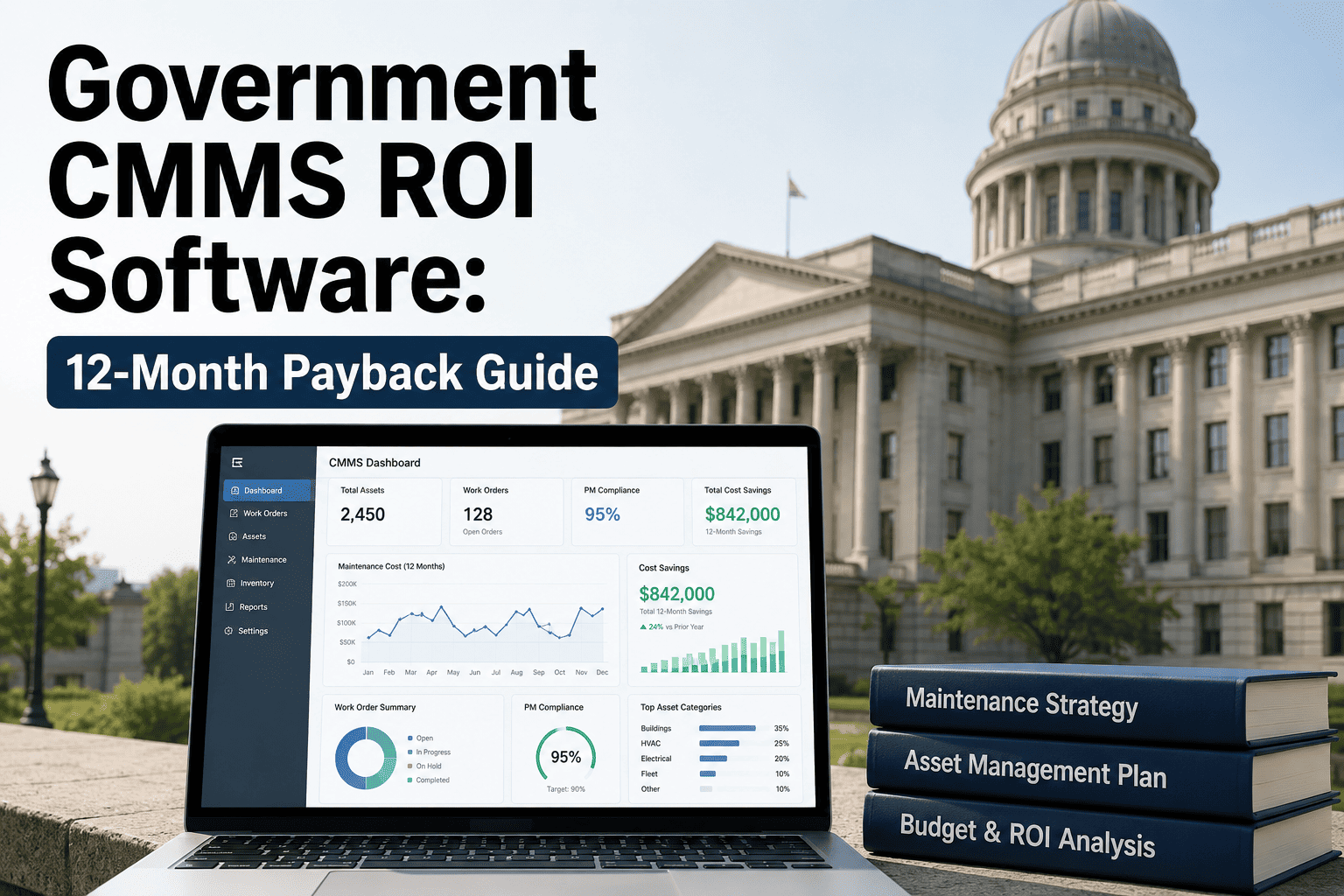
A public works director walks into the same budget hearing every year with the same problem: maintenance is invisible until something breaks, and by then the fix costs four times what prevention would have cost. Elected officials fund ribbon-cuttings for new infrastructure far more readily than they fund the software that keeps existing infrastructure running, because a deferred maintenance backlog does not show up on a ballot or a press release. A government CMMS changes that conversation by turning maintenance into a documented, auditable line item with a measurable payback period. Agencies that track work order cycle time, PM completion, and deferred maintenance backlog together typically recover the cost of the platform within 12 months. See how that payback case gets built with Oxmaint — free trial, no credit card required.
Who This ROI Framework Is Built For
This framework applies whether the department in question is a public works division managing roads and water lines, a facilities team responsible for city halls and libraries, a fleet manager overseeing a municipal or school bus fleet, or a parks and recreation department maintaining community assets. The asset types differ, but the budget conversation is identical everywhere: finance wants proof that money spent on maintenance software returns more than it costs, and operations needs a system that field staff will actually use every day instead of abandoning after the first month.
Why Maintenance Budgets Get Cut First
Public agencies operate on annual or biennial budget cycles, and maintenance almost always competes against capital projects that come with a ribbon and a photo opportunity. When a finance committee has to choose between funding a new facility and funding upkeep of the ones already built, upkeep loses — not because it matters less, but because nobody in the room can point to a number that proves what deferring it costs. Without a CMMS, most agencies track valve turns, HVAC filters, fleet PMs, and facility work orders on spreadsheets, paper logs, or a mix of both, split across departments that never compare notes. That fragmentation means nobody actually knows the size of the deferred maintenance backlog until an asset fails in public — a burst pipe, a stalled elevator, a fleet vehicle pulled from service mid-route. Each failure becomes an emergency repair, and emergency repairs cost three to four times what a planned work order costs, because they involve overtime labor, rush-ordered parts, and disruption to public services that the agency is accountable for. A government CMMS breaks this cycle by giving finance and operations the same shared number: cycle time, completion rate, and backlog value, updated automatically instead of reconstructed once a year for a report nobody reads until it is too late.
The consequences of skipping this step compound faster in government than almost anywhere else, because public agencies carry accountability that private facilities do not. A road authority that cannot show a documented inspection history faces a different kind of liability exposure after a pothole claim than a private landlord does. A school district that cannot prove HVAC filters were changed on schedule has a harder conversation with parents than a private employer would. A utility that cannot show valve exercising records struggles to defend a rate increase request in front of a public commission. None of these are hypothetical — they are the recurring findings in state and municipal audit reports every year, and nearly all of them trace back to the same root cause: maintenance activity that happened but was never documented in a system anyone could query later. Book a demo to see how the framework applies to your department's current backlog.
Your Next Budget Hearing Needs a Number, Not an Anecdote.
Oxmaint tracks work order cycle time, PM completion, and deferred maintenance backlog automatically, so the ROI case builds itself instead of getting reconstructed the week before the hearing.
The Three-Pillar ROI Framework
Every credible government CMMS business case rests on three measurable pillars, tracked before and after go-live so the improvement is provable rather than assumed. A single metric on its own is easy to dismiss in a budget hearing — a faster cycle time could just mean crews are cutting corners, and a lower backlog could just mean fewer inspections happened. Presented together, the three pillars corroborate each other: cycle time falling while PM completion rises and backlog shrinks is the signature of a maintenance program actually getting healthier, not one that is just reporting differently.
How Oxmaint Delivers Each Pillar
The three pillars only move if the software behind them is actually built for how government field crews and finance teams work day to day.
The 12-Month Payback Roadmap
Government procurement timelines are slower than the private sector, but the payback clock does not need to wait for the next fiscal year to start ticking.
A 12-Month Roadmap Only Works if Month One Starts Today.
Every month without a baseline is a month of backlog data your agency cannot use in next year's budget request. Start the clock now.
Procurement & Compliance Coverage Across Regions
Government agencies answer to public records law, procurement standards, and data residency requirements that private-sector CMMS deployments rarely face. A vendor that cannot produce an audit-ready export in the format a specific jurisdiction expects adds work instead of removing it, which is why compliance mapping has to happen before go-live rather than after the first records request lands. Oxmaint's audit trail and reporting are configured to match the jurisdiction an agency operates in, so the export a records officer needs is already in the right format the first time it is requested.
Common Objections and How the Data Answers Them
Every finance committee raises the same three concerns before approving a new software line item. Here is how the ROI framework answers each one directly.
Oxmaint vs Other Government CMMS Options
Swipe to view the full comparison table
| Capability | Oxmaint | MaintainX | UpKeep | Fiix (Rockwell) | Limble CMMS | IBM Maximo | Hippo (Eptura) |
|---|---|---|---|---|---|---|---|
| Budget-Ready ROI Reporting | Automated cycle time, PM, backlog dashboard | Manual export only | Manual export only | Custom config | Manual export only | Full (complex build) | Manual export only |
| Deferred Maintenance Backlog Tracking | Live condition scoring | Not available | Limited | Enterprise tier | Not available | Custom build | Not available |
| Multi-Department Work Order Routing | Built-in, automatic | Basic routing | Basic routing | Configurable | Basic routing | Full (complex) | Basic routing |
| Public Records / Audit Trail | FOIA-ready export | General log | General log | Custom config | General log | Configurable | General log |
| Offline Mobile for Field Crews | Full offline + sync | Online only | Limited offline | Limited offline | Limited offline | Limited | Online only |
| Deploy Time | 7–21 days | 2–3 weeks | 2–4 weeks | 4–12 weeks | 1–2 weeks | 6–18 months | 2–6 weeks |
The gap between Oxmaint and general-purpose CMMS platforms is not a feature checklist — it is whether the platform was built around the three numbers a government budget hearing actually needs. General maintenance software can log a work order and schedule a PM, but few are built to surface a deferred maintenance backlog as a standing dollar figure, or to format an export that a records officer can hand over unmodified in response to a public disclosure request. Enterprise platforms like IBM Maximo can technically be configured to do all of this, but the configuration project alone often takes longer than a typical council term, which defeats the purpose of a fast, defensible payback case.
Proven Results
Data Security & Records Compliance
Government data carries a different risk profile than private-sector data, because most of it is eventually subject to a public records request, a legislative audit, or a vendor risk review before it can be adopted at all. Oxmaint is built to survive that scrutiny from day one rather than retrofitting compliance after the fact.
Frequently Asked Questions
How fast can a government CMMS actually pay for itself?
Does this work across multiple departments with separate budgets?
Can we present this data directly to council or a finance committee?
What happens to our deferred maintenance backlog data during migration?
Is field crew adoption difficult for staff without technical backgrounds?
Build the Payback Case Before the Next Budget Hearing.
Baseline your assets, automate PM completion, and shrink the deferred maintenance backlog — all documented automatically for the finance committee. Free to start. Live in under three weeks.