Bridge inspection reports carry legal weight — once a Team Leader signs one, it becomes part of the official record that a state DOT submits to the National Bridge Inventory. Under 23 CFR 650.313, every bridge program must run two distinct layers of review behind that signature: Quality Control checks performed close to the original inspection, and independent Quality Assurance sampling performed by someone outside the original team. When these two layers live across spreadsheets, shared drives, and email threads, tracking who reviewed what, when, and against which checklist becomes a compliance risk of its own. A CMMS built for bridge programs turns peer review into a structured, timestamped workflow instead of a paperwork chase every audit season. See how a connected QC/QA workflow runs inside OxMaint by booking a short walkthrough.
Bridge Management · QC/QA · NBIS Compliance
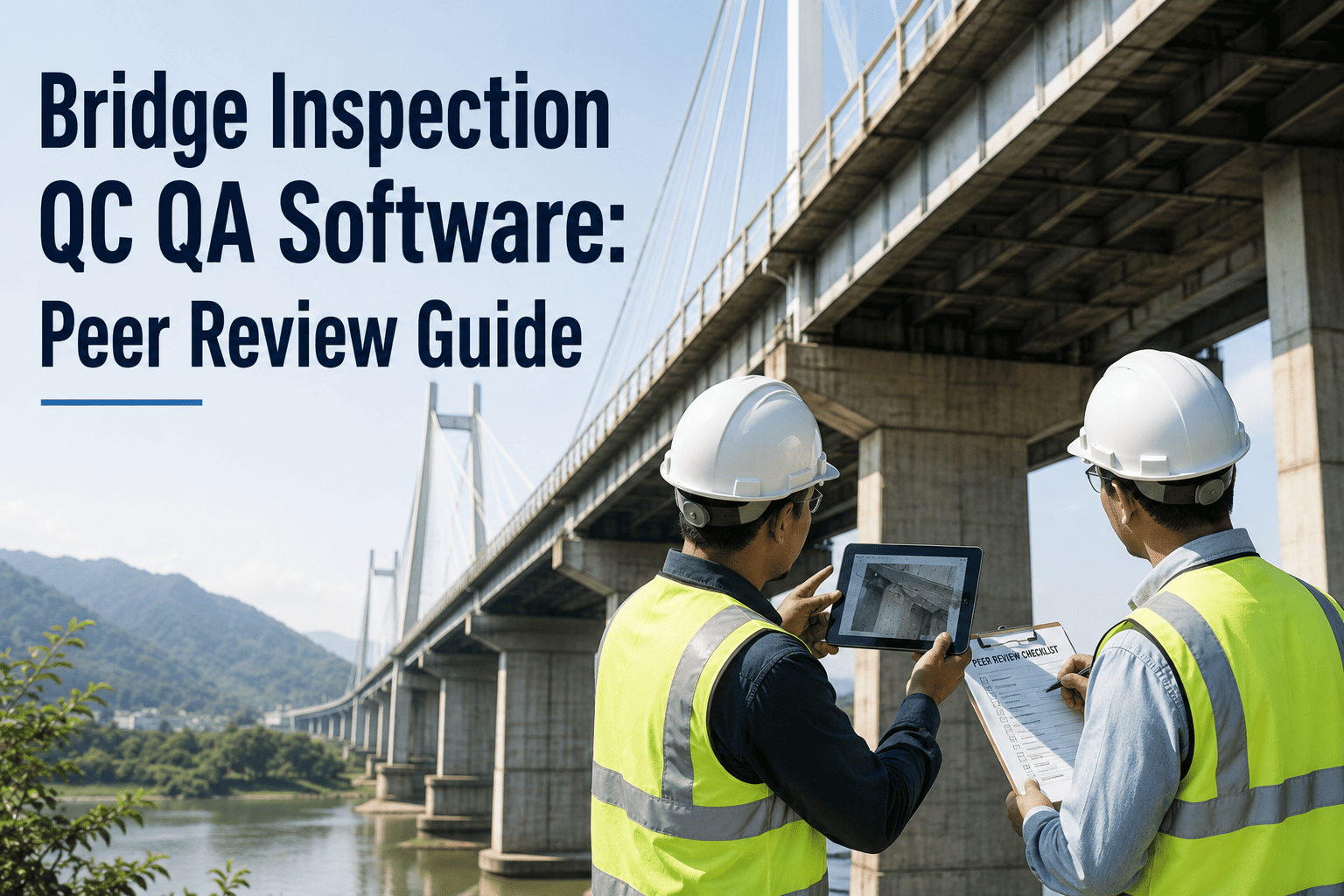
Bridge Inspection QC/QA Software: The Peer Review Guide
Team Leader review, independent QA review, and final sign-off — the three-part discipline every NBIS-compliant bridge program has to prove during a metrics audit, run inside one connected CMMS instead of scattered across spreadsheets, shared drives, and inspector memory.
5%
of each team's completed inspections is the FHWA-recommended independent QA field review sample size, per year
24 mo
maximum cycle for routine inspections, refresher review, and team leader file checks under NBIS Metric 20
68%
of bridge programs still confirm QC and QA sign-off manually across spreadsheets and shared folders
4 days
typical FHWA metrics audit prep time once QC/QA sign-off trails are stored digitally instead of on paper
Reading The Numbers
What These Figures Mean For A Bridge Program
None of these figures are dramatic on their own — a 5 percent sample, a 24-month cycle, a handful of spreadsheets. The risk shows up in aggregate, over years of inspection cycles, when nobody can quickly answer a simple question: for this specific bridge, who reviewed the last report, and when. Programs that still manage sign-off manually are not necessarily doing worse inspections. They are simply carrying more risk that a documentation gap, rather than a structural issue, becomes the finding that shows up in their next FHWA compliance review.
Programs with hundreds or thousands of structures on a two-year inspection cycle generate a steady stream of files that need QC review, QA sampling, and sign-off every single week of the year, not just around an audit date. Once that volume is spread across multiple team leaders, consultants, and reviewing engineers, a shared spreadsheet stops being a system of record and starts being a place where the most recent update quietly overwrites the last one.
Why This Matters
A Signature Is Only as Strong as the Review Behind It
NBIS Metric 20 does not just ask whether a bridge got inspected — it asks whether the inspection was checked by someone else, and whether that check was genuinely independent of the person who did the original work. That second condition is where most programs quietly fall short. A Team Leader reviewing their own team's report is Quality Control. A reviewer from outside the workgroup sampling that same report later is Quality Assurance. Regulators expect both practices, documented separately, with a clear record of who reviewed what, which checklist items were checked, and when any resulting finding was closed. When a program cannot produce that record on demand, the finding is not that the inspection was wrong — it is that the process cannot prove it was right, which is treated just as seriously during a compliance review.
The 2022 update to the National Bridge Inspection Standards, along with the ongoing transition to the Specifications for the National Bridge Inventory, has only raised the bar on documentation. Reviewers increasingly expect programs to show not just a completed checklist, but a timeline: when the QC review happened relative to the field visit, when the QA sample was pulled, and how long a critical finding sat open before it was resolved. Programs that still rely on manual sign-off logs often discover the gaps only when an auditor asks for them.
The consequence of falling short on Metric 20 is not abstract. A program found non-compliant is typically required to adopt an FHWA-approved Plan of Corrective Action, with its own deadlines and follow-up review, and repeated or serious findings can eventually put federal-aid funding for the bridge program at risk. None of this stems from bridges being unsafe — it stems from a review program that cannot demonstrate, on paper, that its own quality checks are working the way the state's own manual says they should.
Paper-Based QC/QA Tracking
Team Leader signs off on a report with no structured checklist behind the signature
QA sampling is chosen informally — the same reviewer's bridges get picked every cycle
Corrective actions get noted in email but never tracked to closure
Audit season becomes a scramble to reconstruct who reviewed which file and when
Metric 20 findings show inconsistent documentation across the program
CMMS-Managed QC/QA Workflow
Every report is locked behind a structured QC checklist before it can be submitted
The system auto-selects a compliant sample of reports for independent QA review
QA reviewers outside the original workgroup are assigned automatically, no manual routing
Corrective actions carry a due date, owner, and closure timestamp
A single audit-ready log shows every review, finding, and sign-off in one place
Common Failure Points
Where Bridge Peer Review Programs Quietly Break Down
Most programs already have a QC/QA plan written down somewhere. The gap almost never shows up in the policy document — it shows up in daily execution, months before an auditor ever asks for a file. These are the failure points that come up most often when a program's paper trail does not match what actually happened in the field.
Self-Review Disguised As QC
A Team Leader technically reviews their own team's report because no second qualified reviewer is available that week, and the exception becomes the norm without anyone documenting why.
Year-End Batch Sign-Off
Sign-offs pile up and get approved in bulk before a deadline, which makes it look like every report was reviewed the same week it was written, even when it sat untouched for months.
Sampling That Isn't Random
The same cooperative reviewer's bridges get pulled for QA sampling every cycle because it's easier to schedule, which defeats the purpose of an independent, representative sample.
Critical Findings Without A Clock
A critical finding gets logged in a report but never linked to a corrective action with an owner and a due date, so nobody can say how long the structure sat with an open safety concern.
None of these patterns necessarily mean an inspection was performed poorly. They mean the review process around it cannot be verified after the fact, which is exactly what a compliance reviewer is trained to look for. Closing these gaps usually has less to do with hiring more reviewers and more to do with making the correct behavior the default path inside whatever system inspectors already use every day.
The Two-Tier Review System
Team Leader QC Review vs. Independent QA Review vs. Sign-Off
Bridge programs are required to separate who checks the work from who did the work. The table below breaks down what each review layer actually covers, who is allowed to perform it, and what a CMMS should automate at each stage so nothing depends on someone remembering a rule. Together, these four layers form the chain of custody that a program manager needs to defend during an FHWA metrics review, and each layer should leave its own timestamp rather than sharing one generic "reviewed" flag.
| Review Layer |
Performed By |
What Gets Reviewed |
Typical Sampling |
CMMS Automation |
| Team Leader QC Review |
Team Leader or a QC reviewer other than the original inspector |
Field notes, condition ratings, photos, sketches, load rating inputs |
Every completed report, before submission |
Report locked until QC checklist fields are completed and signed |
| Independent QA Review |
QA Officer from outside the original inspection workgroup |
Random sample of completed reports, ratings, and computations |
Around 5% of each team's completed inspections annually |
Auto-selected sample routed to a reviewer flagged as independent |
| Field Verification Review |
QA Officer or Program Manager |
On-site re-inspection of a sampled structure against the filed report |
Set by the program's documented QC/QA plan |
Field checklist compared side-by-side with the original submission |
| Sign-Off & Certification |
Program Manager or the responsible Professional Engineer |
Final compliance check and closure of any open critical findings |
Every report, prior to NBI data submission |
Digital sign-off recorded with a timestamped audit trail |
Roles & Qualifications
Who Is Actually Allowed To Sign Off At Each Level
A common source of confusion during a metrics review is not the review sequence itself, but whether the person who performed each step was qualified to do so. NBIS ties specific qualifications to each role, and a CMMS should check those qualifications automatically rather than trusting a manual assignment.
Program Manager — oversees the entire bridge inspection and QC/QA program, holds the qualifications required under the state's bridge inspection manual, and is ultimately responsible for NBIS compliance even when duties are delegated
Team Leader — leads the field inspection, completes required refresher training on a defined cycle, and performs the first-level QC review of their own team's report before submission
QC Reviewer — a qualified individual other than the original inspector who checks field notes, ratings, and computations for accuracy and completeness before the report is finalized
QA Officer — sits outside the workgroup that performed the original inspection, samples a defined percentage of completed reports, and may perform an independent field verification of the structure
Inside The Workflow
How Peer Review Should Move Through Your CMMS
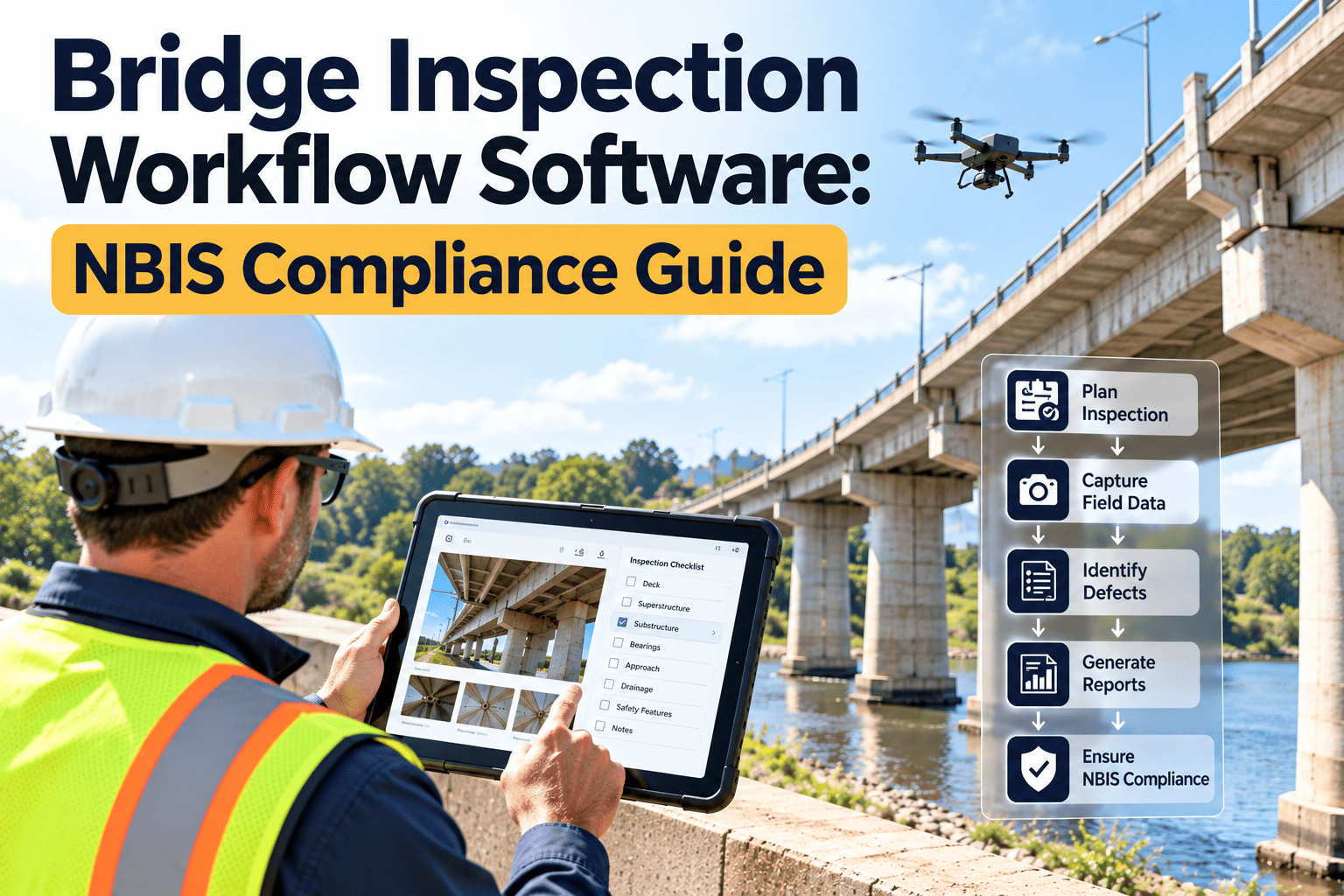
Turning QC/QA from a policy document into daily behavior takes a workflow that enforces the rules automatically, rather than trusting every inspector to remember them. Here is the four-stage sequence a bridge program should expect from its CMMS.
1
QC Checklist At Submission
Before a report leaves the field, the Team Leader completes a structured QC checklist covering condition ratings, photo completeness, sketches, and load rating inputs. The system will not let the report move forward without every required field filled in, so the checklist stops being optional paperwork and becomes a gate.
2
Automatic QA Sampling
Once a report clears QC, the CMMS checks each team's running completion count for the year and pulls the required percentage into an independent QA queue on its own schedule, so sampling stays statistically representative instead of drifting toward whichever files are easiest to pull.
3
Independent Reviewer Assignment
The system checks reviewer identity against the original inspection workgroup and blocks anyone who touched the report from claiming its QA review, preserving the separation of duties that Metric 20 is specifically designed to test for during a compliance visit.
4
Corrective Action & Sign-Off
Any QC or QA finding routes back to the original team as a tracked corrective action with an owner and a due date. Once resolved and verified, the Program Manager or responsible Professional Engineer applies a digital sign-off, closing the loop with a timestamp before the record moves to NBI submission.
Audit Readiness
What A Metrics Reviewer Actually Asks To See
FHWA compliance reviews under Metric 20 do not just look at whether a QC/QA plan exists on paper — they sample records and ask a program to prove the plan was followed. These are the items that come up most often when a reviewer sits down with a bridge program's files.
Documented QC and QA roles and responsibilities, matched to each individual's actual qualifications on file
A record showing the QA reviewer for a given bridge was outside the original inspection workgroup
Evidence that the QA sample size met the program's own documented sampling percentage for the year
Timestamps showing when a critical finding was identified, escalated, and closed — not just that it was closed
A refresher training record for program managers and team leaders within the required review cycle
Reviewers rarely ask for all five at once, but they will ask for whichever one lines up with the specific bridge, team, or time period they choose to sample, and a program's credibility often rests on how quickly that specific record can be pulled up.
OxMaint · Bridge Program CMMS
Run Team Leader Review, QA Review, and Sign-Off From One Screen
OxMaint gives bridge programs a structured QC checklist, automatic QA sampling, independent reviewer routing, and a permanent sign-off trail — everything a Metric 20 audit asks to see, already documented and ready to hand over without a scramble.
Getting Started
Rolling Out Structured Peer Review Without Slowing Down Field Crews
The biggest hesitation around formalizing QC/QA is usually not disagreement with the process — it is fear that adding structure will slow inspectors down in the field. In practice, the opposite tends to happen once the checklist lives inside the same system used to file the report, rather than as a separate form someone has to remember to fill out later. A few practical steps make the transition smoother for teams used to paper-based sign-off.
Start with your highest-bridge-count teams first, since that is where manual tracking breaks down fastest and the payoff from automation is largest
Migrate your existing QC checklist fields as-is before adding new ones, so field crews recognize the same questions in a new interface
Set the QA sampling percentage to match your current documented plan, then adjust once a full cycle of data is available
Run one full inspection cycle in parallel with your existing paper process before retiring it, so program managers can compare and trust the output
Most programs find that resistance fades within a single inspection cycle, once field crews notice the checklist takes the same amount of time to fill out but nobody has to chase them for a missing signature two months later. The bigger shift is cultural rather than technical — QC and QA stop feeling like an audit exercise bolted on at the end of the year and start feeling like a normal part of closing out every report, the same way filing photos or sketches already is.
From The Field
What Bridge Program Managers Say About Structured Peer Review
Our QC files used to live across three different shared folders, and every audit season turned into three weeks of chasing down who reviewed what and when. Once every review had an assigned owner, a due date, and a permanent timestamped record, our FHWA metrics prep dropped to about four days, and we stopped dreading the compliance review entirely.
State Bridge Program Manager, Midwest DOT · 15 years in bridge management
Independent QA only means something if the reviewer genuinely had no hand in the original inspection. Relying on people to remember that rule is how a program fails a metrics review without ever knowing why. Having the system enforce the separation automatically, instead of trusting a scheduling spreadsheet, removed that guesswork completely.
Bridge QA Officer, Regional Transportation Authority · 11 years in bridge inspection
Frequently Asked Questions
Bridge QC/QA and Peer Review — Common Questions
What is the actual difference between QC and QA in bridge inspection?
Quality Control is the check performed close to the original inspection, usually by the Team Leader or another qualified reviewer, before a report is submitted. Quality Assurance is a separate, independent sample review performed later by someone outside that workgroup, aimed at verifying the QC process itself.
Book a demo to see both tracked side by side.
How often does FHWA expect independent QA review to happen?
Programs typically sample around 5 percent of each team's completed inspections annually for independent field review, alongside periodic refresher training and file checks on a 24-month cycle tied to the routine inspection interval. The exact sampling rate should be documented in your state's own QC/QA manual.
Who is qualified to perform a QA review on a bridge report?
A QA reviewer must sit outside the workgroup that produced the original inspection, and typically holds the same team leader or program manager qualifications required to inspect the structure in the first place. Consulting firms often use a QA officer from a different regional office for exactly this reason.
Can a small bridge program run QC/QA without dedicated software?
It is possible with spreadsheets and manual routing, but keeping sampling consistent, enforcing separation of duties, and reconstructing a timeline for an audit all get harder as bridge counts grow.
Start a free trial to see a lighter-weight setup built for smaller programs.
What happens after a QC or QA reviewer flags an error in a report?
The finding routes back to the original team as a corrective action with an assigned owner and due date. The report cannot move to final sign-off until that action is marked closed and verified, and the full timeline stays attached to the record for future reference.
OxMaint · Peer Review Built Into Your CMMS
Your Next Metrics Audit Shouldn't Depend On Someone's Memory
Structured QC checklists, automatic QA sampling, independent reviewer assignment, and a permanent sign-off trail — OxMaint gives bridge programs a peer review process that documents itself, every single cycle, on every single structure.