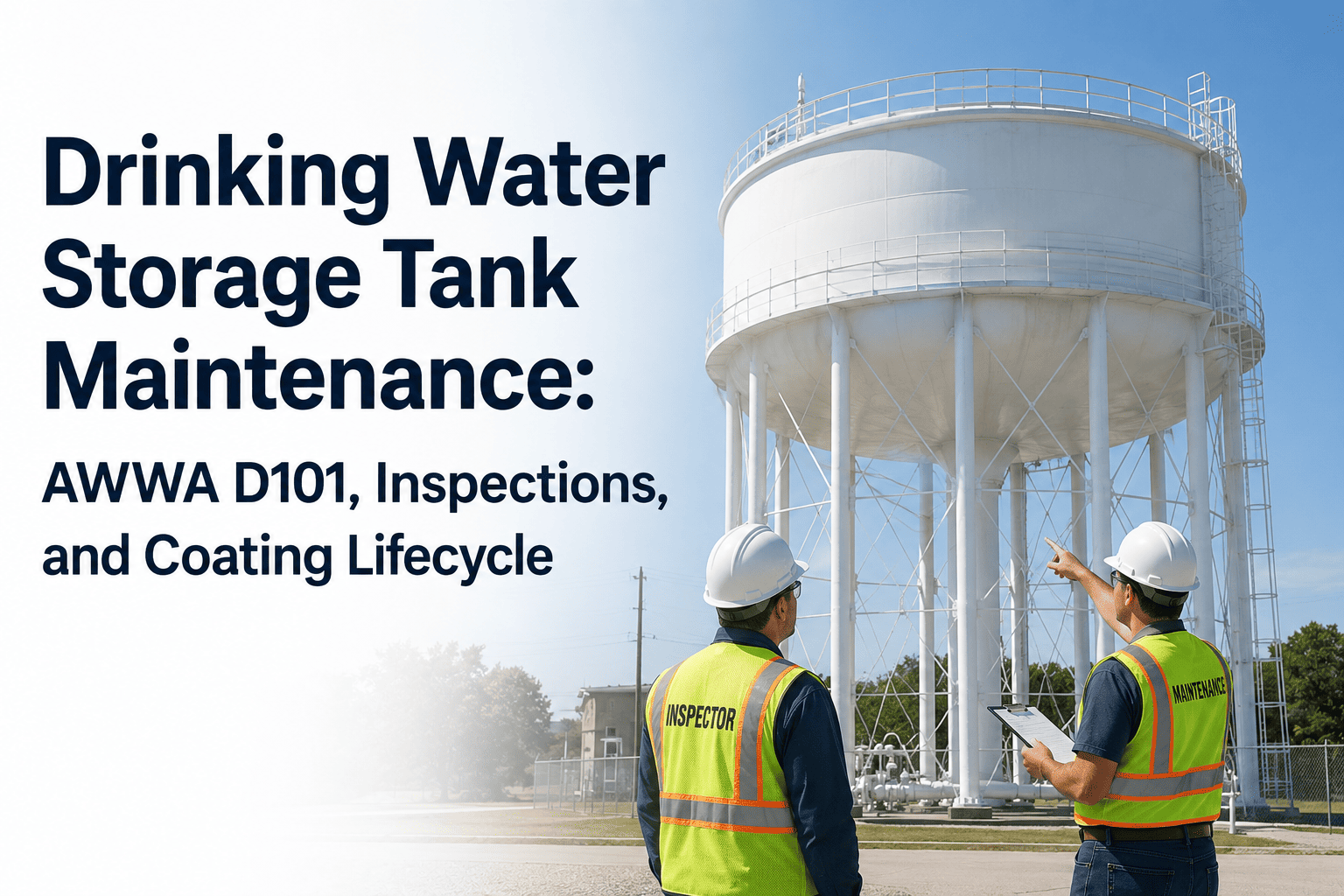
Drinking Water Storage Tank Maintenance: AWWA D101, Inspections, and Coating Lifecycle

By James Smith on May 15, 2026

drinking-water-storage-tank-maintenance-awwa-d101-coating

Municipal drinking water storage tanks are critical infrastructure — and among the most inspection-deferred assets in public works. AWWA D101 sets the standard for inspection cycles, coating evaluation, and structural integrity checks, but compliance requires more than a written policy. It requires documented inspection records, coating lifecycle tracking, hatch security logs, and SDWA-aligned reporting — all maintained in a CMMS that auditors can review on demand. This guide covers the full tank maintenance program: what to inspect, when, and how CMMS documentation protects your utility during regulatory review. See how Oxmaint tracks AWWA-aligned tank inspection cycles and coating lifecycle records — or book a session with a municipal water utility maintenance specialist.

AWWA D101, SDWA, and What State Primacy Agencies Actually Audit

AWWA D101
Inspecting and Repairing Steel Water Tanks
Sets inspection intervals, structural assessment methods, and coating evaluation criteria for welded and bolted steel storage tanks. Used by state agencies as the baseline standard for tank condition reporting.
AWWA D102
Coating Steel Water Storage Tanks
Defines coating system requirements, surface preparation standards, and inspection protocols for interior and exterior tank coatings. Coating lifecycle documentation is a primary audit target for state inspectors.
SDWA
Safe Drinking Water Act — Distribution System
Requires utilities to maintain distribution system integrity including storage facilities. Hatch security, contamination prevention, and inspection records are all subject to sanitary survey review under SDWA primacy rules.

AWWA D101 Inspection Schedule — What Must Be Documented

Inspection Type AWWA Frequency Key Findings Tracked CMMS Record Required
Exterior Visual Annual Coating condition, rust streaks, structural deformation, vent screens, hatch seals Photo log, deficiency notes, inspector ID
Interior Full Inspection Every 3–5 years Interior coating integrity, sediment accumulation, joint seams, roof structure, overflow condition Coating thickness readings, photo documentation, repair recommendations
Coating Assessment Every 5 years or after DFT readings below spec Dry film thickness, adhesion test results, cathodic protection status DFT readings by zone, coating system type, remaining service life estimate
Structural Engineering Review Every 10 years or after seismic event Foundation settlement, anchor bolt condition, shell plate thickness, weld integrity Engineer-stamped report, corrective work order history
Hatch Security & Vents Quarterly Lock condition, hatch seal integrity, vent screen integrity, overflow screen Inspection checklist, lock replacement record, tamper evidence log
Cathodic Protection Annual Anode condition, potential readings, rectifier output Potential readings by test station, anode replacement dates

Tank Coating Lifecycle — Planning Rehab Before Failure Forces It

Interior tank coating failure is the most expensive unplanned event in water storage asset management. A proactive coating program tracks dry film thickness (DFT) trends over time, projects end-of-life dates, and schedules recoating projects 18–24 months in advance — when competitive bidding and planned outages are possible, not when an emergency forces an accelerated schedule.

Year 0–5
New Coating
DFT: 100% of spec
Annual exterior visual only
Year 5–12
Stable Service
DFT: 80–95% of spec
Interior inspection at year 5, monitor annually
Year 12–18
Degradation Zone
DFT: 55–79% of spec
Begin rehab planning, budget for recoating project
Year 18+
End of Life
DFT: Below 55% of spec
Recoating required — spot repairs no longer cost-effective

Track Coating Lifecycle and Plan Rehab Projects Before DFT Drops Below Spec

Oxmaint maintains coating inspection history, DFT readings, and projected end-of-life dates for every tank asset — so capital planning is data-driven, not reactive.

Water Storage Tank Maintenance — Industry Cost and Failure Data

$180K–$620K
Average interior recoating cost for a 1–5 MG steel tank when planned on schedule
2.4x
Cost multiplier when recoating is forced by coating failure vs. planned rehabilitation
34%
of municipal water tanks inspected by AWWA-certified inspectors show coating below minimum DFT on first inspection
15–20 yrs
Expected interior coating service life under a documented PM and DFT monitoring program

Source: AWWA Infrastructure Survey 2023; DIPRA Tank Rehabilitation Cost Database; USEPA Drinking Water Infrastructure Gap Analysis

Hatch Security and Contamination Prevention — A Sanitary Survey Priority

01
Locking Hardware Inspection
All access hatches must have tamper-evident locking hardware inspected quarterly. Lock replacement dates and hardware specifications are CMMS-tracked for sanitary survey documentation.
02
Hatch Seal and Gasket Condition
Hatch seals prevent surface water intrusion — the primary contamination pathway at storage tanks. Seal condition is assessed at every quarterly inspection; replacement triggers a PM work order with parts tracking.
03
Vent Screen Integrity
AWWA and state regulations require intact insect and bird screens on all overflow and vent openings. Screen condition is logged at each inspection; breaches create immediate corrective work orders.
04
Access Log and Chain of Custody
Every tank access event — inspection, cleaning, repair — must be logged with technician ID, date, and purpose. CMMS work orders create this audit trail automatically without manual entry.

What Water Utility Asset Managers Say

"We failed our first SDWA sanitary survey on tank documentation — not on condition, on records. The tanks were in fine shape, but we had no systematic inspection log, no coating history, no hatch access records. After deploying CMMS-based tank tracking, our next survey passed with zero deficiencies. The inspector specifically noted our documentation quality."
Water System Manager
Regional Water Authority — 18 Storage Tanks, 3 States
"We caught a coating failure at the 12-year DFT inspection that would have required full interior recoating at emergency rates within 18 months. Because we had the data, we scheduled the project competitively, took the tank offline in a planned window, and came in $240,000 under the emergency cost estimate. That's what lifecycle data does."
Director of Water Infrastructure
Municipal Utility District — 7 Ground Storage Tanks

What Your CMMS Must Capture for SDWA Sanitary Survey Readiness

Audit Category Required Documentation CMMS Record Type
Tank Inspection History Inspection date, inspector credentials, findings, corrective actions Closed PM work orders with attachments
Coating Records Application date, coating system, DFT readings by zone, contractor Asset-linked coating history log
Hatch Security Quarterly inspection logs, lock replacement dates, tamper records PM work orders with security checklist
Cleaning Records Cleaning date, method, contractor, post-clean bacteriological results Work orders with lab result attachments
Access Log Every entry event — technician, date, purpose, duration Work order history by asset
Deficiency Tracking Open deficiencies, corrective action status, resolution timeline Open work order register with due dates

Water Storage Tank Maintenance: Common Questions

AWWA D101 recommends a full interior inspection every 3 to 5 years, with the interval dependent on tank age, coating condition, and water quality characteristics. Tanks in corrosive water environments or those with coating systems approaching end of life should be inspected on the shorter 3-year cycle. State primacy agencies may impose stricter intervals — always verify your state's specific requirements and document compliance in your CMMS. Book a session to configure your tank inspection schedule in Oxmaint.
AWWA D102 does not set a single universal DFT threshold — thresholds vary by coating system type (epoxy, polyurethane, NSF 61 compliant systems). In practice, most certified tank inspectors recommend rehabilitation planning when DFT readings fall below 55–60% of the original specification across more than 20% of measured zones. At that point, spot repair cost-effectiveness diminishes and full recoating within 3–5 years becomes the more economical path. Explore how Oxmaint tracks DFT readings over time by coating zone.
State sanitary survey inspectors commonly request the last 3–5 years of inspection reports, the complete coating history, quarterly hatch and vent inspection logs, all tank access records, post-cleaning bacteriological test results, and any open deficiency items with corrective action documentation. The most common survey finding for otherwise well-maintained tanks is incomplete or disorganized records — a problem CMMS documentation solves entirely. Book a demo to see Oxmaint's sanitary survey report export.
Oxmaint organizes tank assets by service area, pressure zone, or any custom hierarchy your utility uses. Inspection records, coating history, and PM schedules are asset-specific and searchable by location, tank type, or inspection due date. Multi-site utilities can view compliance status across all tanks in a single dashboard view — making sanitary survey preparation a scheduled activity rather than a documentation scramble. Start a free trial to explore multi-site tank asset management.

AWWA-Aligned Tank Inspections. SDWA-Ready Documentation. All in One CMMS.

Oxmaint gives water utilities structured tank inspection scheduling, coating lifecycle tracking, and sanitary survey-ready records — built for the documentation standards state primacy agencies actually audit.
Share This Story, Choose Your Platform!