Courthouse facilities carry a maintenance burden unlike any other government building — they combine the life-safety requirements of a public assembly space, the security infrastructure of a detention facility, the HVAC complexity of a multi-zone sensitive-use environment, and the ADA compliance obligations of a federally accessible public building. A failed door control in a holding area or an inoperable emergency exit in a courtroom is not just a maintenance problem — it is a security incident and a public safety liability. OxMaint's CMMS platform helps courthouse facility managers schedule, execute, and document every maintenance task across all these systems, with a full audit trail for GSA, county authority, and judicial administration inspections.
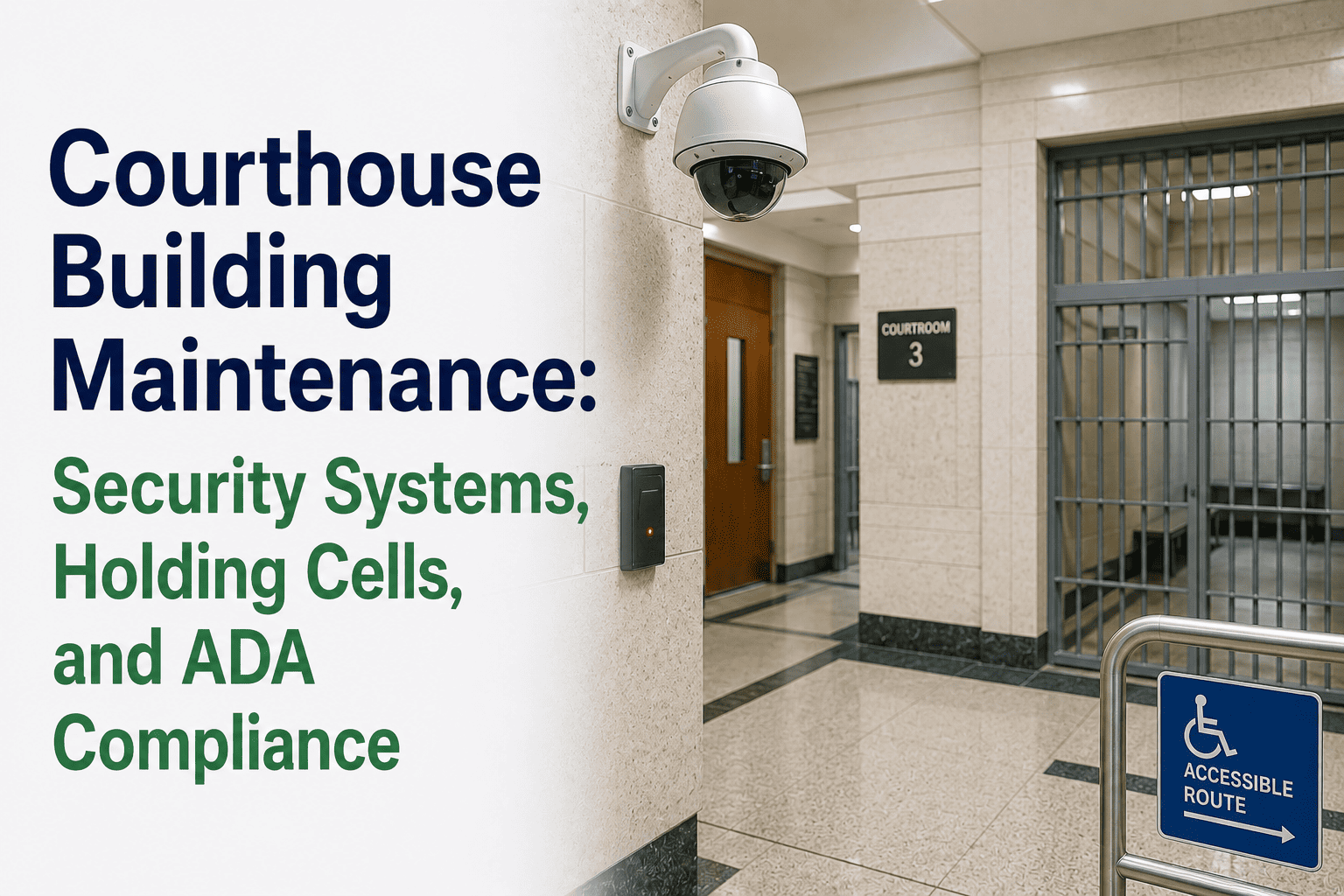
Courthouse Building Maintenance: Security Systems, Holding Cells, and ADA Compliance
Security infrastructure PM, holding cell inspection schedules, ADA accessibility maintenance, HVAC zone management, and CMMS audit trails for county and federal courthouse facility managers
The Unique Maintenance Complexity of Courthouse Facilities
A courthouse is effectively four buildings in one structure — each with different occupancy populations, security classifications, and maintenance requirements. The failure of any system at the boundary between these zones creates compounding risks that go well beyond a typical commercial building maintenance failure.
OxMaint manages all four courthouse maintenance zones — security, holding, courtroom, and administrative — from a single CMMS dashboard with zone-specific PM templates. Book a demo or start free today.
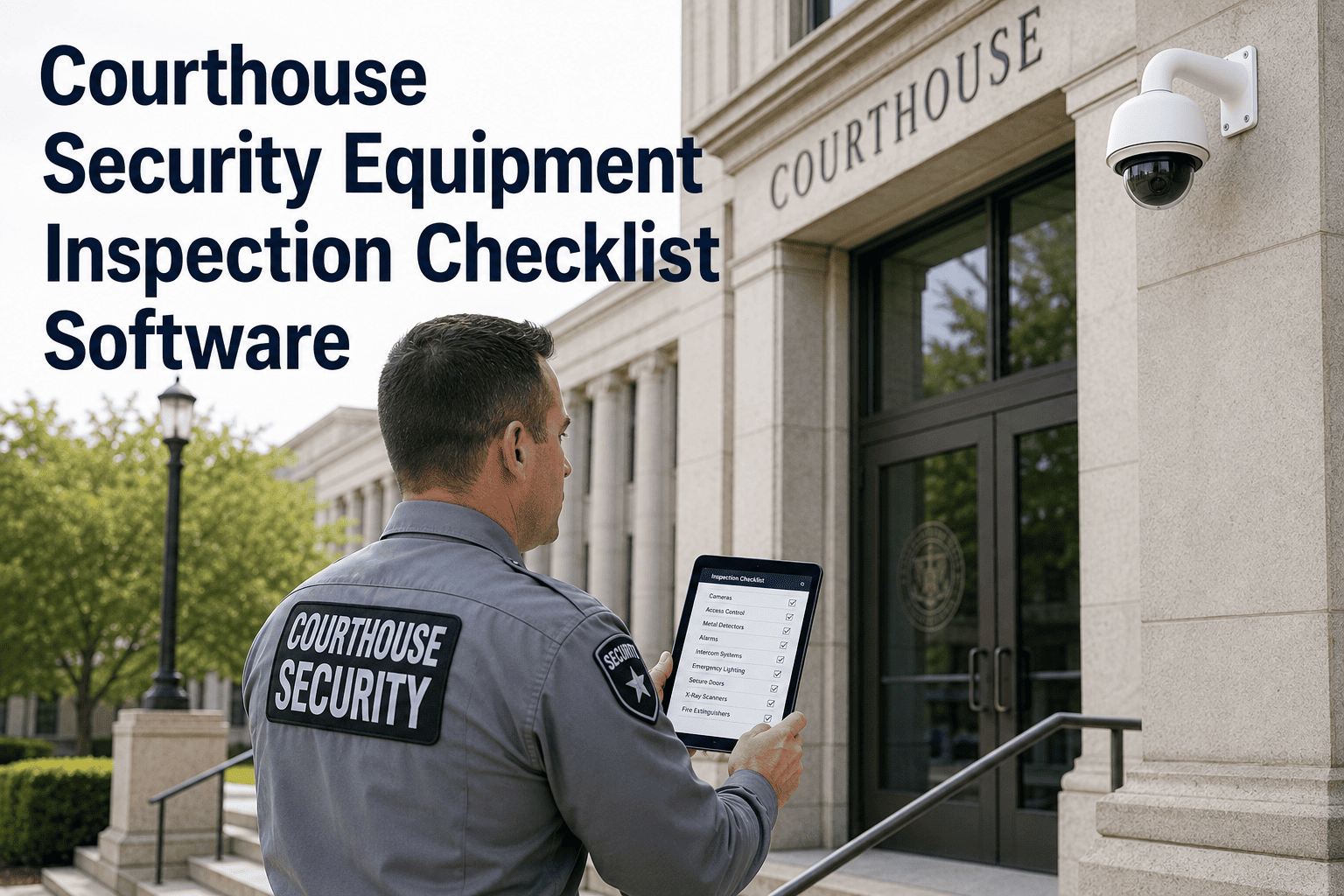
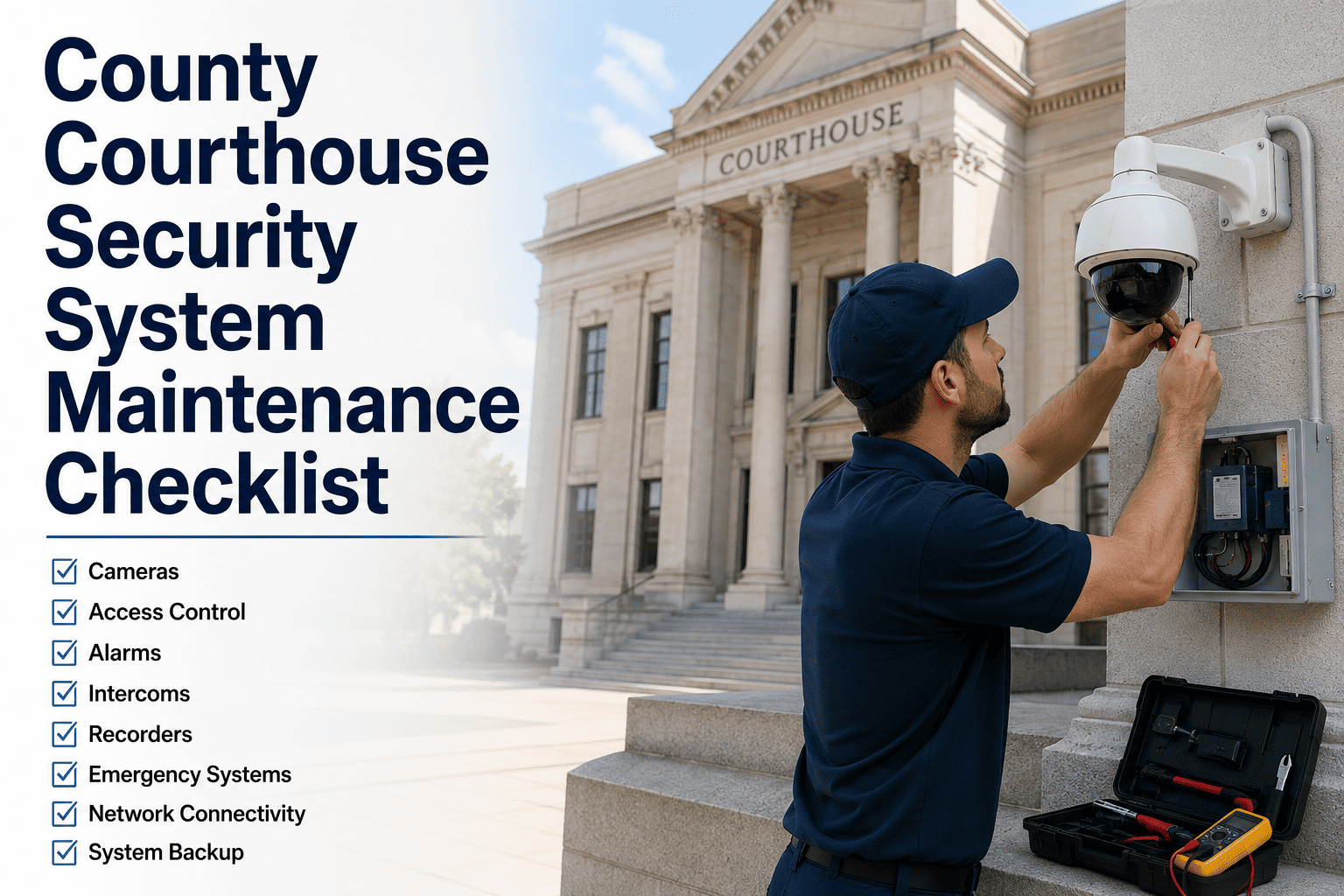
Security System Maintenance Schedule
| System | Frequency | Maintenance Task | Failure Consequence |
|---|---|---|---|
| Magnetometers / X-ray | Weekly | Calibration test with control sample, software update check | Security breach — prohibited items pass undetected |
| CCTV System | Monthly | Recording continuity verification, lens cleaning, storage capacity check | Evidence loss — gaps in footage for incident investigation |
| Access Control (Badge Readers) | Quarterly | Reader test, credential audit, door position sensor check | Unauthorized access to restricted areas |
| Intercom / Duress Alarms | Monthly | Full circuit test from each device, response time log | Staff safety incident — undetected duress situation |
| Secure Entry Doors / Airlock | Daily | Manual operation test, motor current check, seal inspection | Operational disruption — court session delay or cancellation |
| Sally Port Controls | Daily (pre-session) | Interlock function test, hydraulic/pneumatic pressure check | Prisoner escape risk — critical safety incident |
Holding Cell Maintenance — Non-Negotiable Inspection Points
Holding cell maintenance carries legal liability directly tied to the duty of care for persons in custody. Inadequate maintenance that results in inmate injury or escape triggers civil rights litigation, sheriff department review, and facility inspection by state correctional authorities. Every inspection must be dated, signed, and retained.
ADA Compliance Maintenance — High-Risk Failure Points
| ADA Element | ADA Standard | PM Frequency | Common Failure |
|---|---|---|---|
| Accessible route — all paths | ADA 2010 §402 — 36" min width, slope < 1:20 | Monthly inspection | Temporary obstructions, damaged surface |
| Automatic door openers | ADA 2010 §404 — opening force, timing | Monthly test | Motor failure, timing drift — opening force too high |
| Accessible restrooms | ADA 2010 §603 — reach, grab bars, clearances | Monthly inspection | Loose grab bars, non-compliant fixture height after repair |
| Platform lifts (wheelchair) | ADA 2010 §410 — platform size, edge protection | Monthly function test + quarterly PM | Out-of-service lift = building inaccessible to wheelchair users |
| Accessible parking — van spaces | ADA 2010 §502 — 8' space + 8' access aisle | Quarterly site inspection | Faded markings, obstruction by vehicles or signage |
| Accessible public counter heights | ADA 2010 §904 — 28"–34" accessible portion | Annual check after any renovation | Post-renovation modification raises counter above compliant height |
Courthouse CMMS — Audit Trail for Every Inspection, Every System
OxMaint provides courthouse facility managers with zone-specific PM templates, security system inspection logs, holding cell records, ADA compliance tracking, and one-click audit export for GSA, county authority, and judicial administration reviews.
Expert Review
"Managing a courthouse is unlike any other public building because every maintenance failure has a judicial consequence as well as a physical one. A failed duress alarm in a holding area, an inoperable lift for an ADA-protected litigant, a malfunctioning magnetometer at the public entrance — any one of these creates immediate legal exposure for the court administration and the facility team. The documentation burden is enormous: our GSA inspectors want evidence that every security system was tested on schedule and that every ADA element was inspected with a dated record. Paper logs cannot satisfy this at scale. When we moved to OxMaint, our compliance documentation went from a three-week annual scramble to a one-click report. The audit trail exists automatically because it is built from the work orders our technicians close every day. That is the only sustainable model for courthouse facility compliance. Start at app.oxmaint.ai."
Frequently Asked Questions
Your Courthouse Maintenance Records Need to Be Audit-Ready Every Day
OxMaint gives courthouse facility managers a single CMMS that handles security system inspections, holding cell records, ADA compliance logs, and HVAC zone PM — with a full audit trail built automatically from completed work orders. No scramble before inspections. No compliance gaps.