A massive chiller plant in a state administrative building runs at 100% capacity through a mild autumn weekend because an outdated pneumatic control system failed to register the temperature drop. By Monday morning, the facility has burned through thousands of dollars in wasted electricity, severely impacting its quarterly energy reduction targets. When the annual audit arrives, the agency is penalized for violating a strict federal energy mandate. This is public facility management operating on legacy silos—disconnected, inefficient, and bleeding taxpayer dollars. To meet aggressive 30-50% reduction targets, agencies must bridge the gap between their Building Management Systems (BMS) and maintenance execution. Talk to our team about deploying CMMS-tracked energy management to automate HVAC optimizations, track utility consumption, and achieve your government environmental goal without sacrificing occupant comfort.
Public Sector Energy — 2026 Edition
Government Building Sustainability: Meeting Federal and State Energy Mandates
Executive orders and state mandates require government buildings to reduce energy 30-50%. CMMS-tracked energy management with BMS integration demonstrates measurable progress toward sustainability compliance goals.
BMS Integration
Automated HVAC & Lighting Controls
Energy Benchmarking
Utility tracking vs. federal baselines
Carbon Reduction
Scope 1 & 2 emissions monitoring
Compliance Reporting
Audit-ready sustainability logs
30-50%Required public building energy reduction
24/7BMS telemetry and asset health sync
100%Government sustainability reporting readiness
LEEDFramework compliance tracking
The Limitations of Siloed Energy Management
Public infrastructure demands rigorous financial and environmental stewardship, but legacy facility maintenance is inherently disconnected from energy policy. Facility managers face competing priorities—keeping aging equipment running while trying to decipher complex state energy requirement government mandates. Because these operations are tracked in separate spreadsheets and legacy systems, correlating maintenance activities to energy spikes is impossible. When data relies on monthly utility bills rather than real-time BMS telemetry, predictive optimization cannot happen. The result: minor mechanical faults compound into massive government carbon reduction failures. Book a Demo.
Common Public Facility Energy Failures
HVAC Drift
40%
Uncalibrated sensors cause chillers and boilers to operate out of phase, destroying public building sustainability metrics.
Risk: Massive utility overspend
Zombie Lighting
High
Lighting schedules fail to sync with actual occupancy data, keeping empty courthouses and offices illuminated all night.
Risk: Wasted peak-hour energy
Siloed BMS Data
85%
Building Management Systems detect faults, but without CMMS integration, alerts never convert into timely work orders.
Risk: Prolonged equipment inefficiency
Failed Audits
Severe
Inability to produce accurate logs for a government energy mandate audit leads to departmental budget cuts or fines.
Risk: Federal compliance violations
Poor Benchmarking
Critical
Agencies fail to maintain an Energy Star government rating because historical consumption is not mapped to physical assets.
Risk: Loss of green funding/grants
How CMMS and BMS Integration Drives Reductions
Building a successful government sustainability program requires a complete rethinking of asset management. By combining BMS telemetry, smart meter tracking, and automated maintenance workflows, public works departments can continuously optimize their energy footprint. Understanding this integrated workflow reveals how agencies hit their mandated 30-50% reductions.
Integrated Energy Monitoring & Maintenance Process
BMS & Smart Meter Integration
Real-Time Utility Tracking
✓ Connect smart meters to track kWh, therms, and water consumption live.
✓ BMS feeds directly into the CMMS, logging HVAC setpoints and runtime hours.
✓ Operations utilize automated baseline comparisons to detect sudden demand spikes.
Continuous data ingestion allows facility managers to monitor the pulse of their entire public building portfolio from a single dashboard.
Government Energy Benchmarking
Performance Analytics
✓ AI cross-references energy consumption against Energy Star and LEED frameworks.
✓ Identifies underperforming assets driving up Scope 1 and Scope 2 emissions.
✓ System establishes dynamic efficiency thresholds based on seasonal weather patterns.
Benchmarking transforms raw utility data into actionable insights, revealing exactly which buildings are failing mandates.
Automated Fault Correction
CMMS Work Order Generation
✓ BMS-detected inefficiencies (e.g., stuck dampers) automatically trigger work orders.
✓ Predictive maintenance schedules prioritize assets with high energy-draw footprints.
✓ Technicians receive mobile dispatch with specific tuning instructions for optimal efficiency.
Seamless CMMS integration ensures that energy waste is treated as a critical mechanical fault requiring immediate repair.
Compliance & Sustainability Audits
Audit-Ready Documentation
✓ Auto-generate comprehensive government sustainability reporting for stakeholders.
✓ Export formatted logs directly for federal energy mandate and state agency reviews.
✓ Track historical progress of your government green building initiatives.
Flawless reporting protects departmental budgets and proves ROI on sustainability capital investments.
Unify Maintenance and Energy Policy
Oxmaint AI integrates BMS fault detection, smart meter consumption data, and predictive maintenance directly into your workflow. Automate work orders to ensure your facilities meet every government energy mandate.
Transforming Asset Management: Efficiency + Accountability
The true power of a modernized public building energy reduction strategy lies in the synthesis of operations. When daily wrench-turning is aligned with high-level environmental goals, public agencies transition from reactive utility-bill payers to proactive sustainability leaders. Book a Demo.
Key Pillars of Government Sustainability
Federal & State Compliance
Capabilities:
Automated mandate progress tracking
Energy Star government sync
Scope 1 & 2 emissions calculation
State energy requirement government tracking
CMMS Impact:
Maintains a continuous, immutable audit trail
Prevents costly regulatory non-compliance fines
Transforms complex legislative mandates into trackable daily metrics.
BMS / CMMS Integration
Capabilities:
Direct BMS telemetry ingestion
HVAC setpoint deviation alerts
Real-time utility meter monitoring
Automated fault-to-work-order triggers
CMMS Impact:
Eliminates the gap between fault and repair
Prioritizes maintenance by energy impact
Ensures 24/7 oversight of the largest energy-consuming assets.
Green Building Analytics
Capabilities:
LEED government building framework tracking
Predictive lifecycle cost analysis
Public building sustainability dashboard
Capital planning for retrofits
CMMS Impact:
Justifies budget for high-efficiency upgrades
Data-driven prioritization of capital projects
Transforms maintenance data into strategic sustainability investments.
Deployment Lifecycle: Achieving Compliance Goals
Implementing an automated energy reduction program requires a structured approach. Public works departments must establish baselines, integrate intelligent controls, and tune their CMMS to ensure accurate government energy benchmarking.
Sustainability Deployment Lifecycle
From manual utility checks to an AI-driven efficiency dashboard
01
Energy Baseline Audit
Conduct an initial comprehensive review of 36 months of utility bills, existing BMS configurations, and asset health. Create the foundational baseline for measuring the mandated 30-50% reductions.
Planning
02
BMS & Meter Integration
Deploy API connections between the CMMS, smart meters, and building automation controllers. Define initial efficiency thresholds and alerts for chillers, boilers, and AHUs.
Active
03
Benchmarking & Certification Sync
Link your portfolio data to an Energy Star government portfolio manager. Set up automated tracking against the requirements of your target LEED government building certification.
Ongoing
04
Automated Efficiency Workflows
Train the system to recognize energy-wasting faults. Refine algorithms to auto-generate predictive maintenance work orders before minor mechanical drifts cause peak load penalties.
Growth
05
Predictive Sustainability Reporting
Fully enable automated compliance logging. Generate push-button reports that prove to federal and state auditors exactly how your agency achieved its government carbon reduction milestones.
Advanced
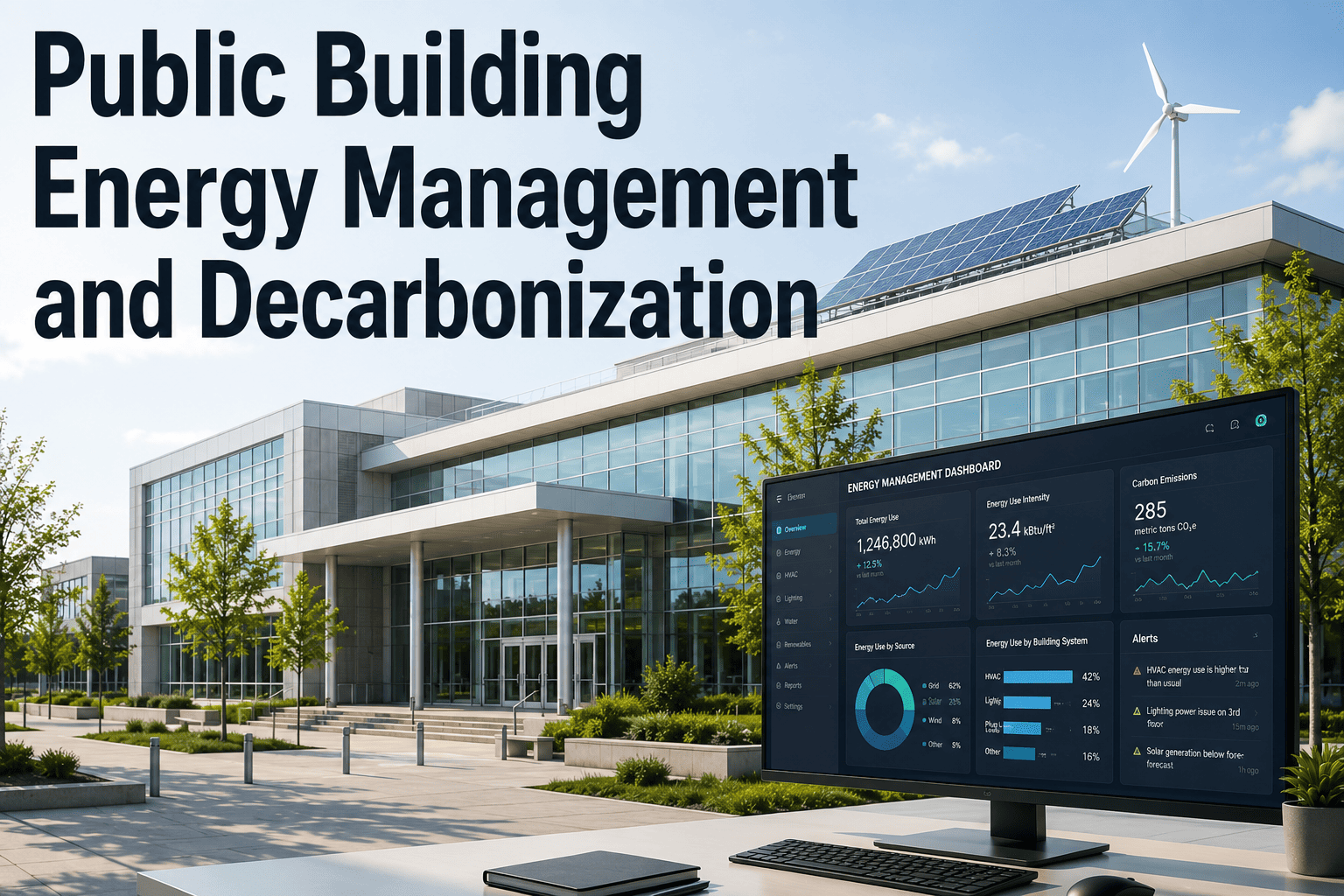
Real-Time Sustainability Dashboard
Visualize your agency's energy footprint in real-time. Oxmaint aggregates utility data and maintenance history to provide facilities directors with a single source of truth for public building sustainability.
Expert Perspective: The New Standard for Public Works
"
Managing energy across a portfolio of aging municipal buildings is a constant battle against outdated hardware and tightening budgets. We used to rely on spreadsheets and end-of-year utility reviews, hoping we hit our government green building targets. By transitioning to a CMMS-tracked government sustainability program, we fundamentally changed our operational profile. Our BMS integration now captures real-time HVAC drift, while our government energy benchmarking provides continuous feedback against federal standards. When a VFD on a main chiller began failing and spiking energy use, the CMMS integration automatically generated a work order before it ruined our monthly public building energy reduction metrics. We've eliminated the guesswork and achieved a 35% reduction in government carbon reduction. This is the new standard for meeting a federal energy mandate.
— Director of Facilities, Department of General Services
35%
Reduction in overall energy consumption
100%
Audit pass rate for state mandates
Real-Time
BMS fault-to-work-order automation
Automated
Government sustainability reporting
Agencies that deploy integrated government energy benchmarking are not just upgrading software—they are demonstrating measurable commitment to a sustainable future through proactive public building sustainability. The technology provides unparalleled oversight and ensures every government environmental goal is met with operational efficiency. Start your free trial today.
Meet Your Mandates with Oxmaint
Oxmaint delivers the ultimate platform for modern facility management—unifying BMS telemetry, Energy Star tracking, and work order automation into a comprehensive dashboard for government building sustainability.
Frequently Asked Questions
How does CMMS integration support a government sustainability program?
A CMMS supports a government sustainability program by linking physical maintenance tasks directly to energy outcomes. Instead of treating a clogged filter or a leaking steam trap as just a mechanical issue, the system flags it as an energy penalty, ensuring that repairs prioritizing public building energy reduction are dispatched and resolved first.
How do we track progress against a federal energy mandate?
Tracking progress against a federal energy mandate or state energy requirement government legislation requires a baseline measurement and continuous utility tracking. Oxmaint ingests data from smart meters and utility invoices, normalizing it for weather and occupancy, and provides real-time government sustainability reporting to prove that your 30-50% reduction targets are on track.
What role does a CMMS play in maintaining a LEED government building?
To maintain a LEED government building status, particularly for Existing Buildings: Operations & Maintenance (EB:O&M), strict documentation of HVAC efficiency, green cleaning protocols, and preventive maintenance is required. The CMMS automates these recurring checklists and securely logs the historical data required by the USGBC for recertification.
Can the software integrate with Energy Star government benchmarks?
Yes. The system streamlines government energy benchmarking by formatting and pushing facility consumption data directly into the Energy Star government Portfolio Manager. This eliminates manual data entry errors and provides an accurate 1-100 score, which is critical for securing government green building grants and funding.
How does automated maintenance lead to government carbon reduction?
Inefficient buildings are the primary driver of public sector Scope 1 and Scope 2 greenhouse gas emissions. By automating responses to BMS alarms—such as fixing a simultaneous heating and cooling fault immediately rather than waiting for an occupant complaint—agencies drastically cut wasted kWh and therms, directly resulting in massive government carbon reduction.