City council members approve maintenance budgets based on one factor: confidence that the spend is defensible and the risk of not spending is greater than the cost. Facilities directors who present age-estimate spreadsheets face 47% rejection rates. Those who present FCI condition maps, cost-of-deferral projections, and documented emergency repair histories achieve 88% approval. The difference is not the quality of the infrastructure — it is the quality of the evidence. Schedule a demo to see how Oxmaint generates council-ready budget justification outputs from your facility data.
Winning maintenance budget approval from city council requires three things: financial framing that connects maintenance spend to avoided costs rather than operational needs, documented condition evidence that replaces subjective estimates with FCI-scored data, and a cost-of-deferral argument that quantifies what happens if the council votes no. This guide provides the structure, language, and data formats for each element.
Why Maintenance Budget Requests Fail at Council
Most maintenance budget submissions fail for the same reasons — presented in facility director language to an audience of elected officials who think in terms of constituent risk, legal exposure, and fiscal stewardship. Understanding the council's decision framework is the first step to constructing a submission that succeeds. Book a demo to see how Oxmaint produces council-formatted budget justification documents.
"We need to replace the HVAC" fails. "The HVAC is at FCI 0.38 — deferring replacement another year adds $84K in compounding liability and a 67% probability of emergency failure costing $140K+" succeeds. Council members approve risk mitigation, not operational maintenance.
Age-based estimates without condition assessment data are dismissed as guesswork by finance-literate council members. FCI scores, work order histories, and sensor-derived condition trends are auditable — and councils respond to data they cannot dispute.
Saying "this needs to be done" gives council the option to vote no with no apparent consequence. Showing that a $120K deferred decision costs $720K+ in 10 years at 7% compounding — or that deferral increases emergency failure probability by 34% next year — makes deferral the financially riskier option.
Elected officials are personally exposed to negligence findings if they vote to defer maintenance on a documented hazard. Surfacing ADA compliance gaps, fire code inspection deficiencies, or documented fall hazards changes the vote calculus — council members who voted no against documented evidence face legal risk.
Generate Council-Ready Budget Justification From Your Facility Data
Oxmaint produces FCI condition maps, cost-of-deferral analyses, and formatted budget justification reports — designed for elected official audiences without facilities expertise.
The Seven Elements of a Winning Council Maintenance Budget Submission
Every successful government maintenance budget justification contains these seven elements — in this order. Each element answers a specific question the council member is asking internally as they review the submission.
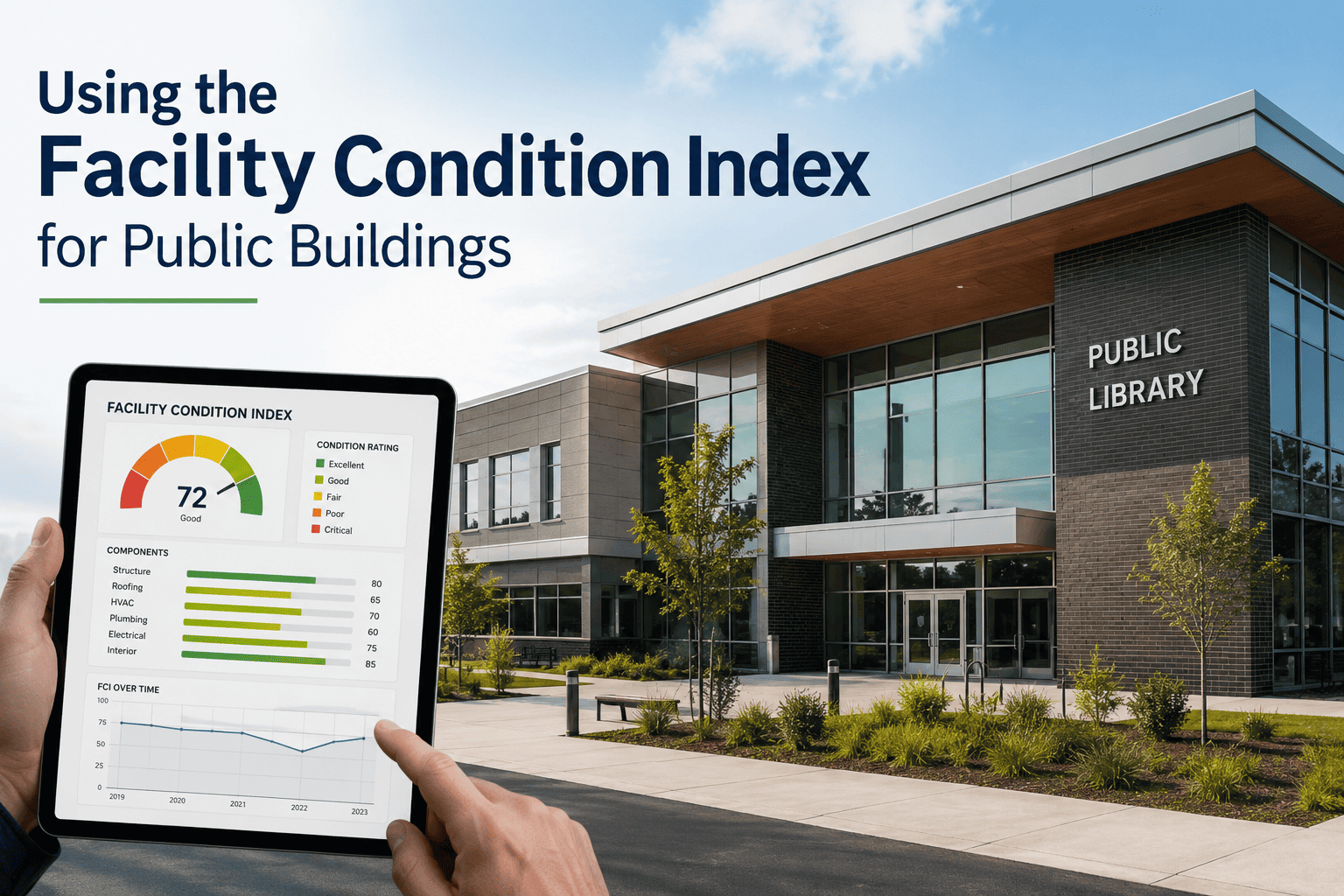
Lead with a visual FCI heat map showing each building color-coded by condition score: green (FCI < 0.10), amber (0.10–0.30), red (> 0.30). Council members respond to spatial, visual evidence faster than tabular data. Buildings shown in red trigger immediate political concern — which is precisely the intended effect. Oxmaint generates this from asset registry data automatically. Book a demo to see the FCI condition map output for your portfolio.
For each major capital request, show: current replacement cost, replacement cost at 7% annual compounding over 3/5/10 years, emergency failure probability increase per year of deferral, and emergency repair cost range if failure occurs. A single A4 table showing this for your top 5 capital requests is the most powerful document in any maintenance budget submission.
Pull work order data for all emergency or reactive repairs in the past 24 months. Show total cost, per-event costs, and the planned maintenance intervention that would have prevented each. Calculate the planning-to-emergency cost ratio. This converts abstract PM arguments into specific, auditable numbers that council finance officers cannot dismiss. Schedule a demo to see how Oxmaint extracts this analysis from your work order history.
List all documented compliance deficiencies — ADA access gaps, fire code items, OSHA findings, and inspection overdue items — with the date first documented, current remediation status, and statutory exposure per deficiency. Council members who vote to defer a documented compliance item share legal exposure for any resulting incident. Surfacing this changes the vote risk calculus fundamentally.
Identify 2–3 federal grant programs (BIL, EPA SRF, FHWA, USDA) for which the requested capital investment creates or strengthens eligibility. Show the grant amount, match requirement, and documentation criteria. Framing maintenance investment as a grant leverage multiplier converts a cost approval into a revenue strategy — a fundamentally different political proposition. Book a demo to see grant eligibility documentation from Oxmaint.
State the total budget request, broken into: planned PM program cost, capital replacement items, and platform/tooling investment. Then show the specific, measurable outcomes: target reactive ratio reduction (e.g., from 42% to 18%), projected emergency repair savings, energy cost reduction, and compliance items closed. Every outcome must be quantified in dollars and timeframe.
Commit to a quarterly dashboard showing: PM compliance rate, reactive repair ratio, FCI score changes per building, and emergency repair spend vs. prior year. Offering real-time accountability through a public-facing or council-accessible dashboard converts skeptical council members — they are approving a program with measurable outcomes, not a blank check. Oxmaint produces this dashboard automatically.
Language That Works — and Language That Fails
The framing of a maintenance budget request is as important as the data it contains. Elected officials hear hundreds of budget presentations. These language patterns separate submissions that advance from those that get deferred.
What Oxmaint Delivers for Council Budget Presentations
Portfolio condition map color-coded by building — green, amber, and red FCI scores that give council members an immediate visual of infrastructure health without facilities expertise.
Per-asset deferral tables showing current cost, 7% compounding projections over 3/5/10 years, and failure probability increases — the evidence that makes deferral the financially riskier vote.
24-month reactive repair cost analysis — every emergency work order with cost, cause, and the planned maintenance alternative that would have prevented it. Exported in council-ready format.
All open ADA, OSHA, NFPA, and fire code deficiencies with date first documented, current status, and statutory exposure — structured to surface council legal exposure on documented items.
AI-generated capital improvement plan ranked by failure probability, consequence weight, and replacement economics — formatted for council submission and updated continuously as field data changes.
Live dashboard showing PM compliance rate, reactive ratio trend, FCI score changes, and emergency repair spend — accessible to council members as ongoing evidence the investment is performing.
Budget Presentation Structures by Audience
The same data needs different packaging for different government audiences. Here is how to structure the submission depending on who is in the room.
Maintenance Investment ROI — Quick Reference Card
| Budget Ask | Primary Saving | Annual Benefit | Payback | Grant Access |
|---|---|---|---|---|
| PM Program — 10 bldgs | Emergency avoidance | $180K–$340K | 6–10 months | BIL, EPA SRF |
| PM Program — 25 bldgs | Emergency + energy | $420K–$860K | 8–14 months | BIL, FHWA, SRF |
| IoT Sensor Integration | Predictive + energy | $200K–$500K | 10–18 months | EPA, BIL Energy |
| CMMS Platform Only | Labor efficiency + compliance | $80K–$220K | 4–8 months | All programs |
| Full Digital Program | All four ROI streams | $600K–$2M+ | 12–20 months | Full portfolio |
Frequently Asked Questions
Continue Reading
Get Council-Ready Budget Justification Documents From Your Facility Data
Oxmaint generates FCI condition maps, cost-of-deferral analyses, compliance deficiency registers, and 10-year CIP schedules — formatted for elected official audiences without facilities expertise.