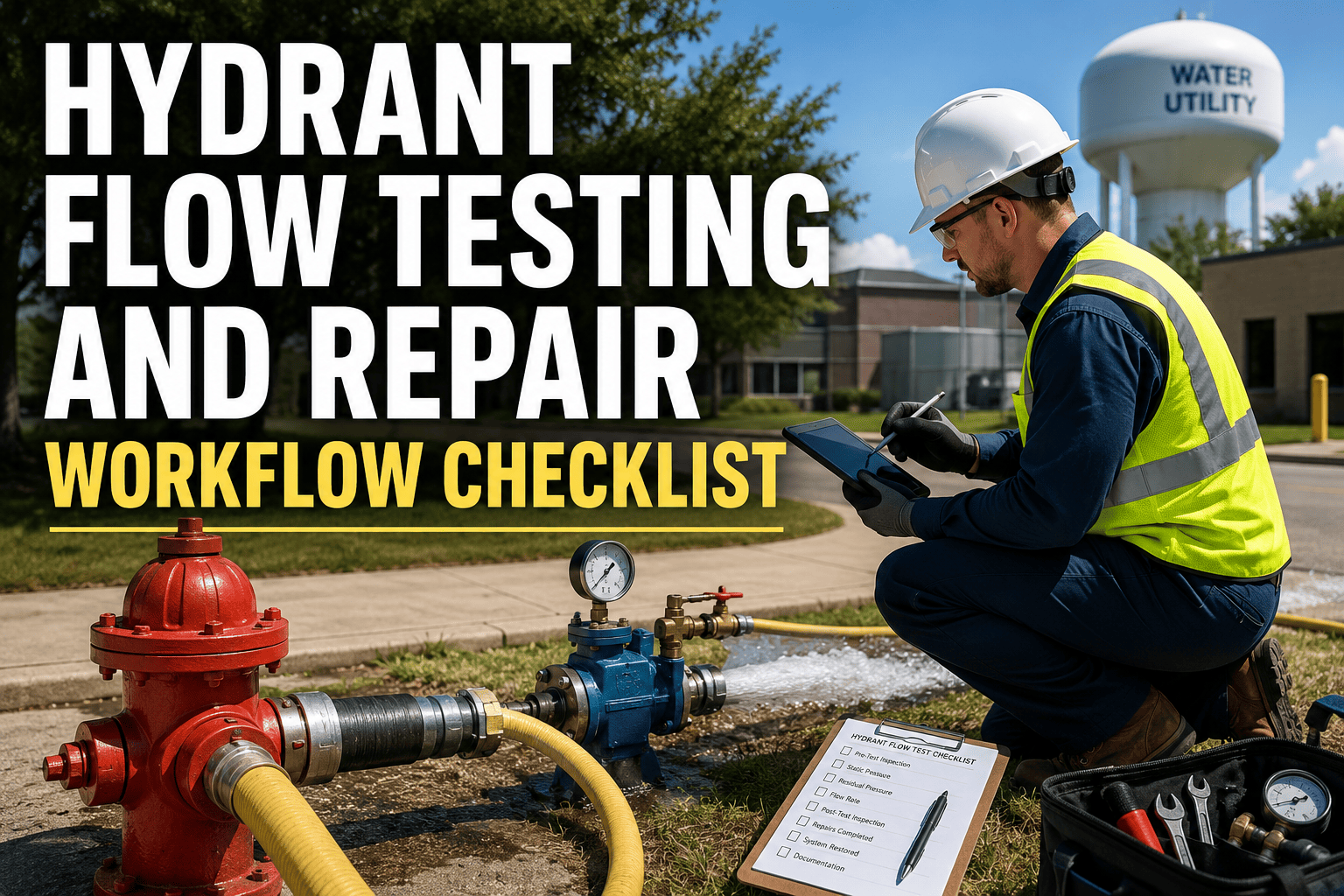
A fire hydrant is a promise the water system makes to every firefighter who arrives on scene — and a promise is only as good as the last time someone verified it. Yet hydrant failures almost never trace to manufacturing defects; they trace to the absence of a proactive maintenance program, paper test sheets that vanish into filing cabinets, and inoperable hydrants nobody flagged until the hose snapped tight. NFPA 291 and AWWA M17 lay out exactly how to test, rate, color-mark, and repair hydrants so crews know the available flow before the fire ever starts. This checklist turns those standards into a field workflow your team can run from a phone, and shows how OxMaint Inspection Management and Mobile CMMS captures every reading, photo, and repair against the hydrant's record. Book a demo to see a full test logged in under two minutes.
Hydrant Flow Testing & Repair Workflow Checklist
Inspect, flush, flow-test, classify, color-mark, and repair every hydrant to NFPA 291 and AWWA M17 — captured digitally so fire crews, ISO reviewers, and your distribution team all see the same current data.
Flow Classification & Color Marking
After the flow test, the available flow at 20 psi residual determines the hydrant's class — and the cap and top colors broadcast that capacity to crews on arrival. Public barrels stay chrome yellow; only the caps and bonnet carry the class color.
| Class | Rated Flow | Cap / Top Color | Fire-Flow Meaning |
|---|---|---|---|
| AA | 1,500 gpm or more | Light Blue | Very good flow |
| A | 1,000–1,499 gpm | Green | Good flow |
| B | 500–999 gpm | Orange | Marginal — caution |
| C | Less than 500 gpm | Red | Inadequate flow |
Five-Stage Hydrant Service Sequence
Run every hydrant through the same five stages, in order, and check each task before moving on. Open hydrants slowly and close them very slowly — a fast close causes water hammer that can damage the main.
With OxMaint Mobile CMMS, a technician scans the hydrant tag, enters static, residual, and pitot pressures, and the class and color update automatically — while a failed inspection raises a tagged repair work order before they leave the curb.
Frequency and the Data Every Test Must Capture
Standards set the floor, not the ceiling — most reliable programs inspect far more often than they flow-test. Whatever the cadence, a flow number with no date, location, or pressure context is worthless to the next crew.
What Hydrant Maintenance Professionals Say
Hydrants are built to perform at a moment's notice, so when one fails it is almost never the casting — it is the program. Crews with a disciplined preventive schedule have fewer repairs and far more reliable hydrants. The single most important rule is this: the moment a hydrant is found inoperable, black-bag it and raise the work order. A hydrant that looks fine but cannot open is more dangerous than no hydrant at all, because a crew will waste precious seconds on it.
Hydrant Product Specialist · 18 Years Distribution O&M and Field TrainingA flow test that lives on a clipboard helps no one. The value is in the record — date, location, static, residual, pitot, and the class that came out of it. That data drives ISO ratings, insurance reviews, and the engineering that spots a weak main before it fails. When inspections sync from the field to one system, the next technician and the responding engine company are finally looking at the same truth.
Water Distribution Superintendent · 23 Years Municipal Fire-Flow ProgramsFrequently Asked Questions
How often do fire hydrants actually need to be flow tested?
NFPA 291 recommends a flow test every five years, while AWWA references roughly a ten-year interval, and your local authority having jurisdiction sets the binding rule. Most utilities also inspect and lubricate annually or twice a year. Book a demo to see automated test-due scheduling per hydrant.
What do the hydrant cap colors actually mean?
Under NFPA 291 the cap and bonnet colors signal rated capacity: light blue is 1,500 gpm or more, green is 1,000–1,499, orange is 500–999, and red is under 500 gpm. Public barrels stay chrome yellow. Start free to log class and color against every record.
What happens the moment a hydrant fails inspection?
Tag or black-bag it immediately to prevent accidental use, then raise a repair work order so packing, gaskets, or a worn operating nut get replaced per AWWA M17. Timely repair and clear records are the core of a defensible program. Book a demo to see the tag-to-repair workflow.
Every Hydrant Test Becomes a Located, Dated, Defensible Record
From the first clearance check to the final color mark, OxMaint connects each field action to the hydrant's history — so capacity data is current, failed hydrants are flagged instantly, and your fire-flow program is audit-ready every day, not just at review time.