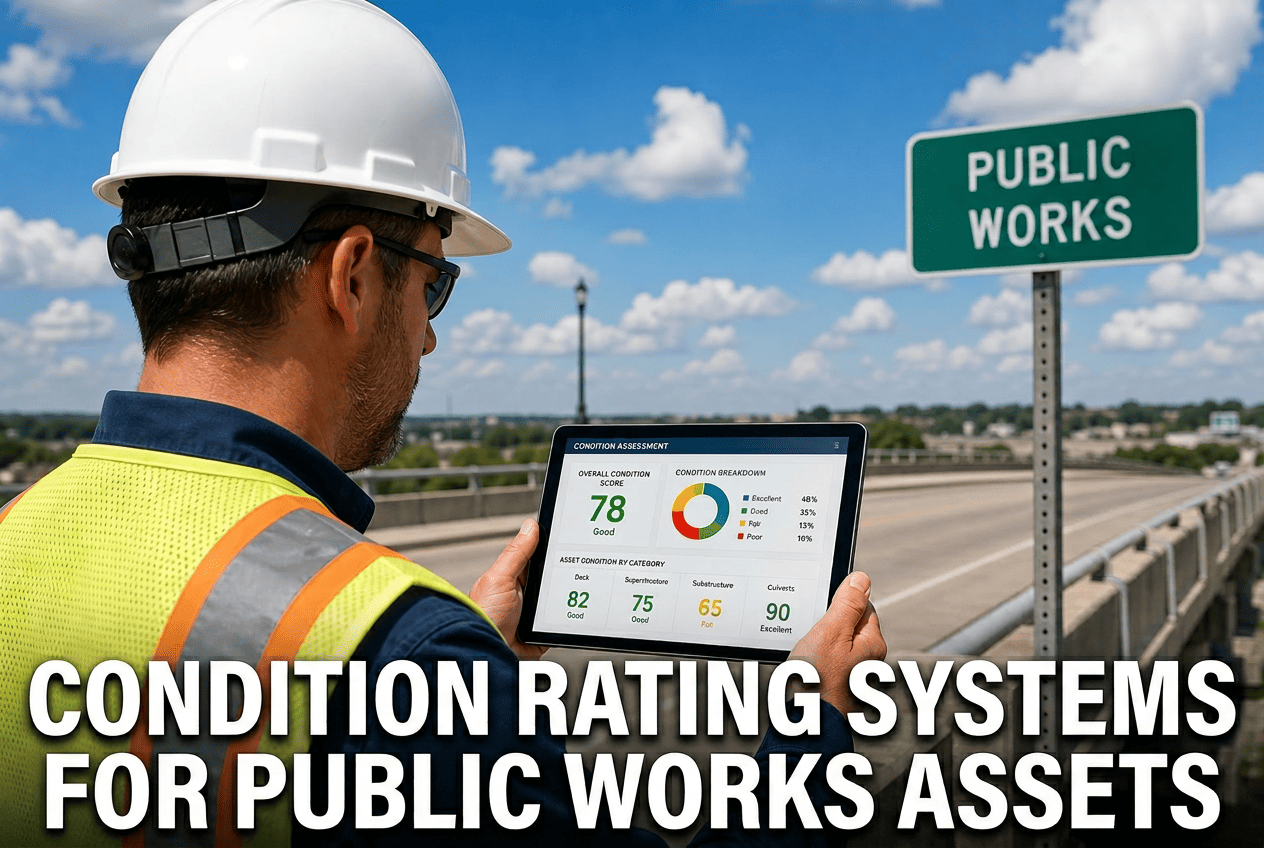
The public works director reviews the capital improvement plan with growing frustration—$4.2 million allocated for road repairs, yet pothole complaints increased 35%, water main breaks reached a 10-year high, and the city council demands answers about why infrastructure keeps failing despite budget increases. The city manager requests ROI justification for the proposed asset management system, but without condition assessments, lifecycle cost data, or failure prediction capabilities, the proposal feels like a gamble rather than a strategy. Meanwhile, neighboring municipalities are showcasing 30-40% reductions in emergency repairs by utilizing comprehensive asset management that makes infrastructure decisions proactive rather than reactive.
This scenario repeats across municipalities nationwide as public works teams struggle to bridge the gap between aging infrastructure and limited budgets. The average American city manages thousands of complex assets spanning roads, bridges, water systems, sewer networks, traffic signals, and municipal buildings—yet 72% operate without centralized visibility into asset condition or remaining useful life estimates.
Municipalities implementing digital asset management systems combined with mobile inspections, GIS integration, and automated work orders achieve 40-50% reductions in emergency repairs while generating audit-proof compliance documentation. The transformation requires calculating precise ROI using condition assessment data, lifecycle costing models, and infrastructure management best practices. Public works directors ready to abandon spreadsheet chaos can explore how digital asset management changes the equation.
What if every budget request was backed by documented asset condition data showing exactly which infrastructure needs attention and when?
While other municipalities pay for avoidable emergency repairs, forward-thinking public works departments use asset management systems to prevent 60% of infrastructure failures before they impact citizens. Discover why leading cities trust Oxmaint to protect their infrastructure investments.
Elevate Infrastructure Performance Using Digital Asset Management
Effective municipal infrastructure asset management begins with understanding how mobile inspections, condition data, and digital workflows create a safety net that catches deterioration before failure. Modern CMMS platforms extend beyond simple work order tracking to include real-time asset health monitoring, automated defect reporting, and "remaining useful life" calculations that identify replacement needs years in advance.
Traditional infrastructure approaches relying on complaint-driven repairs result in "worst-first" prioritization where critical preventive maintenance is deferred 70% of the time, leading to accelerated deterioration and catastrophic failures. Mobile digital inspections equipped with GPS-stamped photos, condition scoring, and mandatory documentation ensure every assessment generates actionable data feeding capital improvement planning. Organizations looking to eliminate reactive management can see how digital asset workflows operate in practice.
Digital logging of PCI scores, crack severity, and drainage conditions during inspections identifies surface treatments before they become full reconstructions. Prevents 65% of premature pavement failures.
Verified pipe condition assessments and pressure monitoring catch weak points before catastrophic main breaks. Reduces emergency response costs by 55% while improving service reliability.
Scheduled inspections of catch basins, detention ponds, and outfalls with photo documentation ensure EPA permit compliance and prevent costly violation notices.
Systematic cabinet inspections with conflict monitor testing and battery backup verification ensures intersection safety and reduces liability exposure.
ROI Calculator Approach: Quantifying Asset Management Returns
Justifying municipal asset management investments requires systematic ROI calculation that translates condition improvements into financial outcomes. Infrastructure management best practices demonstrate that structured ROI frameworks incorporating emergency repair costs, premature replacement expenses, and liability reduction achieve 90% budget approval rates compared to proposals lacking quantified projections.
The foundation of accurate ROI calculation lies in capturing current spending on reactive repairs, accelerated deterioration costs, regulatory fines, and citizen complaint response. Municipalities lacking visibility into these baseline costs often underestimate savings potential by 40-60%. Public works directors preparing for budget conversations can walk through ROI calculation methodologies with infrastructure specialists.
Municipal Infrastructure ROI Calculator Framework
| Infrastructure Category | Reactive Management Cost | Proactive Management Cost | Annual Savings | ROI Timeline |
|---|---|---|---|---|
| Road Network | $1.2M - $4.5M | $500K - $1.8M | 55-65% reduction | 12-18 months |
| Water/Sewer Systems | $800K - $2.5M | $350K - $1.2M | 50-60% reduction | 8-12 months |
| Traffic Signals | $150K - $450K | $80K - $200K | 45-55% reduction | 6-10 months |
| Stormwater | $200K - $600K | $100K - $300K | 40-50% reduction | 10-14 months |
| Municipal Buildings | $300K - $900K | $180K - $500K | 35-45% reduction | 14-20 months |
Making Compliance Effortless — A Municipal Asset Strategy
Municipal infrastructure faces stringent regulatory requirements spanning EPA stormwater permits, DOT bridge inspections, GASB-34 asset reporting, and state-specific mandates. Traditional paper-based audits consuming weeks of administrative scrambling transform into minutes of automated reporting when digital asset management captures every inspection with timestamped accountability.
Strategic CMMS implementation creates perpetual audit readiness where compliance verification becomes a dashboard query. Digital workflows ensure no critical maintenance is deferred beyond acceptable limits, automatically flagging overdue inspections and tracking corrective actions to completion. Teams spending excessive hours on manual compliance reporting can discover how automated audit trails eliminate preparation stress.
Automated tracking of infrastructure value, depreciation, and condition for annual financial statement compliance and capital planning.
- Asset inventory valuation
- Depreciation schedules
- Condition assessment data
- Capital improvement planning
Documentation of BMP inspections, maintenance activities, and outfall monitoring to demonstrate permit compliance.
- Catch basin inspections
- Detention pond maintenance
- Outfall monitoring logs
- Illicit discharge reports
Tracking of NBI bridge inspections, pavement condition indices, and safety improvements meeting federal and state requirements.
- Biennial bridge inspections
- Pavement condition surveys
- Safety improvement tracking
- Federal-aid project documentation
Comprehensive documentation of distribution system maintenance, valve exercising, and hydrant testing for health department compliance.
- Valve exercising records
- Hydrant flow testing
- Main flushing logs
- Cross-connection inspections
Audit-Ready Municipality Benefits
Infrastructure Asset Risk Assessment Matrix
Strategic maintenance allocation requires systematic risk scoring that evaluates each asset class based on condition, criticality, and consequence of failure. Infrastructure management best practices demonstrate that risk-based prioritization enables 40-50% more effective capital budget deployment.
Risk assessment frameworks combining asset age with real-time condition data outperform calendar-based approaches by 60-75% in failure prevention. The distinction lies in evaluating actual infrastructure health rather than assumed degradation curves. Municipal teams implementing risk-based prioritization can understand how AI-driven scoring optimizes maintenance schedules.
| Asset Category | Critical Risk Factors | Inspection Priority | Failure Impact | Assessment Frequency |
|---|---|---|---|---|
| Water Mains (Large) | Age, Material, Pressure, Soil | Critical - Condition Based | Service loss, Property damage | Annual + Leak Detection |
| Bridges & Structures | Deck condition, Load rating | Critical - NBI Required | Safety closure, Detours | Biennial + Event-Based |
| Arterial Roads | PCI, Traffic volume, Safety | High - Network Priority | Mobility, Economic impact | Annual PCI Survey |
| Sanitary Sewer Mains | Age, Material, I&I, Roots | High - CCTV Inspection | SSO violations, Health risk | 5-Year CCTV Cycle |
| Local Streets | PCI, Drainage, Utilities | Moderate - Systematic | Citizen complaints | Biennial PCI Survey |
Infrastructure Criticality Scoring Matrix
Digital Asset Management Implementation Playbook
Transforming municipal operations from reactive chaos to data-driven precision requires systematic implementation following proven infrastructure management best practices. Operations rushing technology deployment without staff buy-in achieve only 30-40% of potential benefits, while structured implementations consistently deliver 80-95% of projected outcomes.
The implementation sequence matters—asset inventory must precede condition assessment, and workflow configuration must precede field deployment. Municipalities inverting these sequences experience resistance and poor data quality. Teams planning implementation can discuss phased rollout strategies with infrastructure specialists.
Municipal Implementation Playbook
Import existing GIS data and create comprehensive asset registry with specifications, installation dates, replacement values, and location data for all infrastructure categories.
Establish standardized condition rating scales (1-5 or PCI) for each asset class with clear definitions, photo requirements, and deterioration thresholds.
Configure logic where condition assessments automatically generate maintenance work orders based on threshold triggers, routing to appropriate crews.
Train field staff on mobile app usage, emphasizing GPS-stamped inspections, photo documentation, and offline capabilities for remote locations.
Activate real-time dashboards showing infrastructure condition scores, work order backlogs, and budget projections for leadership visibility.
Utilize historical condition data to develop deterioration models predicting future maintenance needs and optimal intervention timing.
Infrastructure Reporting Dashboards & Performance KPIs
Measuring municipal infrastructure success requires establishing clear KPIs tracked through real-time dashboards. Effective asset management strategies depend on consistent measurement enabling continuous improvement rather than anecdotal fixes.
Dashboard design impacts operational decisions—field supervisors need "work order queue" visibility while directors need "network condition" summaries. Multi-view dashboard architectures serve different stakeholder needs. Teams designing performance measurement frameworks can explore dashboard configuration options.
Weighted average of all asset condition scores across the network. Leading indicator of infrastructure health and investment effectiveness.
Percentage of scheduled preventive maintenance tasks completed on time. Measures maintenance discipline and resource adequacy.
Ratio of planned maintenance to emergency repairs. The gold standard for measuring proactive management maturity.
Time from citizen request or emergency notification to crew dispatch. Measures operational responsiveness.
Percentage of assets reaching expected useful life versus premature replacement. Measures investment protection.
Survey scores on infrastructure quality and service response. Direct measure of public works effectiveness.
Integration Architecture: Asset Management & Enterprise Systems
Successful municipal asset management requires seamless integration between field apps, GIS platforms, financial systems, and CMMS databases. Fragmented implementations with disconnected data silos result in field crews reporting issues that never reach the budget process.
Integration architecture design determines scalability—municipalities selecting open-API platforms maintain flexibility for future system additions. Teams evaluating integration requirements can discuss compatibility with existing GIS and financial systems.
Conclusion
Municipal infrastructure asset management represents the evolution from reactive emergency repairs to data-driven capital planning excellence. Public works teams implementing comprehensive digital asset management with automated workflows achieve 40-50% reductions in emergency spending while generating documentation that transforms budget requests from guesswork to strategic investment proposals.
Understanding the interconnected architecture of GIS integration, mobile condition assessments, and predictive maintenance reveals that successful implementations require systematic transformation. Infrastructure management best practices demonstrate that ROI projections become reality when technology investments combine with staff accountability and streamlined workflows.
The 2026 municipal environment rewards communities demonstrating data-driven infrastructure stewardship while penalizing those maintaining spreadsheet-based approaches. Success requires balancing proven mobile workflows delivering immediate efficiency improvements with emerging analytics positioning the municipality for long-term infrastructure sustainability.
Imagine presenting your next capital improvement request with documented condition data showing exactly which assets need attention, when they'll fail, and what it costs to wait—what would that do for your infrastructure budget?
Every month without asset management is another month accumulating deferred maintenance and accelerated deterioration. Join the forward-thinking municipalities that transformed operations from reactive firefighting to predictive excellence with Oxmaint's connected infrastructure platform.