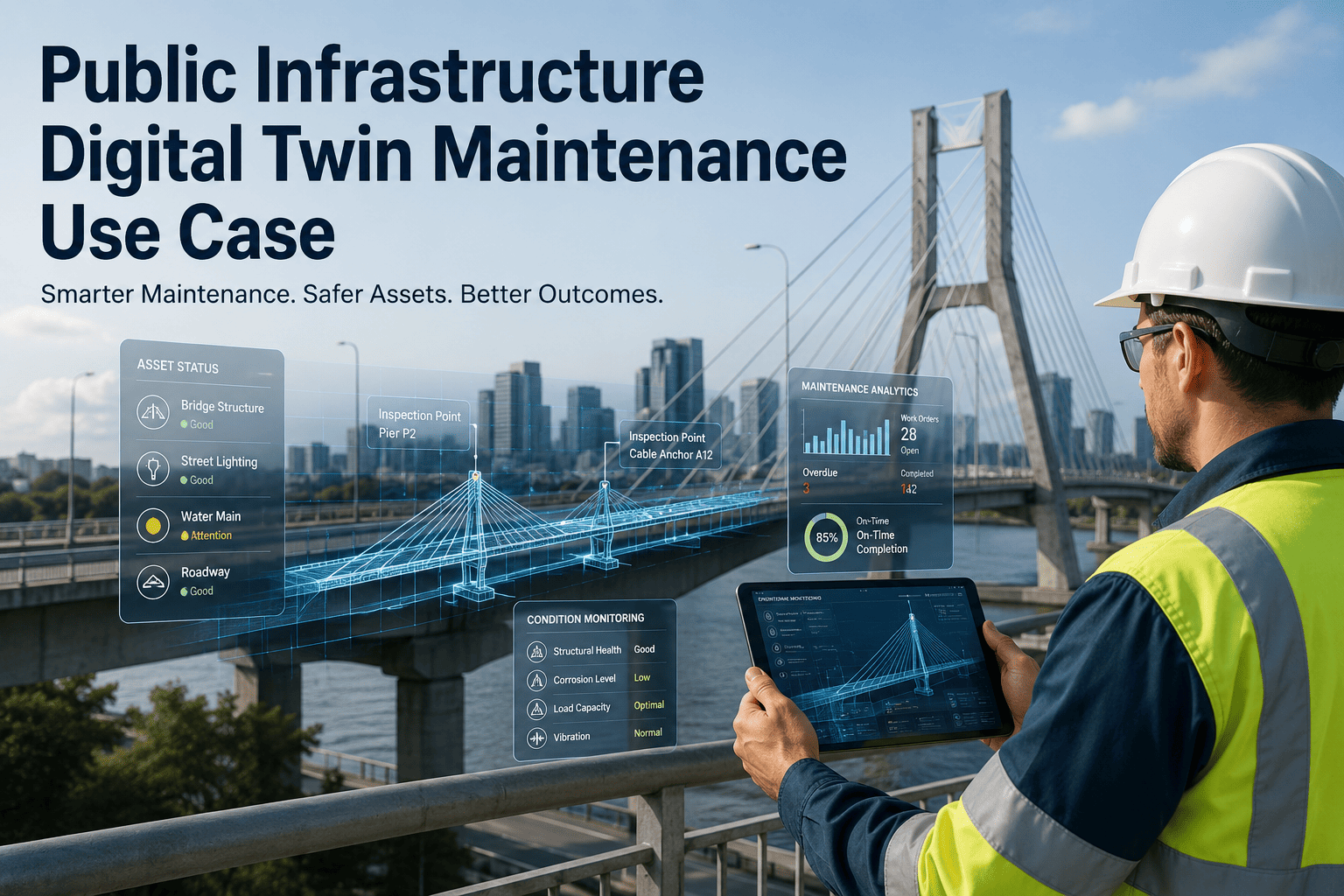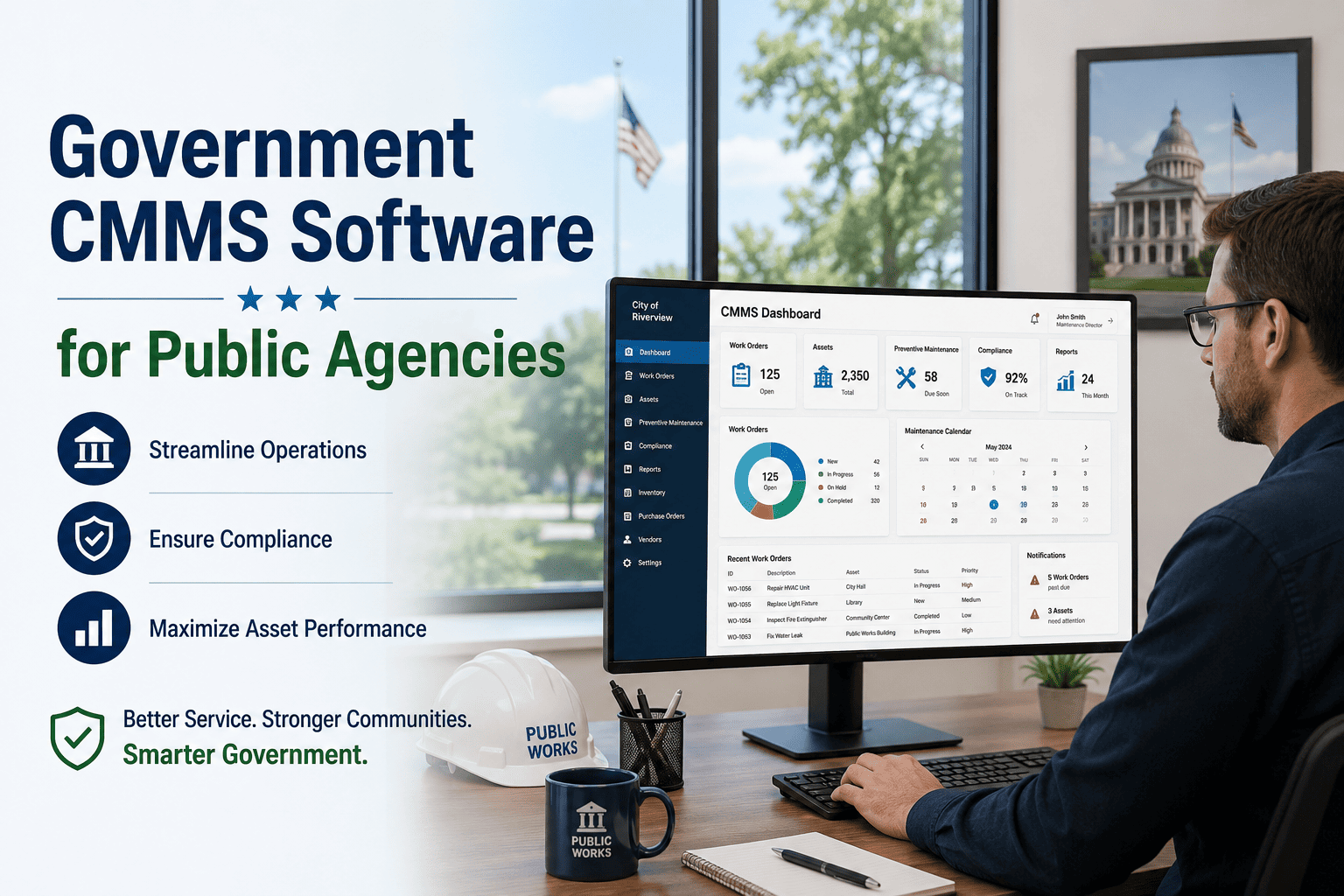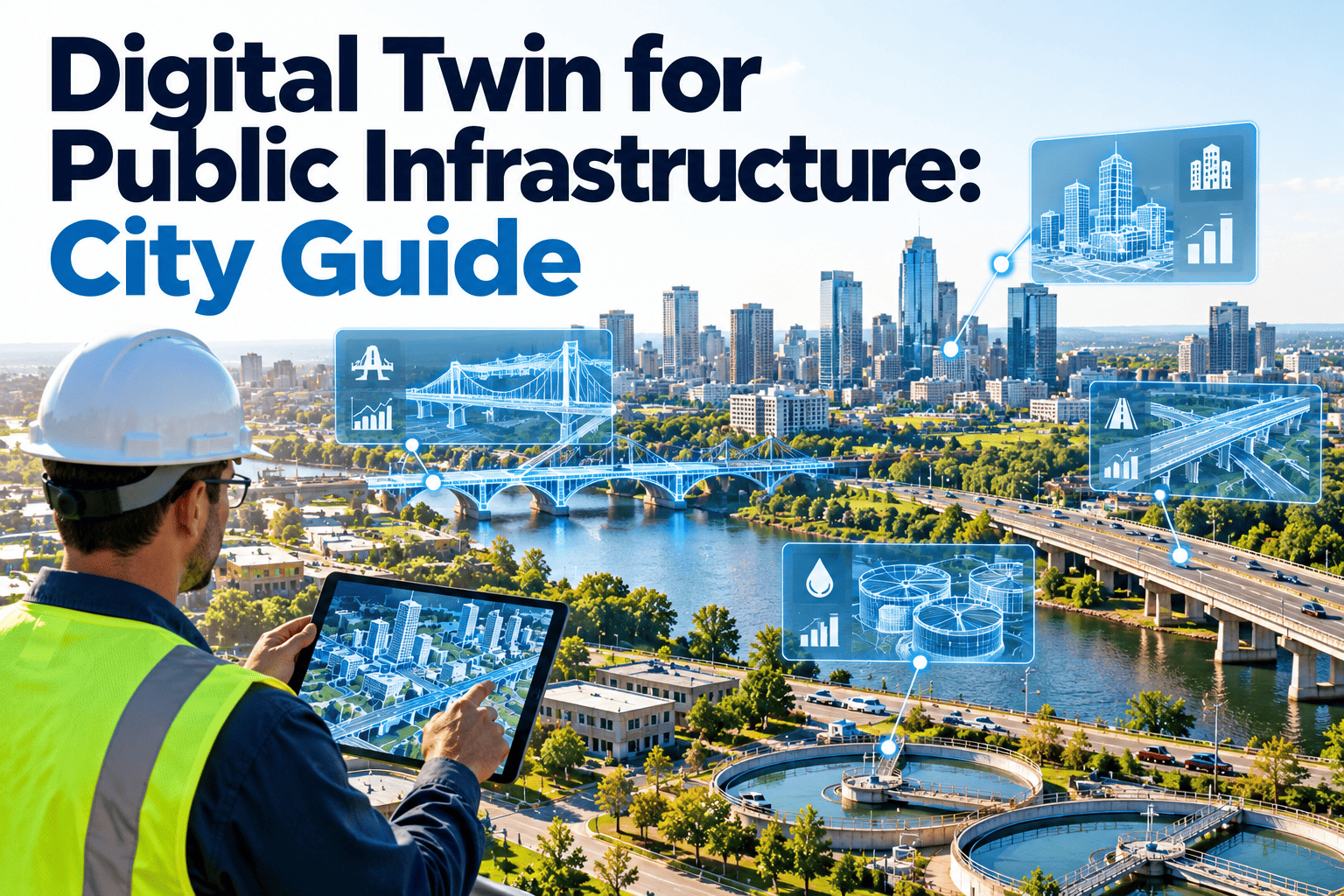
A digital twin sounds like a software purchase, but for most cities it is really a data discipline. A twin is only as useful as the asset records behind it, and many public works departments still hold drawings in cabinets, GIS layers that disagree with field reality and maintenance histories scattered across departments. Before any 3D model or live dashboard can help, those records need to be found, cleaned and tied to real assets. This guide explains what digital twin infrastructure projects actually require and how a city can start small, using a maintenance system like Oxmaint as the working record of each asset.
Digital Twin Infrastructure: What Cities Really Need Before the 3D Model
Understand the data, feeds and workflows behind a public asset digital twin, and how to start with one asset class and scale with confidence.
What a digital twin is, and what it is not
A digital twin is a living digital representation of a physical asset or system, kept current by data from the real world. The key word is living. A static model, however detailed, is a digital replica, not a twin.
- It is a 3D visualization of the city
- One vendor platform delivers it all
- It needs sensors on every asset
- It is an IT project run by one team
- It is finished once the model is built
- It is a connected data model, and visuals are optional
- It combines GIS, asset, maintenance and sensor systems
- It starts with records and adds feeds where value is clear
- It needs engineering, operations, GIS and finance together
- It is maintained continuously as assets change
Related terms matter too. A digital shadow receives data one way from the asset, while a full twin also supports decisions that flow back into operations, such as a scheduled repair or a changed setpoint.
Disconnected drawings and outdated records
Public infrastructure is long-lived. Pipes, bridges, signals and pump stations outlast several software generations and many staff, so records are rarely uniform.
Paper and scanned drawings
As-builts may be unindexed, unreferenced to coordinates or superseded by field changes no one documented.
Conflicting asset lists
Finance, GIS and maintenance each keep a register. The same pump or hydrant may carry three different IDs.
Thin maintenance history
Repairs recorded in notebooks or emails cannot feed condition models or support lifecycle decisions.
Unknown condition
Many assets have no recent inspection, so the twin would simply display old assumptions with high confidence.
- A twin built on unreliable records produces polished but misleading output
- Fixing records first is cheaper than correcting a finished model
- Field verification during maintenance work is the most sustainable way to improve accuracy
A data readiness scorecard for your first twin
Before selecting technology, rate each foundation area honestly. Gaps here predict where the project will stall.
| Foundation | Ready looks like | Not ready looks like | First fix |
|---|---|---|---|
| Unique asset IDs | One ID shared across GIS, finance and maintenance | Multiple names and tags for the same asset | Build a master register and crosswalk old IDs |
| Location accuracy | Assets mapped within a known tolerance | Approximate or missing coordinates | Verify high-risk assets during field visits |
| Attributes | Material, size, age, manufacturer, capacity recorded | Blank or free-text fields | Standardize fields and pick lists |
| Maintenance history | Work orders linked to assets with causes and costs | History in paper files and memory | Capture all new work in a single system |
| Condition data | Dated inspections and readings by asset | No recent condition scores | Start structured inspection routes |
| Data ownership | Named owners and update rules | No one accountable for accuracy | Assign stewards by asset class |
The building blocks behind a public asset digital twin
Each layer has a different owner and refresh rate. Treat them as connected systems rather than one monolith.
GIS, CAD and BIM
GIS provides network location and connectivity. CAD and BIM add detail for facilities. Open data standards ease exchange between them.
Asset and maintenance system
Holds the register, hierarchy, work orders, inspections, parts and costs. This is the operational memory of the twin.
IoT, SCADA and telemetry
Flow, pressure, level, vibration, temperature and status feeds update condition continuously where they justify their cost.
Connectors and data governance
APIs, naming rules, access controls and data quality checks keep layers consistent and secure.
Analytics and simulation
Hydraulic models, risk scoring and condition forecasting support what-if scenarios and investment planning.
Keeping the twin portable with open data practices
Cities change vendors, merge departments and adopt new tools. Data that is locked into one proprietary format becomes a liability, so portability should be a requirement from the first procurement.
Consistent asset classification
Agree on asset types, attribute names and pick lists across departments so a pump or valve means the same thing in every system.
Open formats and documented APIs
Favor documented interfaces and common spatial and building data formats, and confirm you can export your records at any time.
Handover data requirements
Require contractors to deliver structured asset data with new construction, so the register grows without a separate cleanup project.
Validation rules
Set mandatory fields, allowed ranges and duplicate checks so errors are caught at entry rather than discovered during analysis.
Who needs to be involved, and what each group owns
Twin projects stall when they belong to a single department. Shared ownership with clear roles keeps data accurate after the pilot ends.
- Name a data steward for each asset class and publish update rules
- Review data quality metrics at a regular cross-department meeting
- Tie data entry to existing work so it is not an extra task for crews
Quick wins in the first 90 days
- Retire duplicate asset lists and publish one master register for the pilot class
- Replace paper inspection forms with structured digital checklists
- Link at least the top critical assets to drawings, manuals and photos
- Report one cross-department insight, such as repeat failures by asset type, to build support
What to ask any vendor before committing
- Can we export all asset, geometry and history data in open formats without extra fees
- Which existing systems does the platform integrate with, and how is each integration maintained
- What data quality tools help us find duplicates, gaps and outdated records
- How does the solution perform when only partial data exists for an asset class
- What security controls, audit logs and role-based permissions are available
- How are field staff expected to capture data, and does it work with weak connectivity
- What is the realistic effort for our team to keep the system current after launch
Signs a proposal is too ambitious
- It promises a citywide twin without describing how records will be verified
- It depends on sensors for assets that crews already inspect cheaply
- It has no plan for maintaining data once consultants leave
Make every asset a trusted digital record first
Register assets, log inspections and capture every work order in one system so your future twin is built on facts.
Where a twin pays off first: a value and readiness matrix
Not every asset class deserves a twin on day one. Place candidates by value of better decisions and by how complete their data already is.
Start here. Examples often include pump stations, treatment plant equipment or signalized corridors with existing telemetry.
Invest in data capture first. Typical for buried pipe networks and aging bridges with sparse records.
Keep monitored cheaply through routine inspections. Revisit as consequences or costs change.
Defer. Maintain a basic register and collect data opportunistically during normal work.
Start small and scale: a staged path for cities
Digitize and unify the register
Choose one asset class, assign unique IDs and reconcile GIS, finance and maintenance lists. Outcome: one trusted list.
Capture condition through daily work
Use inspections and work orders to record condition, failures and costs. Outcome: history that improves every month.
Link spatial context
Connect records to GIS or facility models so staff can find and understand assets visually. Outcome: faster decisions in the field and office.
Add selective live feeds
Introduce sensors and SCADA data only where a clear decision depends on them. Outcome: condition-based work orders.
Model, forecast and expand
Use history and live data for risk scoring and scenarios, then repeat the pattern for the next asset class.
Practical ways cities use twin data in maintenance
Condition-based maintenance
Live readings and inspection scores trigger work orders when assets drift from healthy ranges, rather than waiting for calendar dates.
Capital planning
Age, condition, failure history and consequence together rank rehabilitation candidates for budget discussions.
Emergency response
Crews see asset connectivity, history and nearby critical facilities when a main break or power loss occurs.
Scenario testing
Planners test the effect of a shutdown, a new development or heavy rainfall on an existing network before acting.
What makes these use cases credible
- Each one depends on a named decision, an owner and a measurable outcome, not on a visual alone
- Each draws on records that crews already create during inspections, repairs and routine rounds
- Each can be tested on a single asset class before the city commits to wider investment
- Each improves as history accumulates, so early data discipline pays back over several years
How maintenance software feeds and uses the twin
A twin shows what an asset is and how it behaves. A maintenance system records what has been done to it and what should happen next. Together they close the loop.
- Oxmaint asset management gives each asset a single identity with attributes, location and documents
- Preventive maintenance schedules and inspections generate dated condition records
- Mobile work orders capture field findings, photos and parts used at the point of work
- Reports and dashboards expose backlog, repeat failures and cost by asset class
- Inventory tracking links spares to the assets that depend on them
Pitfalls to plan for from the start
Indicators that a twin initiative is working
- Share of assets in the priority class with a unique ID, location and complete core attributes
- Percentage of work orders closed with cause, remedy and parts recorded
- Age of the most recent condition record across critical assets
- Proportion of maintenance driven by condition or inspection rather than reaction
- Time needed to answer an asset history question for a council, auditor or regulator
- Number of decisions where staff used twin data and documented the result
- Reduction in time spent searching for drawings, manuals and past repair records
- Consistency between the GIS, finance and maintenance registers for the priority class
Digital twin infrastructure: common questions
How much does a city need to spend to begin?
Cost depends on scope, but a single asset class with a clean register and structured inspections is a modest, low-risk first step.
Do we need live sensors for a digital twin?
Not at the start. Reliable records and inspections deliver value, and sensors can be added where they improve decisions.
Is GIS enough to serve as a twin?
GIS is a core layer, but it lacks work history and live condition. A maintenance system supplies both.
Which assets should a city model first?
Pick high-consequence assets with decent data, such as pump stations or signals, then expand to harder asset classes.
How can Oxmaint help us prepare?
It centralizes assets, inspections and work orders. Schedule a demo to map your asset classes.
Give your city a twin it can trust
Start with accurate asset records, structured inspections and tracked work, then grow into live data and modeling at your own pace.