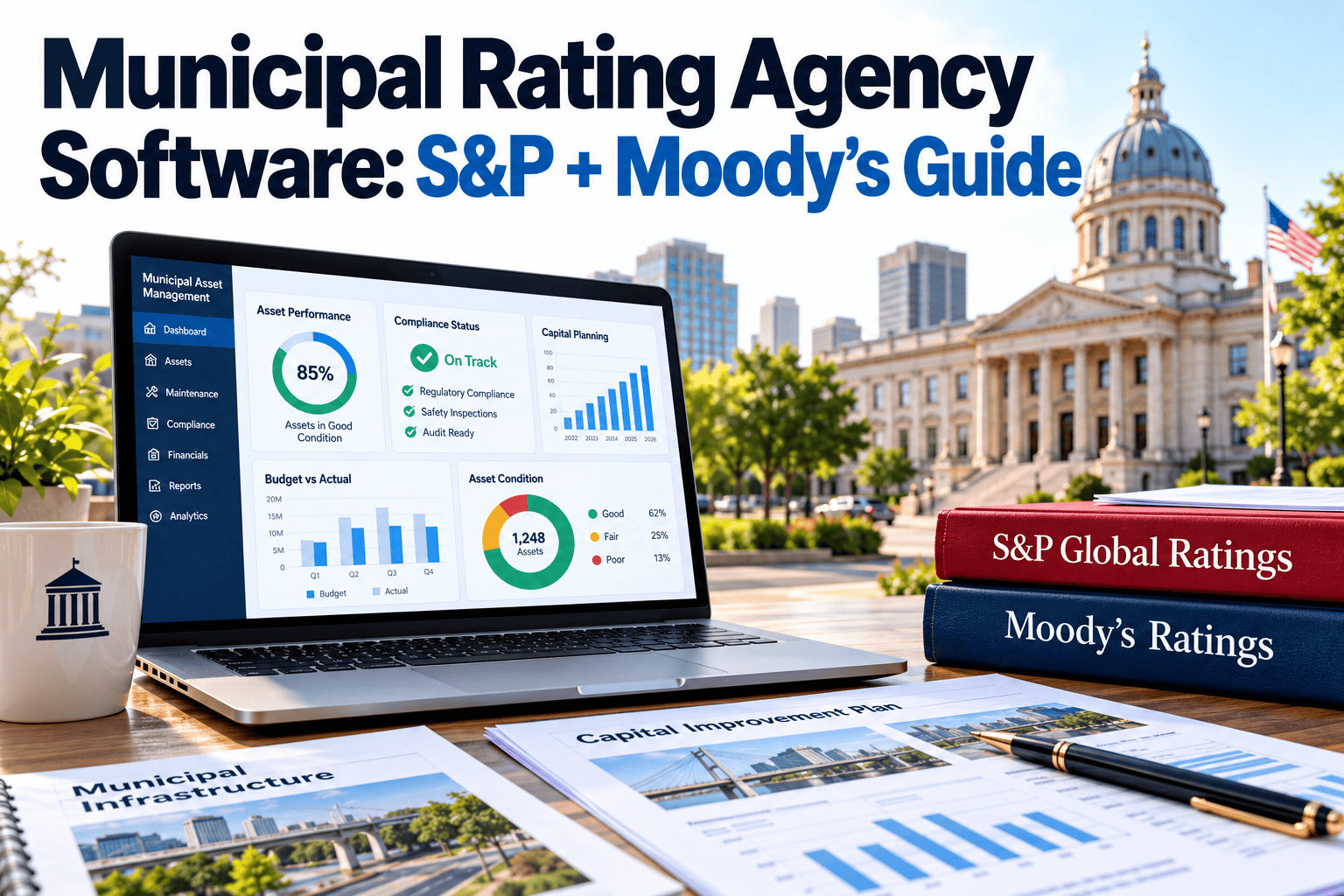
A municipal bond rating is, in practice, a verdict on how well a city runs itself, and infrastructure condition has become one of the hardest parts of that verdict to fake. Analysts at S&P Global Ratings and Moody's Investors Service ask for a capital improvement plan, a facility condition picture, and evidence that maintenance spending matches stated priorities, and a public works or facilities director who cannot produce that evidence on request puts basis points on the table before the meeting even starts. A CMMS that already tracks asset condition, work order history, and deferred maintenance backlog turns a scramble before the rating call into a standing report finance can pull on demand. Get Started to see how maintenance records become rating-ready evidence.
Your bond rating call is in six weeks. Could you hand the analyst a capital plan today?
S&P, Moody's, and Fitch all weigh documented infrastructure condition and capital planning as credit factors, not just financial ratios — and the cities that answer fastest usually answer with the fewest surprises.
One notch is not a rounding error
A downgrade or a missed upgrade on a general obligation issue changes the coupon rate a city pays for the next twenty to thirty years, and on a large bond issue that difference compounds into millions of dollars in avoidable interest. Rating agencies are explicit that a well-documented, regularly updated capital improvement plan is a positive credit factor, separate from the underlying financial ratios.
Cost of a notch
A single rating notch on a large, long-dated general obligation issue can move total interest cost by a meaningful multi-million-dollar range over the life of the bond.
Frequency of review
Ratings are typically reviewed annually or at each new issuance, which means the evidence base needs to be current, not assembled once and left to age.
Split ratings
Moody's and S&P do not always agree on the same issuer, and a documented capital plan is one of the clearer ways to narrow that gap in your favor.
What S&P, Moody's, and Fitch each look for
Each agency runs its own proprietary methodology, but all three converge on a similar core: revenue and economic base, financial performance and reserves, debt burden, and institutional management. Capital planning and asset condition sit inside that last category and are where maintenance data does the most work.
| Agency | Highest Rating | Weighs Capital Planning As | What Analysts Ask For |
|---|---|---|---|
| S&P Global Ratings | AAA | Part of institutional framework and management score | Multi-year CIP, funding sources identified, condition assessments |
| Moody's Investors Service | Aaa | Part of management and governance assessment | Long-term financial planning, documented capital needs, funding gap analysis |
| Fitch Ratings | AAA | Part of operating performance and long-term liabilities review | Capital investment history, deferred maintenance disclosure, asset age profile |
Six documents every rating call assumes you can produce
A current five-year capital improvement plan
Comprehensively scoped, funded, and updated annually — a stale CIP from three cycles ago reads as a governance weakness, not a technicality.
Facility and infrastructure condition data
Condition scores or a facility condition index across the buildings, roads, and utility assets the bond proceeds will touch, not just the specific project being financed.
Deferred maintenance backlog, quantified
A dollar figure and a trend line, not a general statement that backlog exists. Analysts read an undisclosed backlog as a bigger risk than a disclosed one.
Maintenance spend history against the plan
Evidence that budgeted maintenance dollars were actually spent on the assets identified, closing the gap between the stated plan and the operating reality.
Funding source identification
Which capital items are funded by cash, grants, or future debt, and which are still unfunded — analysts specifically flag unfunded gaps in the CIP.
Asset inventory tied to useful life
A record of what the city owns, its age, and its expected remaining life, which underpins every other figure in the capital plan.
Getting rating-ready before the analyst call, not during it
8-10 weeks out: pull the asset baseline
Export current condition scores, deferred maintenance totals, and CIP status directly from the CMMS instead of chasing spreadsheets across departments.
6-8 weeks out: reconcile plan vs. actual spend
Compare what was budgeted for maintenance and capital against what was actually completed, and flag gaps before the analyst does.
4-6 weeks out: brief finance and legal
Share the evidence package internally so finance, public works, and bond counsel are giving the analyst a consistent story.
2 weeks out: submit the rating package
Send the CIP, condition data, and reconciliation ahead of the call so the conversation focuses on strategy, not first-time disclosure.
What changes when maintenance data is rating-ready year-round
- Condition data assembled from department emails weeks before the call
- Deferred maintenance backlog estimated, not quantified from records
- CIP updated only when a bond issuance is already on the calendar
- Finance and public works reconcile numbers for the first time on the call prep
- Analyst questions on spend-vs-plan answered with a promise to follow up
- Condition scores and backlog figures current at any point in the year
- Deferred maintenance tracked as a running dollar figure with trend history
- CIP status reviewed and refreshed on a standing schedule
- Finance and public works work from the same asset and spend data
- Spend-vs-plan questions answered directly from the CMMS export
Walk into the next rating call with the evidence already assembled
Give finance and public works a shared, current picture of asset condition, deferred maintenance, and capital plan status.
Municipal rating agency preparation, answered
Do S&P and Moody's use the same rating scale?
No. S&P and Fitch use a letter scale topping out at AAA, while Moody's uses Aaa at the top with a numeric modifier system below it. The underlying credit factors they evaluate overlap heavily even though the scales differ.
How often should a capital improvement plan be updated?
Annually at minimum, covering at least a five-year horizon. Highly rated issuers treat the CIP as a living document reviewed on a standing schedule, not something revised only when a bond issuance is imminent.
Does deferred maintenance always hurt a rating?
An undisclosed or unquantified backlog is viewed more negatively than a disclosed one with a funded plan to address it. Analysts generally reward transparency and a credible reduction plan over an artificially clean-looking record.
Who typically presents to the rating agency — finance or public works?
Finance usually leads the call, but public works or facilities staff are often needed to answer condition and capital planning questions directly, which is why shared, current data between departments matters. Book a Demo to see how a shared CMMS record supports that handoff.
Can a CMMS actually change a rating outcome?
A CMMS does not set the rating, but it removes one common source of downgrade risk: an inability to document that stated capital priorities are actually being funded and executed.
A notch of interest rate is expensive. Documented asset condition is not.
Keep capital planning and infrastructure condition data current year-round, ready for the next rating call before it is scheduled.