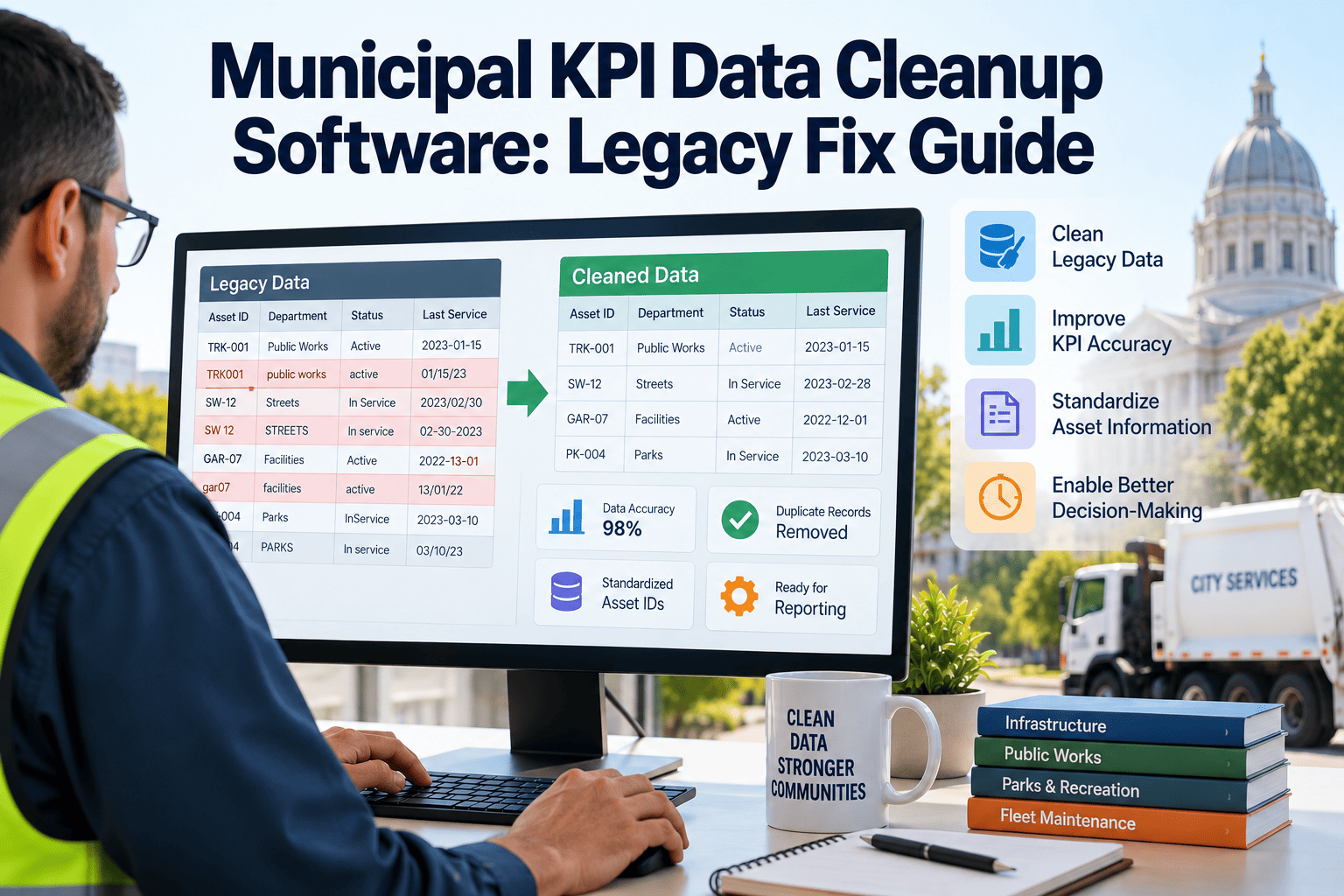
A public works department in a mid-size Midwest city ran on Excel work order logs for eleven years. When the state grant office asked for twelve months of PM compliance and response time records, the two-person office spent six weeks reconstructing numbers from technician memory, paper tickets, and half-updated spreadsheets. The final report still had gaps the auditor flagged. Every KPI a city council, a bond rating agency, or a federal grant reviewer asks for is only as strong as the work order data feeding it — and most municipal systems were never built to capture that data consistently in the first place. OxMaint's structured work order capture closes those gaps at the point of entry, before a KPI is ever calculated.
Stop Rebuilding KPI Reports From Memory Every Grant Cycle
Structured fields, mobile close-out, and asset linkage — captured once, correct everywhere
72 Hrs
Window auditors typically give agencies to produce PM compliance and inspection records before a compliance finding is issued
$400K–$2M
Average grant award size that requires documented PM compliance and maintenance history as an eligibility condition
88% vs 47%
Capital request approval rate when backed by clean condition data, compared with estimate-based submissions
Why a KPI Is Only as Honest as the Work Order Behind It
Backlog ratio, PM compliance, average response time, and emergency repair percentage are the four numbers every public works director eventually has to defend in front of a council, an auditor, or a bond analyst. Each one is a simple formula sitting on top of a work order record. When that record is missing a timestamp, a close-out code, or an asset ID, the formula doesn't fail loudly — it just quietly returns a number that looks plausible and is wrong. That's the trap: bad WO data rarely produces an obviously broken KPI, it produces a slightly-off one that nobody catches until an audit pulls the underlying records.
PM Compliance Rate
Scheduled preventive tasks completed on time. World-class agencies sit at 90%+; most municipal shops run 60–70% without structured scheduling.
Requires: scheduled date, actual completion timestamp, technician ID, task checklist status.
Breaks when: PM tasks are closed days late but back-dated on paper, or never formally scheduled at all.
Backlog Ratio
Open work expressed in crew-weeks. A healthy municipal backlog sits around 3–5 weeks of available labor.
Requires: open/closed status, estimated labor hours, crew assignment, and consistent status transitions.
Breaks when: completed work orders are never formally closed and stay counted as open indefinitely.
Response Time
Elapsed time from citizen report or dispatch to technician arrival — a core citizen-facing service metric.
Requires: report timestamp, dispatch timestamp, and arrival timestamp captured at the moment they occur.
Breaks when: timestamps are entered retroactively at end-of-shift instead of in real time.
Emergency Repair Ratio
Share of total work that is reactive versus planned. Most municipal operations start at a 30–50% emergency ratio.
Requires: consistent work order categorization at creation — planned, PM, or emergency — never reassigned after the fact.
Breaks when: dispatchers use one generic work order type for everything to save time on data entry.
Manual Logging vs Structured Capture — What Changes at the KPI Level
A spreadsheet does not enforce a required field, reject a duplicate entry, or timestamp an event automatically. A structured capture system does all three, silently, on every single work order. The difference shows up months later, when someone tries to pull a defensible number out of the data. OxMaint's mandatory field capture is designed specifically to make the KPI defensible from the first work order forward.
Municipal Work Order Data Quality
Every KPI Your Council Trusts Started as a Work Order Someone Typed
See what a fully structured work order looks like from creation to close-out, and how it feeds every downstream compliance report automatically.
Five Data Quality Failures That Quietly Corrupt Municipal KPI Reporting
These five failure patterns show up in nearly every municipal maintenance operation that hasn't moved to structured digital work orders. None of them look like a crisis day to day. All five compound into a KPI report that doesn't survive an audit.
Missing or Backdated Timestamps
Technicians log arrival and completion times from memory at shift end instead of in real time, which quietly compresses response-time averages and hides slow days from the dashboard.
Inconsistent Work Order Categorization
Without a locked category list, one crew logs a water main break as "emergency" and another logs the same event as "repair," making the planned-versus-reactive ratio meaningless across teams.
Orphaned Close-Outs
Jobs finished in the field never get formally closed in the system, so they sit in the backlog count for weeks, inflating the number a director has to explain to council.
No Asset-Level Linkage
Work orders reference a street name instead of a permanent asset record, which makes it impossible to calculate deferred maintenance backlog or justify a capital replacement request per asset.
Paper-to-Digital Transcription Lag
Field tickets sit in a truck for days before someone re-keys them into the system, meaning every real-time dashboard is actually showing last week's operations, not today's.
The KPI Foundation Framework — Four Stages From Chaos to Clean Data
Fixing municipal work order data quality is not a one-time cleanup project. It's a four-stage discipline that has to be built into how every work order is captured, standardized, checked, and reported, day after day.
Capture
Mobile-first work order creation at the point of dispatch or field discovery
Mandatory fields for asset ID, category, and priority before submission is allowed
Automatic timestamping on every status change, with no manual override
Standardize
Locked category and priority dropdowns instead of free-text entry
Uniform close-out checklist required before a work order can be marked complete
Consistent asset hierarchy shared across every department and crew
Validate
Weekly review flags work orders missing required fields before they age into reports
Duplicate and stale open work orders surfaced automatically for supervisor review
Spot checks compare GPS location data against logged asset locations
Report
Live KPI dashboards calculated directly from validated work order data
Council-ready and grant-ready exports generated without manual reassembly
Full audit trail retained for every field, every technician, every timestamp
We didn't have a maintenance problem. We had a data problem that was pretending to be a maintenance problem. Once every work order carried the same required fields, our backlog number finally matched what the crews actually saw in the field, and our next grant application went through without a single follow-up question.
— Director of Public Works, Mid-Size City, Midwest
Benchmarks Worth Defending in Front of Council
A KPI without a benchmark is just a number. These four figures are the ones federal auditors, bond analysts, and grant reviewers most consistently ask municipal agencies to produce.
90%+
World-class PM compliance rate — the threshold most grant reviewers treat as evidence of a functioning maintenance program
3–5 wks
Healthy backlog range expressed in crew-weeks, giving planning buffer without an unmanageable queue
30–50%
Typical starting emergency repair ratio for municipal operations beginning a structured KPI program
72 Hrs
Standard audit response window for producing PM completion and inspection compliance records on request
Who Actually Reads These Numbers — And What Each One Needs
The same work order data has to satisfy four very different audiences at once. Structured capture means one dataset serves all four without separate reporting systems or manual reformatting.
Field Dispatcher
Needs a queue view showing open, in-progress, and overdue work orders by crew, updated the moment a technician changes status from a mobile device rather than at end of day.
Public Works Director
Needs backlog, PM compliance, and emergency ratio trending month over month, in a format that can be dropped directly into a council presentation without reformatting.
Grant & Compliance Officer
Needs a timestamped, exportable record of maintenance history and inspection compliance that can be produced within the audit window without assembling files from multiple departments.
Finance & Budget Office
Needs cost per work order and deferred maintenance backlog by asset class to support capital planning requests with data instead of estimates.
How OxMaint Fits Into Systems You Already Run
Municipal agencies rarely replace every system at once. OxMaint's work order platform is built to sit alongside existing GIS, finance, and asset registers rather than forcing a rip-and-replace migration.
GIS and Asset Registry Sync
Every work order is tied to a permanent asset record with a mapped location, so a hydrant, a lift station, or a stretch of road carries its full maintenance history forward regardless of which crew or department logged the last repair. This is what makes deferred maintenance backlog calculable by asset class instead of a single citywide guess.
Mobile Field Capture
Technicians close work orders, log hours, and attach photos directly from a smartphone in the field, which is the single biggest driver of timestamp accuracy. The easier the mobile workflow, the less likely a crew is to revert to a paper ticket and re-key it later.
Finance and ERP Data Flow
Labor hours, parts cost, and contractor invoices attached to a work order flow through to cost-per-asset reporting automatically, giving the budget office a defensible number instead of a year-end estimate assembled from separate spreadsheets.
Automated Council and Grant Reporting
Formatted performance summaries for council meetings, annual reports, and grant renewal packets export directly from live work order data, removing the multi-week manual assembly process that most public works offices currently repeat every reporting cycle.
Frequently Asked Questions
Municipal Work Order Data Quality
Your Next Audit Will Ask For Numbers Your Spreadsheets Can't Prove.
90%+
PM compliance target
72 Hrs
audit-ready export