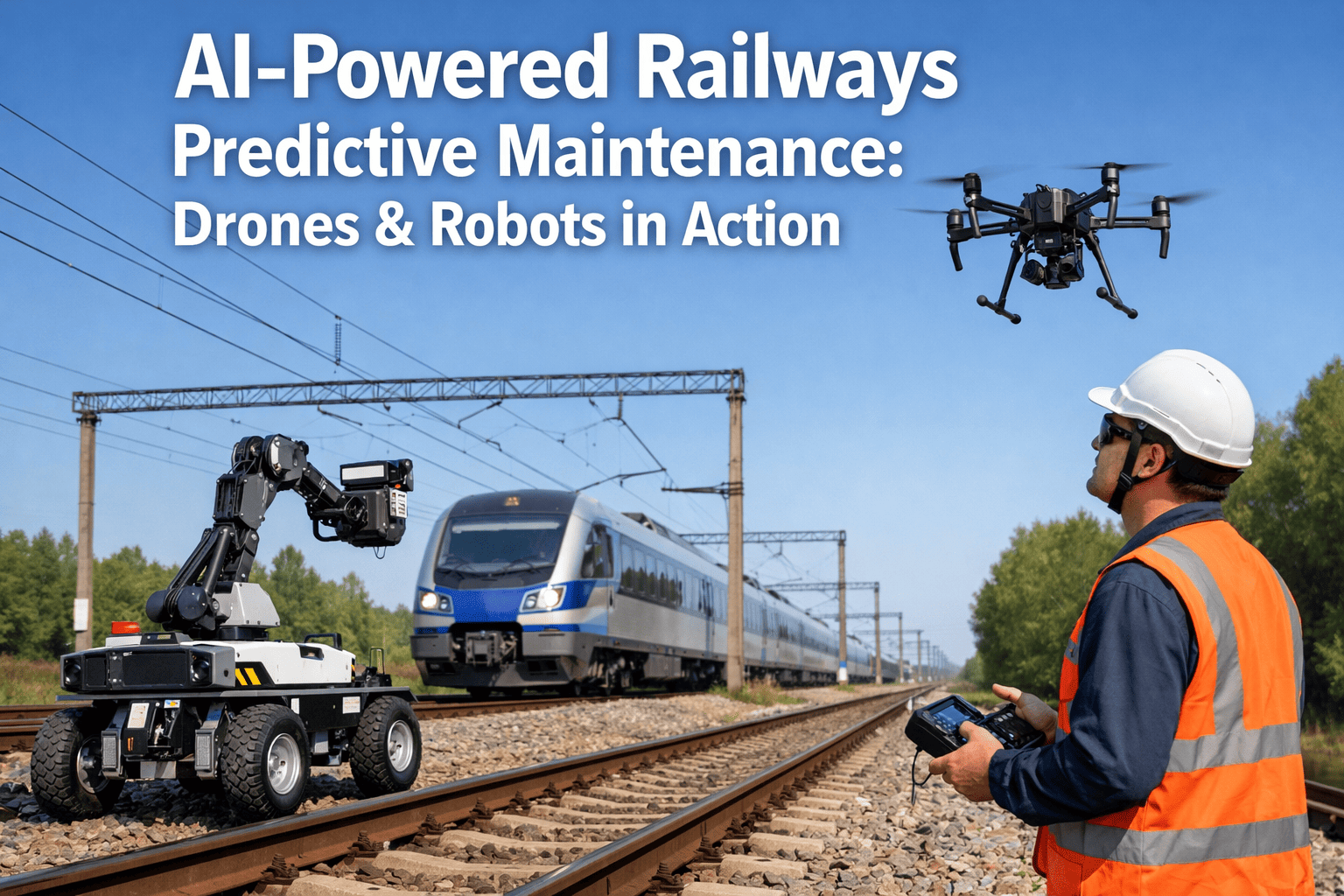
Oxmaint AI for Railways Infrastructure Maintenance
By Taylor on February 20, 2026
In November 2024, a 47-metre steel truss bridge on a Class I freight corridor collapsed during a routine overnight crossing — not from a sudden impact, but from a fatigue crack in a lower chord gusset plate that had been growing for an estimated 18 months. The post-incident investigation revealed the crack had been visible in drone imagery captured nine months earlier, but the 14,000 inspection photos from that survey sat in an unprocessed folder on a regional engineer's hard drive. No AI detection pipeline existed. No digital twin flagged the structural degradation. No CMMS work order was ever generated. The collapse caused $34 million in direct infrastructure damage, $120 million in rerouting costs, and a 96-day line closure that disrupted supply chains across three states. A single integrated pipeline — drone capture, AI defect detection, digital twin risk scoring, and automated CMMS work order generation — would have flagged that gusset plate crack as a Priority-1 defect within 48 hours of the original survey flight. Schedule a demo to see how Oxmaint AI eliminates the gap between inspection data and maintenance action.
Railway Intelligence 2026
Oxmaint AI for Railways Infrastructure Maintenance
70%
of rail infrastructure failures originate from defects detectable months before collapse
80%
faster defect identification with AI vision vs. manual photo review of drone surveys
$4.2B
annual cost of unplanned rail infrastructure failures across North American networks
Railway networks are aging faster than they can be manually inspected. With over 140,000 miles of track, 620,000 bridges and culverts, and millions of components degrading under constant load, the traditional walk-the-line inspection model cannot scale. Drone-captured imagery analysed by AI vision models, fed into living digital twins, and converted into prioritised CMMS work orders represents the only viable path to managing infrastructure at the speed and scale modern rail demands. Operators ready to modernise their inspection-to-action pipeline can begin today. Start Free Trial.
Drone & AI Inspections: See Every Defect, Miss Nothing
Manual bridge and track inspections are slow, dangerous, and inconsistent — limited by human fatigue, access constraints, and the sheer volume of assets requiring assessment. Drone-based inspection workflows paired with AI vision defect detection transform thousands of raw images into actionable defect reports in hours, not weeks, while keeping inspectors safely on the ground.
AI-Powered Drone Inspection Pipeline
From mission planning to automated defect work orders
01
Mission Planning
Define flight routes, waypoints, and camera angles for bridges, tunnels, embankments, and track corridors using GIS overlays
02
Autonomous Capture
Drones execute repeatable survey missions — high-res RGB, thermal, and LiDAR — with GPS-tagged imagery and flight logs
03
AI Vision Analysis
ML models detect cracks, corrosion, spalling, vegetation encroachment, fastener defects, and deformation across all imagery
04
CMMS Work Orders
Confirmed defects auto-generate prioritised work orders with location, severity, photos, and recommended repair actions
The AI inspection pipeline eliminates the bottleneck that kills traditional programmes: the gap between data capture and maintenance action. Where manual review of a single bridge survey might take an inspector 3–5 days, AI processes the same dataset in under 2 hours — with higher detection rates for hairline cracks, section loss, and early-stage corrosion that the human eye routinely misses under field conditions.
Manual vs. AI-Powered: The Inspection Revolution
Traditional rail inspection depends on experienced personnel walking structures in all weather, photographing defects with handheld cameras, and writing narrative reports that may not reach maintenance planners for weeks. AI-powered drone inspection replaces this fragile chain with a repeatable, auditable, and vastly faster pipeline that catches more defects at earlier stages.
Traditional Inspection vs. AI Drone Pipeline
✗
Manual Inspection
3–5 days per bridge survey
Rope access / scaffold required
Inspector fatigue = missed defects
Narrative reports, weeks to deliver
Photos unlinked to asset models
No change-over-time comparison
Track possession required
Slow, Risky & Inconsistent
✓
AI Drone Pipeline
2-hour survey + 2-hour AI analysis
No scaffolding, no rope access
Consistent AI detection, every pixel
Auto-generated defect reports same day
GPS-tagged imagery linked to digital twin
Temporal comparison flags degradation
Minimal to zero track disruption
Fast, Safe & Comprehensive
The safety transformation alone justifies the investment. Rail bridge inspections account for a disproportionate share of inspector injuries — falls, struck-by incidents, and heat-related illness during summer surveys. Drone deployment eliminates direct human exposure to these hazards while producing higher-fidelity data from angles that physical access cannot reach.
AI Inspection Performance Metrics
Documented results from railway AI vision deployments
96%
Defect Detection Rate
Cracks, Corrosion, Spalling
80%
Faster Processing
vs. Manual Photo Review
60%
Cost Reduction
Per Inspection Cycle
Zero
Inspector Exposure
Height & Track Hazards Eliminated
Digital Twin & SHM: A Living Model of Every Asset
Inspection data without context is noise. Digital twin technology transforms raw drone imagery, sensor readings, and maintenance records into a living, queryable 3D model of every bridge, tunnel, viaduct, and track section — overlaid on GIS maps with real-time structural health monitoring (SHM) data, risk scores, and asset criticality rankings that drive maintenance prioritisation.
Digital Twin Intelligence: The Four Pillars
3D Asset Models
Photogrammetry and LiDAR build centimetre-accurate digital twins of bridges, tunnels, and structures — updated with every survey.
GIS Map Overlays
Every asset plotted on geospatial maps with condition layers, inspection history, and corridor-level risk heat maps for network planning.
SHM Sensor Fusion
Strain gauges, accelerometers, and tilt sensors feed live data into the digital twin — correlating load, vibration, and temperature with structural response.
Risk Scoring Engine
AI-driven criticality scores combine defect data, traffic load, environmental exposure, and age to rank every asset by intervention urgency.
The ROI Equation: Reactive vs. Predictive Infrastructure
Reactive rail maintenance — fixing failures after they occur — is catastrophically expensive. Emergency bridge repairs cost 5–8x planned maintenance. Unplanned track closures cascade into $500K+/day in rerouting and delay penalties. The business case for predictive infrastructure management, powered by AI inspection and digital twins, is not marginal — it is transformational.
Cost Impact: Reactive vs. AI-Predictive Maintenance
Based on a 500-mile rail corridor with 120 bridges over 5 years
Reactive Maintenance (Status Quo)
Annual Emergency Repairs$8M - $15M
Unplanned Closures$2M - $6M/yr
Manual Inspection Cost$1.2M - $2M/yr
Regulatory Penalties$500K - $3M risk
5-Year Cost: $60M - $130M+
VS
AI-Predictive Programme
Planned Maintenance$3M - $6M/yr
Closures Avoided85-95% reduction
AI Drone Inspection$400K - $800K/yr
Regulatory ComplianceAudit-ready records
5-Year Net Savings: $25M - $70M+
The financial argument extends beyond direct savings. Regulatory bodies including the FRA are increasingly mandating digital inspection records and risk-based prioritisation. Railways that invest in AI-powered inspection pipelines now position themselves ahead of compliance requirements, avoiding the retrofit costs that follow regulation.
Transform Inspection Data Into Maintenance Action
Stop letting critical defect data die in folders. Oxmaint AI connects drone imagery, AI detection, digital twins, and CMMS work orders into a single pipeline that turns every inspection into a prioritised maintenance plan.
CMMS Integration: From Predictive Insight to Work Order
The most sophisticated AI defect detection is worthless if findings never reach a maintenance crew. Oxmaint's CMMS closes the loop by automatically converting AI-confirmed defects into prioritised work orders — complete with GPS coordinates, severity classifications, defect photographs, recommended repair methods, and deadline assignments based on risk scoring.
Predictive-to-Work-Order Maturity Model
Level 1 — Foundation
Digital Inspection & Asset Registry
Mobile Inspection ChecklistsGPS-Tagged Photo CaptureAsset Hierarchy in CMMSAudit Trail Documentation
Risk-Based Work Order GenerationSHM Sensor Fusion AlertsPredictive Lifecycle ModellingNetwork-Level Capital Planning
Each maturity level builds on the previous. Start by digitising existing inspection workflows and building a complete asset registry in CMMS. Then layer drone survey data and AI defect detection. Finally, integrate SHM sensor feeds and predictive models that generate work orders before failures become emergencies — transforming maintenance from reactive firefighting into planned, budgeted, and optimised operations.
The Railway AI Tech Stack
Effective railway infrastructure intelligence requires tight integration across drone operations, computer vision, structural health monitoring, geospatial systems, and maintenance management. When these data streams converge in a unified platform, every defect is detected, every risk is scored, and every maintenance action is traceable from detection through completion.
AI models classify cracks, corrosion, spalling, deformation, and vegetation encroachment — with severity grading and confidence scores.
Temporal Change Detection
Compare survey-over-survey imagery to quantify degradation rates, predict failure timelines, and prioritise intervention windows.
Network-Level Risk Dashboard
GIS-based risk heat maps show infrastructure condition across the entire network — enabling capital allocation by criticality, not politics.
Build your railway AI inspection pipeline todayGet Started →
The integration of these technologies is what separates isolated point solutions from a true infrastructure intelligence platform. Drone data alone is photographs. AI alone is a model without context. Digital twins alone are visualisations without action. CMMS alone is a work order system without intelligence. Oxmaint connects all four into a closed-loop system where every inspection finding reaches the right crew at the right time. Book a Demo.
Future-Proof Your Railway Infrastructure Programme
From drone capture to work order completion, Oxmaint AI gives railway operators the tools to detect defects earlier, prioritise smarter, and maintain safer — with full audit trails that satisfy regulatory requirements.
What types of railway defects can AI vision models detect from drone imagery?
Current AI models reliably detect surface cracks (hairline to structural), corrosion and section loss, concrete spalling and delamination, bearing pad deterioration, fastener defects (missing or broken clips), rail head wear, ballast fouling, vegetation encroachment, and thermal anomalies indicating subsurface issues. Detection rates exceed 96% for trained defect classes, with false positive rates below 5%. Models continuously improve as training datasets grow with each inspection cycle. Sign up free to explore AI defect detection capabilities.
How does a digital twin improve railway maintenance decision-making?
A digital twin provides spatial context that flat databases cannot. Engineers can navigate a 3D model of a bridge, click on any element, and instantly see its full inspection history, current defects, sensor readings, load rating, and predicted remaining service life. When combined with GIS overlays, digital twins enable corridor-level risk visualisation — showing which assets are deteriorating fastest, which carry the highest traffic loads, and where intervention budgets will have the greatest safety impact. This transforms maintenance from asset-by-asset triage into strategic network management.
How does Oxmaint CMMS convert AI findings into work orders?
When the AI vision model confirms a defect above the configured severity threshold, Oxmaint automatically generates a CMMS work order that includes: GPS coordinates and asset identification, defect classification and severity grade, annotated photographs with defect bounding boxes, recommended repair method and material requirements, priority ranking based on risk score, deadline assignment based on criticality algorithm, and assigned maintenance crew based on skill requirements and proximity. Engineers can review, modify, or approve work orders via mobile app before dispatch. Every action is logged for FRA compliance documentation. Book a demo to see the full pipeline in action.
What drone and sensor hardware integrates with the Oxmaint platform?
Oxmaint is hardware-agnostic and integrates with all major commercial drone platforms (DJI Matrice/Mavic series, Skydio X10, Autel EVO II) and sensor payloads including high-resolution RGB cameras, thermal infrared (FLIR), LiDAR (Livox, Ouster), and multispectral sensors. For structural health monitoring, the platform ingests data from strain gauges, MEMS accelerometers, tilt sensors, and displacement transducers via standard IoT protocols (MQTT, Modbus, REST API). This flexibility ensures operators can use existing equipment investments while building toward a fully integrated inspection pipeline.
How quickly can a railway operator deploy the Oxmaint AI inspection pipeline?
Deployment follows the three-level maturity model. Level 1 (digital inspection and asset registry) can be live within 30-60 days — replacing paper forms with mobile checklists and building the CMMS asset hierarchy. Level 2 (AI drone integration and digital twin) typically requires 90-120 days for model training on operator-specific asset types and initial digital twin construction. Level 3 (predictive operations with SHM sensor fusion) is an ongoing capability build that matures over 6-12 months as sensor networks expand and historical data accumulates. Most operators see measurable ROI from Level 1 within the first quarter of deployment.