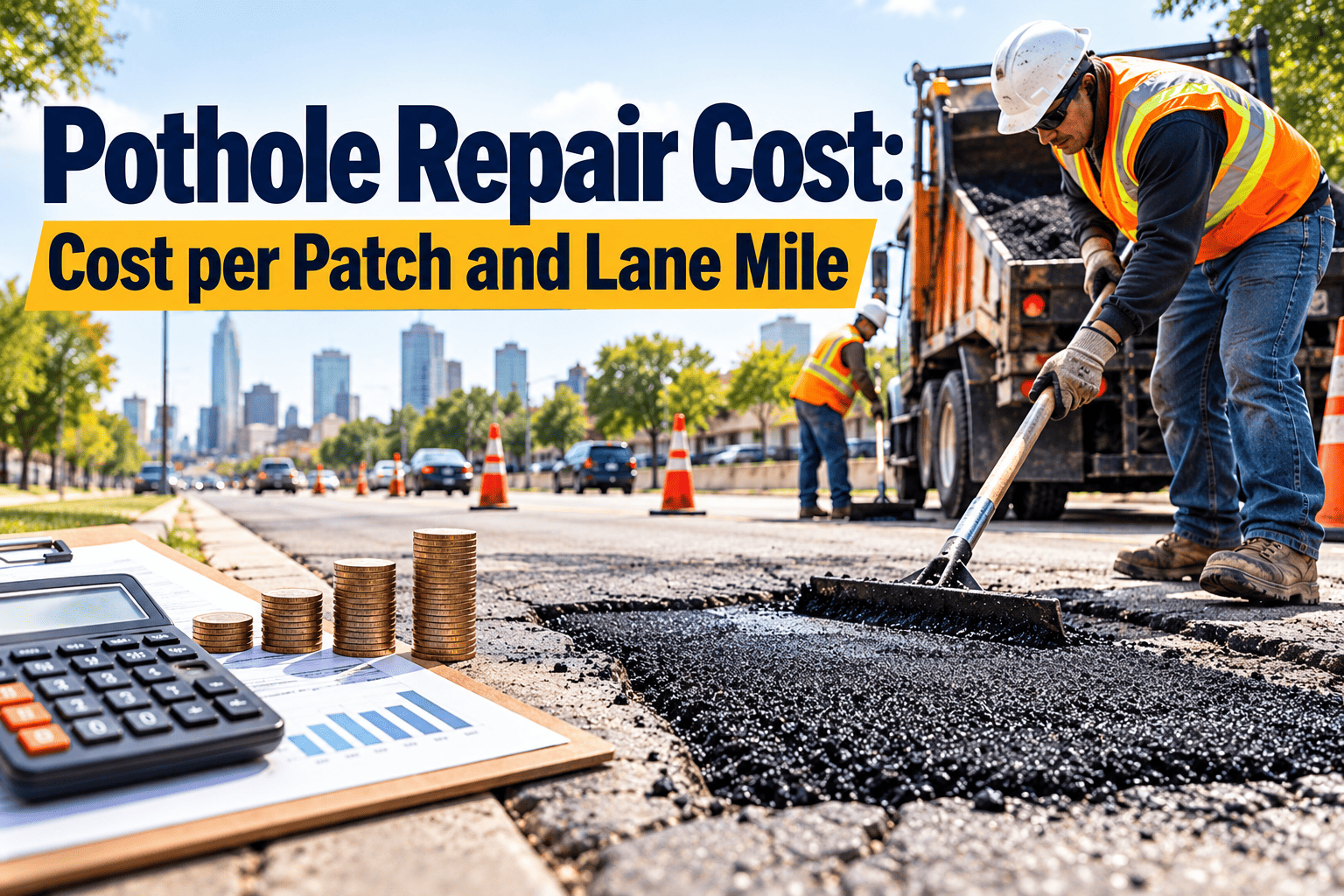
Ask a public works crew what a pothole costs to fix and the honest answer is usually a shrug and a rough per-hole number that leaves most of the real spend invisible. The asphalt in the hole is the cheapest part of the job. What actually drives the cost is the crew time, the equipment, and — on a live roadway — the traffic control that can rival everything else combined. State agencies routinely put the true cost of a single freeway pothole in the range of several hundred dollars once labor, materials, and equipment are all counted. Knowing that full number, per patch and per lane mile, is what separates a defensible road budget from a guess — and it is exactly the kind of cost visibility a work order and asset platform is built to deliver.
Pothole Repair Cost: What a Patch Really Costs, Per Hole and Per Lane Mile
The material in the hole is the smallest line on the invoice. Break the true cost into labor, equipment, and traffic control, benchmark it by method, and you can finally compare crews, defend budgets, and see where the money actually goes.
The Four Components of a True Pothole Cost
Every pothole repair cost decomposes into the same four buckets. The reason agencies underestimate the total is that they track the one they can see on a receipt — material — and absorb the other three into general crew overhead where no one ever ties them back to the hole.
Repair Method Changes the Cost — and the Lifespan
There is no single pothole repair cost because there is no single method. The standard approaches trade speed against durability, and the cheapest patch to place is often the most expensive over time because it fails and has to be redone. Costing has to account for both the placement cost and the patch's life.
| Method | How It Works | Relative Cost | Durability |
|---|---|---|---|
| Cold-patch (throw-and-roll) | Cold mix dropped in and compacted by traffic or a quick roll | Lowest per placement | Short — a temporary fix for harsh conditions |
| Semi-permanent | Clean and square the hole, tack, hot or cold mix, proper compaction | Higher — more labor and equipment | Longer — improves patch performance markedly |
| Spray-injection | Machine blows out debris, sprays tack and aggregate in one pass | Moderate — specialized equipment | Good — minimal crew, fast placement |
| Full-depth patch | Saw-cut, remove to subgrade, rebuild the layers | Highest — most material and time | Longest — a near-permanent repair |
Why the cheap patch is often the expensive one
A throw-and-roll patch placed in February to stop a tire hazard is the right call in the moment, but if it is counted as "done" and never scheduled for a permanent repair, the same hole returns and the crew pays the mobilization and traffic-control cost a second and third time. The per-placement cost was low; the per-fixed-pothole cost was not.
OxMaint logs labor hours, equipment, and materials against each pothole work order and ties repeat repairs to the same location — so your per-patch and per-lane-mile numbers reflect reality, not just the receipt for asphalt.
From Cost Per Patch to Cost Per Lane Mile
Per-patch cost tells you what one hole costs. Per-lane-mile cost — the unit public works budgets and specifications actually use — tells you what a stretch of road costs to keep serviceable. Getting from one to the other requires knowing how many patches a mile demands and what each one truly cost.
The Hidden Costs That Never Reach the Spreadsheet
Even agencies that track the four core buckets usually miss a second tier of cost that patching quietly generates. These are real dollars, and they are the ones that make reactive pothole repair so much more expensive than it looks on paper.
How Work Order Data Makes Pothole Costing Real
Frequently Asked Questions
What does it actually cost an agency to fix one pothole?
Once labor, materials, and equipment are counted, a single roadway pothole commonly lands in the few-hundred-dollar range — traffic control on a busy street pushes it higher. Material alone badly understates it. Start free to capture your true per-patch cost.
Why is traffic control such a big part of the cost?
On a live roadway, patching requires cones, flaggers, or lane closures to keep crews safe, which can rival or exceed the labor and material combined. It's the line most per-hole estimates leave out. Book a demo to see it tracked per job.
How do I calculate cost per lane mile instead of per patch?
Multiply the true cost per patch by the pothole density per mile, then add mobilization and rework for patches that failed. The result is the budget-ready unit for comparing segments. Start a trial to roll your data up automatically.
Is cold-patch cheaper than a permanent repair?
Per placement, yes — but if the patch fails and the hole is repaired again, the per-fixed-pothole cost can exceed a durable repair done once. Durability has to be part of the costing, not just placement price.
Can OxMaint show which roads cost the most to maintain?
Yes. Patch costs tie to segments and roll up into cost-per-lane-mile reporting, so the segments quietly draining the budget surface for capital consideration. Book a demo to see segment-level cost reporting.
OxMaint captures labor, equipment, materials, and repeat repairs against every pothole work order and rolls them up into cost-per-lane-mile reporting — the visibility that turns a guessed road budget into a defensible one. Talk to our public works team about your cost data.