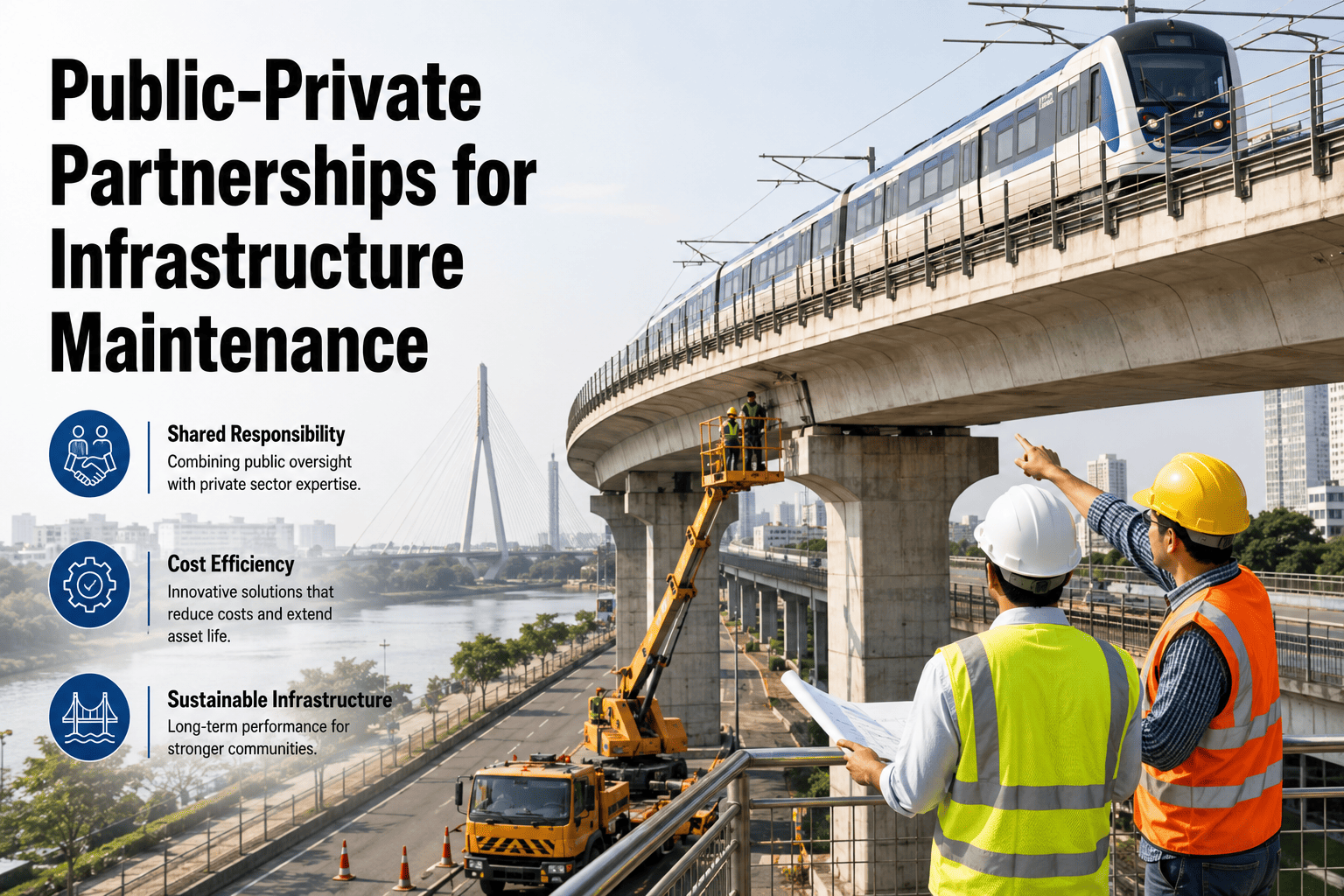
Public-private partnerships for infrastructure maintenance have emerged as one of the most effective ways to fund, operate, and sustain critical public assets when traditional budgets fall short. A P3 infrastructure maintenance agreement transfers specific risks—design, construction, major rehabilitation, and long-term upkeep—to a private consortium in exchange for performance-based payments over a contract term of 20 to 40 years. Getting the risk allocation right, structuring availability payments correctly, and maintaining audit-ready compliance data are the factors that determine whether a municipal P3 or a government P3 actually delivers value for money. To see how a modern CMMS supports this data-intensive contract model, you can Start Free Trial of OxMaint and explore the asset-tracking and reporting tools firsthand.
Is a public-private partnership the right structure for your infrastructure assets?
P3s can fund maintenance that budgets alone can't — but the whole game is risk allocation, availability payments, and performance reporting that holds up for 30+ years. OxMaint gives public agencies and private operators the audit-ready asset data both sides need.
P3 Structure Options for Infrastructure Maintenance
A public private partnership government agreement is not a single contract type — it is a spectrum of structures that transfer varying degrees of risk and responsibility to the private sector. Choosing the right structure determines lifecycle cost, service quality, and whether the public agency retains operational control.
| P3 Structure | Maintenance Scope | Risk Transfer | Payment Mechanism | Typical Term |
|---|---|---|---|---|
| DBFOM (Design-Build-Finance-Operate-Maintain) | Full lifecycle maintenance | High — private partner bears demand, availability, and lifecycle risk | Availability payments or toll revenue | 30–40 years |
| DBOM (Design-Build-Operate-Maintain) | Operations + maintenance | Medium — private partner maintains to performance specs | Fixed periodic payments | 20–30 years |
| OMM (Operate-Maintain-Manage) | Operations, maintenance, facility management | Low–Medium — public retains asset ownership and capital risk | Performance-based fee | 10–20 years |
| Concession / Lease | Full operations and maintenance | High — private partner assumes revenue and lifecycle risk | User fees / tolls | 30–50 years |
| Availability Contract | Specified maintenance to defined standards | Medium — deductions for non-compliance | Availability payments subject to KPIs | 15–30 years |
Worked example: A mid-sized transit authority funds a $420M light-rail extension via a 35-year DBFOM P3. The private consortium handles all track, signal, and station maintenance against an availability payment of $18.6M/year — but faces deductions up to $2.1M/year if on-time performance drops below 94%. Without a CMMS that tracks every work order, inspection, and asset condition score in real time, neither side can prove compliance. That is exactly the gap OxMaint fills.
P3 Risk Allocation: Who Bears What Over 30+ Years
The core economic rationale for a public private infrastructure partnership is that the private sector can manage certain risks more efficiently than the public sector. But risk transfer is not binary — it is a negotiated allocation across 8 risk categories that must be tracked, priced, and managed throughout the contract life.
Lifecycle & Maintenance Risk
Private partner bears cost of upkeep, major rehabilitation, and asset renewal to maintain performance standards — incentivizing build quality and proactive maintenance.
Availability & Performance
If the asset is not available to the defined service level — lane closures, signal failures, elevator outages — the private partner's payment is deducted automatically.
Demand / Revenue Risk
In concession structures, the private partner bears ridership or toll volume risk. In availability-payment P3s, the public agency retains demand risk — a critical distinction.
Regulatory & Permitting
Changes in law during the contract term are typically borne by the public agency; routine compliance and permitting is the private partner's responsibility.
Force Majeure
Uninsurable events — extreme weather, terrorism, pandemics — remain with the public sector, with contract relief mechanisms and cost-sharing protocols.
Site & Environmental
Pre-existing contamination and unknown site conditions discovered after financial close typically remain a public risk unless specifically transferred.
The private partner's revenue is directly tied to the asset being open, operational, and meeting service KPIs. OxMaint captures the real-time maintenance data that calculates and disputes these deductions.
How to Evaluate Whether P3 Is the Right Structure for Your Asset
Not every infrastructure asset benefits from a public private partnership public works structure. Agencies must conduct a rigorous Value for Money (VfM) analysis comparing the P3 delivery model against traditional public procurement across quantitative and qualitative factors. The evaluation typically follows a 6-step framework aligned with ISO 55000 asset management principles.
Business Case & Asset Baseline
Document current asset condition, remaining useful life, deferred maintenance backlog, and lifecycle cost projections. OxMaint's asset registry and condition-score analytics produce this baseline in days, not months.
Public Sector Comparator (PSC)
Calculate the risk-adjusted whole-of-life cost of delivering the project through traditional public procurement, including retained risks priced at market rates.
Risk Valuation & Transfer Pricing
Quantify the value of risks transferred to the private sector — lifecycle, availability, demand — and compare against the premium the private partner charges for accepting them.
Value for Money (VfM) Comparison
Compare the risk-adjusted PSC against the P3 bid price. A P3 is justified only when the transferred risk value plus efficiency gains exceed the private financing premium — typically 1.5–3% over public borrowing.
Affordability & Fiscal Impact
Assess whether the multi-decade payment obligations fit within the agency's capital and operating budget envelope without crowding out other essential services.
Performance Specification Design
Draft output-based performance specifications — measurable, auditable, enforceable — that the private partner must meet. Vague specs are the #1 cause of P3 disputes. OxMaint's KPI and inspection templates make these specs operational.
See OxMaint on your P3 assets — book a 30-minute demo
Whether you represent the public agency or the private consortium, OxMaint's CMMS and EAM platform tracks every work order, inspection, and KPI deduction across a 30-year contract. Book a demo and we'll show you the exact dashboards your contract requires.
How OxMaint Helps Agencies and Operators Manage P3 Maintenance
A P3 maintenance infrastructure contract runs on data — every work order, every inspection, every spare part, every downtime minute is tied to a payment, a deduction, or a compliance obligation. OxMaint is the AI-powered CMMS and EAM platform that makes this data operational, auditable, and available to both parties in real time.
Availability-Payment KPI Tracking
Define service-level KPIs in OxMaint — uptime %, response times, inspection compliance — and the platform automatically calculates deductions against your contract formula. Both parties see the same live dashboard. Outcome: eliminate payment disputes with shared, timestamped data.
Lifecycle Asset Management
OxMaint's asset registry tracks condition scores, remaining useful life, and rehabilitation schedules for every component — from pumps to bridges to signal systems — aligned with ISO 55000. Outcome: cut unplanned downtime 30–50% with predictive maintenance driven by AI failure models.
Audit-Ready Compliance Reporting
Every work order, inspection record, and spare-parts transaction is logged immutably with timestamps, technician IDs, and photo evidence. Generate FMCSA, FTA, or agency-specific compliance reports in one click. Outcome: pass any audit without scrambling — documentation is always current.
Multi-Party Dashboards & Shared Visibility
Role-based access lets the public agency monitor contractor performance while the private operator manages execution — all on one platform. Configurable views show exactly what each party is entitled to see. Outcome: replace 15 spreadsheets and weekly status meetings with a single source of truth.
Public-Private Partnership Infrastructure Maintenance: FAQs
What is a public-private partnership for infrastructure maintenance?
A public-private partnership (P3) for infrastructure maintenance is a long-term contractual arrangement in which a government agency partners with a private consortium to design, build, finance, operate, and maintain a public asset — such as a highway, bridge, water treatment plant, or transit system — over a 20- to 40-year term. The private partner is compensated through availability payments or user fees and is contractually responsible for maintaining the asset to defined performance standards, bearing lifecycle and maintenance risk.
How are P3 maintenance contractors paid?
Most P3 infrastructure maintenance contracts use availability payments — fixed periodic payments subject to deductions if the asset is unavailable or fails to meet performance KPIs. For example, if a highway lane is closed for unscheduled maintenance beyond an allowed threshold, the payment is reduced. Concession-based P3s pay the private partner through user fees (tolls, fares). In both models, the private partner's revenue depends on maintaining the asset to contract standards, which is why real-time CMMS data from a platform like OxMaint is essential for calculating and verifying payments.
When does a P3 make sense for infrastructure maintenance?
A P3 makes sense when the asset has a long design life (30+ years), well-defined and measurable performance standards, significant lifecycle maintenance risk that the private sector can manage more efficiently, and when the public agency lacks the capital or in-house expertise for long-term asset management. P3s are most commonly used for highways, bridges, transit systems, water and wastewater facilities, social infrastructure (hospitals, schools), and government buildings where whole-of-life cost optimization creates genuine value for money.
What are the main risks in a P3 infrastructure maintenance contract?
The main risks are lifecycle/maintenance risk (cost of keeping the asset operational), availability/performance risk (payment deductions for non-compliance), demand/revenue risk (in concession structures), regulatory and political risk (changes in law or government), financing risk (interest rate exposure), and force majeure. Successful P3s allocate each risk to the party best able to manage it — typically the private sector bears lifecycle and availability risk while the public sector retains force majeure and demand risk in availability-payment structures.
What is the difference between a P3 and traditional public procurement?
In traditional public procurement, the government designs, builds, and maintains the asset using public funds and in-house or separately contracted maintenance — bearing all lifecycle, cost, and performance risk. In a P3, a single private consortium takes responsibility for design, construction, financing, operations, and maintenance over the full contract term, with payment tied to performance. The private partner's profit depends on efficient lifecycle management, which incentivizes better build quality and proactive maintenance — but the public agency pays a financing premium for this risk transfer.
Make your P3 maintenance data audit-ready in weeks, not years
Whether you're evaluating a P3 structure, preparing for financial close, or managing a 30-year contract, OxMaint gives you the CMMS and EAM platform that both sides trust. Start your free trial or book a 30-minute demo and we'll show you the dashboards your contract demands.
Free 14-day trial · No credit card