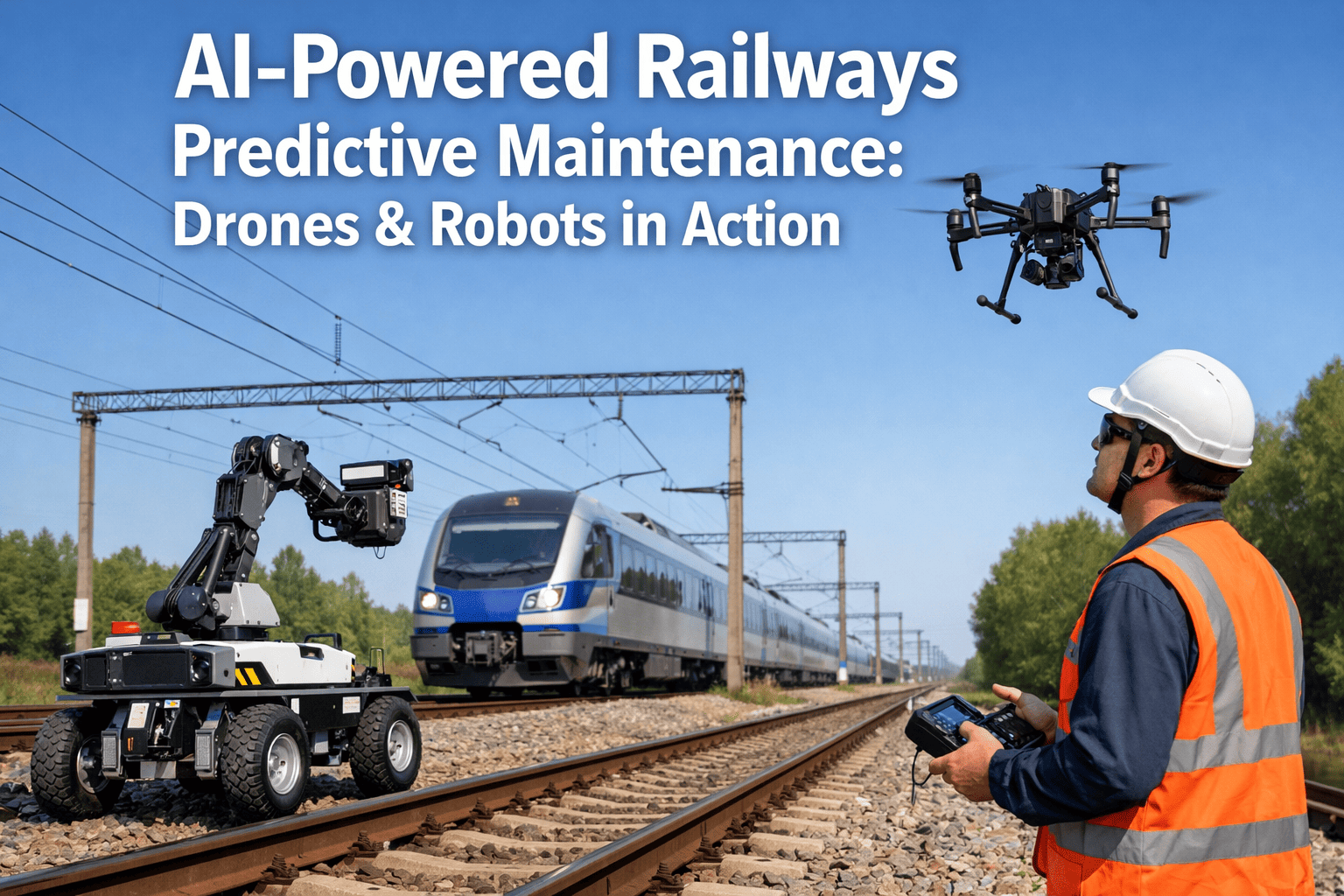
When a commuter rail agency discovered a fractured rail joint on a mainline corridor—during the morning rush, with a loaded passenger train 90 seconds away—the emergency brake application and subsequent service disruption cost the agency $2.3 million in direct costs, litigation reserves, and ridership loss. The post-incident investigation revealed that an ultrasonic flaw had been growing at that joint for seven months. Three separate manual inspections hadpassed over it because the inspector was covering 140 miles of track with a hand-held detector and a clipboard. The data existed to predict this failure—rail stress telemetry, drone imagery showing ballast degradation at that precise location, and historical defect patterns in the asset management system—but none of these streams were connected. This is not an edge case; it is the systemic consequence of maintaining 21st-century rail infrastructure with 20th-century methods.
A Railways Predictive Maintenance Platform unifies AI analytics, autonomous drone inspection, ground-based robots, and embedded IoT sensors into a single intelligence layer that detects failures weeks before they occur. Instead of scheduling inspections by calendar, the platform schedules them by risk. Instead of sending crews to walk every mile of track, it sends them precisely where the data says a defect is forming. Oxmaint CMMS sits at the center of this architecture, converting AI predictions and robotic inspection findings into prioritized, geo-tagged work orders that maintenance crews execute with full context. Talk to our team about building a predictive maintenance platform that prevents service disruptions instead of just responding to them.
Reduction in unplanned service disruptions
Faster track inspection vs manual walking patrols
Average annual savings for mid-sized rail operators
Why Predictive Maintenance Is a Safety Imperative
Railways are among the most safety-critical infrastructure systems in public service. A single undetected rail defect, a degraded signal relay, or a failing bridge bearing can result in derailment, service collapse, and loss of life. Traditional time-based maintenance—inspecting every asset on a fixed calendar regardless of condition—wastes resources on healthy assets while missing deterioration on stressed ones. Predictive maintenance flips this model by using real-time data from sensors, drones, and robots to direct maintenance exactly where and when it's needed, before failure occurs.
Oxmaint AI EnginePredict · Prioritize · Dispatch
Track Inspection Drones
LiDAR, Thermal, Visual AI
Rail-Mounted Robots
Ultrasonic, Eddy Current, Gauge
Embedded IoT Sensors
Strain, Vibration, Temperature
Signal & Switch Monitors
Current, Position, Response Time
Bridge & Structure Sensors
Tilt, Displacement, Corrosion
CMMS Work Orders
Auto-Priority, Geo-Tagged, Crew Dispatch
The platform architecture connects three data streams—autonomous drones scanning overhead catenary and bridge structures, rail-mounted robots detecting subsurface track defects, and embedded IoT sensors streaming continuous structural health data—into a unified AI engine. This engine correlates patterns across data sources, predicts remaining useful life for each asset, and auto-generates prioritized work orders in Oxmaint CMMS. The result is a maintenance program driven by asset condition instead of calendar dates. Book a demo to see the platform in action.
Platform Maturity: From Reactive to Predictive
Most rail agencies operate somewhere between reactive and planned maintenance. The predictive maintenance platform represents a quantum leap in capability—moving from "fix what's broken" to "prevent what's breaking." The maturity matrix below helps agencies assess their current state and chart a path to full predictive operations.
HIGHData IntegrationLOW
PREDICTIVE (AI-DRIVEN)
Multi-sensor fusion analyticsAI failure prediction modelsAuto-generated CMMS work ordersDigital twin asset modeling
Failures prevented before symptoms appear
CONDITION-BASED
IoT sensors on critical assetsThreshold-based alertsDrone inspection programsCentralized data dashboards
Maintenance triggered by measured condition
PLANNED / PREVENTIVE
Calendar-based PM schedulesManual inspection patrolsPaper-based reportingBasic CMMS tracking
Fixed intervals regardless of asset condition
REACTIVE (BREAK-FIX)
No scheduled inspectionsEmergency repairs onlySpreadsheet/paper logsNo data analysis
Failures cause service disruptions
LOWAutomation LevelHIGH
Implementation Roadmap: From Pilot to Full Deployment
Deploying a predictive maintenance platform is not a single purchase—it's a phased transformation. Agencies that succeed start with a focused pilot on their highest-risk corridor, prove ROI with real data, and then scale systematically. Rushing to full deployment without proven processes leads to expensive technology sitting unused. The following roadmap reflects best practices from successful rail implementations.
Months 1-2
Asset registry audit
Risk corridor identification
Baseline condition assessment
Discovery Phase
Months 3-4
IoT sensor installation
Drone flight planning
CMMS configuration
Pilot Setup
Months 5-8
Pilot corridor operations
AI model training
Crew workflow validation
ROI data collection
Pilot Execution
Months 9-12
ROI validation report
Expand to additional corridors
Robot fleet deployment
Advanced analytics rollout
Scale Phase
Year 2+
Network-wide coverage
Digital twin integration
Continuous model refinement
Capital planning integration
Optimization
Start With a Pilot, Scale With Confidence
Oxmaint helps rail agencies deploy predictive maintenance in phases—starting with your highest-risk corridor and expanding as AI models prove their value. See how our platform connects drones, robots, and sensors to maintenance workflows.
Platform Performance Dashboard
Measuring the impact of a predictive maintenance platform requires tracking both leading indicators (inspection coverage, defect detection rate) and lagging indicators (service disruptions avoided, cost savings achieved). The following KPIs represent the metrics that matter most to rail agency leadership and funding bodies. Schedule a demo to see live dashboards.
AI-detected defects confirmed by field verification
Predicted failures corrected before service impact
Track miles inspected by drone/robot this quarter
Average time from work order to repair completion
Reduction in track possession hours for inspections
Net savings vs. traditional inspection + reactive repair
Expert Perspective: The Operational Case for AI
"
For two decades I watched our inspectors walk track with ultrasonic detectors, covering 8 miles on a good day and logging findings on paper that took another week to enter into a system. We were always behind. When we deployed our first rail-mounted inspection robot, it covered 60 miles in a single shift with higher defect detection accuracy than our best human inspector. But the real transformation came when we connected that robot's output to an AI engine and a CMMS. Suddenly, we weren't just finding defects—we were predicting them. A rail stress pattern that would have become a fracture in six weeks was flagged, prioritized, and repaired in three days. That's the difference between a predictive platform and a collection of gadgets. The technology only matters when it connects to a maintenance action.
— Chief Engineer, Regional Transit Authority, 20 years rail maintenance experience
60 mi
Inspected per shift by rail robot vs 8 mi manual
6 wks
Advance warning before predicted rail fracture
3 days
From AI prediction to completed repair
The convergence of AI, drones, robots, and IoT sensors represents the most significant transformation in rail maintenance since the shift from steam to diesel. Agencies that adopt predictive maintenance platforms today will operate safer, more reliable, and more cost-effective rail networks for decades to come. Those that wait will continue to chase failures, absorb disruption costs, and expose passengers to preventable risk. Start your free trial and begin the transition from reactive to predictive.
Build a Safer, Smarter Railway
Oxmaint connects drones, robots, IoT sensors, and AI analytics into a single predictive maintenance platform. Auto-generate prioritized work orders, track asset health in real time, and prevent the failures that cause service disruptions and safety incidents.
Frequently Asked Questions
How do rail-mounted inspection robots work?
Rail-mounted inspection robots are autonomous or semi-autonomous platforms that travel on the track itself, equipped with ultrasonic probes for subsurface defect detection, eddy current sensors for surface crack identification, track geometry measurement systems, and high-resolution cameras. They can inspect 40-80 miles of track per shift at speeds up to 25 mph—compared to 5-10 miles for a walking inspector. Data is uploaded in real time to the AI platform, where defects are auto-classified, severity-graded, and converted into CMMS work orders with precise GPS coordinates.
What role do drones play in railway predictive maintenance?
Drones handle inspection tasks that are dangerous, time-consuming, or impossible for ground crews: overhead catenary wire assessment, bridge and viaduct structural inspection, vegetation encroachment mapping, and post-storm damage assessment. Equipped with LiDAR, thermal, and high-resolution cameras, drones capture data without requiring track possessions—keeping revenue service running while inspections occur. AI processes the imagery to detect catenary sag, insulator damage, bridge corrosion, and ballast fouling automatically.
How does the AI predict failures before they happen?
The AI engine ingests data from multiple sources—rail stress sensors, inspection robot findings, drone imagery, weather data, traffic loading patterns, and historical maintenance records. Machine learning models identify degradation patterns and correlate them with known failure modes. For example, the AI learns that a specific combination of rail temperature, tonnage accumulation, and ultrasonic reflection pattern at a joint typically precedes a fracture within 4-8 weeks. It then flags that joint for preventive maintenance before any human inspector would notice the defect. Prediction accuracy improves continuously as the model trains on more data from your specific network.
What does Oxmaint CMMS do in this platform?
Oxmaint CMMS is the action layer of the predictive maintenance platform. When the AI engine identifies a predicted failure or a robot/drone detects a defect, Oxmaint auto-generates a prioritized work order with: defect type and severity grade, GPS coordinates and track segment ID, predicted failure window, recommended repair method, required parts and tools, and before/after photo documentation. Maintenance supervisors see these work orders in a prioritized queue, assign crews, and track completion. The system also manages the maintenance of the drones and robots themselves—tracking flight hours, sensor calibrations, and battery health.
What is the ROI timeline for implementing this platform?
Most rail agencies see measurable ROI within the first pilot phase (5-8 months). The primary savings come from: eliminated track possessions for manual inspections (40-60% reduction), prevented emergency repairs that cost 5-10x more than planned maintenance, avoided service disruption costs ($50K-$500K per incident), reduced liability from prevented safety incidents, and extended asset life through optimized maintenance timing. For a mid-sized rail operator, total annual savings typically range from $2M-$5M against a platform investment of $300K-$600K, yielding a 5-15x return.
Book a demo to model ROI for your specific network.