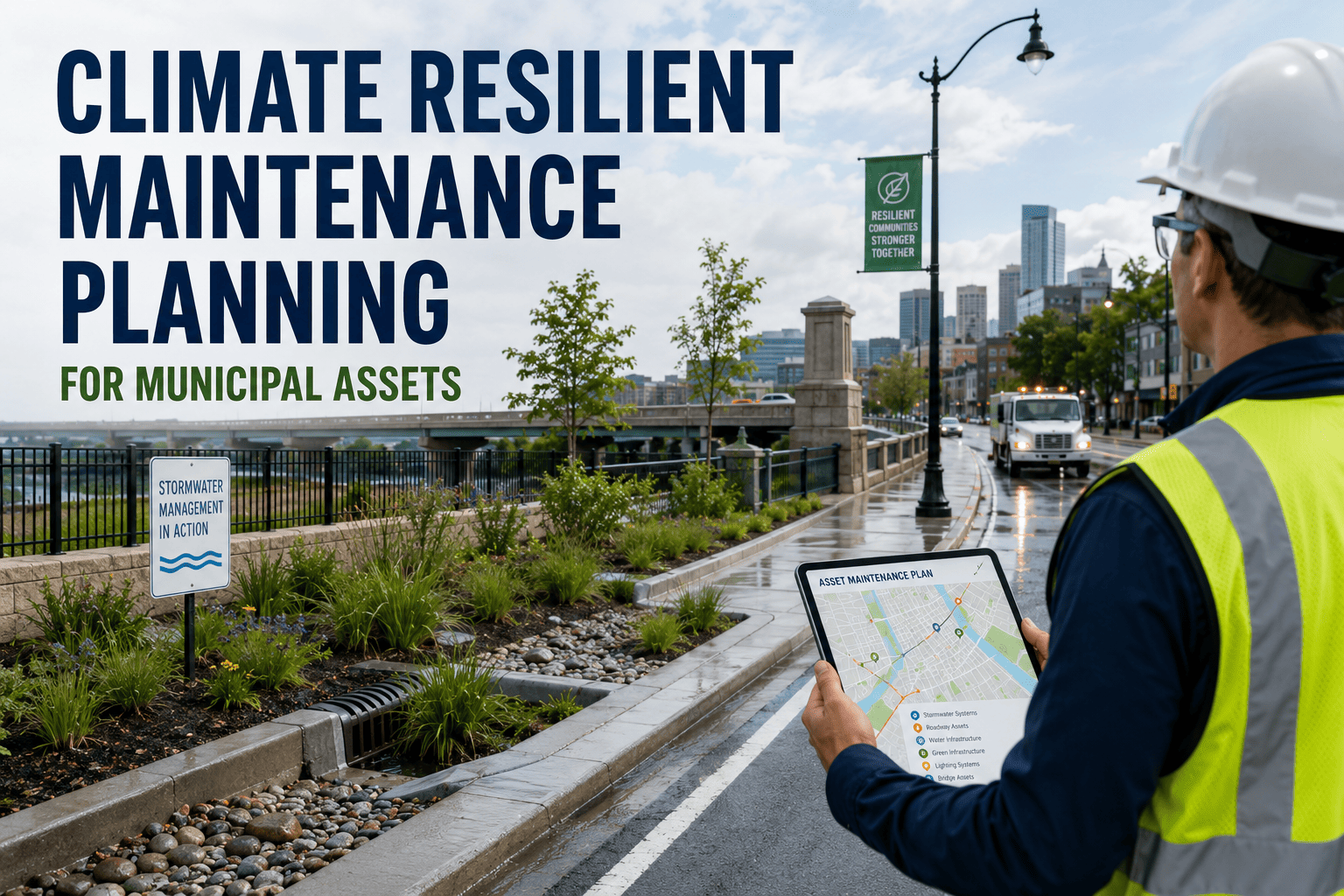
Infrastructure resilience and climate adaptation are now central pillars of public works planning, as heat waves, inland flooding, drought, and intensified storms overwhelm assets designed for a calmer 20th-century climate. Building climate resilient infrastructure means systematically assessing vulnerability, prioritizing capital improvements, and operationalizing maintenance so adaptation moves from policy aspiration to documented, funded action on the ground. Municipalities that embed climate adaptation infrastructure into their daily maintenance workflows reduce emergency repair costs, extend asset life, and protect public safety. You can Start Free Trial to see how OxMaint turns resilience planning into executed work orders, or book a demo to map your asset registry to a climate vulnerability framework.
Climate Adaptation Infrastructure
Is your public infrastructure built to survive the climate of 2035 — or the climate of 1985?
Extreme weather events now cost governments an estimated $50B annually in damaged infrastructure and emergency repairs. Transitioning from reactive storm recovery to proactive climate resilience public works requires a hardened asset registry, predictive maintenance triggers, and documented adaptation plans.
Vulnerability Assessment Framework
How to assess public infrastructure resilience and climate vulnerability
A robust infrastructure climate adaptation strategy begins with a data-driven vulnerability assessment. Over 60% of municipalities still rely on static spreadsheets to track critical assets, leaving them blind to climate exposure until failure occurs. Building municipal climate resilience requires mapping every asset against four primary climate stressors.
Extreme Heat
Roadway buckling, power transformer failures, and HVAC overload. Pavement above 50°C degrades 40% faster. Track thermal exposure limits on critical electrical and transit assets.
Inland & Coastal Flooding
Stormwater system exceedance and submerged pump stations. A 100-year flood event now occurs every 20 years in many regions. Monitor lift station elevation and impervious surface runoff.
Drought & Soil Movement
Expansive clay soils shift water mains, causing joint failures. Drought conditions accelerate buried asset degradation by 25%. Log soil moisture data against break frequency.
High Wind & Storm Intensity
Roof damage, fallen transmission lines, and debris impact. Wind loads exceeding ASCE 7 design baselines compromise 15% of older public facilities. Track structural condition scores.
Adaptation Planning Timeline
From vulnerability mapping to funded resilience: a 6-month roadmap
Government infrastructure resilience cannot be achieved overnight. This phased timeline shows how a mid-sized municipality (approx. 180 critical assets across water, transit, and facilities) moves from ad-hoc reactive repairs to a fully documented, CMMS-driven climate adaptation public works program.
Centralize Asset Registry
Consolidate fragmented spreadsheets into a single digital EAM database. Capture install date, materials, design specs, and GPS coordinates. Baseline ISO 55000 asset hierarchy.
Climate Stressor Overlay
Map FEMA flood zones, heat island data, and wind risk models against the asset registry. Tag each asset with a vulnerability score from 1 to 5 based on exposure and criticality.
Risk-Based Capital Prioritization
Calculate a Risk Priority Number (RPN) for every asset. Shift 30% of reactive maintenance budget to preventive and predictive tasks targeting the top 20% highest-risk assets.
Automate Resilience Work Orders
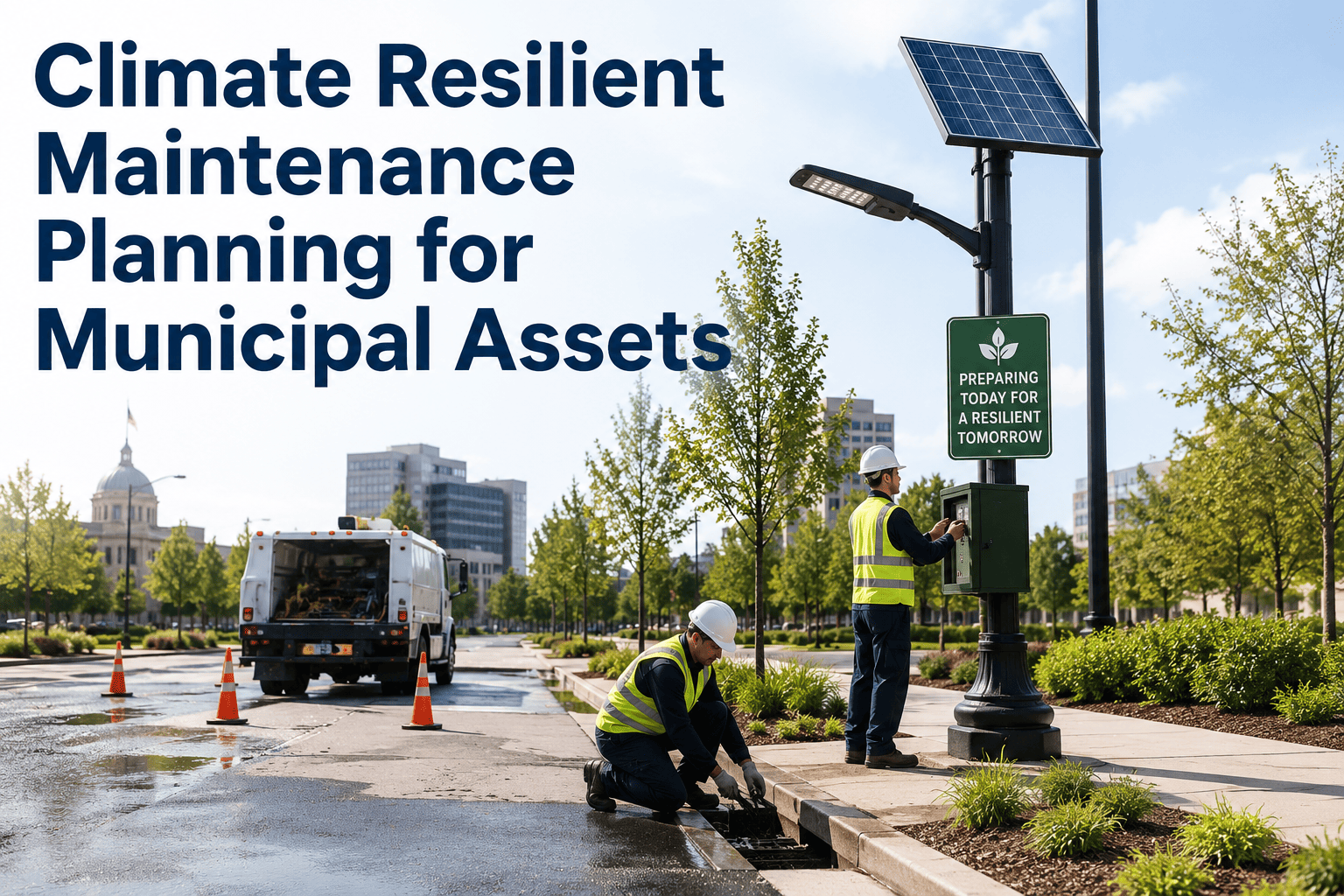
Configure seasonal PM triggers: inspect stormwater grates before monsoon season, test backup generators before winter storms. Eliminate paper work orders and manual scheduling errors.
Spare Parts Hardening
Strategically stock critical spares (submersible pumps, breakers, pipe sleeves) based on lead times and failure probability. Target a 95% fill rate for climate-critical inventory.
Document Adaptation Outcomes
Generate compliance reports demonstrating reduced downtime, improved OEE, and deferred capital expenditures. Use this data to secure federal infrastructure resilience funding grants.
Cost of Inaction
The ROI of proactive climate resilient infrastructure
Reactive maintenance on climate-damaged assets costs 3 to 5 times more than planned preventive maintenance. When public works departments wait for failure, they pay emergency contractor premiums, face compliance penalties, and accelerate total asset replacement. Calculate the financial impact of delayed adaptation.
Vulnerability Risk Formula
Score each variable 1–5. An RPN above 60 dictates immediate inclusion in the climate adaptation capital plan and automated CMMS condition monitoring.
Deferred Maintenance Multiplier
Hardening a pump station against flooding costs $5,000. Replacing a flooded, shorted pump motor during a storm event costs $22,000 plus 48 hours of system downtime.
| Maintenance Strategy | Avg. Cost per Asset / Year | Unplanned Downtime | Asset Life Span |
|---|---|---|---|
| Reactive (Wait for climate failure) | $4,200 | 14% | 12 years |
| Preventive (Time-based PM) | $1,800 | 6% | 18 years |
| Predictive + Resilience (CMMS-driven) | $1,150 | 2% | 23+ years |
"A 180-asset municipal water system spending $42K annually on storm-related emergency repairs reduced those costs to $11K within 18 months by overlaying flood data on their asset registry and automating pre-storm inspections via CMMS."
— Worked scenario: Mid-size municipal public works department
OxMaint CMMS + EAM Platform
How OxMaint operationalizes infrastructure climate adaptation
Climate adaptation public works plans fail when they remain trapped in static PDF reports. OxMaint bridges the gap between climate resilience planning and daily maintenance execution, ensuring every vulnerability assessment triggers a tracked, measurable work order. Transition from spreadsheets to a proactive EAM in days, not months.
AI-Driven Predictive Maintenance
Move beyond time-based PMs. OxMaint analyzes vibration, thermal, and run-time data to predict asset failure before extreme weather hits, reducing unplanned downtime by 30–50%.
Geospatial Asset Tracking
Visualize critical infrastructure on dynamic maps. Overlay FEMA flood zones and heat island data directly onto your asset registry to instantly identify high-risk public works assets.
Resilience Capital Prioritization
Generate automated Risk Priority Numbers for every asset. Defend your capital improvement budget to city councils with data-backed reports proving climate adaptation ROI.
Hardened Spare Parts Inventory
Pre-position critical spares based on predictive failure models. Ensure a 95% fill rate for climate-essential parts like submersible pumps and backup generators during storm events.
See OxMaint on Your Assets
Stop reacting to climate damage. Start engineering resilience.
Book a 30-minute demo to see how OxMaint maps your infrastructure to climate risk, automates preventive work orders, and documents adaptation outcomes for federal funding compliance.
Frequently Asked Questions
Public infrastructure resilience & climate adaptation
What is infrastructure resilience in the context of climate change?
Infrastructure resilience is the ability of public assets—such as water systems, roads, and power grids—to withstand, absorb, and rapidly recover from extreme weather events intensified by climate change. It involves designing new assets for future climate projections and hardening existing assets through proactive, predictive maintenance rather than waiting for failure. You can Start Free Trial to immediately assess your asset resilience baseline.
How does a CMMS support climate adaptation public works?
A CMMS operationalizes climate adaptation by centralizing the asset registry, overlaying climate risk data, and automatically triggering preventive work orders based on weather patterns or seasonal risk. Instead of keeping adaptation plans in static documents, a platform like OxMaint ensures resilience tasks are executed, tracked, and documented for compliance audits and federal grant reporting.
How do we prioritize infrastructure resilience projects with a limited budget?
Prioritization should be driven by a Risk Priority Number (RPN) that multiplies climate exposure, asset criticality, and failure probability. By scoring assets on a 1–5 scale, public works directors can rank projects objectively, shifting funds from low-risk reactive repairs to high-risk resilience upgrades. This data-backed approach is essential for securing municipal and federal infrastructure funding.
What is the ROI of climate resilient infrastructure for municipalities?
The ROI is measured in emergency repair savings, reduced unplanned downtime, and extended asset life. Reactive maintenance on climate-damaged assets costs 3 to 5 times more than planned resilience upgrades. A robust CMMS can cut unplanned downtime by 30–50% and extend asset life by 5 to 10 years, yielding a typical payback period of under 12 months for most public works departments.
How long does it take to implement a climate resilience maintenance program?
With a cloud-based EAM like OxMaint, a mid-sized municipality can centralize its asset registry and overlay climate vulnerability data within 30 to 60 days. Full implementation of automated resilience work orders and spare parts hardening typically takes 3 to 6 months, allowing agencies to secure grant funding and document measurable adaptation outcomes within a single fiscal year.
Build Climate-Proof Public Works
Ready to transform your climate adaptation strategy into action?
Join the municipalities using OxMaint to cut emergency repair costs, extend asset life, and document infrastructure resilience for federal compliance.
Free 14-day trial · No credit card