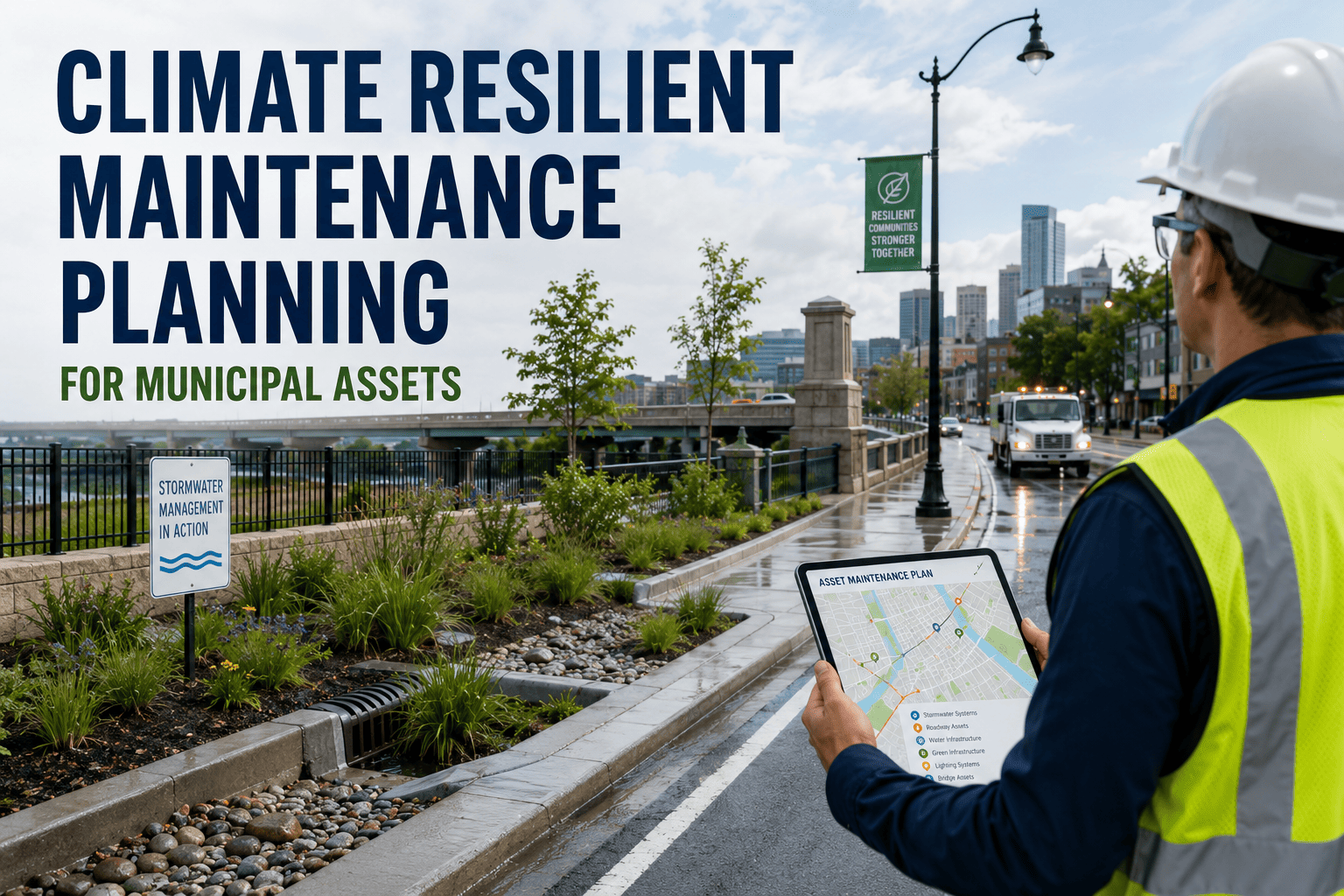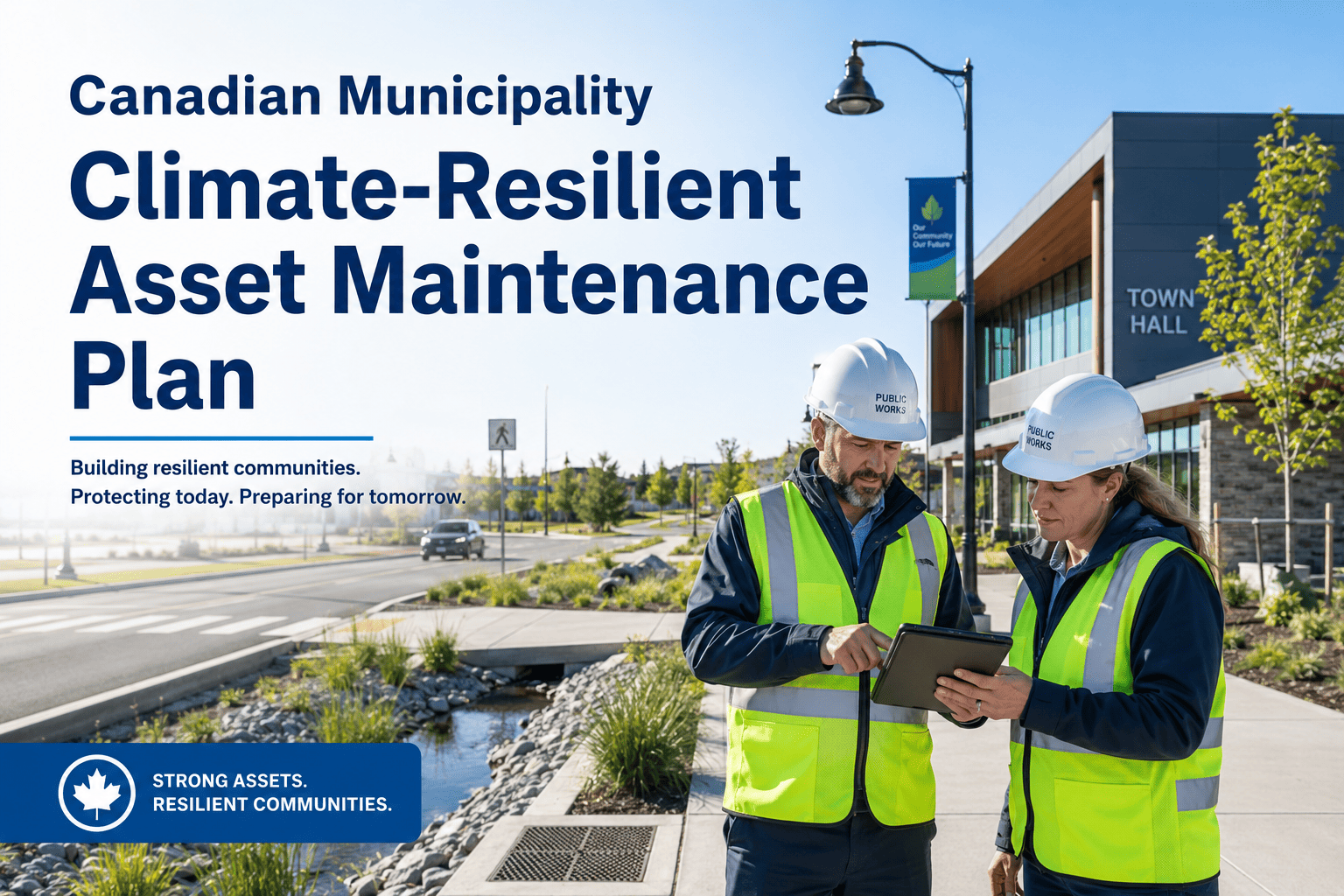
Canadian municipalities face a compounding maintenance challenge: infrastructure built for a mid-20th century climate is now absorbing freeze-thaw cycles, atmospheric rivers, and summer drought conditions that existing PM schedules were never designed to address. Roads, drainage, facilities, and utilities are all at risk — and the cost of reactive repairs is growing faster than capital budgets can absorb. OxMaint helps public works teams build climate-ready maintenance plans using asset condition scoring, risk prioritization, and predictive PM cycles grounded in real environmental exposure data. Book a demo to see how Canadian municipalities are using OxMaint to protect infrastructure investment across climate zones.
Climate Resilience · Canadian Municipalities · Asset Management
Climate-Resilient Asset Maintenance Plan for Canadian Municipalities
Roads, drainage, facilities, and utilities — a structured framework for building a climate-adapted maintenance programme using asset condition data, risk scoring, and AI-assisted PM scheduling.
$2.1B
Annual municipal infrastructure damage in Canada attributable to climate-related weather events (FCM 2023 estimate)
3.4×
Reactive repair cost multiplier versus planned preventive maintenance for climate-damaged municipal assets
58%
of Canadian public works directors report their current PM schedules do not account for accelerated climate exposure
4 categories
Asset categories requiring climate-adapted PM cycles in every Canadian municipality regardless of size
The 4 Asset Categories
Four Infrastructure Categories That Need Climate-Adapted PM — And What Changes
01
Roads & Pavements
Climate Impact
Accelerated freeze-thaw cracking, heave, and edge-break from longer shoulder seasons; heat-softening of asphalt binders during summer extremes
PM Adaptation
Add spring post-thaw condition scoring, shift crack sealing window earlier, increase edge-drain PM frequency
OxMaint Feature
Asset health scoring per road segment, automated PM trigger after freeze-thaw event threshold
02
Stormwater & Drainage
Climate Impact
Higher peak-flow events from atmospheric rivers exceeding design capacity; increased sediment load from unstable slopes
PM Adaptation
Increase culvert clearing frequency before wet season, add post-storm inspection trigger, inspect outfall scour quarterly
OxMaint Feature
Weather-triggered work orders, mobile inspection forms with photo capture, sediment accumulation trending
03
Municipal Facilities
Climate Impact
Roof and envelope stress from variable ice loading, membrane failures from UV intensification, HVAC overload from heat-day frequency increase
PM Adaptation
Add summer pre-heat-dome HVAC readiness check, increase roof inspection frequency, document ice-dam occurrence by building
OxMaint Feature
Facility asset register with condition scoring, seasonal PM trigger automation, HVAC runtime analytics
04
Water & Utility Systems
Climate Impact
Water main exposure to deeper frost penetration in northern zones, pump station flooding from high-water events, pipe joint stress from ground movement
PM Adaptation
Risk-score mains by burial depth and soil type, add pump station flood-response protocol, shift cathodic protection inspections to post-thaw window
OxMaint Feature
Utility asset risk matrix, emergency work order templates, compliance reporting by asset class
Risk Scoring Framework
How to Prioritize Climate Maintenance Investment — The OxMaint Risk Matrix
Prioritizing which assets get enhanced PM first requires scoring each asset on two axes: climate exposure likelihood and consequence of failure. The table below shows the five-zone risk matrix used inside OxMaint's asset health module — municipalities assign each asset a zone, and PM frequency is automatically adjusted accordingly.
| Risk Zone | Climate Exposure | Failure Consequence | PM Frequency Adjustment | Capital Priority |
|---|---|---|---|---|
| Zone 5 — Critical | High (direct exposure) | Life safety / service loss | +50% above standard cycle | Year 1–2 capital plan |
| Zone 4 — High | High | Major service disruption | +30% above standard cycle | Year 2–4 capital plan |
| Zone 3 — Medium | Moderate | Moderate disruption | +15% above standard cycle | Year 3–6 capital plan |
| Zone 2 — Low | Low | Minor inconvenience | Standard cycle maintained | Ongoing operating budget |
| Zone 1 — Monitor | Very low | Negligible | Condition-based trigger only | Deferred |
Expert Review
Canadian Public Works Leaders on Climate-Adaptive Asset Management
5 / 5
We were doing PM on a time-based calendar that hadn't been meaningfully updated in eleven years. After three consecutive years of spring flood damage to the same culvert network, we realized the issue wasn't the assets — it was that our inspection cadence hadn't moved with the precipitation regime. Shifting to condition-based and event-triggered inspections in OxMaint reduced repeat damage at our highest-risk sites by 40% in the first post-implementation season. The post-storm inspection trigger alone paid for the platform.
LB
Liane Bouchard, P.Eng.
Director of Public Works, Ontario Regional Municipality · 18 yrs municipal infrastructure
5 / 5
Getting federal DMAF funding requires demonstrating that you have a rigorous, documented approach to climate risk prioritization. When we applied, we were able to export an OxMaint asset risk report showing condition scores, risk zone assignments, PM history, and deferred maintenance backlog for every asset in scope. The adjudicator specifically noted that our documentation package was the most structured they had reviewed from a municipality of our size. We received funding approval within one cycle.
DT
David Tremblay
Chief Administrative Officer, Quebec Mid-Sized Municipality · 14 yrs municipal administration
4 / 5
The challenge for smaller BC municipalities is that you have a high-exposure climate environment but a very lean team. OxMaint's mobile inspection forms meant our two-person roads crew could do structured post-atmospheric-river assessments using a phone, with data flowing directly into the asset record without anyone back at the office re-entering it. Our deferred maintenance backlog visibility improved dramatically, and we were able to make the case to council for a roads capital allocation based on OxMaint condition trend data rather than anecdotal crew reports.
KM
Karen MacLeod
Public Works Manager, British Columbia Small Municipality · 12 yrs public works operations
Frequently Asked Questions
Canadian Climate-Resilient Asset Maintenance — Key Questions
How does a climate-resilient maintenance plan differ from a standard asset management plan?
A standard asset management plan schedules PM based on manufacturer recommendations and historical failure rates. A climate-resilient plan layers environmental exposure data — precipitation intensity, freeze-thaw cycles, heat-day frequency — onto each asset's risk score, then adjusts PM cadence and capital priority accordingly. The result is a plan that tracks with actual degradation rates rather than theoretical ones, reducing reactive repair costs and improving funding eligibility. OxMaint supports both standard and climate-adapted PM cycles within the same asset register.
What federal and provincial funding programs require a documented climate asset management plan in Canada?
Several major programs require or heavily weight a structured climate risk approach: DMAF (Disaster Mitigation and Adaptation Fund) from Infrastructure Canada requires demonstrated climate vulnerability assessment; the Green Infrastructure stream under ICIP expects asset condition documentation; several provincial infrastructure grant programs in Ontario, BC, and Quebec now require AM plans aligned with FCM's asset management framework. Having OxMaint-generated condition data, risk scoring, and PM history documentation positions municipalities strongly for all of these programs. Book a demo to see what a grant-ready evidence export looks like.
How does OxMaint handle seasonal and weather-triggered PM cycles for Canadian climates?
OxMaint allows PM work orders to be configured with both time-based and condition-based triggers. For Canadian municipalities this means you can set spring post-thaw inspection windows, pre-winter readiness PMs, and post-storm inspection triggers that fire automatically when weather thresholds are recorded. Each triggered work order routes to the assigned crew with the correct inspection checklist, and completion records are attached to the asset's maintenance history for funding and audit purposes. The free trial includes seasonal PM templates pre-configured for Canadian climate zones.
How small does a municipality need to be before a CMMS-based climate plan becomes impractical?
There is no lower bound. Municipalities as small as 1,200 population are using OxMaint because the value is not in managing thousands of assets — it is in having any structured, documented record of inspections and condition scores when funding applications or insurance reviews arrive. A two-person public works team managing roads, drainage, and a civic building can implement a meaningful climate-adapted PM programme in OxMaint in under a week, starting with free templates and mobile-first inspection forms. Book a demo to see a small-municipality configuration walkthrough.
OxMaint for Canadian Municipalities · Climate Infrastructure
Build the Asset Maintenance Plan That Protects Infrastructure and Unlocks Climate Funding
OxMaint gives Canadian public works teams the condition data, risk scoring, and PM documentation needed to make a climate-resilient maintenance plan real — not just a policy document. Start with your highest-risk asset category and build out from there.