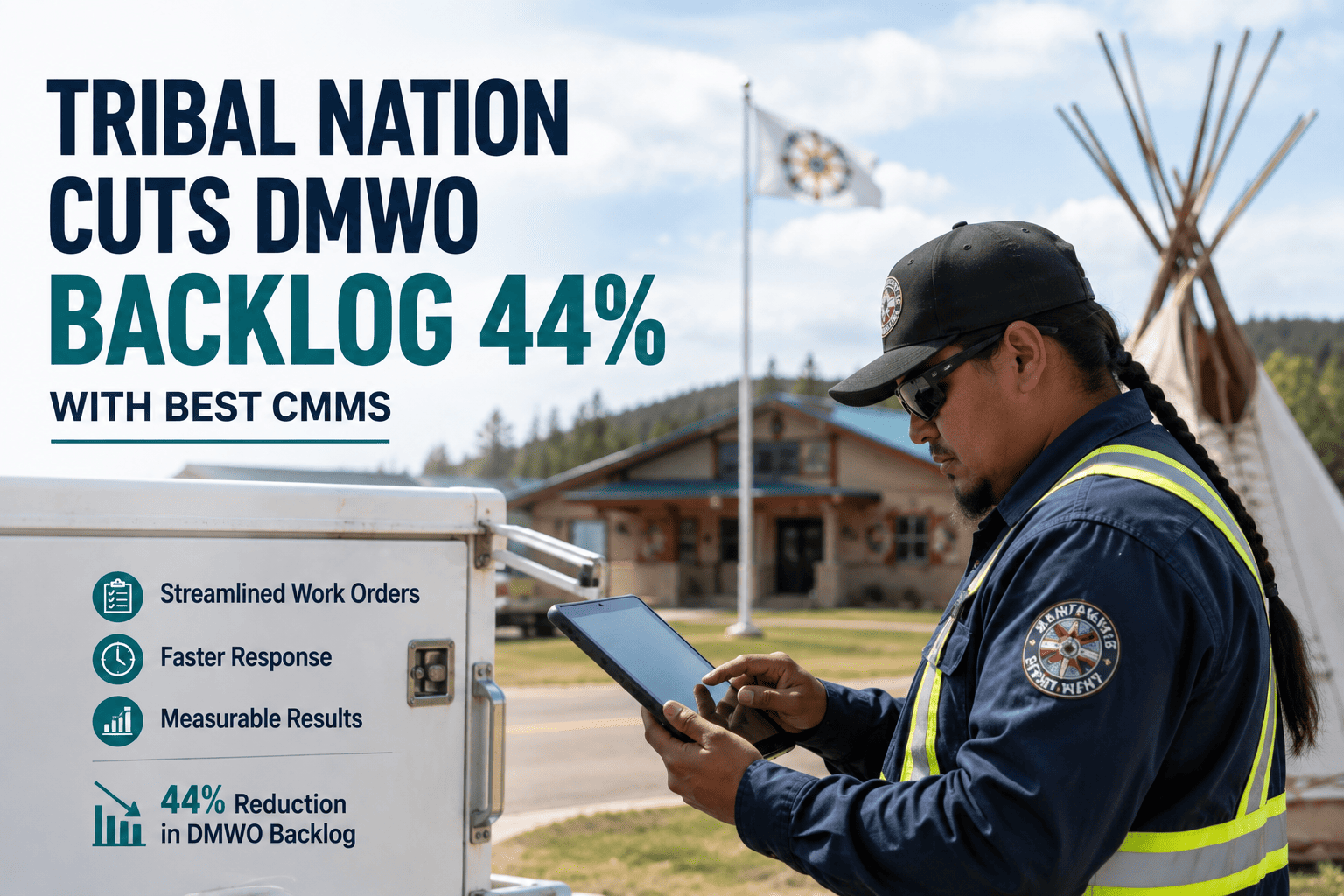
A tribal nation's facilities department was drowning in deferred maintenance work orders, or DMWOs, spread across BIE schools, an IHS-supported clinic, and a handful of BIA-funded administrative buildings. Requests came in on paper forms, phone calls, and hallway conversations, and nobody had a single list of what was actually open. Emergency repairs kept jumping the queue while routine preventive work sat untouched for months, quietly building a backlog that grew every quarter. Within two years of moving to a single digital CMMS, that backlog dropped by 44 percent, and the maintenance team could finally see, prioritize, and close work in one place. The full rollout details are outlined at https://app.oxmaint.ai.
Case Study: Tribal Nation Cuts DMWO Backlog 44% With Best CMMS
A two-year rollout across schools, a health clinic, and administrative facilities turned a paper-based backlog into a tracked, prioritized, and steadily shrinking work order queue.
The Problem: A Backlog Nobody Could See in Full
Before the rollout, work orders lived in three separate worlds. School facility staff logged repairs in a shared spreadsheet that only they could edit. The clinic's maintenance requests went through a paper form routed to a regional office. Administrative building issues were reported verbally to whoever happened to answer the phone that day. None of these systems talked to each other, so leadership had no single number for how many work orders were open, how old the oldest ones were, or which facilities were falling furthest behind.
Fragmented Intake
Three different reporting methods across schools, the clinic, and administrative buildings meant no unified backlog count.
Reactive Prioritization
Whoever complained loudest got fixed first, while preventive tasks with real safety impact sat unscheduled.
No Historical Record
Paper forms were rarely archived consistently, so recurring failures at the same asset went unnoticed for years.
The Rollout Timeline
Backlog Audit and Data Migration
Every open paper request, spreadsheet row, and verbally reported issue across schools, the clinic, and administrative buildings was collected into a single digital backlog for the first time.
Facility-by-Facility CMMS Rollout
Schools went live first, followed by the clinic and administrative buildings, each with a facility-specific asset list and priority framework.
Preventive Scheduling Introduced
Recurring preventive tasks were scheduled for the first time alongside reactive requests, instead of preventive work being skipped whenever reactive volume spiked.
Backlog Stabilizes and Shrinks
With intake, prioritization, and preventive work all tracked in one system, the department closed more work orders than it opened for the first time, driving the 44 percent backlog reduction.
See What a Unified Backlog Looks Like
Oxmaint brings schools, clinics, and administrative facilities into one CMMS so leadership always has a single, current backlog number.
Before and After: What Actually Changed
| Area | Before CMMS | After CMMS |
|---|---|---|
| Work Order Intake | Paper forms, spreadsheets, verbal reports | Single digital intake across all facility types |
| Prioritization | First-complained, first-fixed | Priority scoring by safety impact and asset criticality |
| Preventive Maintenance | Skipped whenever reactive volume rose | Scheduled and tracked alongside reactive work |
| Backlog Visibility | No single number existed | Live backlog count visible to leadership at any time |
| Recurring Failures | Rarely noticed across disconnected logs | Flagged automatically from asset history |
What Drove the 44% Reduction
The backlog did not shrink because the maintenance team got bigger. It shrank because the same team could finally see the whole picture and work through it in order of actual risk instead of volume of complaints. Three changes made the biggest difference.
One Backlog, Not Three
Combining schools, the clinic, and administrative buildings into a single view eliminated the duplicate effort of tracking status across separate systems.
Preventive Work Protected From Reactive Spikes
Scheduled preventive tasks stayed on the calendar instead of being silently dropped, which reduced the reactive volume feeding the backlog in the first place.
Aging Requests Surfaced Automatically
Work orders sitting open past a set threshold were flagged for review instead of quietly aging for years in a paper file.
Before this, I could not tell you how many open work orders we actually had across our schools and the clinic. Now our team opens one dashboard and knows exactly what is overdue and what is next.
Facilities Coordinator, Tribal Public Works DepartmentFrequently Asked Questions
How long did the full rollout take?
The rollout took roughly two years from the initial backlog audit to a steady-state system where more work orders were closed than opened each quarter. Facilities went live in phases rather than all at once.
Did this cover BIE schools and IHS clinics together?
Yes. Schools, a health clinic, and administrative buildings were brought into the same CMMS, each with its own asset list, but all reporting into one shared backlog view for leadership.
What counted toward the 44% backlog reduction?
The figure reflects the net drop in open deferred maintenance work orders across all tracked facilities from the start of the rollout to the two-year mark. You can review methodology details at app.oxmaint.ai.
Did preventive maintenance replace reactive repairs entirely?
No. Reactive repairs still happen, but preventive tasks are now protected on the schedule instead of being the first thing dropped when reactive volume spikes.
Can a similar rollout work for a smaller tribal facilities team?
Yes. The phased, facility-by-facility approach is designed to scale down as easily as it scales up. A walkthrough is available at calendly.com/oxmaintapp/30min.
Bring Every Facility Into One Backlog View
Oxmaint helped this tribal facilities team cut its DMWO backlog by 44 percent in two years. See what a phased rollout could look like for your schools, clinics, and administrative buildings.