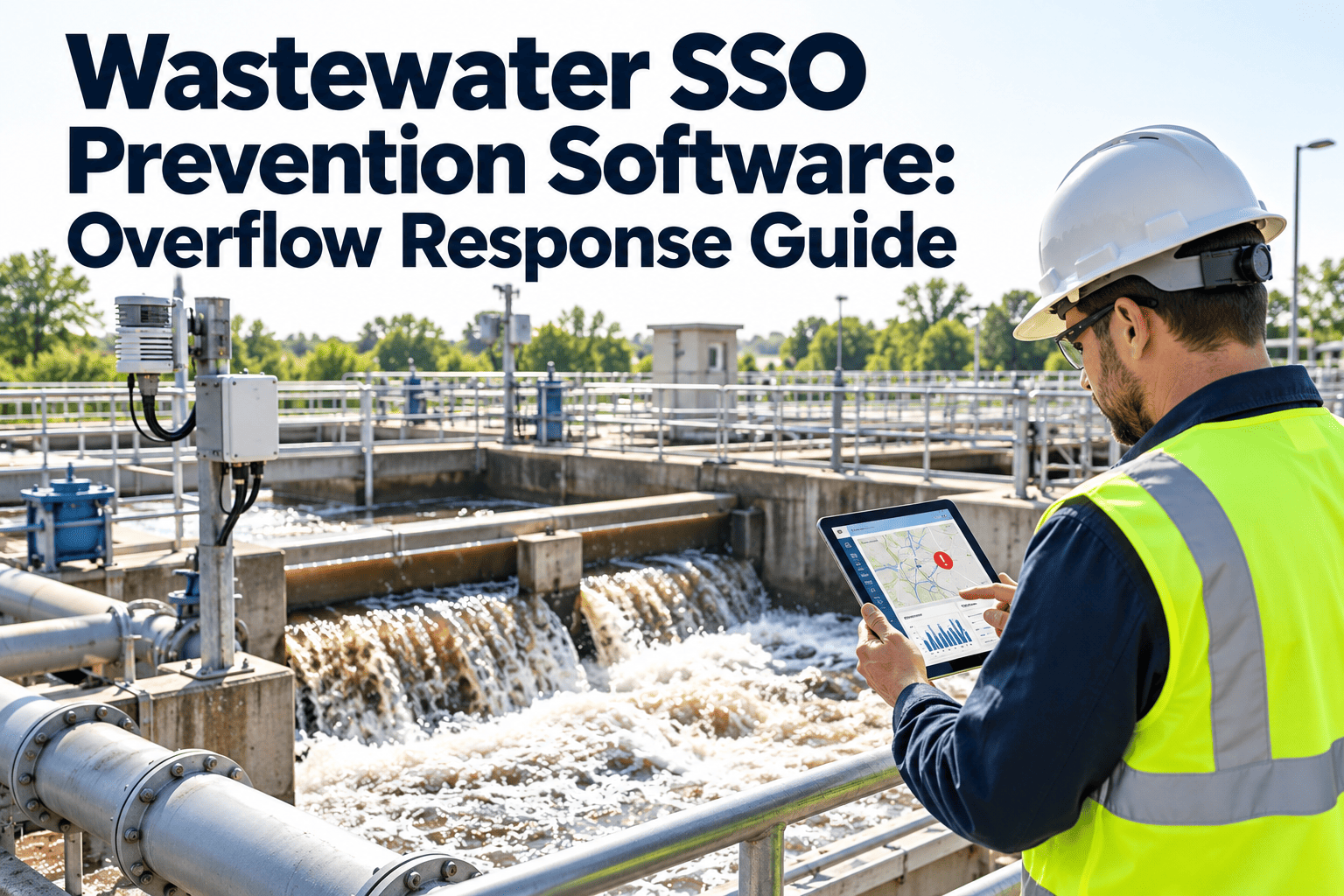
Sanitary sewer overflows put a wastewater utility in the worst possible position: a public health hazard, a Clean Water Act violation, and a visible maintenance failure, all inside the same event. Most SSOs trace back to a short list of preventable causes — blocked mains, failing pumps, and lift stations nobody was watching closely enough — yet many collection systems still rely on paper rounds and institutional memory to catch them before they discharge. A CMMS built around lift station monitoring, structured response workflows, and NPDES-ready documentation turns that reactive scramble into a program a utility can defend to its state regulator and its ratepayers. Sign Up to see how condition data and automated work orders close the gap between a rising wet well and a preventable discharge.
How many of your lift stations would fail silently tonight — and would anyone know before the discharge report was due?
Wet well level, pump run-hours, amperage draw, and power-loss signals feed directly into a CMMS work order queue, so a rising station triggers a dispatched crew hours before it triggers a permit violation.
Why sanitary sewer overflows keep happening
Separate sanitary sewers are designed to carry only domestic, commercial, and industrial wastewater, but collection systems age, and every mile of pipe is a mile that can let groundwater in, roots grow through, or a joint fail. EPA groups the recurring causes into a short, well-documented list.
Inflow and infiltration (I&I)
Stormwater entering through manhole covers and cracked joints, plus groundwater seeping through aging pipe, can turn a dry-weather system into one that surcharges every time it rains. I&I is rarely the headline cause on its own, but it is almost always the multiplier behind the other three.
Blockages: roots, grease, and debris
Root intrusion at pipe joints, fats-oils-and-grease buildup from commercial and residential kitchens, and construction or wipe debris account for a large share of the SSOs that make it into annual reports. These are also the causes most consistently prevented by a scheduled cleaning and CCTV inspection program rather than a sensor.
Mechanical, electrical, and structural failure
Pump failure, a tripped breaker, a failed float switch, or a collapsed pipe segment turns a functioning lift station into a rising wet well within minutes. These are the causes that condition monitoring is built to catch, because the equipment usually shows a trend before it shows a failure.
Capacity deficiency under peak flow
Undersized mains and pump stations that were adequate at the time of installation can be overwhelmed by growth, new development, or a wet-weather event well beyond their design storm. Capacity SSOs usually recur at the same locations, which makes them identifiable from work order history alone.
A four-tier way to triage every station on your collection system
Not every lift station needs the same level of scrutiny. Ranking stations by consequence of failure and current condition trend gives a maintenance team a defensible reason to inspect station 14 weekly and station 3 monthly, instead of visiting every station on the same fixed interval regardless of risk.
A CMMS asset record can carry this tier as a field on the station itself, so inspection frequency, alert thresholds, and callout priority are all driven from one consistent risk rating instead of a spreadsheet someone updates twice a year.
What a lift station tells you before it overflows
Level transducer or ultrasonic sensor
Tracks rise rate against the station's normal cycling band. A level that climbs faster than the pump can draw it down, or one that stalls near the high-level alarm setpoint, is the earliest and most direct SSO warning signal available.
Motor current and cycle counters
Rising amp draw on a submersible pump often signals impeller wear, rag buildup, or bearing failure weeks before the pump trips offline. Cycle counts that shorten over time point to a check valve or float switch problem long before a technician would notice on a routine visit.
Loss-of-power and communication monitoring
A significant share of preventable SSOs trace back to a power outage that a station's telemetry never reported because the dial-out itself had failed. Monitoring the health of the alarm system, not just the process it protects, closes that blind spot.
From first alarm to closed report: the six-step response chain
Detect and confirm
A high-level or loss-of-communication alarm from the lift station reaches the CMMS and the on-call technician within seconds, not at the next scheduled round.
Contain what you can
Crews close valves, deploy a bypass pump, or redirect flow to available storage while the root cause is diagnosed on site.
Notify the regulator
If the overflow reaches surface water or presents a health risk, the initial verbal or electronic notification goes out inside the permit's required window, logged as a CMMS work order note.
Mobilize the repair crew
A Priority 1 work order carries the asset history, prior failure notes, and parts on hand, so the dispatched crew isn't starting from zero at the manhole.
Remediate and restore
Pump replacement, blockage clearing, or bypass pump removal is logged against the asset, updating its run-hours and failure history for the next risk review.
Document and close
Volume estimate, duration, cause, and corrective action are compiled into the written report due within the permit's follow-up window, pulled directly from the work order rather than reconstructed after the fact.
NPDES notification timelines, at a glance
Reporting requirements for sewer overflows and bypass events sit in the conditions applicable to every NPDES permit under 40 CFR 122.41, but the exact clock varies by event type and by state. The table below reflects the general federal framework; always confirm against your specific permit and state program.
| Event Type | Initial Notification | Written Follow-Up | Typical Trigger |
|---|---|---|---|
| Emergency SSO | Immediate call to state hotline and local health authority | Written report, often within 24 hours | Overflow endangering human health, safety, or reaching a basement or waterway |
| Standard reportable SSO | Verbal or electronic notice within 24 hours of discovery | Detailed SSO report within 5 days | Any SSO with the potential to reach surface waters of the state |
| Unanticipated bypass | Notice to the permitting authority within 24 hours | Full bypass report within 5 days | Unplanned diversion of flow around a treatment process |
| Anticipated bypass | Advance notice at least 10 days before the event | Not applicable | Planned maintenance requiring a temporary process bypass |
| Annual SSO summary | Not applicable | Included in the periodic or annual reporting package | Aggregated collection-system performance for the reporting year |
What changes when overflow response stops being reactive
- Lift stations checked on a fixed weekly or biweekly round regardless of condition
- High-level alarms discovered by phone call from a resident, not a sensor
- SSO reports reconstructed from memory and paper logs after the fact
- Every station treated as equal risk, so attention is spread thin
- Root cause analysis limited to whatever the crew remembers on site
- Wet well and pump data streamed continuously, with alerts tied to risk tier
- Work orders auto-generated the moment a threshold is crossed
- Reports assembled from the logged work order timeline, not recollection
- Inspection frequency and callout priority scaled to each station's actual risk
- Failure history and parts usage build a searchable root-cause record over time
Building an SSO prevention program that holds up under audit
Every lift station and force main has an asset record with a current risk tier and inspection frequency.
High-level, loss-of-power, and communication-failure alarms route to a named on-call technician automatically.
Response, notification, and reporting steps are written into a standard work order template, not left to memory.
Root cause, volume estimate, and corrective action are captured on every closed SSO work order for trend analysis.
CCTV inspection and cleaning schedules target the mains with the highest root, grease, or debris history first.
Annual SSO summary data can be exported directly from the CMMS rather than rebuilt from spreadsheets each year.
Stop finding out about overflows from a resident's phone call
Connect lift station condition data to a CMMS built for SSO response, notification, and reporting, and give your collection system crew hours of warning instead of minutes.
Sanitary sewer overflow prevention, answered
What is the difference between an SSO and a CSO?
A sanitary sewer overflow occurs in a separate sanitary system that is designed to carry only wastewater; it is prohibited outright under the Clean Water Act. A combined sewer overflow occurs in a system that carries both stormwater and wastewater together and is typically permitted for wet-weather events under its own NPDES conditions.
Does every SSO have to be reported to the state?
Most state programs require reporting of any SSO with the potential to reach surface waters, and immediate reporting of any overflow that endangers human health. Backups confined to internal plumbing that a utility does not own or operate are generally excluded; confirm the exact scope against your permit.
Can a CMMS actually prevent an overflow, or only document it?
Both. Trending wet well level and pump amperage against a station's normal band lets a CMMS generate a work order while the pump is still degrading, not after it fails, which is what converts an SSO into a planned repair. Book a Demo to see the alert-to-work-order flow.
Do smaller collection systems need full IoT instrumentation on every station?
No. Ranking stations by consequence of failure lets a smaller utility instrument its highest-risk stations first — typically those near waterways or with a single pump and no backup — while lower-risk stations stay on a scheduled inspection interval inside the same CMMS.
What information does a defensible SSO report actually need?
At minimum: discovery time, estimated start and stop time, estimated volume, receiving location, root cause, and corrective action taken. Building the report from a CMMS work order timeline keeps these details consistent instead of reconstructed weeks later.
Your next overflow is either a data point or a violation. The difference is how early you see it.
Bring lift station monitoring, response workflows, and NPDES-ready documentation into one CMMS built for wastewater collection systems.