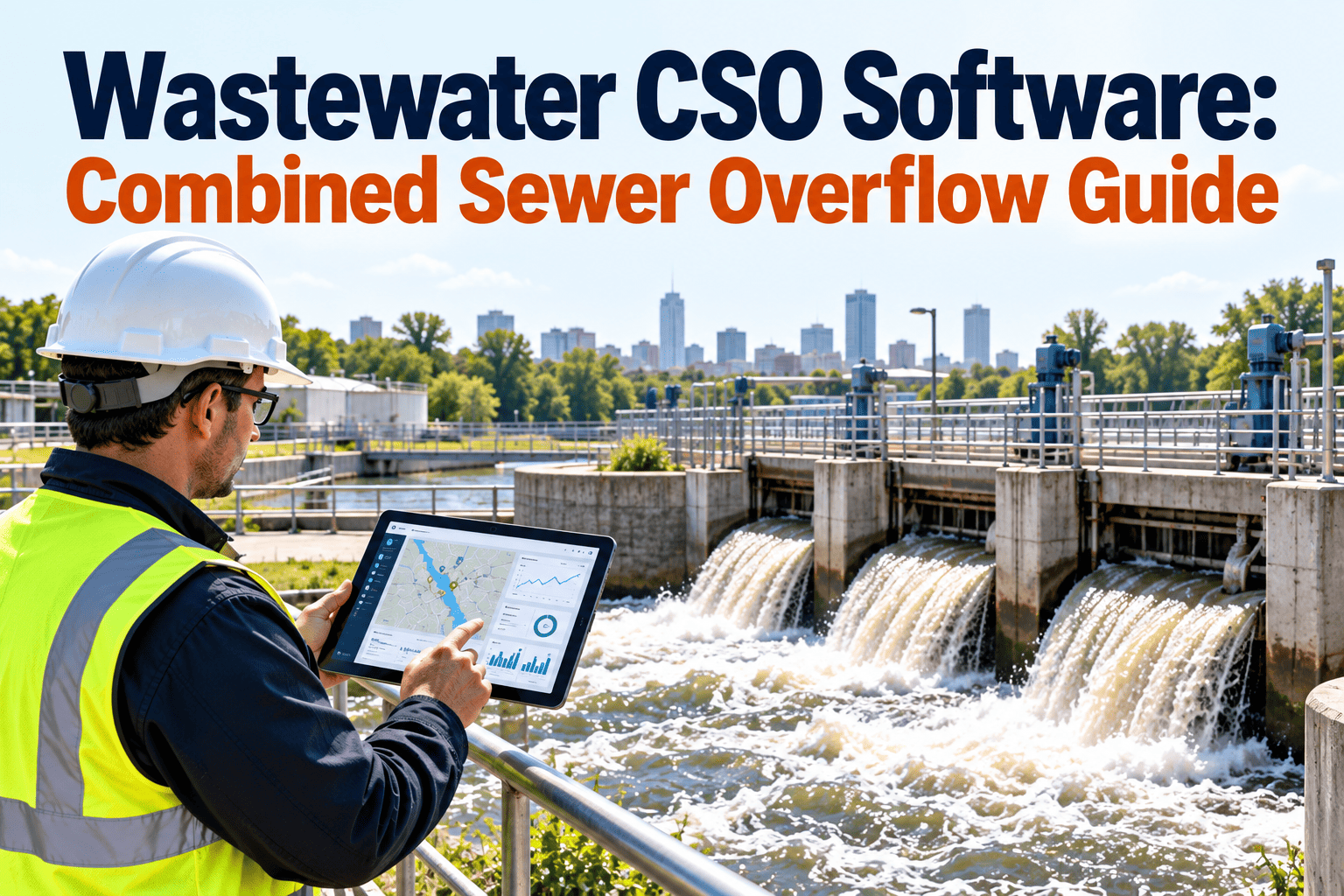
Every wet-weather season, combined sewer utilities face the same reckoning: a storm rolls through, regulators open, and an outfall that was dry an hour ago is discharging untreated flow into a receiving stream. Under the Clean Water Act, that event is not just an operational headache — it is a permit obligation, and the plant has to prove exactly what happened, when, and why. A wastewater CSO software layer built on top of a CMMS is what turns that proof from a scramble into a routine, defensible record, and it is increasingly the backbone of how utilities carry out their long-term control plan commitments day to day.
Combined sewer overflow management, from Nine Minimum Controls to consent decree reporting
Track regulator activations, LTCP milestones, wet-weather asset performance and NPDES documentation in one CMMS built for POTWs operating under a CSO permit or consent decree.
CSO control is a permit condition, not a maintenance nicety
Roughly 700–800 municipalities across the United States still operate combined sewer systems, and nearly all of them are under an NPDES permit or a federal or state consent decree requiring a Long-Term Control Plan under EPA's 1994 CSO Control Policy.
The policy sets two tracks utilities can follow to satisfy water-quality-based requirements: a demonstration approach, where the utility shows its planned controls meet water quality standards, or a presumption approach, which is met by capturing at least 85% of system-wide wet-weather flow for treatment, or by holding overflow events to a set number per year, often in the four-to-six range depending on the permit.
EPA's Nine Minimum Controls — the operational baseline every LTCP builds on
- Proper operation and regular maintenance programs for the sewer system and CSO outfalls
- Maximum use of the collection system itself for in-line storage during storms
- Review and modification of pretreatment requirements to limit CSO impacts
- Maximization of flow to the treatment plant for full treatment
- Prohibition of CSO discharges during dry weather
- Control of solids and floatable materials in overflow events
- Pollution prevention programs across the collection system
- Public notification of CSO occurrences and their impacts
- Monitoring to characterize CSO impacts and confirm control effectiveness
The operational gap between an LTCP on paper and CSO control in the field
A Long-Term Control Plan can run to hundreds of pages and take fifteen to twenty years to fully implement, but permit compliance is judged event by event, inspection by inspection.
Overflow events go undocumented in real time
When regulator activations, duration and estimated volume are logged after the fact from operator memory or a paper log sheet, the record rarely matches what a state inspector or consent decree monitor expects to see.
Nine Minimum Controls maintenance drifts
Regulators, tide gates, diversion structures and screening equipment sit on inconsistent inspection cycles across different crews, so the "proper operation and maintenance" control quietly erodes between audits.
Public notification requirements slip
Many state permits require notification of an overflow to the public or downstream users within a set window of hours. Missed or late notification is one of the most common citations in CSO enforcement actions.
LTCP milestone tracking lives in spreadsheets
Consent decree schedules list specific construction and implementation milestones with hard dates. When that schedule is not tied to real work orders and asset records, status updates to the regulator become guesswork.
Where a CMMS plugs into the Long-Term Control Plan process
An LTCP moves through a defined sequence — from characterizing the system to implementing controls to confirming they work — and each stage produces a record a CMMS is well suited to hold.
System and receiving-water characterization
Baseline monitoring data on outfall activity, rainfall and flow is attached to each regulator and outfall asset record, building the historical dataset an LTCP update or permit renewal will need.
Evaluation of control alternatives
Asset condition and failure history feed the cost-effectiveness case for storage tunnels, sewer separation, green infrastructure or treatment upgrades that the LTCP must justify to the permitting authority.
Construction and implementation schedule
Each consent decree milestone becomes a tracked project with linked work orders, so the utility can report percent-complete against the schedule with a real audit trail, not a status memo.
Nine Minimum Controls in daily operation
Inspection and PM routes for regulators, gates, screens and pump stations run on fixed schedules with mobile completion, closing the gap between the LTCP's stated maintenance commitments and what happens on the ground.
Performance verification
Once controls are built, monitoring confirms whether the LTCP's target overflow frequency or capture rate is actually being achieved, and the CMMS record is the evidence base for that determination.
The wet-weather assets a CSO CMMS needs to track by name
CSO control is only as strong as the individual regulators, gates and structures that decide where flow goes during a storm. Each one needs its own maintenance history and inspection cadence.
| Asset type | Role in CSO control | Typical inspection driver | Common failure mode |
|---|---|---|---|
| CSO regulator / diversion structure | Splits dry-weather flow to the plant and wet-weather flow to the outfall | Quarterly inspection, post-storm check | Weir or orifice blockage, mis-set gate |
| Tide gate / flap gate | Prevents receiving-water backflow into the collection system | Monthly or post-storm inspection | Debris jamming, hinge corrosion |
| Inflatable or mechanical dam | Maximizes in-line storage before an overflow triggers | Manufacturer-set PM interval | Bladder wear, control system fault |
| CSO screening / netting facility | Removes solids and floatables before discharge | Weekly during wet season | Screen fouling, actuator failure |
| Flow monitor / level sensor | Records activation, duration and estimated volume for reporting | Calibration on fixed schedule | Sensor drift, communication dropout |
| Storage tunnel or off-line storage basin | Holds wet-weather flow for later treatment | Annual structural, post-fill inspection | Sediment accumulation, valve failure |
From storm to submitted report, without the reconstruction step
The difference between a defensible CSO record and a liability is usually whether the documentation was captured at the time of the event or rebuilt afterward from memory.
Without a connected workflow
- Operators radio in an activation; someone writes it on a clipboard
- Duration and estimated volume are approximated after the storm passes
- Public notification is sent late because no one owns the trigger
- Monthly and annual DMR data is assembled by hand from scattered notes
- An auditor asking "prove the regulator was inspected last quarter" gets a shrug
With CSO events tied to the CMMS
- Regulator activation opens a logged event tied to the specific outfall asset
- Duration and flow-monitor data attach automatically to the event record
- Public notification task fires with a due time built into the workflow
- Reporting periods roll up event history directly from the asset log
- Inspection history for every regulator is one query away, timestamped
Put your CSO program on a system your next audit can trust
Log overflow events, run Nine Minimum Controls inspections, and track LTCP milestones inside one CMMS built for combined sewer utilities.
The numbers a permitting authority actually asks for
Whether a utility is under the presumption approach or the demonstration approach, the same handful of metrics tend to anchor every compliance conversation.
Overflow events per outfall, per year
Tracked against the permit-specific target, commonly four to six events annually under the presumption approach.
System-wide wet-weather capture rate
The percentage of combined flow captured and routed to treatment, measured against the 85% presumption threshold.
Nine Minimum Controls inspection compliance
Percentage of scheduled regulator, gate and screening inspections completed on time across the wet season.
Public notification response time
Elapsed time from confirmed activation to public notification, checked against the state's required window.
LTCP milestone status
Percent complete against the consent decree schedule for each construction and implementation milestone.
Repeat activations at the same outfall
Flags regulators or structures where recurring activity points to a maintenance or capacity issue worth investigating.
Built for the maintenance side of the Long-Term Control Plan
Oxmaint does not replace hydraulic modeling or flow-monitoring instrumentation — it is the system of record for the maintenance, inspection and event-documentation work that keeps a CSO program in compliance between audits.
Preventive maintenance schedules cover regulators, tide gates, screening equipment and storage assets, with mobile forms field crews complete during wet-season rounds. Work orders capture corrective repairs on any structure tied to an overflow event, and inspection records stay attached to the specific asset for the life of the permit cycle — useful the day a state agency or a consent decree monitor asks for the file. Dashboards roll activation counts, inspection compliance and milestone status into reports operations and compliance staff can hand to leadership without rebuilding them from scratch each quarter. Utilities exploring how this fits their permit obligations can book a demo to walk through a regulator inspection and event-logging workflow end to end.
Wastewater CSO software — frequently asked questions
What is the difference between the demonstration and presumption approach under the CSO Control Policy?
The demonstration approach requires proving proposed controls meet water quality standards through modeling and monitoring. The presumption approach is satisfied by capturing at least 85% of wet-weather flow, or by limiting overflow events to a set number per year set in the permit.
Do the Nine Minimum Controls require a formal software system?
EPA's policy does not name a specific system, but the controls call for documented, regular maintenance and monitoring — requirements that a CMMS with scheduled inspections and event logging is built to satisfy. Get started to see how the workflow maps to your outfall inventory.
How long does a Long-Term Control Plan typically take to implement?
Full implementation commonly spans fifteen to twenty years given the scale of storage, tunneling or sewer-separation projects involved, which is why milestone tracking against the consent decree schedule matters as much as the plan itself.
What happens if a utility misses a public notification requirement?
Late or missed notification is a common basis for enforcement action separate from the overflow event itself, since most state permits set a fixed notification window measured in hours from confirmed activation.
Can a CMMS help during an LTCP update or permit renewal?
Historical event and inspection data stored by asset gives the engineering team consulting on an LTCP update a real activity record to work from instead of reconstructing years of outfall history from paper files.
Bring your CSO documentation up to permit standard
Set up regulator inspections, event logging and LTCP milestone tracking on one platform built for combined sewer compliance.