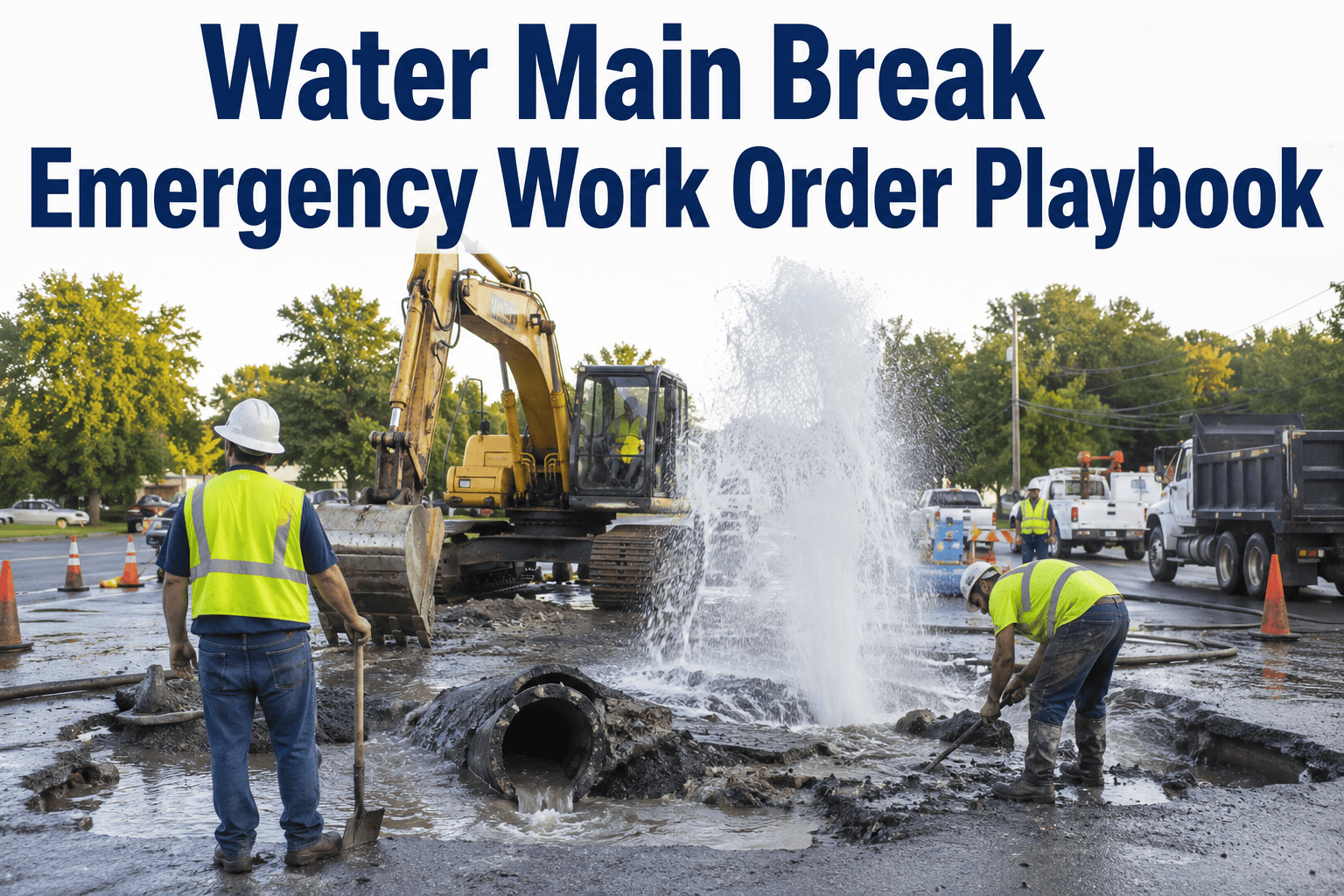
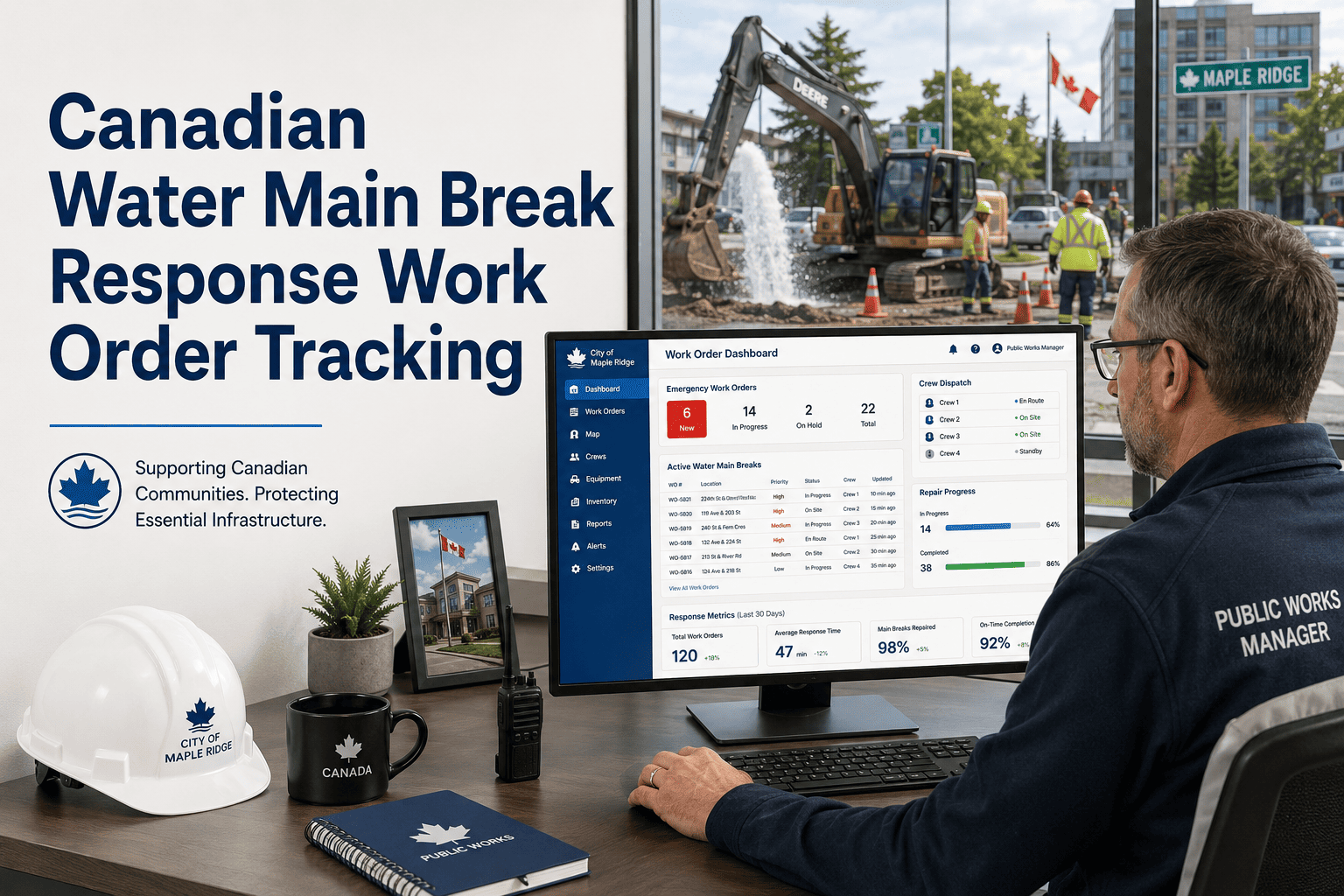
A water main break is the worst time to improvise. With more than 700 mains failing across the US every day and the average repair running 8 to 12 hours, the crews who restore service fastest are the ones following the same playbook every single time — log it, isolate it, mark it, fix it, restore it. The difference between a tidy four-hour job and a flooded intersection often comes down to whether the right valves, parts, and crew were captured on one work order instead of scattered across radios and notebooks. This playbook lays out a standardized emergency response and shows how to run it from the field with OxMaint's mobile work orders and parts tracking — or book a demo to see it on your own network.
Water Utilities / Work Order Management & Mobile CMMS
Water Main Break Emergency Work Order Playbook
One repeatable response — location tagging, crews, valves, parts, photos, and restoration — captured on a single work order from first call to final report.
700+
Water mains break across the US every single day
8-12 hr
Average time to repair a typical water main break
15/100mi
Industry benchmark break rate per 100 miles of pipe per year
Dozens
Valves a crew may turn to isolate one large break
The five-phase response playbook
Most utilities run the same sequence under different names. Standardizing it on one work order keeps nothing lost between phases.
1Identify
24/7 dispatch logs the caller, location, landmarks, and severity, then opens an emergency work order with a GPS location tag and the break classification.
2Contain
Crews close valves at each end, starting nearest the rupture and working outward. Any valve that won't fully seat gets flagged on the order — a stuck valve forces a wider shutdown.
3Pinpoint
Call 811 for utility markout before digging, set traffic control and OSHA-compliant trench shoring, and dewater the trench to below the pipe invert.
4Repair
Pull the right clamp, sleeve, or fittings from inventory, keep positive pressure above 20 psi where possible, and disinfect parts with a chlorine solution per AWWA C651 before installing.
5Restore
Flush the line, restore disinfectant residual, sample if required, backfill and patch, then close the order with photos, costs, and asset history updated.
Turn the playbook into one tap-through work order
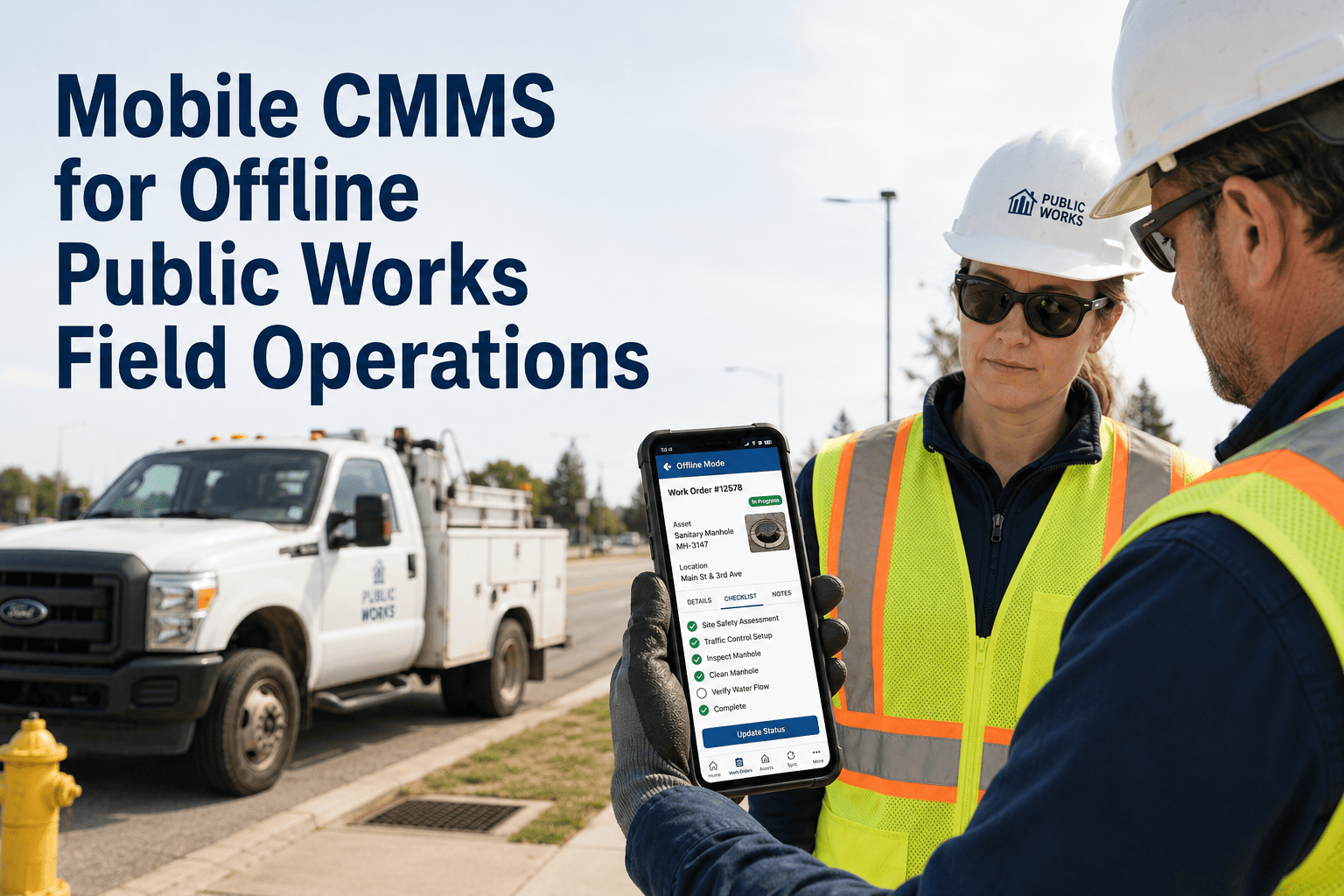
OxMaint puts the whole sequence in the crew's hands — location, valves, parts, and photos captured on site, not back at the yard.
Anatomy of the emergency work order
Every break should produce the same complete record. These are the fields that make a response repeatable and a report defensible.
Location tag
GPS pin, nearest landmark, and the mapped asset ID so the next crew finds it instantly.
Crew & dispatch
Who responded, arrival time, and equipment on site for accurate response timing.
Valves closed
Which valves were turned, turn counts, and any that failed to seat for follow-up.
Parts & inventory
Clamps, sleeves, gaskets, and fittings pulled — auto-decremented from stock.
Photos
Before, during, and after images for quality assurance and damage claims.
Restoration & report
Flush, disinfect, sample, backfill, paving handoff, and a closing cost summary.
Match the response to the break
Not every break needs the same crew or notification. Tiering the response keeps resources matched to public-health risk.
| Severity | Typical scope | Response |
|---|
| Minor | Small main, few or no customers | Routine crew, standard isolation |
| Moderate | Several properties affected | Crew plus customer notification |
| Major | Many customers, traffic impact | Specialized shutdown crew, public updates |
| Critical | Hospital, school, or transmission main | Full activation, boil-water risk review |
Expert Review
"The clock on a main break starts before the first valve turns. What slows crews down isn't the digging — it's hunting for which valves isolate the segment, which parts are in the truck, and who already left for another call. A standardized work order answers all three before anyone arrives. And the single most common surprise in the field is a valve that won't close, which is exactly why your break records and your valve-exercising program have to talk to each other. Capture it once, in the field, and the after-action report writes itself."
Reviewed by a public-works distribution operations supervisor, 20+ years in municipal emergency response and asset management.
See an emergency response close itself out
Walk through a live main-break work order on your own system — valves, parts, photos, and report in one record, ready for the next call.
Frequently asked questions
What should an emergency work order capture?
At minimum: a GPS location tag, the responding crew and times, every valve closed, parts pulled from stock, before-and-after photos, and the restoration steps. That record drives both the repair and the report. See the template in
OxMaint.
How fast should crews isolate a break?
As fast as the valves allow — crews start nearest the rupture and work outward, which can mean turning dozens of valves on a large main. Pre-mapped isolation valves cut that time sharply.
Book a demo to see isolation mapping in action.
What if an isolation valve won't close?
The crew must close the next valves outward, widening the outage and the customer impact — then flag the failed valve for repair. Tying break records to a valve-exercising program prevents the repeat. Track both in
OxMaint.
What parts should be staged for main breaks?
Keep repair clamps, sleeves, couplings, gaskets, and common fittings sized to your mains ready in the truck, with stock levels watched automatically. Running out mid-repair adds hours.
Book a demo to see parts auto-tracking.
When is a boil-water advisory required?
It depends on whether positive pressure was held and contamination risk during the repair; crews maintain pressure above 20 psi where possible and sample afterward. Local rules and AWWA C651 guide the call. Log every step in
OxMaint.
How do photos help after a break?
Time-stamped before, during, and after photos document the repair quality, support damage claims, and feed asset history for recurring trouble spots. Captured on the work order, they're never lost.
See it in a demo.
How does OxMaint standardize emergency response?
OxMaint gives every break the same mobile work order — location, valves, crews, parts, photos, and restoration — then files it to asset history for the next event. Try it on your own network with a
free trial.
Make every break run the same way
Replace radio chatter and paper notes with one standardized, mobile work order — faster restoration, cleaner reports, and a record that builds your asset history.