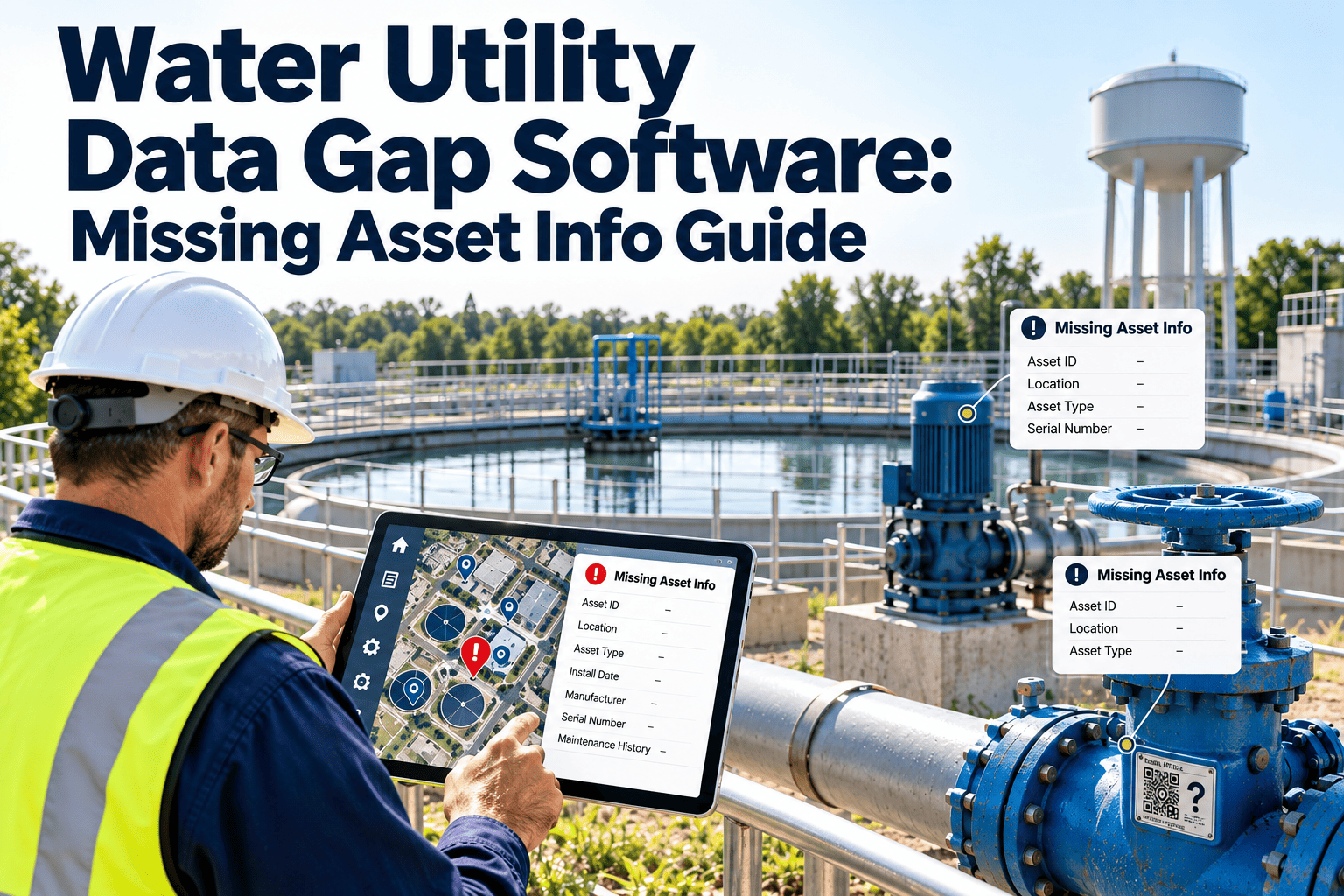
Ask most water utilities how old a given section of main is, and the honest answer for a large share of the system is "we're not entirely sure." Install records were lost in a records-room fire decades ago, ownership of a subdivision's lines transferred without a full handoff of documentation, or the pipe simply predates whichever system the utility currently uses to track assets. None of that is a failure of the current team, it's the accumulated effect of decades of paper records, mergers and staff turnover. The problem is that AWIA-driven risk assessments, GASB 34 condition reporting and everyday capital planning all assume the utility knows what it owns, when it was installed, and what condition it's in — and closing that gap is exactly where a connected asset record inside Oxmaint's CMMS starts to matter.
Water Utility Data Gap Software: Find and Close the Missing Asset Information Before It Costs You
Identify missing install dates, material types, and condition records across your distribution and collection system, and route the gaps into a work order instead of a permanent asterisk on the map.
The Attributes Most Utilities Are Missing, and Why
Not every gap has the same origin, and the fix looks different depending on which one is missing. Most utilities carry some combination of the four below across at least part of their system, and the split between them tends to fall along the age of the infrastructure and how many hands have managed it over the decades.
| Missing Attribute | Common Cause | Operational Consequence |
|---|---|---|
| Install date | Pre-digital records, annexed or transferred service areas | Cannot prioritize replacement by expected service life |
| Pipe material | As-built drawings never digitized or filed inconsistently | Cannot estimate failure risk by material type (cast iron, AC, PVC) |
| Condition data | No systematic inspection program, or findings never logged centrally | Reactive repairs instead of planned rehabilitation |
| Criticality or consequence of failure | Never formally assessed against customers served or nearby facilities | Risk and resilience assessment lacks a defensible ranking |
Why This Gap Isn't Just a Data Hygiene Problem
A missing install date on a spreadsheet looks like a minor annoyance until it shows up in a document with a federal deadline attached to it, at which point it stops being a data quality note and becomes a question a utility has to answer in writing.
Turn "We Don't Know" Into a Scheduled Field Task
Oxmaint flags incomplete asset records and routes them as a field verification work order, so gaps get closed the next time a crew is already at that location.
A Simple Risk Lens for Prioritizing Which Gaps to Close First
Not every missing record deserves the same urgency. Cross-referencing how critical an asset is against how little is known about it gives a defensible order to work in, rather than closing gaps in whatever order they're discovered, which is usually whichever segment happens to fail next.
Where Missing Data Shows Up Across the System
Distribution and collection assets aren't the only place gaps accumulate. Treatment, storage and control assets carry their own version of the same problem, often with the added complication of equipment that's been swapped out without the change ever reaching the asset record.
| Asset Category | Typical Gap | Where the Fix Starts |
|---|---|---|
| Distribution and collection mains | Install date and material by segment | Cross-reference GIS with permit and as-built archives |
| Valves and hydrants | Location, last exercised date, functional status | Field verification during routine valve exercising rounds |
| Treatment plant equipment | Manufacturer, install date, expected service life | Nameplate capture during the next PM visit |
| Storage tanks and reservoirs | Last inspection date, coating condition | Scheduled inspection tied to a recurring work order |
| SCADA and control assets | Firmware version, last calibration date | Digital asset record tied to the physical control point |
Sources Worth Checking Before Sending a Crew to Verify
Field verification is the last step, not the first. A surprising amount of missing data already exists somewhere in the utility, just not attached to the asset record that needs it.
- As-built construction drawings, even where they were never digitized or indexed by segment
- Permit and tap card files from the building or engineering department
- Prior condition assessments or CCTV inspection reports for sewer segments
- Institutional knowledge from long-tenured field staff, captured before retirements take it out the door
- Records from a neighboring utility or municipality for annexed or transferred service areas
Checking these sources first, before scheduling a dedicated verification visit, closes a meaningful share of the gap without adding a single field task to the crew's schedule.
GASB 34's Modified Approach, in Practice
Utilities that want to report infrastructure value under GASB 34's modified approach, rather than a straight depreciation schedule, take on two specific obligations, and both depend directly on the same asset data most utilities are still filling in.
| Requirement | What It Means in Practice |
|---|---|
| Maintain an asset management system | A current inventory of eligible infrastructure with condition data, not a one-time inventory from years ago |
| Document a minimum condition level | A defined, board-approved condition standard the utility commits to maintaining assets above |
| Repeat the condition assessment cycle | A systemwide reassessment at least once every three years, using a consistent method |
| Report budgeted vs. actual maintenance | A comparison auditors expect to see alongside the condition results each cycle |
None of these are unusual requirements on their own. They become difficult only when the underlying asset data is incomplete, since a condition assessment cannot rate the condition of an asset the utility can't fully describe yet, and an auditor reviewing the modified approach will ask about exactly that gap before signing off.
Closing the Gap Without a Separate Data Project
Most utilities don't have the budget for a system-wide condition assessment all at once. Closing the gap incrementally, tied to work that's already happening, tends to hold up better than a standalone data cleanup initiative, since it doesn't compete for funding against a repair budget that's already stretched thin.
Before and After: What Closing the Gap Changes
The difference isn't a new system replacing an old one, it's the same asset record finally carrying the information that risk assessments, budget requests and emergency crews have all been missing for years.
- Age and material unknown for large sections of the system
- Risk assessment ranks assets on incident history alone
- Field crews trace shutoffs manually during emergencies
- GASB modified approach documentation has visible holes
- Capital requests get questioned for lacking supporting data
- Age and material tracked by segment, verified in the field
- Risk ranking reflects both criticality and condition data
- Valve and shutoff records available on a mobile device
- Condition assessment cycle documented and repeatable
- Capital requests backed by a traceable data source
Bring Data Verification Into the Work Your Crews Already Do
See how Oxmaint flags incomplete asset records and turns them into field tasks tied to your existing routes and repair calls.
AWIA and GASB 34 Readiness Checklist
Neither requirement demands perfect data on day one. Both require a documented, repeatable process for closing what's missing, which is a lower bar than most utilities assume once the process is actually written down.
- checkInventory every asset category required by the risk and resilience assessment
- checkFlag missing install date, material and condition fields by segment
- checkRank gaps by criticality, not just by discovery order
- checkRoute verification tasks to crews already working nearby
- checkRepeat the condition assessment on the cycle GASB 34 requires
- checkDocument the asset management process itself for auditors and the EPA
Metrics That Show the Gap Is Actually Closing
A data-gap initiative can run for years without anyone being able to say whether it's working. A small set of tracked figures answers that question directly, and works just as well in a quarterly update to leadership as it does in a full AWIA recertification package.
Who Should Own Closing the Data Gap
Data gaps get closed fastest when responsibility is split by what each group already touches, rather than assigning the whole effort to one overworked team that has to chase down every department for information it doesn't own.
What Oxmaint Gives a Water or Wastewater Utility
Oxmaint doesn't replace the GIS or hydraulic model a utility already relies on, it gives the asset record underneath both of them a place to track what's known, what's missing, and what's been verified, so the answer to "how old is this main" stops depending on who happens to remember.
Our risk and resilience assessment kept stalling on the same question: how old is this section of main, actually? Once field crews could log what they found during a normal repair instead of waiting for a dedicated survey, the missing fields started closing themselves a few segments at a time.
Frequently Asked Questions
Close the Gap Where the Work Already Happens
Stop treating missing asset data as a permanent asterisk on the map. Flag it, rank it by risk, and let field crews close it as part of the work they're already doing.