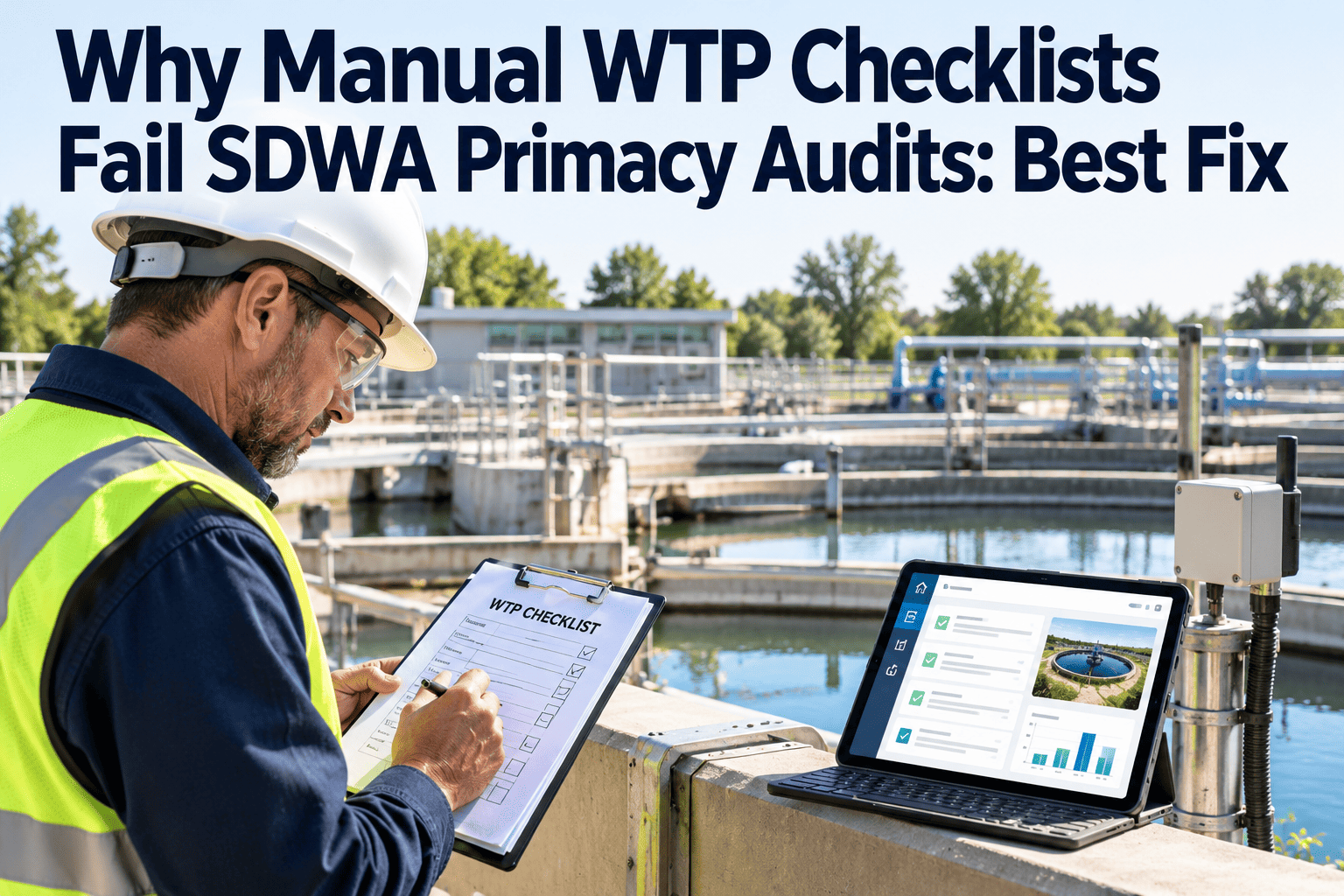
Most water systems do not fail a primacy audit because operators skipped their jobs. They struggle because the paper record cannot prove the job was done, when it was done, or what happened after something looked wrong. Under the Safe Drinking Water Act, state primacy agencies review records, conduct sanitary surveys, and expect documented corrective action. A manual WTP checklist can hold the right information, yet still fall short as evidence at scale. This article explains the structural reasons and shows how a digital CMMS closes each gap. You can book a demo to see the evidence trail in practice.
Why Manual WTP Checklists Fail SDWA Primacy Audits
Paper rounds break the evidence chain at scale. A digital checklist framework restores it with timestamps, photo evidence, and an escalation trail.
What primacy reviewers actually look for
Primacy agencies are states or tribes with primary enforcement responsibility for drinking water rules. Their reviewers rarely ask whether a checklist exists. They ask whether it can be trusted.
| Reviewer question | What a weak record shows | What a strong record shows |
|---|---|---|
| Who performed the check? | Initials, sometimes illegible | Named, certified operator tied to the entry |
| When was it performed? | A time written at shift end | A system timestamp for each station |
| Was every required item covered? | Blank boxes or batch entries | Required fields and incomplete-round records |
| What happened to out-of-range readings? | A note with no follow-up | Linked work order, owner, and close date |
| Can records be produced quickly? | Binders across several offices | Searchable history by date, asset, or operator |
Record retention periods and required log formats differ by record type and by state. Confirm them with your primacy agency rather than relying on a general rule.
Five structural failure points of manual checklists
These are design limits of paper, not operator shortcomings. Training alone does not remove them.
Timing cannot be verified
A handwritten time is a claim. Two sheets completed in a single sitting look identical to two sheets completed on schedule.Completeness depends on memory
Nothing stops an operator from leaving a station blank. The gap is usually found during review, long after it can be fixed.Findings stay on the page
A note about a leaking feed line has no route to the maintenance team unless someone copies it elsewhere.Evidence is thin
Signatures show who claimed to check, not what they saw. A photo of a gauge or a corroded fitting shows condition.Retrieval does not scale
As plants, shifts, and years multiply, locating one entry for an audit request becomes a project in itself.
Audit exposure by failure point
| Failure point | Likelihood on paper | Audit impact | Digital control |
|---|---|---|---|
| Unverified timing | High | High | System timestamps |
| Skipped stations | Medium to high | High | Required fields, completion alerts |
| Unactioned findings | High | Very high | Automatic work orders |
| Weak evidence | High | Medium | Photo and note capture |
| Slow retrieval | Certain at scale | Medium | Searchable records and reports |
Ratings are a qualitative planning view, not measured statistics. Use your own audit history to adjust them.
See an audit-ready round record
What an audit-ready WTP checklist record contains
Every entry
- Operator name and certification level
- Station and asset identifier
- Recorded value with unit
- System timestamp
- Pass, fail, or not completed status
Every exception
- Written description of what was observed
- Photo of the condition or display
- Linked corrective work order
- Supervisor notification record
- Verified closure with date and technician
The escalation trail that closes the loop
How Oxmaint supports the fix
- Inspection checklists with numeric limits and required notes for each station
- Mobile workflows so entries are made at the asset, not from memory
- Work orders that convert failed items into assigned corrective tasks
- Preventive maintenance scheduling for calibrations and equipment inspections
- Asset records, inventory links, compliance records, and reporting dashboards
Oxmaint does not replace your operating plan or regulatory judgment. It makes the evidence behind them consistent and retrievable.