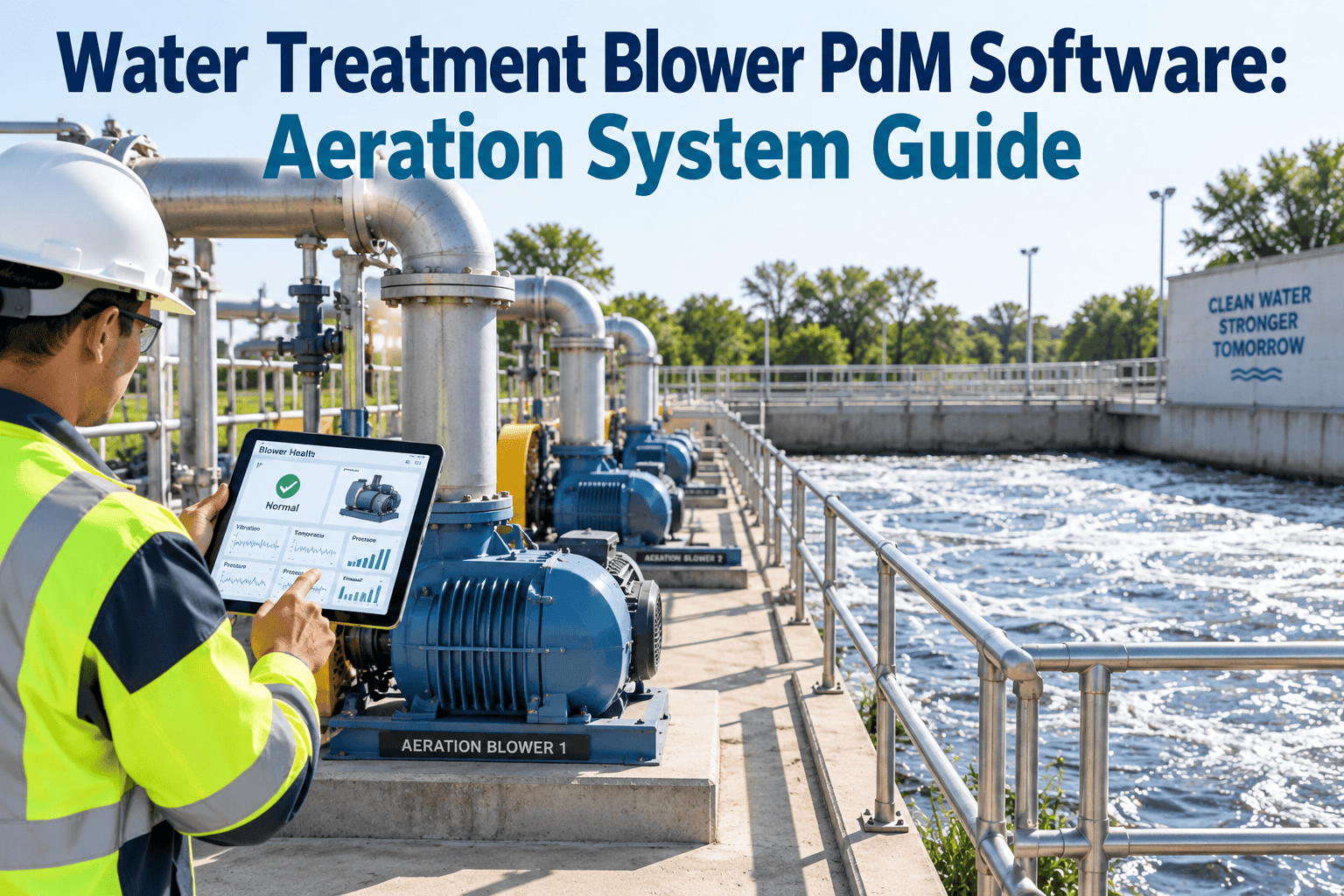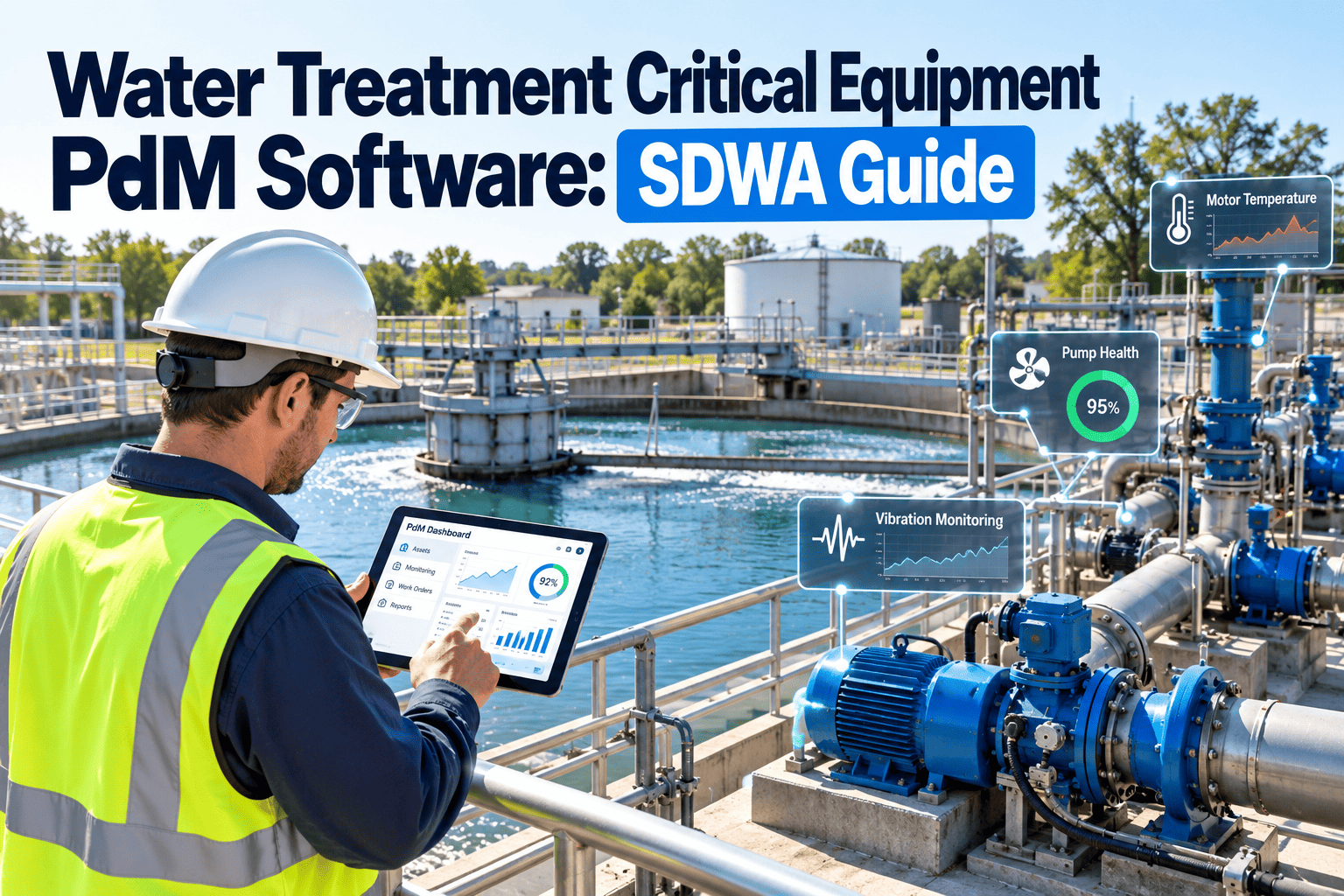
Water treatment plants depend on a short list of machines that cannot be allowed to fail quietly: clarifier drives, filter surface wash systems, chemical feed pumps, and disinfection equipment. Under the Safe Drinking Water Act, a failure in any of them is both a maintenance event and a possible compliance event. Predictive maintenance (PdM) gives operators early warning of wear and drift, so repairs happen in planned windows instead of during a turbidity spike. This guide shows how to build that discipline for critical equipment, and how maintenance management software keeps every signal, work order, and record in one place.
Critical Equipment PdM for Water Treatment Plants: An SDWA Compliance Guide
Clarifier drives, filter surface wash, and disinfection systems decide whether treated water meets its targets. Move them from run-to-failure to condition-based maintenance, with every action documented in a CMMS.
Where SDWA Meets the Maintenance Shop
The Safe Drinking Water Act sets performance targets, not maintenance schedules. Your equipment is how you meet them, so each requirement maps back to a machine.
| Compliance area | Equipment that protects it | What failure looks like | PdM signal to watch |
|---|---|---|---|
| Filter performance: combined filter effluent turbidity of 0.3 NTU or less in 95 percent of monthly samples, never above 1 NTU for conventional and direct filtration | Clarifier drives, surface wash, backwash pumps and valves | Floc carryover, mudballs, filter breakthrough | Clarifier torque trend, backwash flow, headloss recovery |
| Disinfectant residual entering distribution, detectable at all times and not below 0.2 mg/L for more than four hours | Chlorine feed pumps, chlorinators, analyzers, UV reactors, ozone generators | Lost dose, drifting analyzer, lamp output decline | Feed rate versus flow, analyzer versus grab sample, UV intensity |
| Monitoring and reporting records | Online analyzers, SCADA points, inspection rounds | Missing readings, unverifiable calibration | Calibration due dates, inspection completion |
| Contaminant control under the Lead and Copper Rule and related rules | Corrosion control chemical feed systems | Under-dosing that goes unnoticed | Metering pump output, tank level reconciliation |
Requirements vary by treatment technique and state. Confirm current limits with your primacy agency.
The Class A Test: Which Assets Deserve Predictive Maintenance
Not every pump needs sensors. Class A assets are those whose failure can breach a treatment objective, halt production, or endanger staff, with no ready backup.
Three questions that identify a Class A asset
- If it stops, can the plant still meet turbidity and residual targets at current demand?
- Is there an installed standby, and has it been run recently under load?
- How long would a replacement drive, lamp bank, or pump take to arrive?
Example placement only. Score your own assets with your operations and safety teams, then store the rating on each asset record.
Asset Dossiers: Failure Modes, Signals, and CMMS Response
Each Class A system fails in recognisable ways. The goal is to catch the early signal and route it into a work order automatically.
Failure modes
- Gearbox wear and degraded oil
- Torque overload from sludge buildup
- Rake or scraper damage
- Submerged bearing failure
Condition signals
- Rising torque or motor current trend
- Gearbox vibration and temperature
- Oil analysis for wear metals and water
- Unusual noise on operator rounds
CMMS response
- Run-hour lubrication PMs
- Work order when torque trend crosses a set band
- Sludge withdrawal check linked to the same asset
- Spare gearbox tracked in inventory
Failure modes
- Clogged nozzles on rotary arms
- Seized swivel joints
- Wash water pump pressure loss
- Slow or sticking valve actuators
Condition signals
- Pressure and flow at start of wash
- Arm rotation confirmed during inspection
- Headloss recovery after each backwash
- Actuator stroke time
CMMS response
- Per-filter inspection checklists
- Corrective order when recovery degrades
- Filter media inspection scheduled by run history
- Nozzle and swivel kits stocked per filter
Failure modes
- Diaphragm and check valve failure on feed pumps
- Analyzer drift or fouled sensors
- UV lamp ageing and sleeve fouling
- Ozone generator cooling problems
Condition signals
- Pump output versus flow-paced setpoint
- Analyzer reading versus daily grab sample
- UV intensity sensor and lamp hours
- Leak detector and scrubber test results
CMMS response
- Calibration PMs with recorded results
- Lamp replacement by hours, not failure
- Safety inspections tied to compliance records
- Standby pump exercise schedule
Give Every Class A Asset a Work History
Register clarifier drives, wash systems, and feed pumps, then attach PMs, inspections, and spares to each one.
Choosing the Right PdM Technique for Each Machine
Match the technique to the failure mechanism. Water plants often get the best results from simple process data combined with disciplined inspections.
| Technique | Best suited to | What it catches early | How it flows into the CMMS |
|---|---|---|---|
| Vibration analysis | Pump and drive motors, gearboxes | Bearing wear, misalignment, imbalance | Route readings logged against the asset; alert creates an order |
| Oil analysis | Clarifier and mixer gearboxes | Wear metals, water ingress, degraded lubricant | Sample PM with lab result attached |
| Thermography | Motor control centers, motors, connections | Loose connections, overheating windings | Inspection with photo, corrective order if abnormal |
| Torque and current trending | Clarifier drives, mixers | Sludge overload, mechanical drag | Threshold rule opens a work order |
| Process-based monitoring | Wash systems, feed pumps, filters | Loss of flow, pressure, or dose accuracy | Logged readings compared with baseline |
| Ultrasonic testing | Valves, air and chemical leaks | Internal leakage, early seal failure | Inspection findings converted to tasks |
The Condition-Based Work Order Lifecycle
A signal only helps if someone acts on it. This six-step loop turns readings into completed, documented repairs.
Signal
A reading, alarm, or round observation crosses a set band.
Validate
A reliability lead or senior operator confirms it is real.
Plan
Work order created with parts, procedure, and outage window.
Execute
Technician completes it on a mobile device with notes and photos.
Verify
Post-repair readings confirm the fault is cleared.
Learn
Failure cause is recorded and the alert threshold is refined.
Reactive Operation Versus Planned Reliability
The difference is easiest to see on an ordinary day at the plant.
Run to failure
- Gearbox noise noticed only after the drive trips
- Filters pulled from service without warning
- Feed pump failure found through a low residual
- Calibration records kept in binders
- Spares ordered after the breakdown
Condition-based with a CMMS
- Torque trend flags the drive weeks ahead
- Filter repairs scheduled around demand
- Feed pump rebuilt on a set interval
- Calibration results stored on the asset
- Spares reserved from inventory before the outage
KPIs That Show Whether PdM Is Working
Track a few measures consistently, and report them monthly to operations and management.
PM compliance
Share of scheduled PMs on Class A assets closed on time.
Planned versus unplanned work
A rising planned share shows PdM is displacing breakdowns.
Condition coverage
Percentage of Class A assets with a defined monitoring method.
MTBF on feed pumps
Mean time between failures for chemical pumps and lamps.
Mean time to repair
Measures how well parts and procedures are prepared.
Record completeness
Inspections and calibrations with complete, signed results.
A 90-Day Rollout That Stays Realistic
Start small, prove value on a few assets, then expand.
Register and rank
Load the asset register, assign criticality, and link manuals, spares, and existing PMs.
Baseline and inspect
Build mobile inspection rounds for drives, wash systems, and disinfection, and capture baseline readings.
Trigger and review
Set condition thresholds, route alerts to work orders, and review results in a monthly dashboard.
Common Mistakes to Avoid
- Applying the same PM interval to every pump regardless of duty
- Collecting readings that no one reviews or escalates
- Skipping standby equipment, then finding it seized during an emergency
- Leaving calibration and safety records outside the maintenance system
- Setting alert bands before establishing a baseline
Frequently Asked Questions
Does SDWA require predictive maintenance?
No. It sets treatment and monitoring requirements, and PdM is how many plants reliably meet them while keeping audit-ready records.
Which assets should I start with?
Start with clarifier drives, feed pumps, and surface wash systems that have no installed backup.
Do I need new sensors first?
Not always. Existing SCADA data and structured inspections can trigger useful work orders before you add hardware.
How does a CMMS support audits?
Calibrations, inspections, and repairs are time-stamped and tied to each asset, making retrieval simple.
Can I see it working on my own equipment?
Yes. You can book a walkthrough using your asset list.
Protect Water Quality With Maintenance You Can Prove
Bring clarifier drives, surface wash, and disinfection equipment into one condition-based maintenance system.