A reservation clinic tracks its generators in one spreadsheet, the housing authority logs boiler repairs in a paper binder, and the tribal college keeps its own maintenance notebook in a filing cabinet nobody outside the facilities office has ever opened. None of these records talk to each other, so when a BIA or IHS grant renewal asks for a unified facility condition report, someone spends three weeks reconstructing history that should have already existed. This fragmentation is not a paperwork inconvenience, it is a quiet, recurring cost that shows up as duplicate purchases, missed compliance deadlines, and assets that get replaced early simply because nobody could prove they were still serviceable. Talk to our team about bringing every facility record onto one shared system.
Tribal Facilities Reliability Series
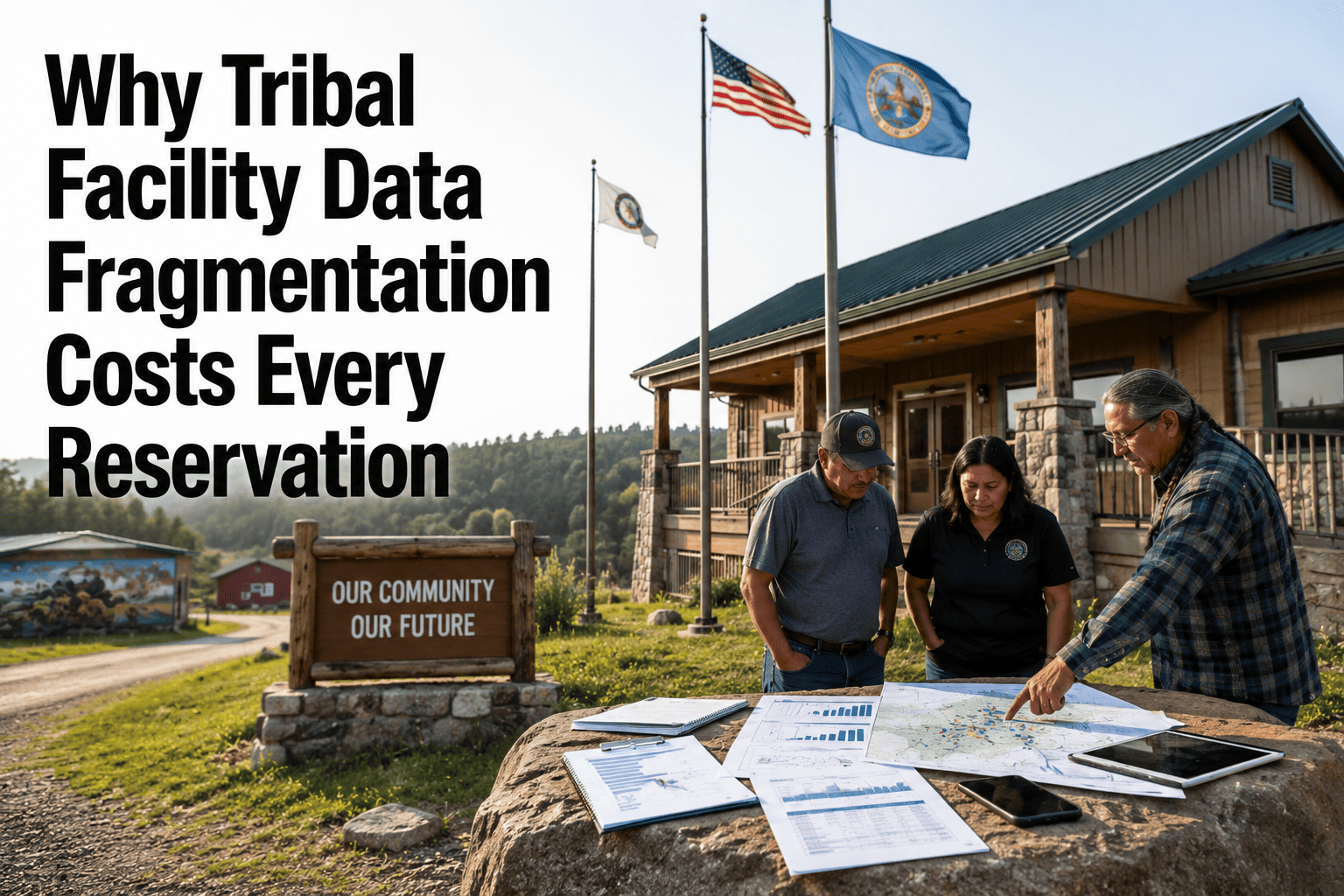
Why Tribal Facility Data Fragmentation Costs Every Reservation
A closer look at how scattered spreadsheets and paper logs across BIA, BIE, and IHS-funded facilities quietly drain tribal maintenance budgets, and what a unified asset view changes.
4-6
Separate record systems a typical reservation runs across clinics, schools, housing, and public works
3 wks
Average time spent reconstructing asset history for a single federal grant compliance report
2x
How often parts or equipment get duplicated across departments unaware of shared inventory
100%
Traceability tribes need to demonstrate for BIA, BIE, and IHS-funded facility investments
Where the Fragmentation Actually Lives
Data fragmentation on a reservation rarely looks like one dramatic failure. It looks like five departments that each built their own small, reasonable system years ago, none of which were ever designed to talk to the others. Over time, those systems calcify into habit, and nobody has the bandwidth to reconcile them until a compliance deadline or an emergency forces the question.
Health Facilities
IHS clinics often track biomedical and HVAC equipment separately from the rest of the reservation's facility records.
Tribal Schools
BIE-funded schools maintain boilers, buses, and building systems on their own logs disconnected from tribal public works.
Housing Authority
Housing maintenance requests and unit condition histories frequently live in a separate property management tool entirely.
Public Works and Utilities
Water, wastewater, and road equipment records are often the most mature system, but rarely shared outward.
Administrative Buildings
Tribal government offices and community centers frequently have no formal maintenance tracking system at all.
Grant-Funded Assets
Equipment purchased through federal grants needs its own traceable history, which fragmentation makes difficult to produce.
The Real Cost of Disconnected Records
When facility data lives in silos, the cost does not announce itself as a single expense. It accumulates through decisions made without full information, and the table below lays out the pattern most reservations recognize once they compare notes across departments.
| Fragmentation Symptom |
Department Affected |
Downstream Cost |
| Duplicate part purchases |
Public Works, Housing |
Unnecessary spend on parts already in another department's inventory |
| Lost maintenance history |
Health, Schools |
Equipment replaced early because service records could not be produced |
| Missed compliance deadlines |
All departments |
Grant funding risk from incomplete facility condition reporting |
| Manual report reconstruction |
Administration |
Weeks of staff time diverted from operational work |
| No cross-department visibility |
All departments |
Slower emergency response when shared equipment status is unknown |
One Facility Record for the Whole Reservation
Oxmaint brings health, education, housing, and public works asset records into a single connected system built for tribal facility teams.
The Data Maturity Path for Tribal Facilities
Moving from fragmented records to a unified asset view does not happen overnight, and it should not require replacing every department's workflow at once. The stages below describe the realistic path most reservations follow toward a single source of facility truth.
1
Paper and Memory
Maintenance history exists mostly in the heads of long-tenured staff and scattered paper logs.
2
Departmental Spreadsheets
Each department keeps its own digital records, but formats and update frequency vary widely.
3
Shared Folder Coordination
Departments share files periodically, but there is no live system reflecting current asset condition.
4
Unified Digital Platform
All departments log assets, work orders, and inventory in one shared, searchable system.
5
Grant-Ready Reporting
Compliance and condition reports for BIA, BIE, and IHS funders are generated directly from live records.
Building a Unified Asset View in Four Phases
Tribal facility teams that successfully consolidate their records tend to follow a similar sequence, one that respects each department's existing workflow while steadily building toward a shared system everyone can trust.
1
Inventory What Already Exists
Catalog every department's current tracking method, from spreadsheets to paper logs, before changing anything.
2
Standardize Asset Records
Align naming conventions and asset categories across departments so records can eventually merge cleanly.
3
Migrate to a Shared Platform
Move each department's records onto one system in phases, starting with the highest compliance risk area.
4
Train and Sustain
Establish ongoing data entry habits and reporting routines so the unified view stays accurate long term.
Before we consolidated, our clinic, our school, and our public works department each thought they were the only ones tracking the community center's HVAC system. Turned out none of them were, fully. When a federal reviewer asked for maintenance history on grant-funded equipment, we had to piece it together from four different sources. Now every department logs into the same system, and pulling a compliance report takes an afternoon instead of a month.
Facilities Director, Tribal Nation Public Works
Frequently Asked Questions
Which departments typically benefit most from consolidation?
Health facilities, tribal schools, housing authorities, and public works see the fastest impact, since these departments most often share equipment, vendors, or funding sources without realizing it.
Does this replace each department's existing workflow?
No, a
unified platform is designed to sit underneath existing workflows, giving each department its own view while feeding one shared reservation-wide record.
How does this help with BIA and IHS grant compliance?
Grant reporting requires demonstrable asset history and condition tracking, which a unified system produces automatically instead of requiring manual reconstruction before every deadline.
What happens to years of existing paper records?
Historical paper and spreadsheet records can be migrated in batches during the standardization phase, so institutional knowledge is not lost during the transition.
How long does a typical consolidation take?
Most reservations complete the four-phase process within two to four months, starting with the department facing the nearest compliance deadline.
Give Every Department the Same Facility Picture
See how Oxmaint helps tribal facility teams replace scattered spreadsheets with one connected, audit-ready system.