Drug discovery has historically been one of humanity's most expensive and time-consuming endeavors. Developing a single new medicine takes an average of 12 to 15 years and costs upwards of $2.6 billion, with a failure rate exceeding 90% in clinical trials. Artificial intelligence is fundamentally restructuring this calculus. By applying machine learning, deep neural networks, and predictive modeling to biological data at a scale no human team could process, AI platforms are compressing timelines, slashing attrition rates, and identifying drug candidates that traditional methods would have entirely missed. From early-stage target identification to late-stage clinical trial design, AI is rewriting the rules of pharmaceutical R&D — and the pace of adoption is accelerating rapidly. Sign up free to explore how AI-powered platforms are reshaping pharmaceutical innovation today.
Explore AI-Powered Drug Discovery Platforms
See how leading pharmaceutical teams leverage AI to accelerate their pipeline from target to clinical candidate.
The Scale Problem AI Was Built to Solve
The human genome encodes approximately 20,000 proteins, yet fewer than 700 have been successfully targeted by approved drugs. Meanwhile, the universe of drug-like small molecules is estimated at 10 to the power of 60 — a combinatorial space no wet-lab approach could meaningfully search. Traditional high-throughput screening, while faster than manual methods, still physically tests millions of compounds against a single target and produces enormous quantities of data requiring months of expert interpretation.
AI transforms this equation by learning the underlying patterns in biological and chemical data. Trained on decades of genomic databases, protein structures, clinical outcomes, and published literature, AI models can predict with remarkable accuracy which molecules are likely to bind a given target, which compounds will be toxic, and which patient subpopulations will respond to a candidate therapy. The result is a virtual funnel that narrows the experimental search space before a single compound is synthesized in a lab.
AI in Target Identification and Validation
The first critical step in drug discovery is identifying which biological target — a protein, receptor, or enzyme — drives a disease. Historically, this required years of foundational research, hypothesis testing, and serendipitous observation. AI platforms now analyze multi-omics datasets combining genomics, proteomics, transcriptomics, and metabolomics to surface disease-associated targets with high confidence scores.
Natural language processing models trained on biomedical literature can extract mechanistic hypotheses from millions of published papers, identifying connections between genes, proteins, and disease phenotypes that no research team could synthesize manually. Graph neural networks map these relationships as biological knowledge graphs, highlighting which nodes in a disease pathway are most amenable to therapeutic intervention. AlphaFold's landmark protein structure prediction capability — now embedded in drug discovery workflows globally — further enables researchers to assess target druggability by visualizing binding pockets even in proteins that had never been crystallized. Book a demo to see how AI target identification tools integrate into your existing R&D workflow.
Key AI Capabilities in Target Identification
| AI Technique | Application | Impact |
|---|---|---|
| Graph Neural Networks | Biological pathway mapping and target ranking | Surfaces non-obvious therapeutic nodes |
| NLP / LLMs | Literature mining and hypothesis generation | Years of reading compressed to hours |
| Structure Prediction (AlphaFold) | 3D protein structure and binding site analysis | Druggability assessment without crystallography |
| Multi-omics Integration | Cross-modal disease signature analysis | Higher confidence target validation |
Generative AI and Molecule Design
Perhaps the most transformative application of AI in drug discovery is the de novo design of novel therapeutic molecules. Rather than screening existing compound libraries, generative AI models — including variational autoencoders, generative adversarial networks, and transformer-based architectures — learn the chemical grammar of drug-like molecules and then generate entirely new structures optimized for specific properties. These properties can include binding affinity to a target, selectivity against related proteins, metabolic stability, cell membrane permeability, and aqueous solubility.
Reinforcement learning frameworks further refine this process by rewarding the model for generating molecules that score well across multiple objectives simultaneously — a multi-parameter optimization problem that is computationally intractable by traditional methods. Insilico Medicine's generative chemistry platform, for instance, designed a clinical candidate for idiopathic pulmonary fibrosis in under 18 months, compared to an industry average of more than five years for the preclinical phase alone. Recursion Pharmaceuticals, Exscientia, and Schrodinger have similarly demonstrated that AI-designed molecules can reach clinical trials with favorable drug-like properties and novel mechanisms of action. Sign up free to discover how generative molecule design platforms can accelerate your lead discovery pipeline.
Accelerating Clinical Trials with AI
Clinical trials represent the most costly and time-intensive phase of drug development, consuming more than 60% of total R&D expenditure. AI is making measurable inroads across every dimension of trial design and execution. Predictive models analyze electronic health records, genetic biomarkers, imaging data, and claims databases to identify ideal patient cohorts, dramatically improving enrollment speed while reducing screen-failure rates — one of the leading drivers of trial cost overruns.
Adaptive trial design platforms powered by Bayesian machine learning models allow real-time modification of dosing arms, patient stratification, and primary endpoints based on interim data signals, without compromising statistical integrity. This flexibility can reduce the number of patients required to reach statistically significant results and shorten overall trial duration. Furthermore, AI-powered pharmacovigilance systems continuously monitor safety signals across real-world data streams, enabling earlier detection of adverse events and more responsive risk management throughout the trial lifecycle.
Precision Medicine and Biomarker Discovery
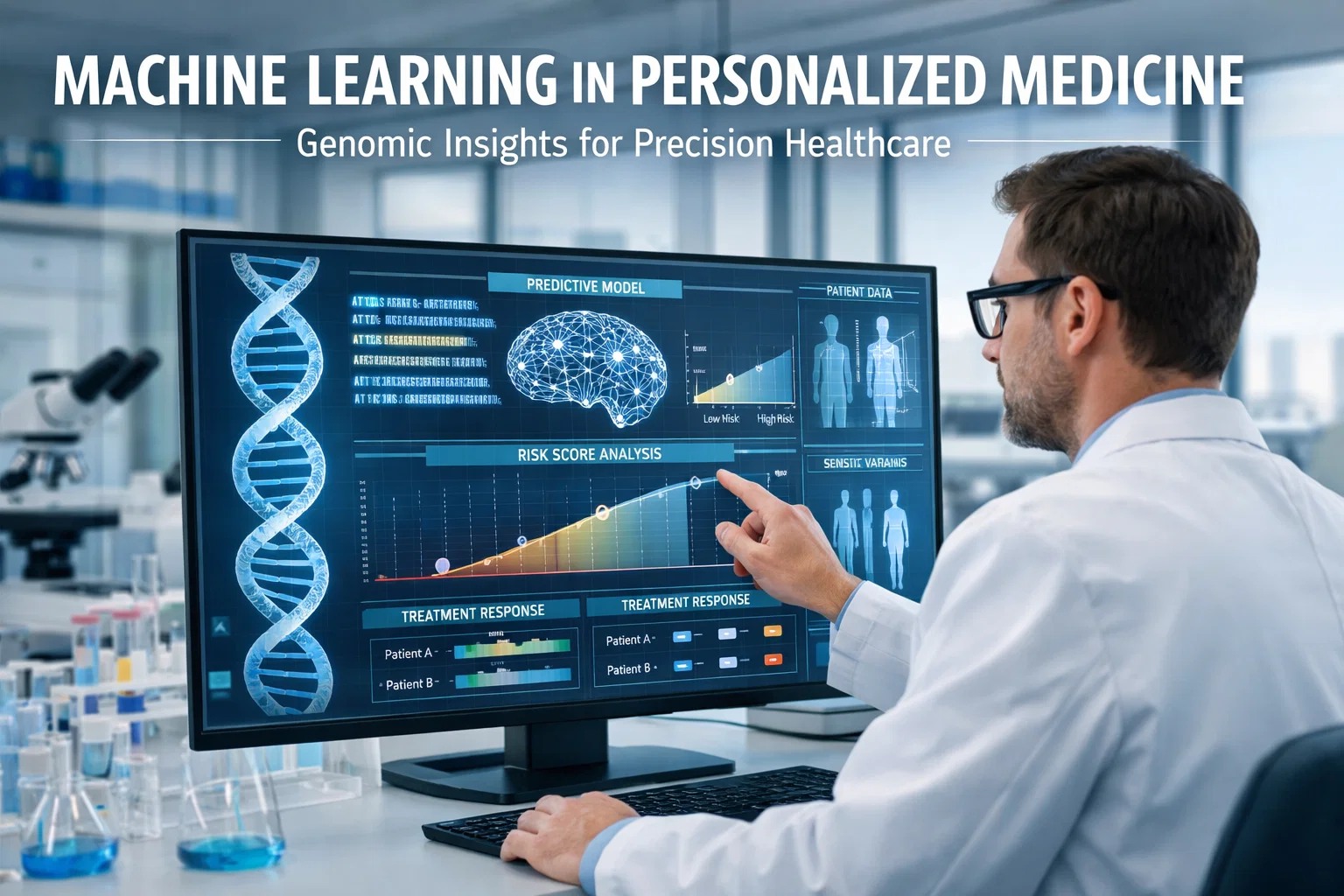
One of the most profound long-term contributions of AI to pharmaceutical development is enabling precision medicine — the matching of specific drugs to the specific patients most likely to respond. Population-level clinical trials often mask subgroup effects that render a drug highly effective for some patients and ineffective or harmful for others. AI models that analyze genomic data, protein expression profiles, microbiome composition, and longitudinal clinical records can identify predictive biomarkers that stratify patient populations with far greater resolution than traditional statistical approaches allow.
In oncology, deep learning models trained on tumor genomics data have identified mutation signatures that predict response to immunotherapy, enabling oncologists to select treatments with evidence-based confidence rather than trial and error. This biomarker-guided approach simultaneously improves patient outcomes and reduces the patient numbers required for statistically powered clinical trials, cutting both cost and development timelines. The FDA's increasing openness to companion diagnostic approvals co-developed with AI platforms signals a regulatory environment that is catching up with the science. Book a demo to learn how AI-driven biomarker discovery can strengthen your precision medicine strategy.
Challenges, Limitations, and the Path Forward
Despite extraordinary progress, AI drug discovery faces real and substantial challenges that temper near-term expectations. Training data quality and availability remain the primary constraint — AI models are only as reliable as the datasets they learn from, and pharmaceutical data has historically been siloed, inconsistently curated, and biased toward failed compounds that were never published. Federated learning approaches and pre-competitive data sharing consortia are beginning to address these gaps, but the problem of distribution shift — where a model trained on existing drug classes generalizes poorly to novel chemical scaffolds — remains unsolved.
Interpretability is a second persistent challenge. Regulatory agencies require mechanistic explanations for drug activity that "black box" deep learning models cannot easily provide. Explainable AI approaches — including attention visualization, concept-based explanations, and causal inference frameworks — are an active research frontier, but they are not yet mature enough to fully satisfy regulatory documentation requirements. Finally, the translation gap between in silico predictions and in vivo biological behavior remains wider than AI proponents often acknowledge, underscoring that AI accelerates discovery but does not eliminate the fundamental complexity of biology.
Accelerate Your Pharmaceutical Pipeline with AI
Discover how AI-native platforms are helping research teams move from target to clinical candidate in record time — without sacrificing rigor.
The Competitive Landscape: Who Is Leading AI Drug Discovery
The AI drug discovery ecosystem has matured rapidly from a collection of academic spinouts into a strategically important segment of global pharmaceutical R&D. Pure-play AI biotech companies have demonstrated that AI-native approaches can deliver clinical candidates at speeds and costs that compete favorably with traditional methods, attracting substantial partnership capital from major pharmaceutical corporations. Large pharma has responded through a combination of internal AI capability building, strategic acquisitions, and multi-year collaboration agreements that give AI platforms access to proprietary clinical data in exchange for co-development rights.
Frequently Asked Questions
How does AI reduce the time required for drug discovery?
AI compresses timelines at multiple stages simultaneously. In target identification, it processes multi-omics data in days rather than years. In lead discovery, it screens virtual chemical libraries orders of magnitude larger than physical compound collections. In lead optimization, it proposes synthesis-ready improvements in hours rather than months of iterative medicinal chemistry. Cumulatively, AI-native approaches have demonstrated preclinical timelines four to five years shorter than traditional methods.
What types of AI are most commonly used in pharmaceutical research?
The most impactful AI techniques in drug discovery include graph neural networks for molecular property prediction and biological network analysis, transformer-based large language models for literature mining and protein sequence modeling, generative adversarial networks and diffusion models for de novo molecule design, and Bayesian optimization methods for adaptive clinical trial design. Convolutional neural networks are also widely applied to pathology image analysis and compound screening data.
Can AI design drugs entirely without human scientists?
No. AI functions as a powerful acceleration and prioritization tool within human-led scientific programs. Human expertise remains essential for framing disease hypotheses, interpreting AI outputs in biological context, designing experiments that generate high-quality training data, and navigating the regulatory and ethical dimensions of drug development. The most effective drug discovery programs integrate AI decision support throughout a workflow that remains fundamentally human-directed.
What is AI drug repurposing and why is it gaining attention?
AI drug repurposing uses knowledge graphs, molecular similarity analysis, and network pharmacology models to identify existing approved drugs that may be effective against new disease targets. Because repurposed drugs already have established human safety profiles, they can enter Phase II trials directly, bypassing Phase I dose-escalation studies entirely. The COVID-19 pandemic accelerated interest in repurposing after AI platforms identified several existing antivirals and anti-inflammatory agents as candidate treatments within weeks of the pandemic's onset.
How is AI used in clinical trial optimization?
AI improves clinical trials through patient matching algorithms that mine electronic health records to identify eligible participants, predictive models that forecast dropout and non-compliance risk, adaptive trial design platforms that modify protocol parameters in response to interim data, and pharmacovigilance systems that detect safety signals continuously across real-world data feeds. Together these capabilities can reduce overall trial duration by 20 to 40% while improving the probability of statistical success.
Are AI-discovered drugs approved by regulatory agencies?
Regulatory approval is based on the clinical evidence package — safety and efficacy data from human trials — rather than the discovery method. Several AI-designed drug candidates are currently in Phase II and Phase III clinical trials, with the first fully AI-designed molecules expected to complete late-stage trials within the next two to three years. Regulatory agencies including the FDA and EMA have issued guidance acknowledging AI's role in drug development and are actively developing frameworks for evaluating AI-generated evidence.