Hospital facilities teams face a relentless challenge: keeping millions of square feet of complex infrastructure running without a single critical failure. HVAC systems that drift out of calibration can compromise sterile surgical environments. An undetected fault in a backup generator can cascade into a life-threatening power outage. Water system anomalies can trigger Legionella outbreaks that shut down entire wings. Traditional time-based maintenance schedules are no longer sufficient to manage this level of complexity and risk. AI-powered predictive maintenance is now giving hospital facilities engineers the foresight to act before failures happen — protecting patients, staff, and the infrastructure they depend on every day. Smart hospital facility management platforms powered by predictive analytics are rapidly becoming the standard of care for healthcare operations infrastructure management, replacing guesswork with data-driven precision across every critical building system.
The Hidden Cost of Reactive Facility Maintenance in Healthcare
Most hospital facilities departments operate under severe resource constraints, managing hundreds of assets across sprawling campuses with lean engineering teams. When maintenance is reactive — responding only after equipment fails — the consequences extend far beyond the repair bill. Emergency HVAC repairs during summer can cost three to five times more than planned interventions. Hospitals that switch to AI-driven condition monitoring consistently cut emergency repair costs by 25–40% — sign up for OxMaint to stop paying emergency rates. Generator failures during peak demand hours force the activation of expensive emergency protocols. Repeated boiler outages disrupt central sterile supply departments, delaying surgical schedules and creating compliance headaches with accreditation bodies.
Beyond direct costs, unplanned infrastructure failures directly threaten patient safety. Operating rooms require precise temperature and humidity control. ICUs depend on uninterrupted power for life-critical devices. Pharmacy clean rooms must maintain positive pressure differentials at all times. Any deviation, even brief, can trigger regulatory reviews and patient harm investigations. For healthcare facility managers, the stakes of a missed maintenance signal are fundamentally different from those in commercial real estate or manufacturing.
What AI Predictive Maintenance Means for Hospital Infrastructure
From Reactive Repairs to Predictive Analytics Facility Maintenance
AI predictive maintenance combines continuous sensor monitoring with machine learning algorithms to detect the early warning signs of equipment degradation — well before a failure event occurs. Unlike preventive maintenance, which services equipment on a fixed calendar regardless of actual condition, predictive maintenance intervenes precisely when the data signals that intervention is needed. This condition-based approach dramatically reduces both over-maintenance and emergency repairs simultaneously.
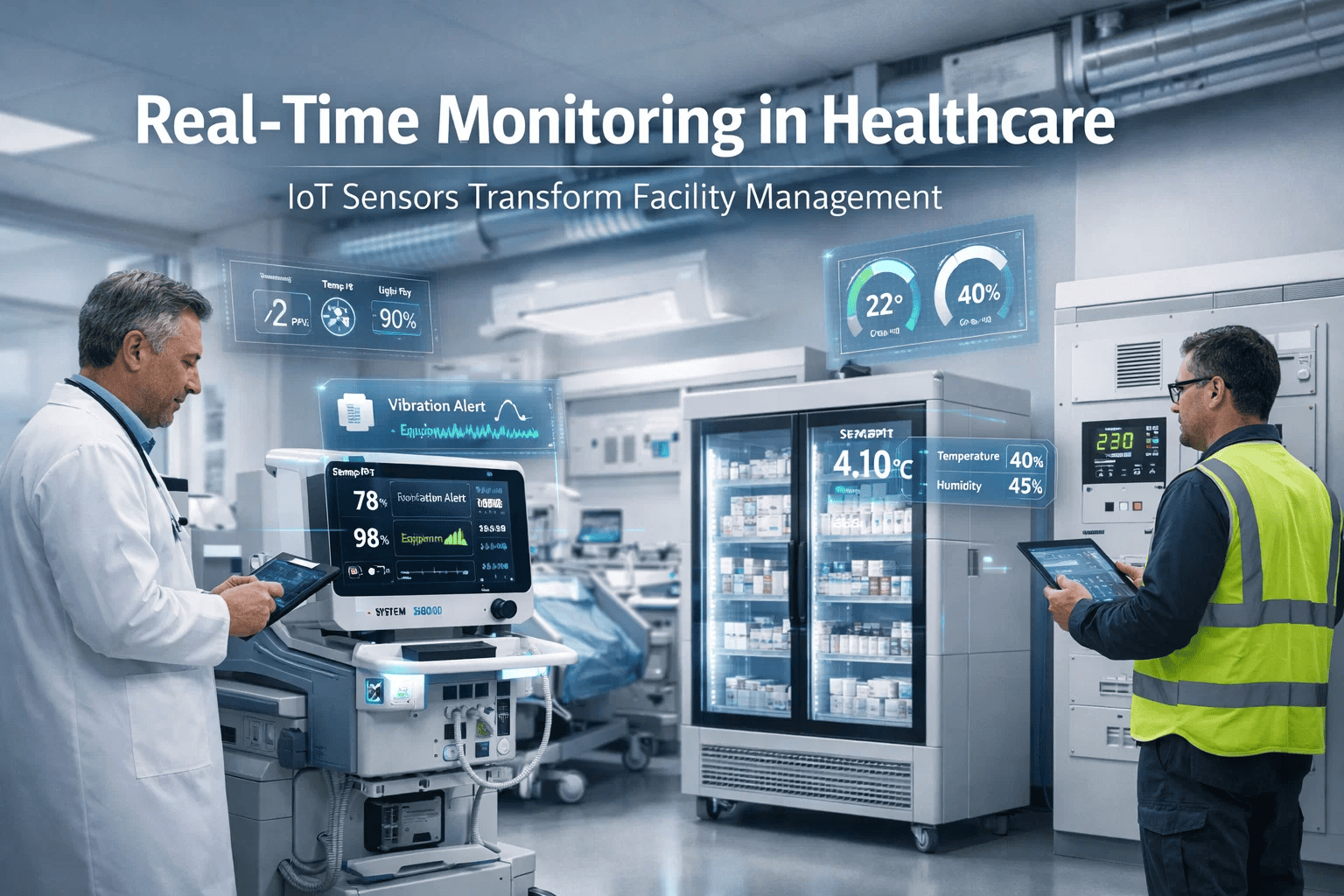
In a hospital facility context, this means embedding sensors across HVAC units, chillers, boilers, electrical switchgear, emergency generators, water systems, and building automation components. These sensors stream performance data — temperature deltas, vibration signatures, pressure fluctuations, voltage irregularities, flow rates — to a central AI analytics platform. The AI models learn what normal operation looks like for each asset under varying load conditions and seasonal patterns. When readings begin to deviate from established baselines, the system generates alerts, risk scores, and prioritized work orders automatically.
The Role of Healthcare Facility Analytics Platforms
A healthcare facility analytics platform sits at the core of any mature predictive maintenance program. Unlike basic CMMS software that simply logs maintenance history, a true analytics platform ingests real-time sensor streams, applies machine learning models, and surfaces actionable intelligence through role-based dashboards. Facilities directors see portfolio-level risk scores and budget forecasts. Engineers see asset-level health trends and upcoming interventions. OxMaint is purpose-built as exactly this kind of platform for healthcare — book a demo to see how it gives your team real-time control. Technicians see prioritized work queues with full context on their mobile devices. This layered intelligence structure is what separates reactive facilities management from genuinely smart hospital facility management — and it is what drives the measurable outcomes hospitals are reporting across every operational metric.
Critical Hospital Infrastructure Systems That Benefit Most
Prioritizing Assets by Clinical and Financial Risk
Every hospital system is a candidate for predictive monitoring, but certain infrastructure categories carry the highest risk profile and therefore deliver the greatest return when covered by AI-driven analytics. Facilities teams should prioritize deployment on the assets where failure consequences are most severe — clinically, operationally, and financially.
How the AI Analytics Engine Works in Practice
Machine Learning Models Built for Healthcare Infrastructure Monitoring
The intelligence layer that powers predictive maintenance is built on machine learning models trained on large historical datasets of equipment performance under normal and degraded conditions. These models learn the unique behavioral signature of every monitored asset, accounting for variables like seasonal load patterns, operational schedules, equipment age, and maintenance history. As more data accumulates, predictions become progressively more accurate and facility-specific.
Compliance and Regulatory Benefits of Predictive Facility Maintenance
Meeting Joint Commission, CMS, and NFPA 99 Requirements Automatically
Hospital facilities management carries a heavier regulatory burden than almost any other industry. Joint Commission Environment of Care standards, CMS Conditions of Participation, NFPA 99 healthcare facilities code, and ASHRAE 170 ventilation requirements all impose rigorous documentation and performance obligations on facilities teams. Traditional paper-based or spreadsheet-driven maintenance programs struggle to produce the consistent, auditable records that surveyors demand.
AI-powered maintenance platforms automatically generate complete digital audit trails for every maintenance action, inspection, and corrective work order. Compliance checklists aligned with Joint Commission standards are pre-built into the workflow, ensuring that engineers capture every required data point at each visit. When survey teams arrive, compliance documentation is available instantly as structured reports rather than stacks of paper binders. Facilities managers can demonstrate not just that maintenance was performed, but that it was performed on the right assets, at the right intervals, with the right outcomes — precisely what accreditation bodies need to see.
Integration with Existing Hospital Infrastructure and CMMS Platforms
Hospital Utilities Maintenance Software That Works with What You Already Have
A concern frequently raised by hospital facilities directors is the complexity of integrating new predictive analytics platforms with existing systems. Modern AI building maintenance solutions for hospitals are designed to address this directly. Leading solutions are hardware-agnostic, connecting to sensor data from any manufacturer protocol — whether BACnet, Modbus, SNMP, or proprietary equipment communication interfaces. They integrate bidirectionally with existing CMMS platforms, electronic health records systems, and building automation systems, meaning facilities teams do not need to replace the tools they already depend on.
For hospitals that have not yet deployed IoT sensor infrastructure, implementation can begin incrementally — starting with the highest-risk assets and expanding coverage as the program matures. Many platforms also support integration with existing BAS data streams, effectively transforming already-deployed infrastructure into a predictive intelligence network without additional sensor hardware on every asset. No rip-and-replace required — OxMaint connects to what you already have, so your team can sign up and start monitoring critical assets within days, not months. The result is a phased, financially manageable path to full predictive capability rather than a disruptive, all-or-nothing technology overhaul. Hospital utilities maintenance software that integrates seamlessly with existing workflows removes the single biggest barrier to adoption — the fear of disruption — and allows engineering teams to build confidence in AI-driven recommendations before full deployment.
Choosing the Right Healthcare Facility Management System
What to Look for in a Hospital Engineering Maintenance System
Not all facility management software is built for the specific demands of healthcare environments. A hospital engineering maintenance system must go beyond basic work order tracking to deliver genuine predictive intelligence, regulatory compliance automation, and multi-site visibility. When evaluating platforms, facilities directors should assess five core capabilities: real-time sensor data ingestion, AI-powered anomaly detection and failure prediction, mobile-first technician workflows, automated compliance documentation aligned with healthcare standards, and open integration architecture that connects with existing CMMS and BAS platforms.
Equally important is scalability. A community hospital managing 200 assets today may grow into a multi-campus health system managing 5,000 assets within a decade. The chosen platform must scale without requiring a system replacement. Cloud-based healthcare facility management systems offer the most flexible deployment model — eliminating on-premises infrastructure costs while delivering enterprise-grade security, automatic updates, and cross-facility analytics from day one.
Healthcare Infrastructure Monitoring Technology: Key Features Checklist
When comparing healthcare infrastructure monitoring technology solutions, the following capabilities separate genuine AI-powered platforms from basic digitized maintenance logs. Look for platforms that offer condition-based monitoring with configurable alert thresholds, remaining useful life calculations for critical components, automated work order generation with parts and labor recommendations, role-based dashboards with drill-down from portfolio to individual asset, and pre-built compliance checklists aligned with Joint Commission EC and EM standards. The ability to benchmark performance across facilities — identifying which sites are outperforming and why — is a defining feature of mature healthcare facility analytics platforms that delivers strategic value beyond day-to-day operations.
Building the Business Case for AI Predictive Maintenance
Quantifying ROI Across Cost Avoidance, Efficiency, and Risk Mitigation
Securing capital investment for predictive maintenance technology requires a compelling financial argument aligned with hospital leadership priorities. The business case is straightforward when broken down across three value dimensions: cost avoidance, operational efficiency, and risk mitigation. A single avoided emergency chiller replacement at a 500-bed hospital can save $300,000 to $500,000 in emergency parts, contractor labor, and temporary cooling measures. Preventing one unplanned generator failure that triggers a Joint Commission incident review saves not just remediation costs but potentially millions in reputational and regulatory consequences.
On the efficiency side, predictive maintenance platforms typically reduce technician travel time by routing work intelligently, reduce parts waste by replacing components at the right lifecycle point rather than on arbitrary schedules, and reduce overtime hours driven by emergency response. Energy savings from optimized HVAC and chiller performance frequently contribute an additional 10 to 20 percent cost reduction on utility budgets. Most facilities see full ROI within 12–24 months — book a demo to see a cost breakdown tailored to your facility size. Taken together, most healthcare facilities report full ROI within 12 to 24 months of deployment — with ongoing savings compounding annually as the AI models become more accurate and maintenance programs more proactive.
Frequently Asked Questions
How is predictive maintenance different from preventive maintenance for hospital facilities?
Preventive maintenance follows a fixed calendar — servicing equipment at set intervals regardless of actual condition. This leads to both over-servicing of healthy assets and missed failures that occur between scheduled checks. Predictive maintenance uses real-time sensor data and AI analysis to intervene only when the data signals that an asset is degrading toward failure. This approach reduces unnecessary maintenance labor while catching actual developing faults weeks or months before they cause downtime.
Which hospital infrastructure systems should be prioritized for predictive monitoring?
High-priority systems are those where failure carries the greatest patient safety, regulatory, or operational risk. HVAC and air handling units serving operating rooms, isolation suites, and pharmacy clean rooms sit at the top of the priority list. Emergency power systems, central chiller and boiler plants, and domestic water distribution networks are close behind. As monitoring programs mature, coverage can expand to elevators, medical gas systems, and building automation infrastructure.
Does implementing AI predictive maintenance require replacing existing CMMS systems?
No. Leading AI predictive maintenance platforms are designed to integrate with existing CMMS, BAS, and asset management systems rather than replace them. They function as an intelligence and alerting layer that feeds actionable insights into the workflows teams already use. For hospitals that lack existing CMMS infrastructure, integrated platforms like OxMaint provide both the AI analytics and the maintenance management functionality in a single cloud-based solution.
How does predictive maintenance support Joint Commission compliance?
AI-powered maintenance platforms automatically generate the detailed, timestamped documentation that Joint Commission surveyors require under Environment of Care standards. Pre-built inspection checklists aligned with EC and EM chapters ensure that every required data point is captured consistently. Compliance reports can be generated on demand, eliminating the manual effort of compiling paper records and significantly reducing survey preparation time for facilities managers.
What is a realistic timeline to see ROI from AI predictive maintenance in a hospital?
Most hospitals begin seeing measurable outcomes within the first three to six months of deployment, as the AI models establish baselines and begin detecting genuine anomalies before they become failures. Full financial ROI — accounting for avoided emergency repairs, extended asset life, and efficiency gains — is typically realized within 12 to 24 months. The compounding nature of predictive programs means savings accelerate over time as models become more accurate and maintenance teams shift more of their capacity from reactive to planned work.
What is a healthcare facility analytics platform and how does it differ from standard CMMS software?
A healthcare facility analytics platform combines real-time IoT sensor data ingestion, machine learning-powered anomaly detection, and operational dashboards into a single system purpose-built for hospital environments. Standard CMMS software primarily tracks work orders, maintenance history, and asset records — it is a record-keeping tool. A healthcare facility analytics platform goes further by actively predicting failures before they occur, automatically generating prioritized work orders, and providing strategic intelligence on asset health trends, energy performance, and compliance status across single or multi-campus environments.
How does AI building maintenance software help hospitals manage hospital power system monitoring?
AI building maintenance software monitors hospital power systems by continuously tracking electrical parameters across generators, automatic transfer switches, UPS systems, transformers, and distribution panels. Machine learning models establish normal operating baselines for each component and flag deviations — such as voltage fluctuations, abnormal thermal signatures, or unusual load patterns — that indicate developing faults. Automated alerts reach engineers with sufficient lead time to schedule planned repairs during off-peak hours, preventing the unplanned power events that carry the most severe clinical and financial consequences for healthcare facilities.
Can small and mid-sized hospitals benefit from smart hospital facility management platforms?
Yes — cloud-based smart hospital facility management platforms are accessible and cost-effective for facilities of any size. Small and mid-sized hospitals benefit just as significantly from avoiding emergency repairs on critical equipment as large academic medical centers. Cloud deployment eliminates the need for expensive on-premises server infrastructure, and modular pricing models allow smaller facilities to start with coverage on their highest-risk assets and expand incrementally. The absence of a large IT budget is no longer a barrier to deploying genuine predictive intelligence across hospital engineering maintenance systems.