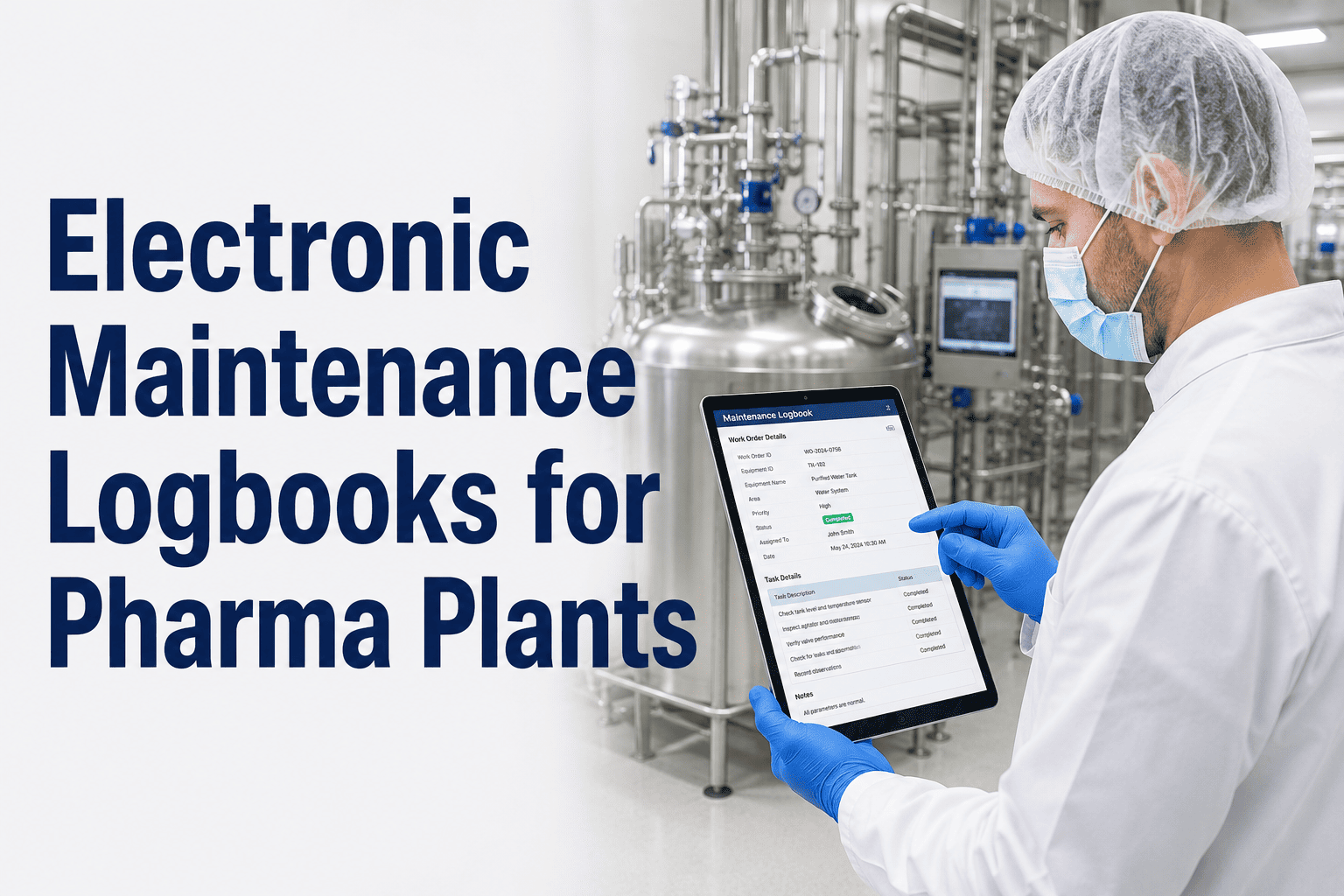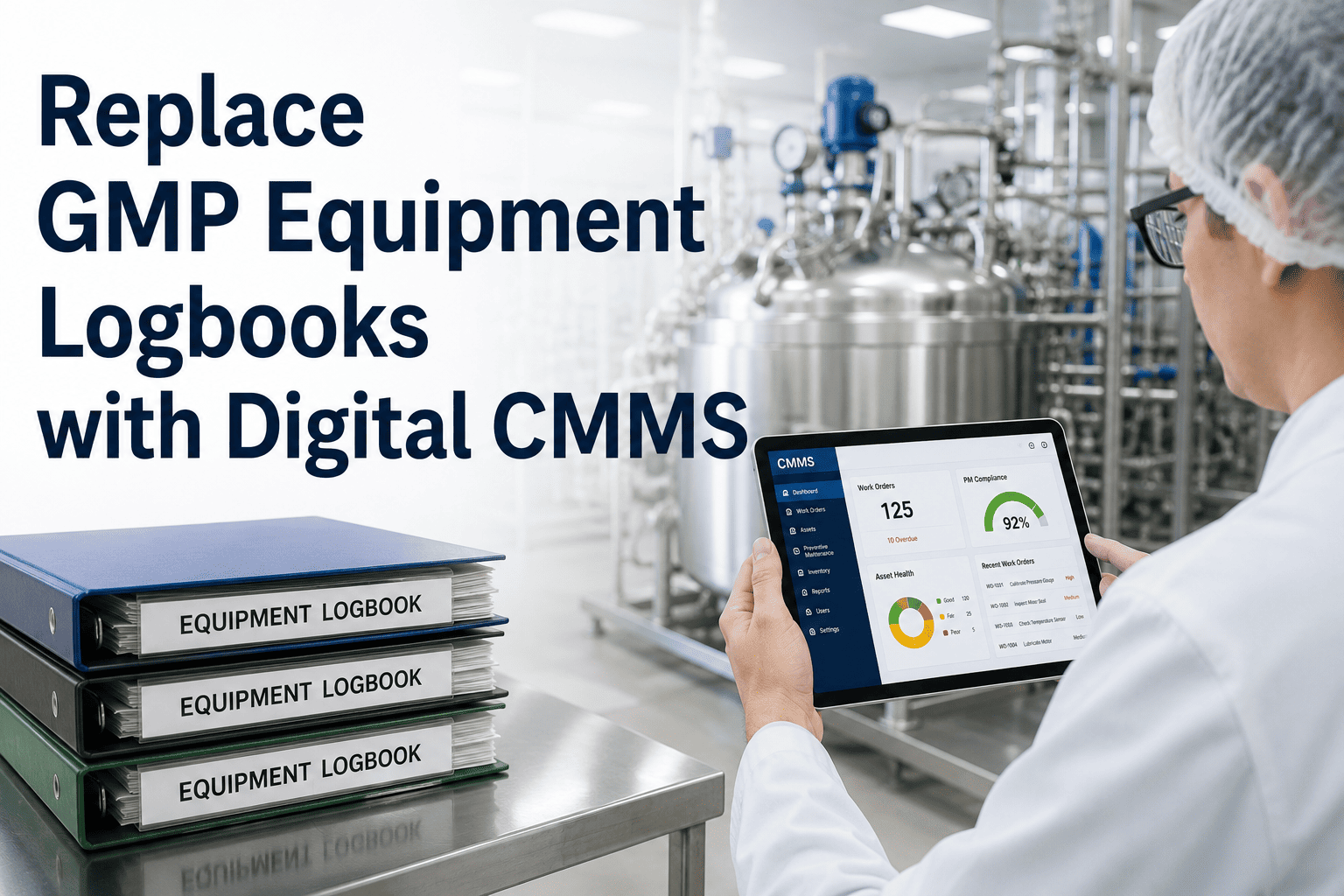
Paper equipment logbooks are among the most persistent compliance risks in pharmaceutical manufacturing — they get lost, damaged, illegible, or incomplete at exactly the wrong moment. When an FDA inspector asks for the last three years of usage and maintenance history for your tablet press, the answer should not be a stack of binders. OxMaint replaces paper logbooks with validated digital asset histories — searchable in seconds, signed electronically, and audit-ready on demand.
LANDING PAGE
Replace Paper GMP Equipment Logbooks with Digital CMMS
Searchable asset history. Electronic signatures. PM evidence. Inspection-ready — in one validated platform.
Paper Logbook
Lost or damaged records
Illegible handwriting
No version control
Manual retrieval — hours
Cannot verify e-signature
Fails Part 11 audit
VS
OxMaint Digital
Encrypted, cloud-backed
Structured data fields
Full change history
Search in seconds
21 CFR Part 11 e-sign
Inspection-ready always
What a Digital Equipment Logbook Captures
01
Equipment Usage Log
Every use event, operator ID, start/end time, batch or order number, and any observations — structured and searchable. No more hunting through handwritten shift logs.
02
Maintenance and Repair History
All PM completions, corrective work orders, parts replacements, and calibration events linked to the equipment record — complete lifecycle history in one place.
03
Electronic Signatures
Technician and supervisor signatures captured with user ID, timestamp, and meaning statement — fully compliant with 21 CFR Part 11 signature requirements.
04
Cleaning and Sanitization Records
Cleaning events with agent used, method, operator, and sign-off — formatted for batch record attachment and regulatory inspection without additional data entry.
05
Deviation and CAPA Links
Any equipment event that triggered a deviation or CAPA is permanently linked in the asset history. Investigators can trace from batch record to equipment event to corrective action in one click.
06
Calibration Status and Due Dates
Current calibration status, last calibration date, next due date, and calibration certificate storage — eliminating the risk of using out-of-calibration equipment on a production batch.
4,400
Monthly searches for digital equipment logbook solutions
87%
Reduction in logbook retrieval time vs paper-based systems
Zero
Paper logbook entries required — fully digital from day one
21 CFR
Part 11 validated electronic record system
Transition Roadmap — Paper to Digital Logbooks
Week 1–2
Asset Import and Setup
Equipment master data imported from existing spreadsheets or legacy CMMS. Asset criticality, calibration schedules, and PM frequencies configured.
Week 3–4
User Access and Training
Role-based access configured for technicians, supervisors, and QA. Training records documented. E-signature credentials assigned and tested per Part 11.
Week 5–6
Historical Data Migration
Prior paper logbook data entered or scanned into OxMaint with retroactive timestamps and user attribution notes. Historical record completeness verified by QA.
Week 7–8
Validation and Go-Live
IQ/OQ/PQ validation executed with OxMaint-provided test scripts and protocols. QA sign-off on validation summary report. Paper logbooks retired.
Ready to retire the paper logbooks?
OxMaint has helped pharma teams complete the paper-to-digital transition in under 8 weeks. Book a session to see the migration process and validation package in detail.
Compliance Requirements Covered by Digital Logbooks
| Regulation | Requirement | How OxMaint Satisfies It |
|---|---|---|
| 21 CFR 211.68 | Maintenance records for automated equipment | Complete work order history with e-signatures stored per asset |
| 21 CFR Part 11 | Electronic records and signatures | User ID + timestamp + meaning statement on every signature event |
| 21 CFR 211.105 | Equipment identification and cleaning logs | Structured cleaning records linked to equipment ID and batch |
| EU GMP Annex 11 | Computerized system audit trail | Full change history for every logbook record, QA-accessible |
| ICH Q7 (API GMP) | Equipment usage and maintenance logs | Consolidated usage and maintenance log per equipment record |
EXPERT REVIEW
Sanjay Krishnamurthy
GMP Compliance Director — 20 Years Pharmaceutical Manufacturing and FDA Inspection Readiness
Paper equipment logbooks are a regulatory risk that most sites underestimate until they face a warning letter. The problems are not just about legibility or lost binders — they are about reconstruction. When an investigator asks you to demonstrate that your tablet press was properly maintained during the campaign that produced the batches under review, you need to show a complete, unbroken record without gaps. Paper does not do that reliably. Digital logbooks in a validated CMMS like OxMaint solve this definitively — every entry is timestamped, attributed, and permanently retained with an audit trail that cannot be backdated or altered. That is what inspection-ready actually looks like.
Frequently Asked Questions
Can OxMaint's digital logbook replace paper-based equipment logs in an FDA-regulated facility?
Yes, with proper validation. 21 CFR Part 11 allows electronic records to replace paper records when the system is validated, access controls are in place, audit trails are enabled, and electronic signatures meet the specified requirements. OxMaint is designed specifically for Part 11 compliance in pharmaceutical environments and includes the full validation documentation package — IQ/OQ/PQ protocols, risk assessments, and validation summary report templates — to support your site's validation effort. The system has been implemented at regulated pharma sites and supported inspections by FDA, EMA, and national health authorities. Sign up free to access the validation overview.
What happens to our existing paper logbook records after transitioning to OxMaint?
Existing paper records must be retained for the full regulatory retention period — typically the batch expiry date plus one year or three years post-distribution, whichever is longer. OxMaint supports a hybrid approach during the transition: historical paper records can be scanned and attached as PDF documents to the equipment record in OxMaint, with index metadata entered to make them searchable. Going forward, all new entries are captured digitally. This ensures continuity of the equipment history and presents investigators with a single consolidated asset record regardless of when entries were made. Your QA team determines the formal cutover date, which is documented in the validation record.
How does OxMaint handle offline use for areas with limited connectivity, such as cleanrooms?
OxMaint supports mobile access through a responsive web application that functions on tablets and handheld devices commonly used in pharma manufacturing areas. For environments with restricted connectivity, work order data can be pre-loaded and entries queued for synchronization when connectivity is restored. All offline entries are timestamped at the moment of data entry, not at synchronization time, maintaining timestamp integrity for Part 11 purposes. Access to cleanroom environments can be further restricted by IP address or device-level access controls per your site's IT security requirements. Book a demo to see the mobile interface for controlled manufacturing areas.