A maintenance work order in a pharmaceutical facility is not just a task record — it is a regulated document. When a technician signs off a PM completion or a supervisor approves a corrective work order, that signature carries legal and regulatory weight under 21 CFR Part 11. Paper signatures, typed names, or unauthenticated check-boxes do not satisfy the FDA's requirements for electronic records. OxMaint delivers fully Part 11-compliant electronic signature workflows for every maintenance work order — with user authentication, timestamp capture, meaning statements, and complete audit trails built in from day one.
21 CFR PART 11
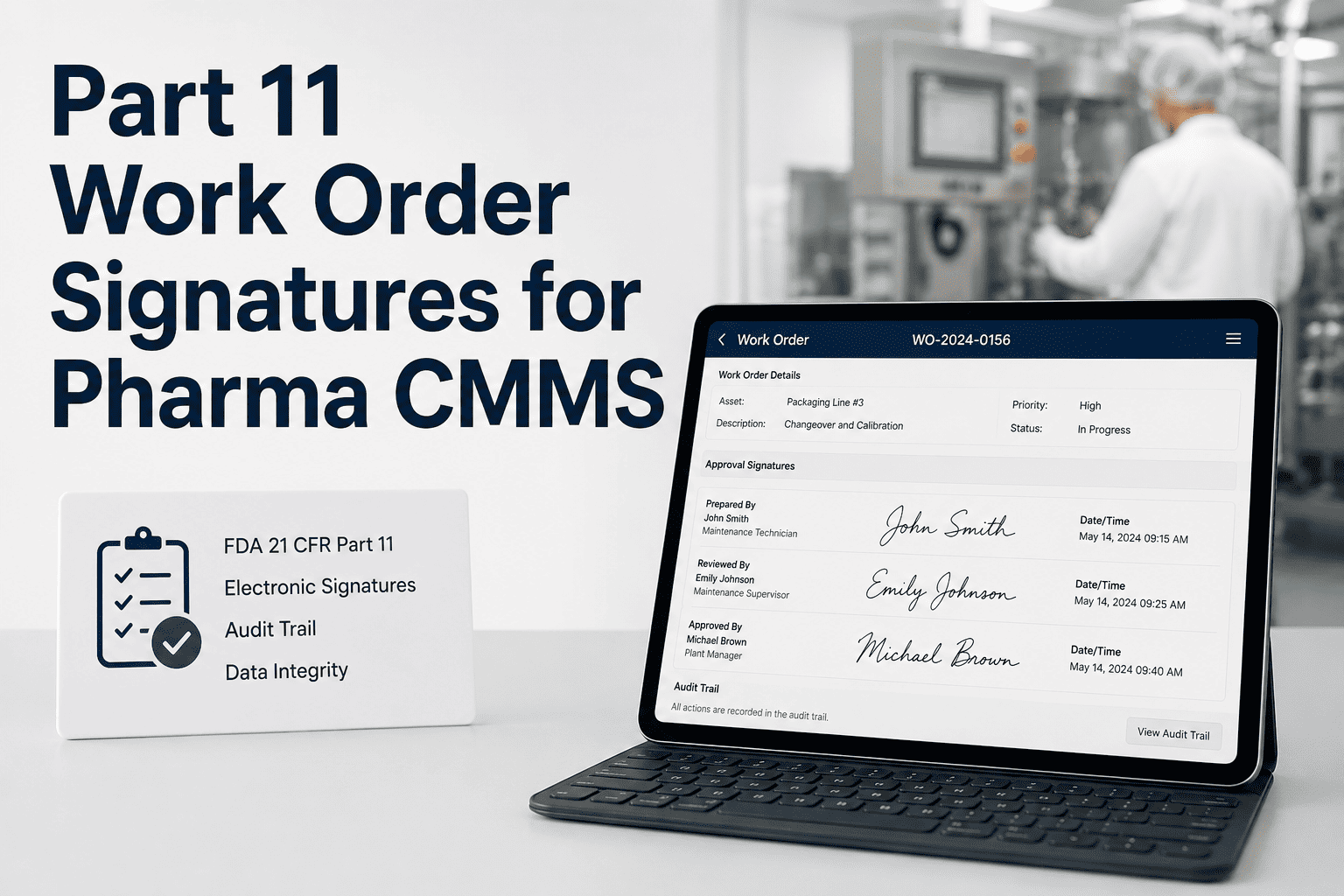
Part 11 Work Order Signatures for Pharma CMMS
Electronic signatures that meet FDA requirements — authentication, timestamps, meaning, and audit trail — on every maintenance work order your team creates.
Part 11 Compliance Checklist
Unique user ID + password authentication
System-generated timestamps on every signature
Signature meaning statement (e.g. "Approved as completed")
Audit trail linking signature to record change
Sequential signature for multi-step approvals
Account lockout after failed authentication
Annual identity verification for signatories
The Three Types of Work Order Signatures in OxMaint
1
Technician Completion Signature
The maintenance technician signs to attest that all tasks in the work order were performed as specified, all required data was entered, and the equipment was returned to service in the appropriate state. Signed with user credentials and recorded with system timestamp.
Meaning: "I performed the maintenance tasks described and the information I provided is accurate and complete."
2
Supervisor Review Signature
A maintenance supervisor or lead reviews the completed work order for quality and completeness before QA sign-off. This creates a two-step verification chain that supports GMP requirements for oversight of maintenance activities on critical equipment.
Meaning: "I have reviewed the maintenance record and confirm it is complete and accurate."
3
QA Approval Signature
For critical equipment maintenance, a QA representative provides final approval — confirming the work was performed per the approved procedure, all required documentation is complete, and the equipment may return to production service. This signature locks the record.
Meaning: "QA has reviewed this maintenance record and approves return to service."
Part 11 Signature Requirements — Side-by-Side Compliance View
| 21 CFR Part 11 Requirement | Section | OxMaint Implementation | Status |
|---|---|---|---|
| Unique user identification + password | 11.300(a) | Individual login credentials, no shared accounts permitted | Met |
| Password aging and security controls | 11.300(d) | Configurable password expiry, complexity rules, lockout policies | Met |
| Signature components: ID + password | 11.200(a)(1) | Re-authentication required at each signing event — not session-based | Met |
| Signature bound to document | 11.70 | Signature cryptographically linked to the work order record version | Met |
| Printed name, date, and meaning | 11.50(a) | Full name, system timestamp, and configured meaning statement on every signature | Met |
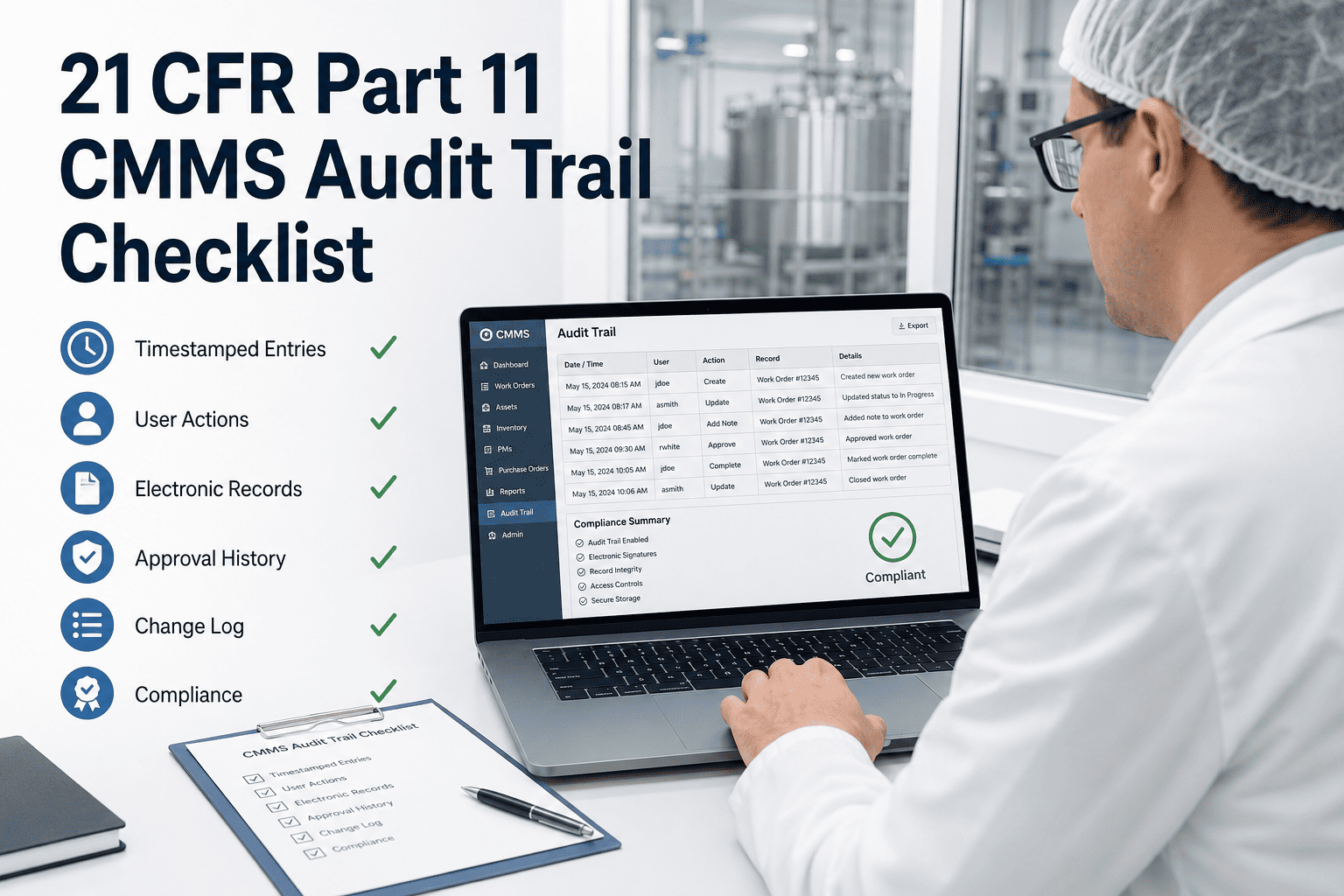
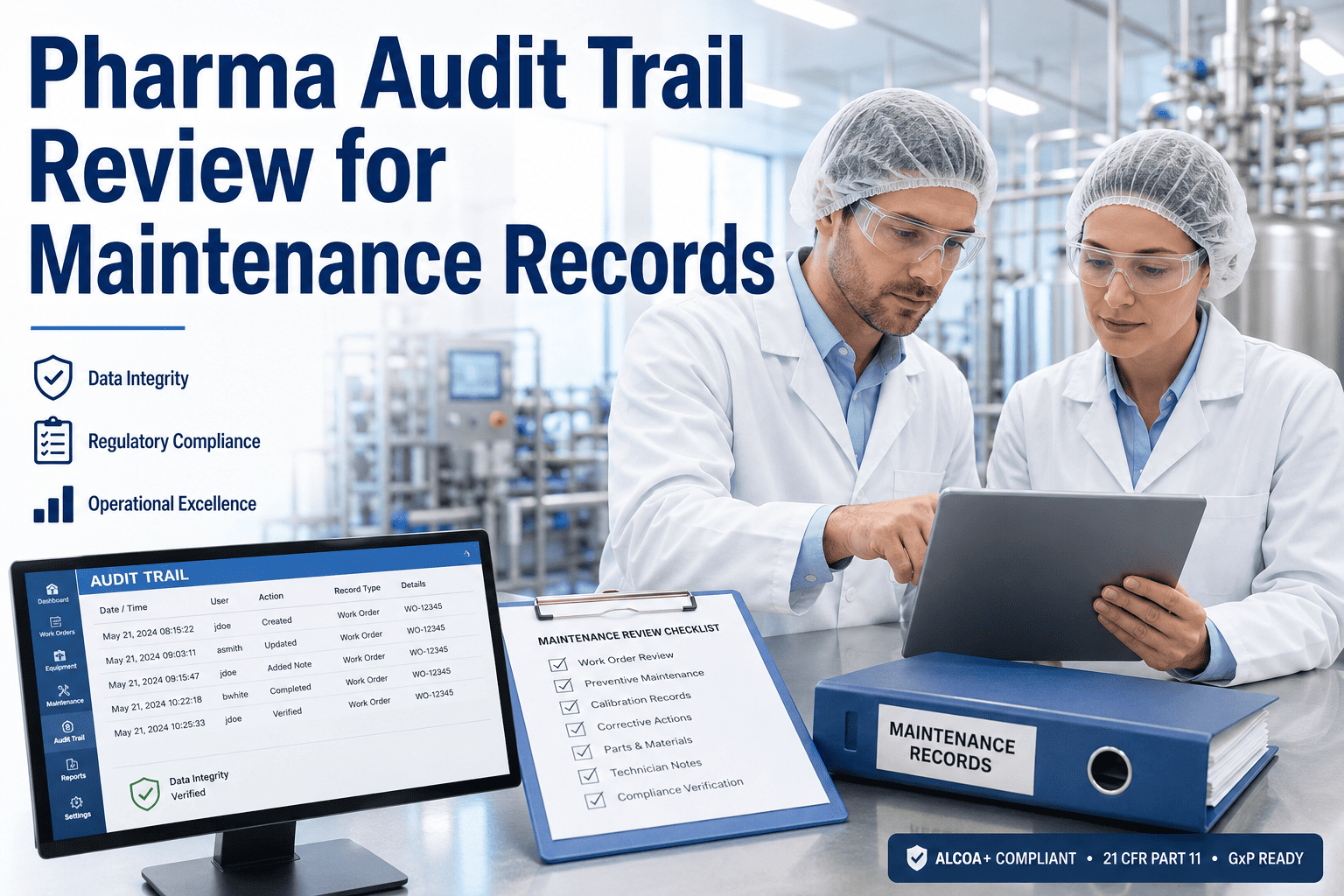
| Audit trail for signature actions | 11.10(e) | Every sign, reject, or void action captured in tamper-evident audit log | Met |
See Part 11 Signatures in Action
Walk through the full e-signature workflow with our pharma validation team — from technician sign-off to QA approval to audit trail export.
What Happens When a Signature is Rejected or Challenged
Supervisor Rejection
If a supervisor identifies incomplete data, they reject the work order with a required reason note. The work order returns to the technician with the rejection reason visible. All rejection actions are captured in the audit trail.
Record Amendment
If a record needs amendment after signing, the change is processed as a controlled edit — the original entry is preserved, the new entry is captured, and a reason-for-change is documented. This satisfies the ALCOA+ "original" requirement.
Signature Void
If a signed record is voided (e.g., duplicate entry), the void action is signed by an authorized user with a justification. The voided record remains visible and searchable — it cannot be deleted from the system.
Access Revocation
When an employee leaves or changes roles, their signing authority is revoked without deleting historical signature records. Past signatures remain valid and attributed; future signing is prevented by deactivating the account.
EXPERT REVIEW
Patricia Donovan
21 CFR Part 11 Compliance Specialist — 17 Years Pharmaceutical Validation and QA Systems
The most common Part 11 gap I see with CMMS implementations is not the signature event itself — it is what surrounds it. Teams implement e-signatures but do not configure the meaning statement. Or they allow session-based signing rather than requiring re-authentication at each signature event. Or the audit trail captures the signature but not the record state at the time of signing, so you cannot prove what the signer actually reviewed. OxMaint addresses all of these in a single validated configuration. When I prepare a site for inspection, having OxMaint's signature audit report available means I can demonstrate full Part 11 compliance in under 10 minutes — showing every signature, every meaning statement, every authentication event, and the exact record state at the time of signing. That is what FDA wants to see.
Frequently Asked Questions
Does OxMaint support biometric electronic signatures, or only ID + password?
OxMaint currently supports identification component plus password as the electronic signature method, which satisfies 21 CFR Part 11.200(a)(1) for non-biometric electronic signatures. This is the most widely used signature approach in pharmaceutical CMMS implementations because it does not require additional hardware (fingerprint readers, card readers) and can be administered entirely through the software with appropriate access controls. If your site requires biometric signatures, OxMaint can integrate with your organization's existing identity management systems. The Part 11 validation documentation covers the identification-plus-password method in full. Book a demo to review the signature configuration options.
Can we configure different signature requirements for different equipment criticality levels?
Yes. OxMaint supports configurable signature workflows based on equipment criticality classification, work order type, and procedure category. Critical equipment maintenance might require a three-signature chain (technician, supervisor, QA), while routine PM on non-critical equipment might require only technician and supervisor sign-off. These configurations are documented in the validation record as part of the functional specification. Changes to signature requirements are themselves controlled through a change control process that is captured in OxMaint's audit trail, ensuring your validation remains current as requirements evolve. Sign up free to explore the signature configuration options.
What documentation does OxMaint provide to support the Part 11 validation of the e-signature system?
OxMaint provides a comprehensive validation support package that includes a system description and user requirements specification, installation qualification (IQ) protocol and report, operational qualification (OQ) protocol with e-signature-specific test scripts, performance qualification (PQ) guidance, Part 11 gap assessment checklist, and a vendor audit questionnaire for your supplier qualification file. The OQ test scripts specifically cover all Part 11.200 and 11.300 requirements for the electronic signature functionality. Your site's validation team uses these documents to execute and document the validation, with OxMaint's support team available for technical queries during the process.