When a critical manufacturing line breaks down at 2 AM, the maintenance team fixes the equipment and logs the work order — but the QA deviation report never gets linked. Weeks later, during an FDA audit, investigators ask for every equipment event connected to a batch deviation. The evidence trail is broken, scattered across paper logs and disconnected systems. OxMaint closes this gap by automatically linking failed PMs, breakdowns, and equipment events to deviations and CAPA records — so pharma teams never lose investigation evidence again.
GMP WORKFLOW GUIDE
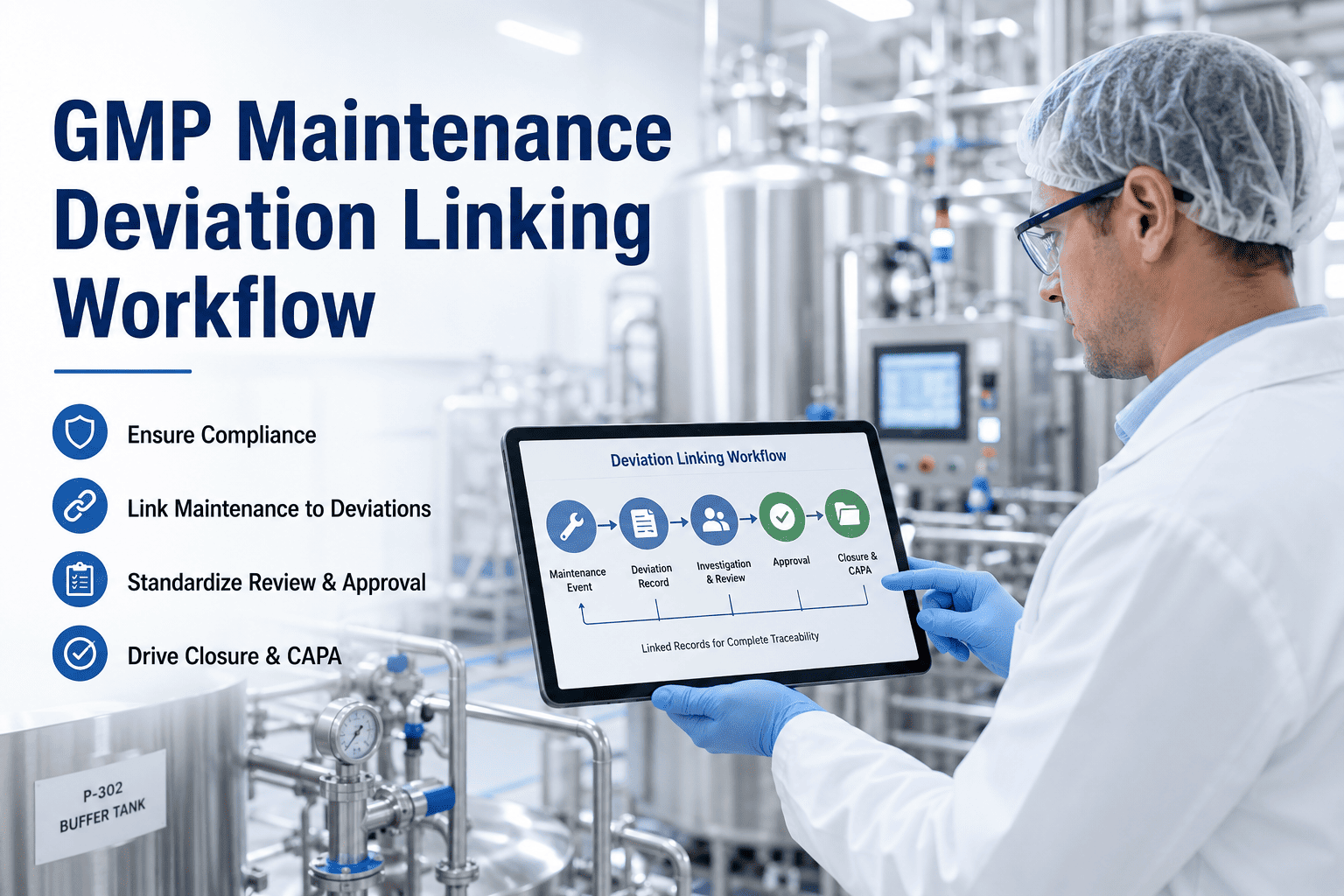
GMP Maintenance Deviation Linking: The Workflow Pharma QA Teams Need
Connect every equipment event to its deviation and CAPA record. Eliminate audit gaps before they become FDA findings.
THE CORE PROBLEM
01
Maintenance work orders completed but never linked to open deviations
02
QA opens CAPA without knowing the root equipment event history
03
Audit investigators find disconnected records across CMMS and QMS
04
Investigation timelines exceed 30-day SLAs due to manual evidence gathering
How the Deviation Linking Workflow Works in OxMaint
1
Equipment Event Triggers
A failed PM, unplanned breakdown, or out-of-spec calibration result automatically creates a flagged equipment event record with timestamp, asset ID, and technician signature.
2
Deviation Auto-Linking
OxMaint matches the equipment event to any open deviation by asset ID and time window. If no deviation exists, QA is notified to evaluate whether one should be raised — evidence is never orphaned.
3
CAPA Record Population
When CAPA is initiated, the linked equipment events, maintenance history, and PM compliance data pre-populate the investigation record. Root cause analysis begins with complete context.
4
Audit-Ready Evidence Package
Every deviation package exports with linked work orders, e-signatures, timestamps, and CAPA status — formatted for FDA review, internal QA sign-off, and third-party audits.
What Gets Linked — And What Gets Missed Without a System
| Equipment Event Type | Without OxMaint | With OxMaint | FDA Risk |
|---|---|---|---|
| Failed Preventive Maintenance | Logged in CMMS only | Auto-linked to deviation queue | High |
| Unplanned Breakdown | Work order closed, no QA notice | QA alert + CAPA trigger option | High |
| Calibration Out-of-Spec | Re-calibrated, deviation not raised | Automatic deviation initiation | Critical |
| Part Replacement on Critical Equipment | Closed work order only | Change control flag + deviation link | Medium |
| Overdue PM (Compliance Breach) | Escalation email only | Deviation auto-initiated, CAPA queued | High |
73%
of FDA 483 observations cite missing maintenance-deviation linkage
30 Days
Average CAPA investigation time reduced to under 12 days with linked records
100%
Equipment events traceable to batch records and QA deviations in OxMaint
See the Deviation Linking Workflow Live
OxMaint connects your CMMS and QA workflows so no equipment event goes unlinked. Book a 30-minute walkthrough with our pharma team.
GMP Compliance Requirements for Deviation Linking
21 CFR 211.68
Equipment Records
All maintenance, calibration, and repair records must be maintained and linked to equipment use records. OxMaint maintains this linkage automatically with tamper-evident timestamps.
ICH Q10
CAPA System
The pharmaceutical quality system requires that equipment-related deviations feed into CAPA with complete root cause data. OxMaint pre-populates CAPA forms from linked maintenance history.
EU GMP Annex 15
Change Control
Parts replacement and equipment modifications on critical systems require change control linkage. OxMaint flags qualifying work orders and routes them to QA for change control initiation.
EXPERT REVIEW
Dr. Ranjana Mehta
Pharmaceutical Quality Systems Consultant — 18 Years FDA Compliance and GMP Auditing
The most common gap I find during pre-approval inspections is not missing work orders — it is work orders that exist but cannot be connected to the deviation investigation. Maintenance teams close tickets. QA teams open deviations. Nobody links them. When an FDA investigator pulls batch records and asks for every equipment event that could have affected that batch, teams spend days manually searching two disconnected systems. A linked CMMS-QA workflow like OxMaint eliminates this problem at the source. Equipment events surface to QA in real time, CAPA investigations start with complete evidence, and audit packages are already assembled. That is not just efficiency — it is the difference between a clean inspection and a 483 observation.
Frequently Asked Questions
What qualifies as a deviation-triggering maintenance event under GMP?
Under 21 CFR Part 211 and EU GMP guidelines, any maintenance event on equipment used in production that could potentially affect product quality requires QA evaluation for deviation initiation. This includes failed PMs, breakdowns during active batch campaigns, calibration failures, and unplanned parts replacements on critical systems. OxMaint uses configurable equipment criticality classifications to automatically flag which events require QA notification, so your team is not manually reviewing every work order. Sign up free to configure your criticality thresholds.
How does OxMaint handle deviation linking when the CAPA is in a separate QMS system?
OxMaint supports integration with leading QMS platforms through structured data exports and API connections. When a maintenance event is linked to a deviation, OxMaint generates a formatted evidence package — including work order details, asset history, PM compliance record, and e-signatures — that can be directly imported into your QMS CAPA record. The linkage reference number is stored in both systems so the connection is maintained for future audits. Contact our team at a demo session to discuss your specific QMS integration needs.
Can OxMaint retroactively link historical maintenance records to past deviations?
Yes. During onboarding, OxMaint supports bulk import of historical work order data with asset IDs and timestamps. Once imported, historical maintenance records can be manually linked to past deviations to complete the evidence trail for long-running investigations or repeat failure trend analysis. This is particularly valuable for teams transitioning from paper-based or legacy CMMS systems where historical linkage was never established. All retroactive links are timestamped with the user action record to maintain data integrity under 21 CFR Part 11.
How does the deviation linking workflow support CAPA effectiveness checks?
OxMaint tracks whether the corrective actions defined in a CAPA have been implemented through subsequent maintenance work orders on the affected equipment. If a CAPA requires enhanced PM frequency, installation of new parts, or retraining of technicians, OxMaint can create the corresponding work orders and monitor completion. The CAPA effectiveness check period then uses OxMaint's PM compliance and breakdown frequency data to verify whether the corrective actions prevented recurrence. This closes the loop between maintenance execution and QA verification — a requirement under both FDA and ICH Q10 standards.