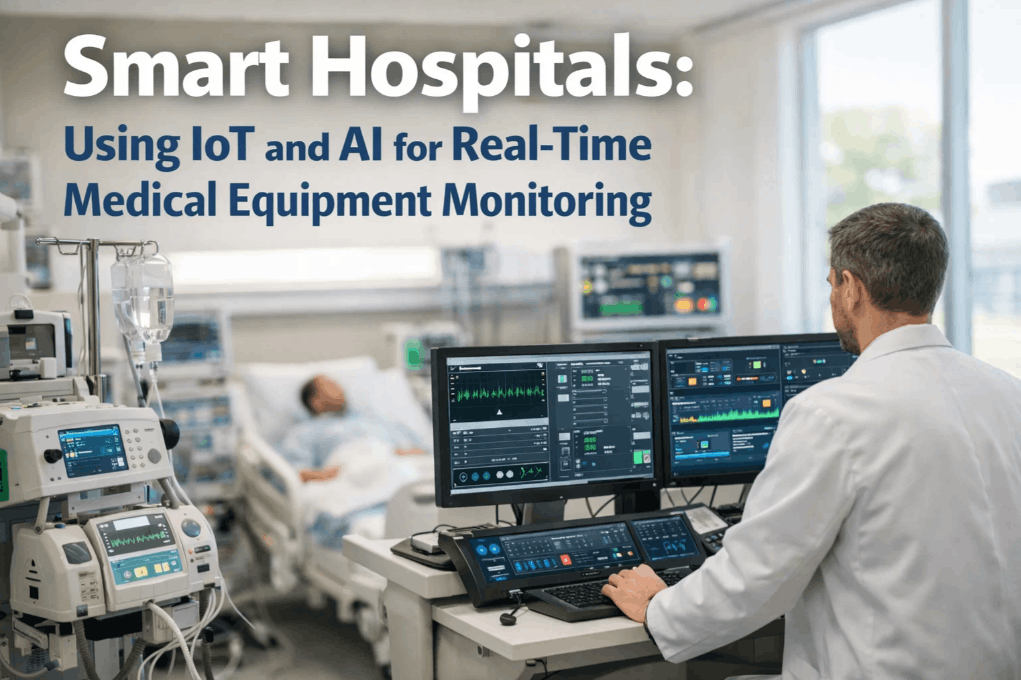
Hospital infrastructure failures don't announce themselves. A ventilator malfunctions mid-procedure. An imaging system crashes during a critical diagnostic window. A power distribution fault silences an entire ICU wing. These aren't hypothetical catastrophes — they are preventable incidents that cost hospitals millions in downtime, regulatory penalties, and most critically, patient lives. In 2026, artificial intelligence has fundamentally changed the calculus of hospital risk management. AI-powered risk prediction platforms now analyze thousands of operational signals in real time, surfacing infrastructure vulnerabilities days or weeks before they escalate into downtime events.
Stop Reacting. Start Predicting.
Oxmaint's AI risk prediction engine monitors your hospital's critical infrastructure around the clock, flagging failure patterns before they become emergencies. Reduce unplanned downtime and protect patient care continuity.
Why Traditional Risk Management Falls Short in Modern Hospitals
For decades, hospital infrastructure risk management relied on scheduled preventive maintenance, paper-based inspection checklists, and reactive repair workflows. These approaches were designed for simpler environments — facilities with far fewer connected devices, limited data throughput, and slower equipment cycles. Today's hospital is a radically different organism. A modern 300-bed facility may operate over 4,000 networked medical devices, each generating continuous performance telemetry, error logs, and usage patterns. Legacy risk frameworks simply cannot process this volume of signals, leaving maintenance teams perpetually behind and executives flying blind on infrastructure health. Sign up to see how Oxmaint modernizes your risk management.
The consequences of this blind spot are measurable. Studies from the American Society for Healthcare Engineering indicate that unplanned equipment downtime costs acute care hospitals between $700,000 and $1.2 million annually when factoring in staff overtime, emergency vendor contracts, delayed procedures, and regulatory exposure. The challenge is no longer data availability — hospitals have abundant operational data. The challenge is intelligent interpretation: knowing which signals matter, which patterns predict failure, and how to act with precision before the cascade begins.
How AI Risk Prediction Models Work in Hospital Environments
AI risk prediction platforms designed for healthcare infrastructure operate across three analytical layers, each compounding the accuracy of the next.
Continuous Sensor Telemetry Ingestion
The platform continuously ingests data from equipment APIs, IoT sensors, building management systems, and electronic maintenance records. This creates a living operational baseline — the normal behavioral fingerprint of each asset under varying load conditions, seasonal environments, and usage intensities.
Anomaly Detection and Pattern Matching
Machine learning models — trained on millions of equipment failure events across healthcare facilities — continuously compare live telemetry against the established baseline. When performance deviates from expected ranges, the system flags anomalies and correlates them against known pre-failure signatures. A gradual rise in motor operating temperature, an increasing frequency of micro-error codes, or subtle pressure fluctuations in HVAC systems all become early warning signals.
Risk Scoring and Prioritized Action Routing
Each flagged anomaly receives a dynamic risk score based on asset criticality, failure probability, patient impact zone, and current maintenance backlog. High-risk alerts are automatically routed to the appropriate technician or department head with context-rich work orders — eliminating the lag between signal detection and human response.
Infrastructure Categories Where AI Prediction Delivers the Highest Impact
Not all hospital infrastructure carries equal risk weight. AI risk prediction systems deliver the most transformative value when applied to systems where failure carries immediate patient safety implications or cascading operational consequences. The following infrastructure categories represent the highest-priority deployment zones.
| Infrastructure Category | Primary Failure Risk | AI Detection Lead Time | Patient Impact Level |
|---|---|---|---|
| Life-Support Equipment | Mechanical degradation, power fault | 48–96 hours | Critical |
| HVAC & Environmental Systems | Filter blockage, compressor wear | 5–14 days | High |
| Medical Imaging Systems | Calibration drift, tube degradation | 3–10 days | High |
| Electrical Distribution | Load imbalance, insulation degradation | 7–21 days | Critical |
| Sterile Processing Equipment | Seal failure, temperature deviation | 24–72 hours | High |
| Elevators & Patient Transport | Motor wear, door mechanism failure | 7–14 days | Moderate |
The Risk Cascade: Why Single-Point Failures Become System Crises
Hospital infrastructure failures rarely occur in isolation. A compromised chiller unit affecting server room cooling can cascade into electronic health record system instability. A failing UPS in a surgical wing doesn't just threaten that wing — it can destabilize adjacent departments drawing from shared power infrastructure. This interconnected vulnerability is what makes AI-powered risk prediction categorically superior to component-level maintenance strategies.
Modern AI risk platforms build dependency maps of hospital infrastructure — understanding not just individual asset health, but the relational topology of how systems interact. When a risk is identified, the platform models the downstream cascade potential: if this component fails, what else is affected, in what sequence, and with what patient impact? This cascade modeling transforms risk prediction from a maintenance tool into a patient safety instrument, giving hospital leadership the information they need to make proactive infrastructure decisions rather than reactive crisis responses. Book a demo to explore cascade risk modeling in action.
Regulatory Compliance as a Risk Prediction Benefit
Joint Commission surveys, DNV audits, and CMS Conditions of Participation all include infrastructure maintenance requirements that demand documented, consistent, and traceable maintenance activity. Hospitals operating understaffed biomedical departments frequently face compliance exposure not because maintenance isn't being performed, but because documentation is incomplete, inconsistent, or missing audit trails.
AI risk prediction platforms address this compliance vulnerability directly. Every anomaly detection event, risk escalation, work order issuance, and resolution action is automatically logged with timestamps, technician attribution, and equipment identifiers. Compliance dashboards provide real-time visibility into maintenance schedule adherence, overdue inspections, and open risk items — transforming audit preparation from a reactive scramble into an always-ready posture. For hospital compliance officers, this represents a structural improvement in risk governance that extends well beyond operational efficiency. Start your free trial and streamline compliance today.
Quantifying the ROI of AI Risk Prediction for Hospital CFOs
Healthcare technology investments face rigorous financial scrutiny, and AI risk prediction platforms are no exception. The return on investment framework for these systems operates across four distinct value streams, each independently justifiable and collectively compelling.
Implementation Pathway: From Deployment to Operational Intelligence
Hospitals evaluating AI risk prediction platforms often cite implementation complexity as a barrier to adoption. In practice, modern platforms are designed for rapid deployment against existing hospital infrastructure, without requiring wholesale system replacement or extended downtime windows.
A phased implementation typically begins with high-criticality asset classes — life-support equipment, imaging systems, and electrical distribution — where the risk-to-reward ratio justifies immediate deployment. Within the first 30 days, automated work order routing and anomaly alerting deliver measurable response time improvements. By months three through six, the AI model has accumulated sufficient facility-specific behavioral data to generate accurate predictive risk scores. Full integration with EHR systems, building management platforms, and compliance reporting frameworks is typically complete within the first year, at which point the platform operates as the central nervous system for hospital infrastructure risk governance. Schedule a demo to walk through your implementation roadmap.
Transform Your Hospital's Risk Posture in 90 Days
Oxmaint's AI-powered infrastructure risk platform integrates with your existing hospital systems to deliver predictive failure alerts, automated compliance documentation, and real-time risk dashboards — all without disrupting ongoing operations.