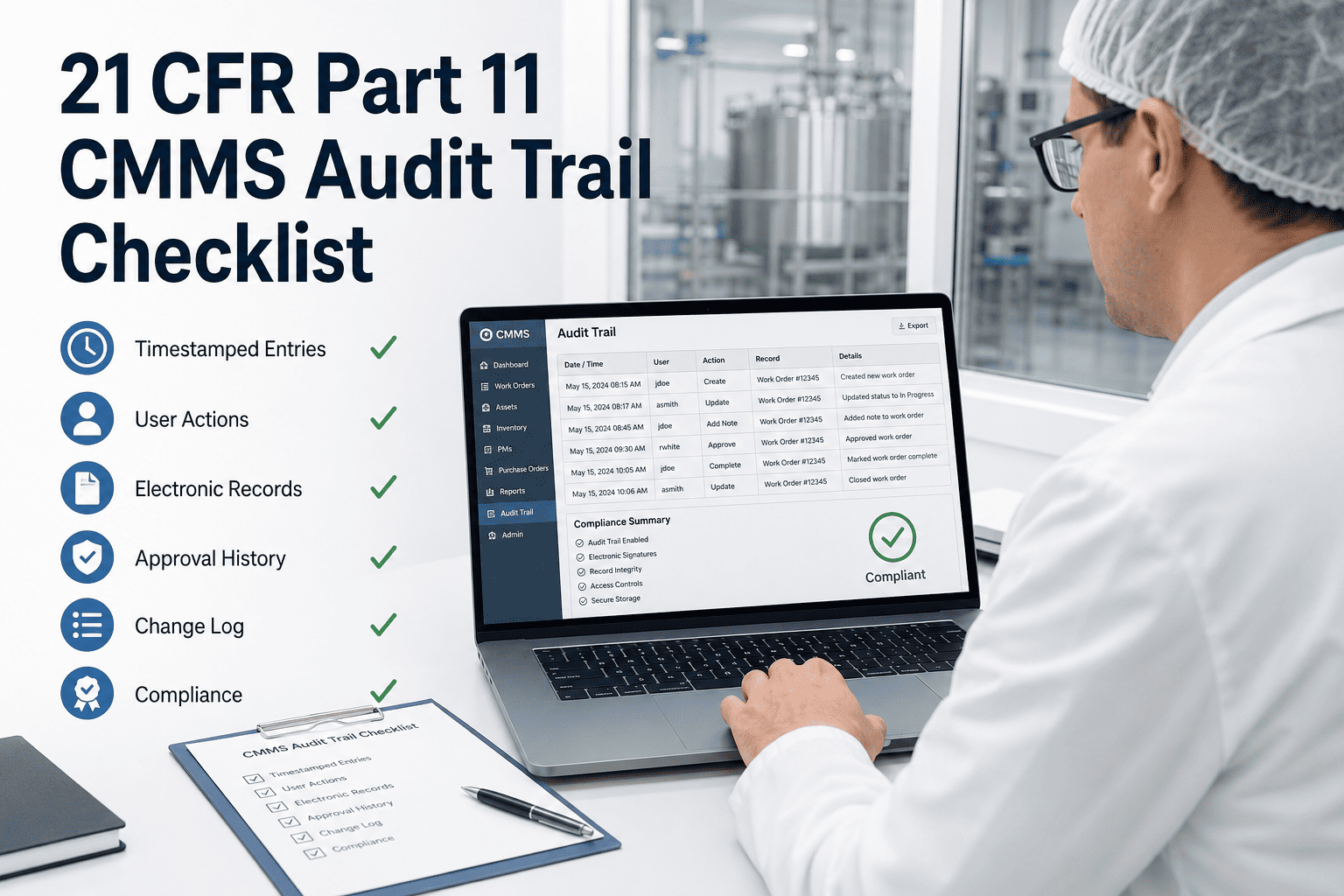
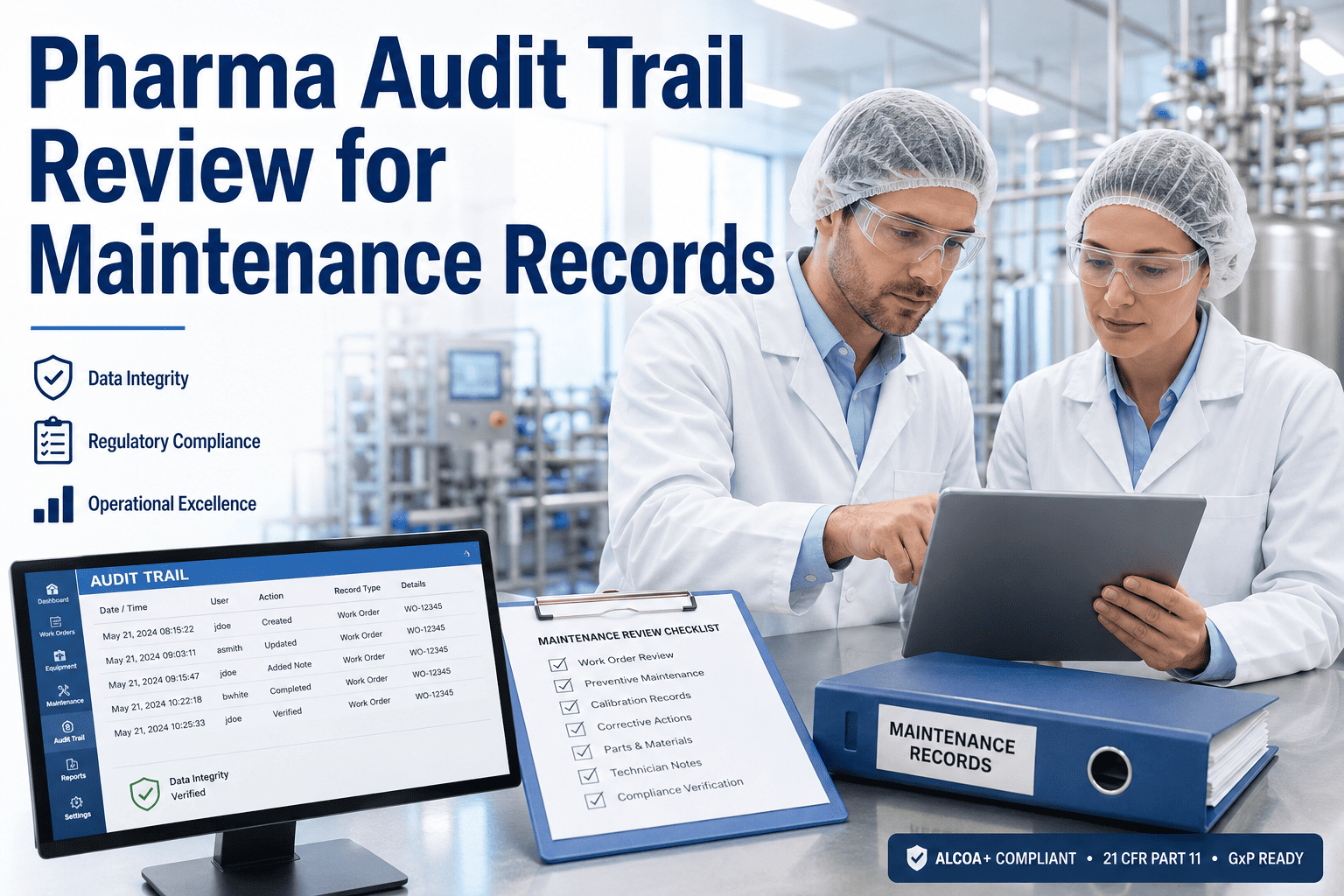
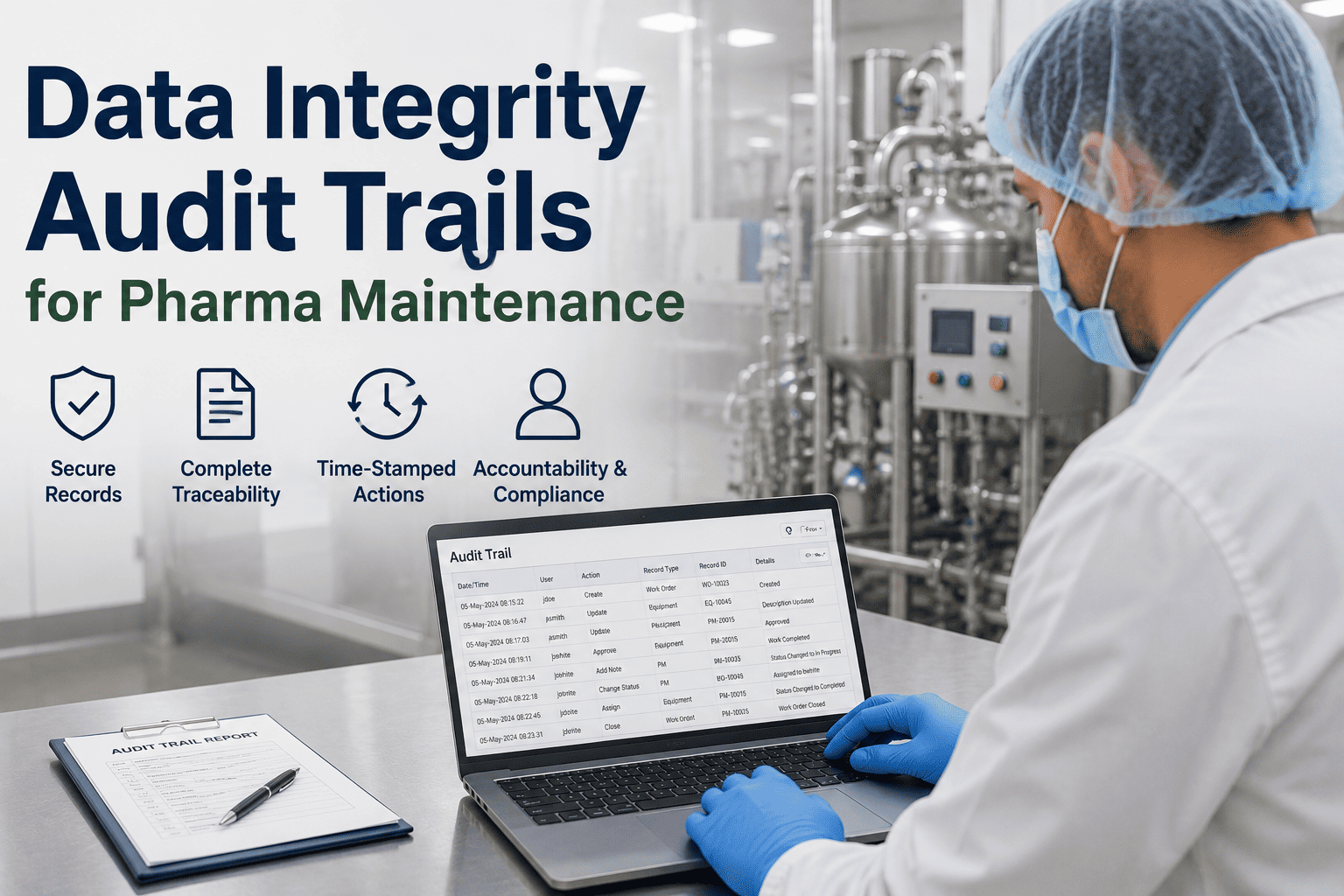
Between 2017 and 2022, the FDA issued more than 160 warning letters citing data integrity deficiencies — and CDER warning letters jumped another 50% in fiscal year 2025, with data integrity and quality system gaps accounting for over 30% of all citations. The pattern across every major enforcement action is consistent: the maintenance was performed, the calibration was done, the deviation was investigated. The failure was that the record produced in evidence could not prove who did it, when they did it, or whether it had been altered after the fact. ALCOA+ is not an IT compliance project. It is the documentation standard that makes a maintenance record defensible — and OxMaint's audit trail and e-signature workflows apply every ALCOA+ principle to every maintenance event your team executes. Start free or book a demo to see ALCOA+-compliant maintenance records in action.
Data Integrity · Landing Page · GMP Documentation
ALCOA+ Maintenance Records for Pharma Sites
What each ALCOA+ principle means for a maintenance work order, why paper-based records fail the standard, and how OxMaint's digital audit trail satisfies every principle by default.
A
Attributable
Every record must identify who performed the activity, not just that it was done.
Paper fail: "MAINT DEPT" or illegible signature. No individual accountability.
OxMaint: Named user account required. E-signature captured at work order closure. User ID, role, and timestamp stored immutably.
L
Legible
Records must be readable throughout their retention period — not degraded, overwritten, or illegible.
Paper fail: Ink faded in high-humidity areas. Correction fluid used. Logbook pages torn or water-damaged.
OxMaint: Digital records never degrade. All entries in typed text. Corrections create a new entry with reason — original is preserved.
C
Contemporaneous
Records must be made at the time the activity occurs — not recalled from memory hours or days later.
Paper fail: Logbook filled in at end of shift. Date/time added retrospectively. "I'll sign it later" culture.
OxMaint: Server-generated timestamp at the moment of task completion on mobile device. Cannot be backdated.
O
Original
The first recording of an activity must be preserved — copies must be identified as copies; transcription eliminates original status.
Paper fail: Field data written on scrap paper and transcribed to logbook. Raw data is not the retained record. Transcription errors occur and are undetectable.
OxMaint: Mobile entry is the original record. No transcription. All subsequent changes are documented edits, not replacements.
A
Accurate
Records must reflect what actually happened — no omissions, no guesses, no values copied from prior records.
Paper fail: Calibration result copied from previous check. PM completion marked without task being performed. "Pass" recorded on an unperformed test.
OxMaint: Required measurement fields enforce data entry before closure. Photo evidence mandatory for key tasks. Structured fields prevent estimated entries.
+
Complete · Consistent · Enduring · Available
No gaps in the record. Uniform format across all entries. Records survive their full retention period. Instantly retrievable on request.
Paper fail: Missing entries for specific periods. Different technicians use different formats. Logbooks lost, damaged, or stored offsite. 2-day document retrieval during FDA audit.
OxMaint: Overdue task escalation prevents gaps. Structured digital forms ensure consistency. Cloud storage survives full retention period. Full history retrievable by equipment ID in under 5 minutes.
Paper vs Digital — The ALCOA+ Evidence Gap
This table maps the most common maintenance record types in a pharmaceutical facility against their ALCOA+ compliance status under paper-based versus OxMaint digital systems.
| Record Type |
Paper-Based Status |
ALCOA+ Principle at Risk |
OxMaint Digital Status |
| PM completion log |
Signature often illegible; date filled retrospectively; no individual audit trail |
Attributable, Contemporaneous, Legible |
Named e-signature + server timestamp at closure. Immutable audit trail. |
| Calibration record |
Certificate filed separately; result transcribed from field note; original often discarded |
Original, Accurate, Complete |
Certificate attached to instrument record. Mobile entry is original. Certificate linked to calibration WO. |
| Equipment breakdown log |
Call-out ticket not linked to formal investigation; root cause added days later |
Contemporaneous, Complete, Consistent |
WO timestamp = time of breakdown report. Deviation investigation auto-linked at creation. |
| Cleaning/sanitation record |
Generic log covers multiple equipment; equipment ID not always specified; missing entries for specific periods |
Attributable, Complete, Available |
Equipment-specific WO per cleaning event. No entry = escalation alert before gap appears. |
| CAPA record |
Handwritten; effectiveness check added without date; closure signed without verification evidence |
Accurate, Complete, Attributable |
Cannot close without effectiveness verification attached. All edits documented with reason-for-change. |
| Deviation record |
Root cause written as "operator error"; no scientific justification; signed by one person |
Accurate, Complete, Attributable |
Structured investigation fields enforce scientific content. Multi-step approval workflow with individual e-signatures at each stage. |
ALCOA+ · DATA INTEGRITY · OXMAINT
Every Maintenance Record. Every ALCOA+ Principle. Satisfied by Default.
OxMaint's audit trail captures who, when, what, and why for every maintenance event — so your records are audit-ready before the investigator arrives, not assembled in the two days after.
21 CFR Part 11 and ALCOA+ — How They Connect for Maintenance Records
21 CFR Part 11 sets the US regulatory requirements for electronic records and signatures. ALCOA+ defines the quality principles that electronic records must satisfy. The two frameworks work together — Part 11 compliance is the mechanism; ALCOA+ is the standard the mechanism must achieve.
01
Audit Trail — 21 CFR 11.10(e)
Computerised systems must generate secure, computer-generated, time-stamped audit trails that record the date and time of operator entries and actions that create, modify, or delete electronic records. This directly satisfies Contemporaneous and Original. Inspectors now expect audit trails to be actively reviewed — not just technically present.
02
Access Controls — 21 CFR 11.10(d)
Limiting system access to authorised individuals ensures records are Attributable to the specific person who performed the activity. Shared logins — the most common data integrity violation found in FDA inspections — violate both Part 11 and the Attributable principle simultaneously.
03
Electronic Signatures — 21 CFR 11.50
Electronic signatures must be linked to the record in a manner that makes it tamper-evident. In maintenance, this means the work order closure signature must be permanently bound to the completion record — not applied to a separate approval document that could be detached from the underlying data.
04
Record Retention — 21 CFR 11.10(c)
Electronic records must be accurate and accessible throughout the records retention period. Cloud-based CMMS records satisfy Enduring and Available simultaneously — they cannot be physically lost, damaged, or selectively retained, eliminating the most common paper-based retention failure mode.
Expert Review
"The most consistent finding in pharmaceutical data integrity inspections is not that records were falsified — it is that records cannot prove they were not falsified. When a maintenance logbook is signed at the end of a shift rather than at the time of task completion, the record is technically present but fails Contemporaneous. When a calibration result is transcribed from a field worksheet to a formal record and the worksheet is discarded, the record fails Original. These are not deliberate manipulation — they are standard paper-based practices that are structurally incompatible with ALCOA+ expectations. A CMMS that generates a server-timestamped record at the moment of mobile task completion, with the named user's e-signature, is not meeting a higher standard than paper — it is meeting the same standard that paper was always supposed to meet but structurally cannot. CDER warning letters jumped 50% in FY 2025, with data integrity a leading driver. The facilities that will be inspected most heavily in the next three years are the ones still operating paper-based maintenance systems."
Dr. Anita Mehta, PhD, RAC
Regulatory Affairs Certified · 20 years pharmaceutical GMP data integrity and FDA inspection readiness · Former FDA Office of Pharmaceutical Quality reviewer · Specialist in ALCOA+ implementation and 21 CFR Part 11 compliance for maintenance and calibration systems
Frequently Asked Questions
What does ALCOA+ stand for and why does it apply to maintenance records?
ALCOA+ stands for
Attributable, Legible, Contemporaneous, Original, Accurate — plus Complete, Consistent, Enduring, and Available. It applies to maintenance records because any record that supports a GMP decision — including PM completion, calibration, deviation investigation, and CAPA — must satisfy these principles to be accepted as valid evidence by FDA, EMA, or MHRA inspectors. A maintenance record that cannot prove who made it, when they made it, or that it has not been altered is not a compliant GMP record, regardless of what the underlying task accomplished.
Book a demo to see how OxMaint applies ALCOA+ to every maintenance work order.
What are the most common ALCOA+ violations in pharmaceutical maintenance?
The four most commonly cited violations are: Contemporaneous failure (records filled in at end of shift rather than at time of activity); Attributable failure (shared logins, department-level signatures rather than individual attribution); Original failure (field data transcribed to formal records with originals discarded); and Complete failure (gaps in PM records for specific periods, deviation investigations without linked root cause). All four are structural failures of paper-based systems that digital CMMS prevents by design.
Start free to configure ALCOA+-compliant work order workflows in OxMaint.
How does 21 CFR Part 11 relate to ALCOA+ for maintenance CMMS systems?
21 CFR Part 11 defines the technical requirements for compliant electronic records and signatures — audit trails, access controls, and e-signature binding. ALCOA+ defines the data quality principles those technical systems must achieve. A CMMS that is Part 11 compliant satisfies the regulatory mechanism; a CMMS that is Part 11 compliant and designed to capture ALCOA+ attributes at every record entry satisfies both the mechanism and the quality standard. Both are required for maintenance records that will be produced in FDA inspections.
Can handwritten corrections to maintenance records still be compliant with ALCOA+?
Yes, but the standard is specific: corrections must draw a single line through the original entry (keeping it readable — satisfying Legible and Original), with the correct value written adjacent, signed and dated by the person making the correction, with a brief reason for the change. Correction fluid, overwriting, and unsigned corrections all violate ALCOA+ principles and are cited in FDA inspections. In digital CMMS, corrections create a documented edit with reason-for-change and the original record is preserved in the audit trail — making every digital correction inherently ALCOA+-compliant.
DATA INTEGRITY · ALCOA+ · OXMAINT
Build Maintenance Records That Prove What They Claim — Every Time, for Every Inspector.
OxMaint generates ALCOA+-compliant maintenance records by design — server-timestamped, named e-signatures, immutable audit trails, structured fields that enforce completeness, and cloud retention that keeps records available across their full GMP retention period.