A pharmaceutical plant manager carries accountability that no other manufacturing role matches: production output, GMP compliance, team safety, utility uptime, and inspection readiness all land on the same desk. A single unplanned equipment failure on a critical GMP line costs a mid-size pharma producer an average of $420,000 in lost production plus regulatory re-qualification liability. In 2024, 68 percent of pharma manufacturers reported at least one unplanned equipment failure per production cycle, and 39 percent of scheduled preventive maintenance tasks were being missed across the industry. OxMaint gives pharma plant managers the operational visibility to stop those numbers from defining their sites. Book a 30-minute demo to see how OxMaint closes the gap between scheduled maintenance and actual execution, or start a free trial and run your first PM compliance report within 24 hours of sign-up.
$420K
Average cost of one unplanned GMP line shutdown
68%
of pharma plants had at least one unplanned failure per cycle in 2024
39%
of scheduled PMs are missed across pharma industry
90 days
to 90-94% PM compliance with OxMaint deployment
The plant manager's five pressure points
Where maintenance failure hits plant managers hardest
Plant managers in pharmaceutical manufacturing face five recurring failure modes that compound each other. A missed PM creates an unplanned failure. An unplanned failure triggers a deviation. A deviation without CAPA closure becomes a 483 observation. A 483 observation becomes a production hold. None of these start as a quality problem. They all start as a maintenance visibility problem.
Unplanned equipment failures
68% of sites affected annually
Missed PM rate across industry
39% of PMs not completed on schedule
Spare parts stockout rate
34% critical spares stockout, 2-hr repairs become 2-day shutdowns
Warning Letters with CAPA deficiencies
61% of pharma Warning Letters in 2024
Technician productive time lost
Only 24.5% of shift is actual repair time without mobile CMMS
Feature impact map
What OxMaint fixes for pharma plant managers
| Plant Manager Pain Point |
Root Cause |
OxMaint Solution |
Measured Result |
| Unplanned equipment failures on GMP lines |
No predictive signal before failure |
Sensor-correlated asset health scoring |
30 to 50% fewer unplanned incidents in 12 months |
| Missed preventive maintenance tasks |
Manual scheduling, no escalation |
Automated PM triggers, SLA-enforced queue |
90 to 94% PM compliance within 90 days |
| Utility failures without warning |
Utilities excluded from PM scope |
HVAC, compressed air, water system PM library |
Utility PM compliance tracked alongside production assets |
| Spare parts stockouts extending shutdowns |
No min/max visibility, manual reorder |
Min/max thresholds, auto-reorder alerts |
58.9% of sites see downtime improvement from inventory control alone |
| Compliance risk from overdue PMs |
QA not notified of overdue events |
Automated QA alert on PM overdue |
Deviation exposure from missed PMs eliminated |
| No visibility into reactive-to-planned ratio |
No unified dashboard |
Real-time R/P ratio dashboard for plant manager |
32-point shift toward planned maintenance in 90-day deployments |
For pharma plant managers
Cut unplanned failures. Hit PM compliance. Stay ahead of inspection.
OxMaint gives you the operational dashboard your site needs to run planned maintenance at scale, with the GMP compliance controls built in from day one. No add-ons, no configuration consultants, no 18-month implementation.
Operational visibility
The four dashboards pharma plant managers run in OxMaint
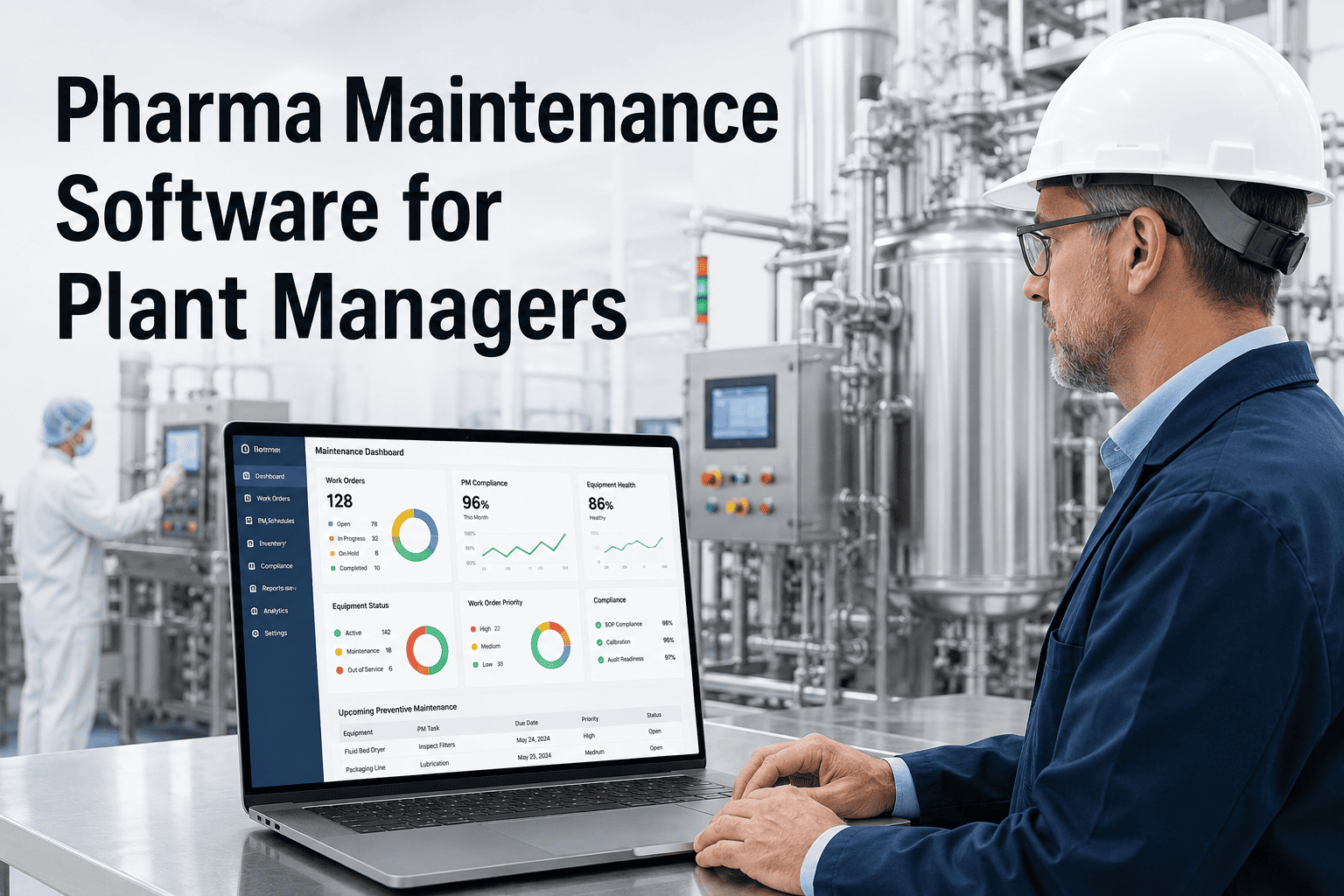
A plant manager needs operational intelligence, not data. OxMaint organises maintenance data into four dashboards that answer the four questions a plant manager asks every morning without having to pull a report or call a supervisor.
01
PM Compliance Dashboard
Shows real-time PM completion rate by area, by asset class, and by technician. Overdue PMs flagged with escalation path. QA notified automatically on any critical asset overdue event. Updated every hour.
Target: 90%+ compliance across all lines
02
Reactive vs Planned Ratio
Live breakdown of reactive versus planned work orders by production area. Industry benchmark is 30 percent reactive or lower. Sites running above 50 percent reactive are in a downtime accumulation pattern visible on this dashboard before failures occur.
Industry benchmark: 30% reactive or lower
03
Critical Spare Parts Status
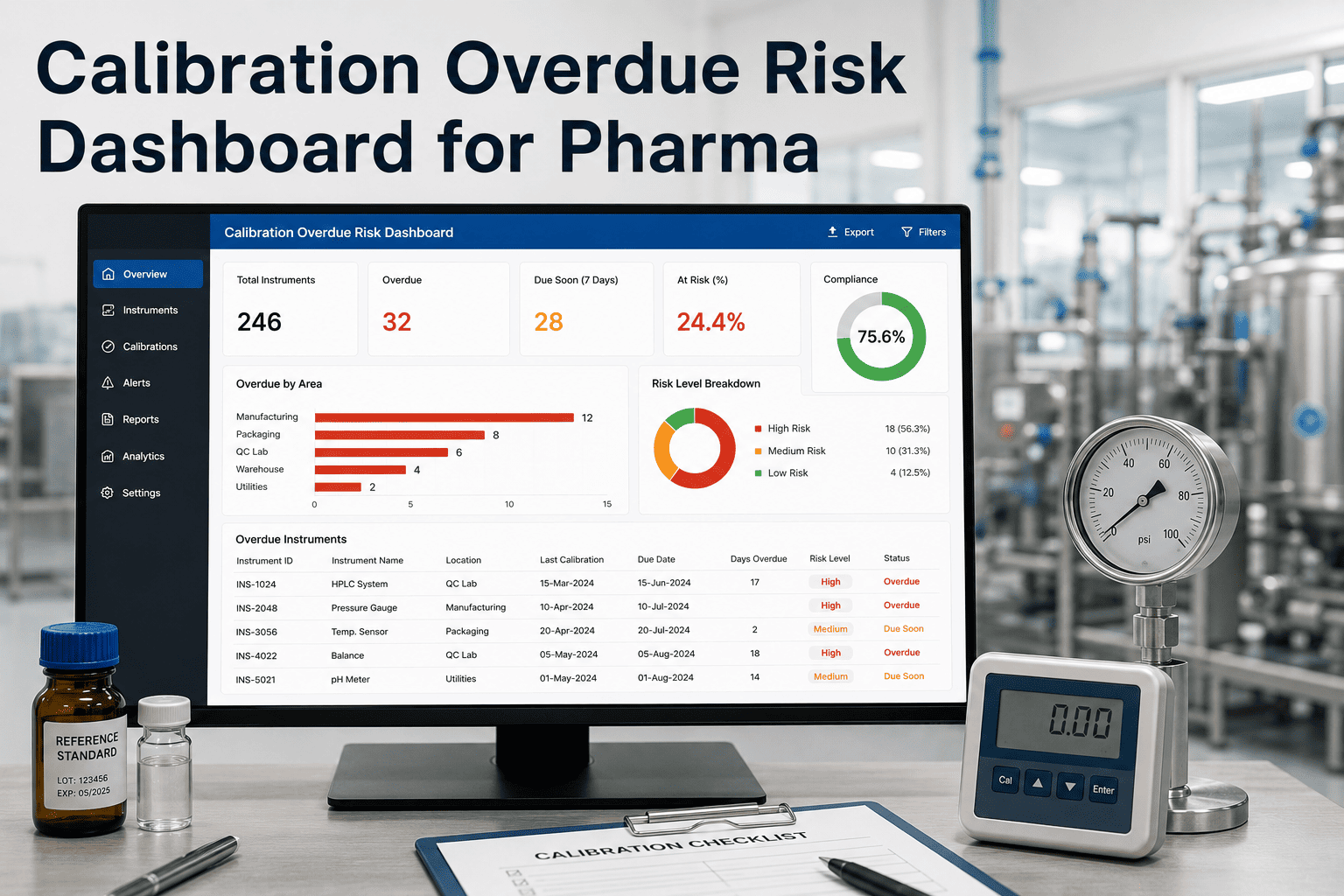
Live stock levels against min/max thresholds for every critical spare. Reorder alerts triggered before stockout. Parts consumption tracked against work order history to adjust reorder points over time. No more 2-hour repairs becoming 2-day shutdowns.
Eliminates 34% critical spare stockout rate
04
Utility Systems Health
HVAC, compressed air, purified water, chilled water, and steam systems tracked alongside production assets on the same PM schedule. Utility PM compliance included in the same weekly stand-up review as production line maintenance.
Utilities included, not a separate system
Expert review
What experienced pharma operations leaders say about maintenance visibility
RS
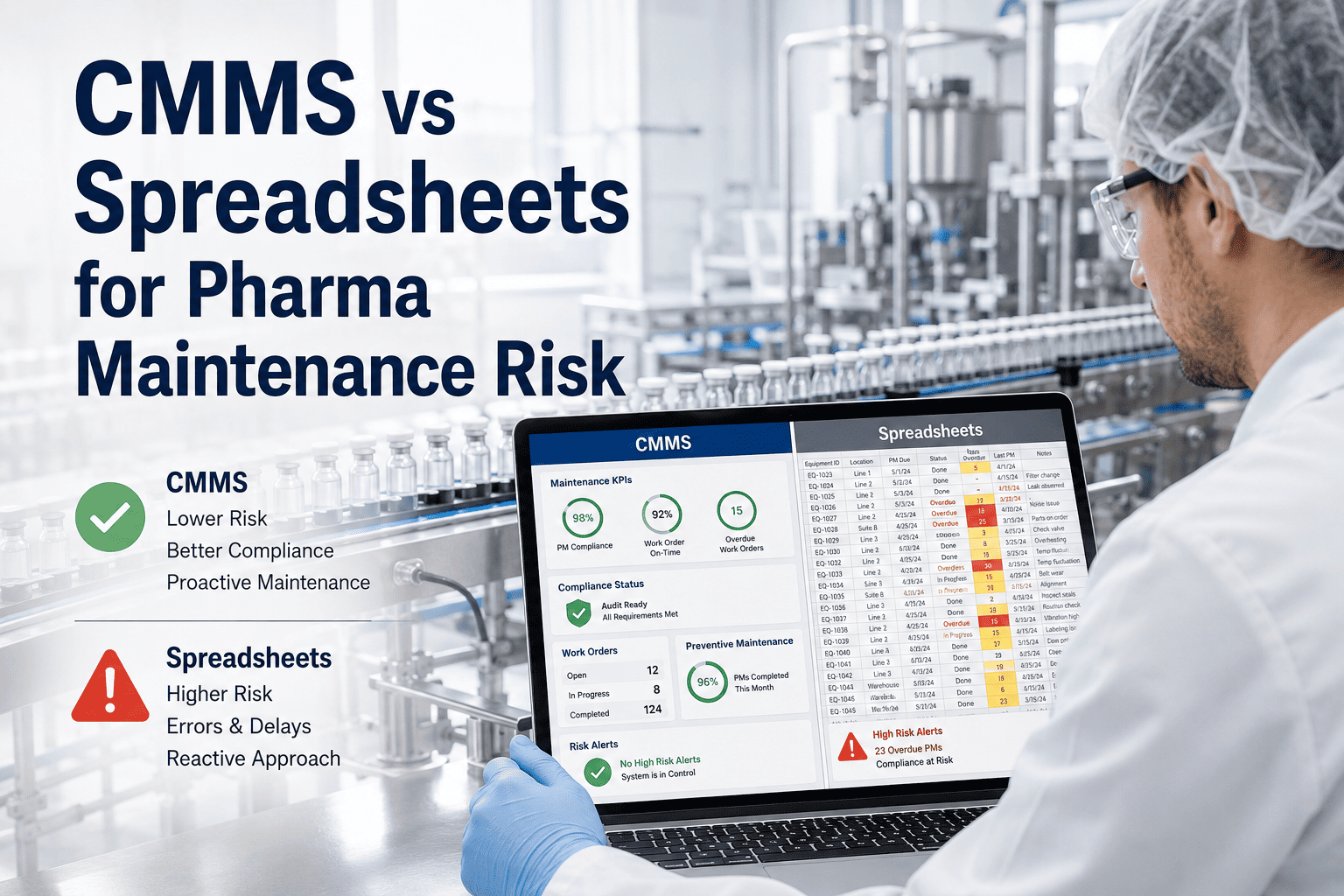
The number one failure mode I have seen across pharmaceutical manufacturing plants is not a technology failure. It is a visibility failure. Plant managers are running blind, getting their maintenance status from a supervisor who is guessing from a spreadsheet. By the time the reactive-to-planned ratio hits 60 percent reactive, the plant manager does not know it has happened because there is no dashboard that shows it. The plants that perform best operationally are the ones where the plant manager reviews a live PM compliance number every morning before the shift briefing. That number drives every conversation after it.
Robert Sanchez
VP Operations, Pharmaceutical Contract Manufacturing — 22 years pharma plant leadership — Former Site Director, three FDA-inspected facilities
Deployment speed
How fast can a pharma plant go live with OxMaint?
Plant managers cannot afford a 12-month implementation that disrupts operations before a single PM is improved. OxMaint deploys in a structured 75-day sequence: asset register validation first, mobile technician rollout second, PM schedule migration third, and dashboards last. No phase starts before the previous gate is cleared.
Asset register and GMP hierarchy
All production and utility assets validated, criticality classified, and structured in GMP-compliant hierarchy. This phase is the foundation everything else depends on.
Mobile rollout and technician onboarding
Tablets provisioned, QR tags applied, technicians trained across all shifts. 100 percent mobile completion rate required before Phase 3 begins.
PM schedule migration and parallel run
OEM-validated PM frequencies imported, criticality classes assigned, two-week parallel run to confirm zero scheduling gaps before paper retirement.
Plant manager dashboard and paper retirement
Live dashboards for plant manager and shift supervisors. Paper work packs formally retired. Weekly maintenance stand-up cadence locked in.
Plant manager ROI
What does your site lose every week maintenance runs without full visibility?
Bring your current PM compliance rate, reactive-to-planned ratio, and critical spare stockout frequency to a 30-minute session. The OxMaint team will calculate your site-specific downtime cost baseline and show you exactly where OxMaint closes the gap.
Frequently asked questions
Questions plant managers ask before deploying OxMaint
How quickly can I see a live PM compliance rate for my entire facility after going live?
Plant managers see a live PM compliance dashboard within 24 hours of completing the asset and schedule configuration phase. The dashboard updates in real time as technicians close work orders on mobile, and you can filter by area, asset class, shift, or individual technician without pulling a separate report.
Start a free trial to see the dashboard layout and configure your own compliance thresholds before full go-live.
Does OxMaint handle utility systems alongside production equipment, or do I need a separate system?
OxMaint manages HVAC, purified water, compressed air, steam, chilled water, and all plant utility systems on the same PM schedule and dashboard as production assets. Utility PMs are included in the same compliance rate, overdue alerts, and weekly review cadence, so the plant manager gets a single number for the entire facility rather than separate maintenance conversations for utilities and production.
Book a demo to see how utility asset hierarchies are configured in OxMaint.
What happens to GMP compliance controls during the transition from a legacy CMMS to OxMaint?
OxMaint runs a mandatory parallel operation phase during weeks five and six of deployment, where both systems run simultaneously for production-critical assets. No GMP-critical asset is cut over to OxMaint-only until 14 consecutive days of parallel running confirm zero scheduling gaps. The legacy system is kept in read-only mode for 60 days post go-live to cover any record retrieval needs.
Start a free trial to access the full transition protocol used in validated pharma deployments.
Can I run OxMaint without bringing in external implementation consultants?
Yes. The OxMaint onboarding team provides three dedicated specialists who work alongside your internal maintenance director, reliability engineer, and IT analyst through the full 75-day deployment. No third-party consultants are required. The structured rollout template and go/no-go gate criteria are designed to be owned and executed by the plant team itself, with OxMaint specialists as a structured support layer, not a driver.
Book a demo to review the onboarding scope with the pharma deployment team.
The cost of waiting is visible. So is the fix.
Pharma plant managers who wait for the next unplanned failure to justify a CMMS change already know the answer
The equipment that will fail next week already has a history. The PM that will be missed next month is already overdue on someone's spreadsheet. The spare part that will extend the next shutdown is already below minimum stock. OxMaint makes all of it visible before it becomes a production event. A 30-minute conversation with our pharma deployment team will show you how.