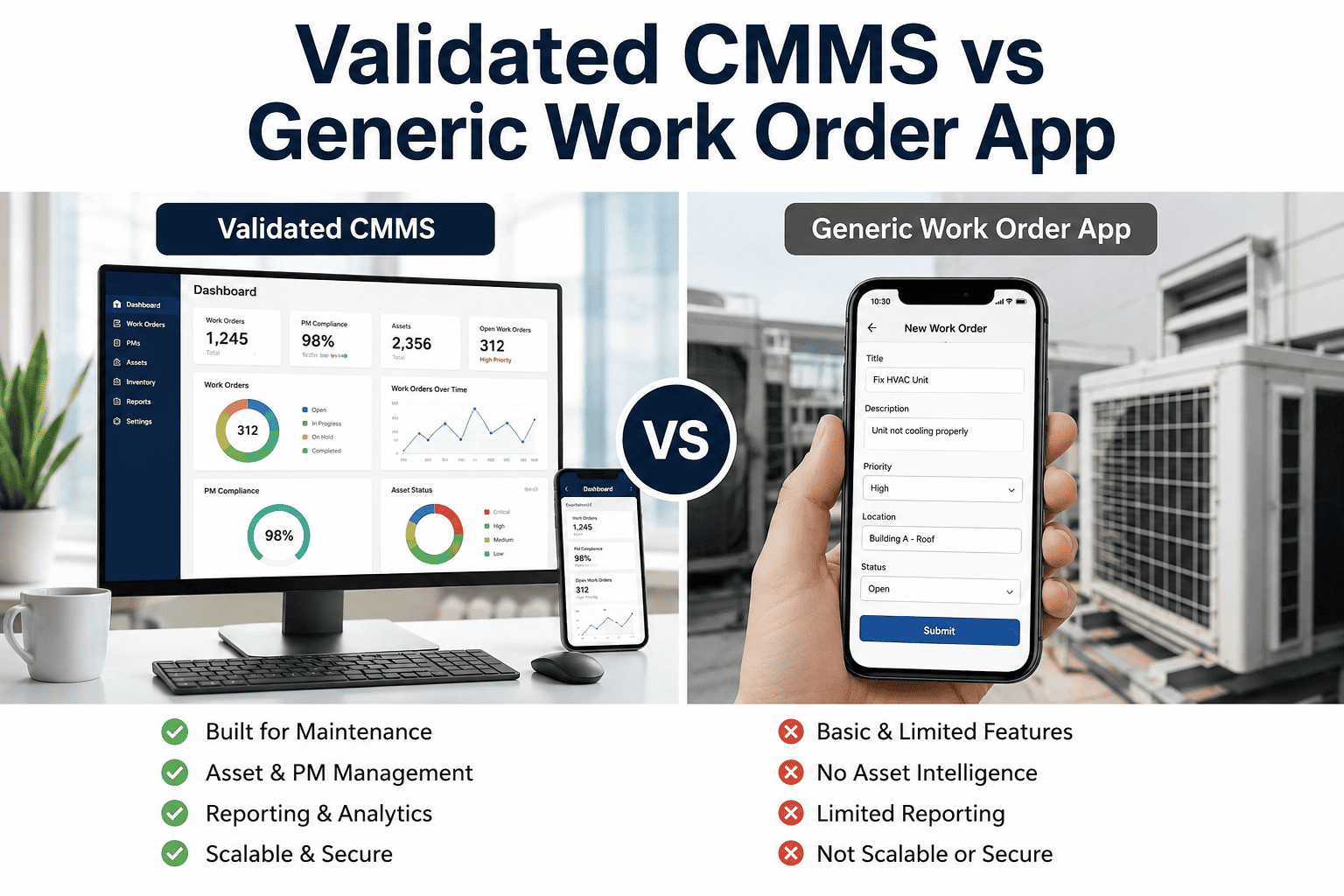
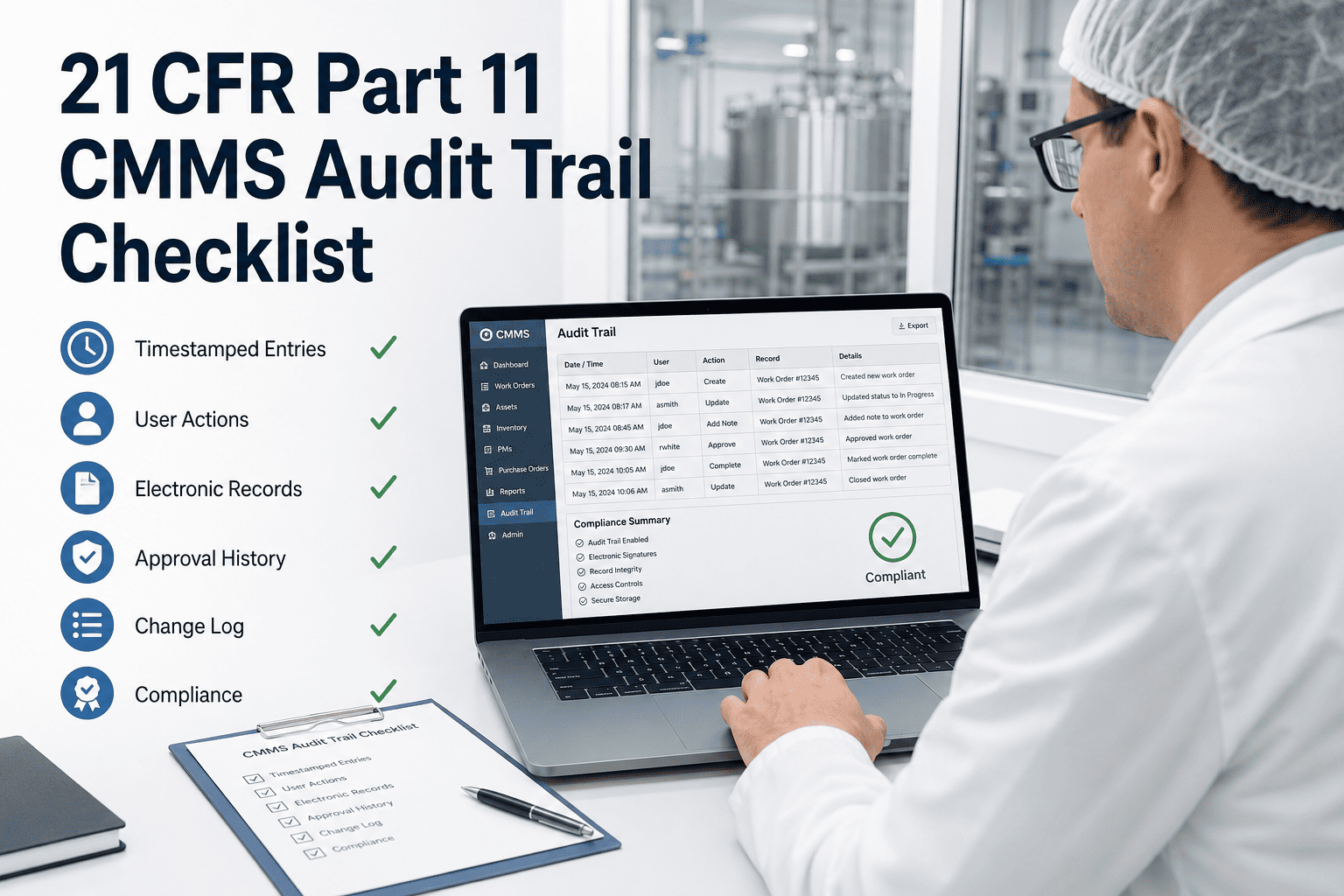
A generic work order app and a validated pharma CMMS can look nearly identical on the surface — both let technicians log a work order, attach a note, and mark a task complete. The difference only becomes visible the day an FDA investigator asks for the complete maintenance and calibration history of a fill-finish line, with every signature, every change, and every timestamp intact. Generic apps were built for facilities management and general industry, where a missing timestamp or an edited record after the fact is a minor inconvenience. In a regulated pharma environment, that same gap is a data integrity finding. Roughly two in three FDA inspections at pharmaceutical facilities cite incomplete electronic record documentation, and the gap is almost always the same — audit trails, e-signatures, and validation evidence that a generic app was never designed to produce. OxMaint's validated CMMS is built around exactly these requirements from the ground up.
CMMS Comparison
Validated CMMS vs Generic Work Order App: What Actually Changes
A side-by-side look at what 21 CFR Part 11, audit trails, change control, and QA oversight actually require — and where generic apps fall short.
Why This Comparison Matters More Than It Looks
A work order app that "technically works" is not the same as a system that holds up under FDA scrutiny. The numbers below explain why pharma manufacturers cannot treat this as a feature checklist exercise.
67%
Of FDA inspections cite incomplete electronic record documentation
$2.4M+
Average exposure once an audit trail gap escalates to a Warning Letter
40-60%
Of manufacturers have significant Part 11 compliance gaps today
10-50x
Cost of non-compliance compared to implementing a validated CMMS
Capability by Capability: Where Generic Apps Fall Short
Most generic work order apps can log a task and a timestamp. What they cannot do is prove, to a regulator's standard, that the record was never altered without trace — and that is the entire point of a validated system.
Not enforced
21 CFR Part 11 Audit Trails
Built-in
Basic login only
Authenticated Electronic Signatures
Built-in
Shared logins common
Role-Based Access Control
Built-in
Manual, off-system
Change Control Workflow
Built-in
Not available
IQ/OQ/PQ Validation Documentation
Provided
Disconnected
CAPA & Deviation Linkage
Built-in
Editable after close
ALCOA+ Data Integrity Controls
Enforced
Manual export, hours
Inspection-Ready Reports
On demand
See Your Maintenance Records the Way an Inspector Will
If your current system cannot produce a complete, tamper-evident audit trail for any asset on request, that gap is exactly what an FDA investigator is trained to find. OxMaint generates 21 CFR Part 11 compliant records automatically from daily maintenance work.
Five Signs Your Current System Isn't Actually Validated
Records Can Be Edited After Close
If a completed work order can be changed without leaving a visible trail of the original value, the system fails basic audit trail requirements.
Logins Are Shared Across Technicians
Electronic signatures must be tied to a specific, authenticated individual — shared accounts make every signature in the system unverifiable.
No Documented IQ/OQ/PQ
Without installation, operational, and performance qualification records for the CMMS itself, the system cannot demonstrate it was validated for use.
Calibration Records Live Elsewhere
If calibration history sits in a separate spreadsheet from the work order that triggered it, the connection an auditor expects to see does not exist.
CAPAs Aren't Linked to Maintenance Records
A corrective action with no traceable link back to the maintenance event that caused it cannot demonstrate closed-loop quality oversight.
Frequently Asked Questions
What makes a CMMS "validated" versus just "compliant-sounding"?
A validated CMMS comes with documented IQ/OQ/PQ evidence proving the system performs as intended, plus enforced audit trails and electronic signatures that cannot be bypassed.
OxMaint provides this documentation as part of implementation, not as an add-on.
Can a generic work order app be made compliant with add-ons or configuration?
Some generic platforms offer partial audit logging, but enforced electronic signatures, role-based access, and change control typically require capabilities the platform was not architected around, leaving gaps that surface during an inspection.
How long does it take to move from a generic app to a validated CMMS?
Implementation timelines vary by site complexity and data migration scope, but the validation documentation itself is provided as part of the platform rather than built from scratch.
Book a demo to discuss a timeline for your facility.
Does QA need to be involved in every maintenance work order in a validated CMMS?
QA oversight is configured by criticality — routine PMs may not require QA review, while work on GMP-critical equipment can be routed for QA sign-off automatically before the work order closes.
What happens to historical maintenance data when switching to a validated CMMS?
Historical records can be migrated and retained for audit purposes, while new records going forward are captured under the validated system's audit trail and electronic signature controls.
Move From "It Works" to "It's Validated"
OxMaint gives pharma maintenance teams Part 11 audit trails, electronic signatures, change control, and QA oversight built into every work order — with the validation documentation to prove it. Start a free trial or book a 30-minute walkthrough.