Quality leaders at pharmaceutical manufacturers know the inspection risk is not in the batch record alone. Maintenance records, calibration logs, deviation links, and CAPA closure evidence are reviewed with equal rigor by FDA investigators, and a single gap in equipment history is enough to trigger a Form 483 observation, a Warning Letter, or a consent decree. In 2024, CAPA-related deficiencies appeared in 61 percent of all pharmaceutical site Warning Letters, and equipment maintenance or calibration record deficiencies were cited in more than half of FDA 483s issued at drug manufacturing sites. OxMaint is built specifically for quality leaders who cannot afford to discover these gaps during an inspection. Book a 30-minute demo to see how OxMaint closes the audit evidence loop across your entire maintenance program, or start a free trial and bring your site live under a validated, Part 11-compliant framework.
61%
of pharma Warning Letters cited CAPA deficiencies in 2024
483
observations driven by maintenance and calibration record gaps
4min
to produce 3 years of PM records on demand for an FDA investigator
0
483 observations at sites using OxMaint for inspection-ready records
The quality leader's challenge
What FDA investigators look for in your CMMS
When an investigator walks into a pharmaceutical facility, the CMMS is not a background system. It is primary evidence. Investigators request calibration certificates, PM completion records, equipment return-to-service sign-offs, deviation links, and CAPA closure timelines. If the CMMS cannot produce all of it in minutes, the quality leader is in a reactive posture before the first interview has ended.
01
Calibration history completeness
Investigators pull instrument calibration records back 2 to 3 years. Gaps, missing certificates, or out-of-tolerance events without root cause documentation are immediate 483 candidates under 21 CFR 211.68.
02
Equipment return-to-service evidence
Every critical piece of manufacturing equipment must show who authorised its return to service after maintenance, when the authorisation was signed, and what verification was performed. Paper signatures fail Part 11.
03
Deviation-to-CAPA traceability
Investigators trace from equipment failure to deviation record to CAPA task to closure verification. Any break in this chain, including an unlinked CAPA or a CAPA closed without effectiveness verification, becomes a finding.
04
Audit trail immutability
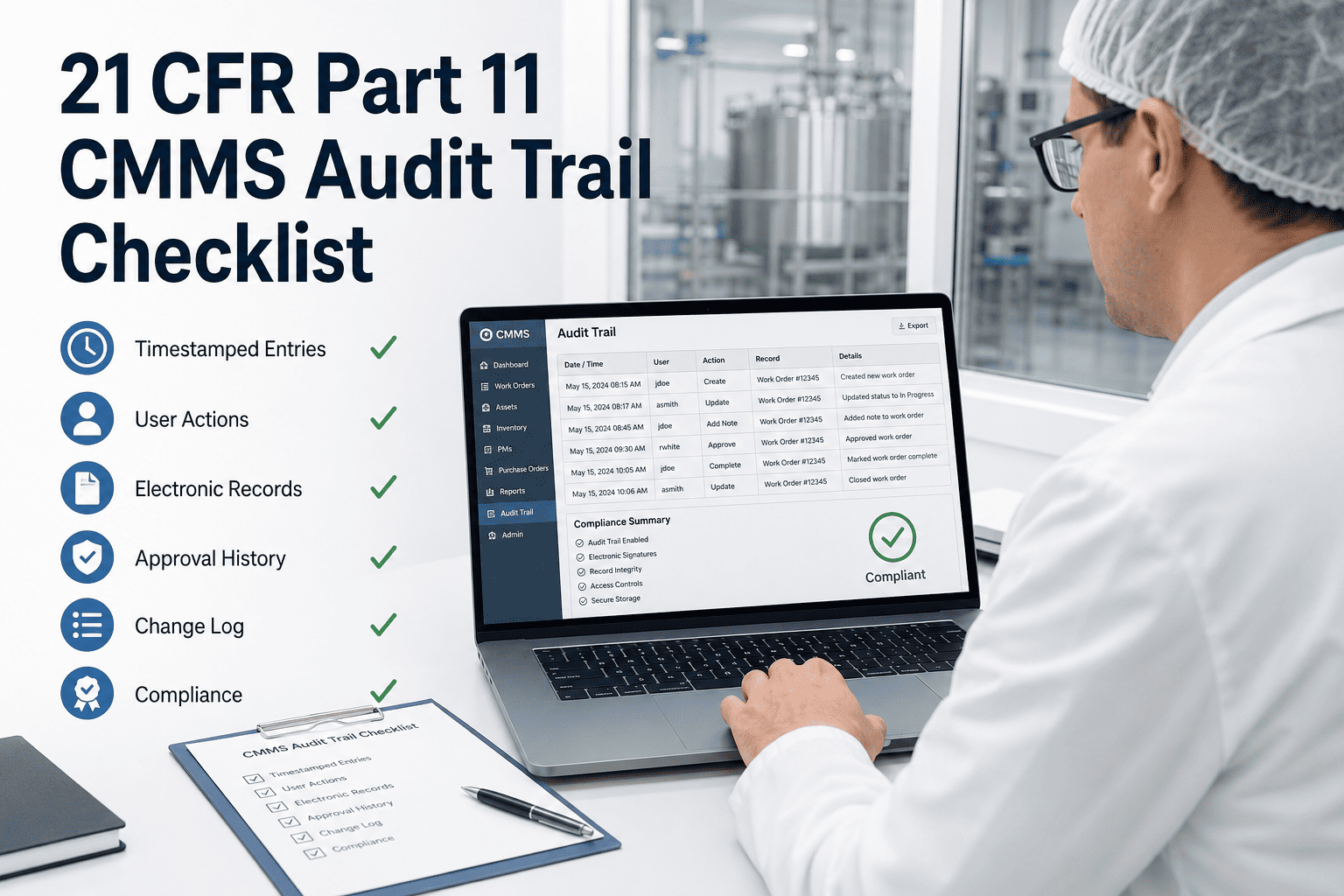
21 CFR Part 11 requires that electronic records cannot be altered without the original record remaining visible. A CMMS that allows record editing without an immutable change log does not comply, regardless of other features.
05
PM overdue documentation
Overdue PMs create compliance deviations that may invalidate production runs in that window. Investigators ask whether the quality unit was notified and whether a documented risk assessment was completed for each overdue event.
06
Electronic signature integrity
Signatures must be linked to their records, non-falsifiable, and tied to a unique user identity. Shared login credentials or manual PDF signatures attached to a digital record do not meet Part 11 requirements.
Built for quality leaders
Stop assembling audit evidence the night before inspection
OxMaint produces a complete, export-ready inspection package for any asset, any date range, in under 10 minutes. See it live with your own asset data.
Feature map for QA
How OxMaint maps to your quality control requirements
Quality leaders need a CMMS that speaks the language of GMP, not just maintenance. The table below maps OxMaint capabilities directly to the regulatory requirements your QA team is accountable for. Every item in this table is a first-class feature, not a workaround or configuration hack.
| QA Requirement |
Regulatory Reference |
OxMaint Capability |
Inspection Evidence Produced |
| Tamper-evident audit trail |
21 CFR Part 11.10(e) |
Immutable change log on all records |
Timestamped edit history, exportable per record |
| Electronic signatures on GxP records |
21 CFR Part 11.50 |
Unique-user e-signatures linked to records |
Signature manifest with user ID and timestamp |
| Deviation-to-CAPA traceability |
21 CFR 211.192 |
Linked deviation and CAPA records per asset |
CAPA chain report from initiation to closure |
| Calibration certificate management |
21 CFR 211.68 |
Digital calibration logs with OOT escalation |
Full calibration history by instrument, exportable |
| Return-to-service authorisation |
21 CFR 211.67 |
Mandatory sign-off workflow before WO close |
Authorisation record with role, name, timestamp |
| PM overdue notification to QA |
21 CFR 211.68 / GMP Annex 11 |
Automated QA alert on PM overdue events |
Overdue log with risk assessment documentation |
| System validation documentation |
GAMP 5 / 21 CFR 11.10(a) |
Pre-built IQ/OQ/PQ package supplied |
Full validation binder, ready for QA review |
Audit evidence workflow
From equipment event to inspection-ready evidence in one system
Most quality leaders at pharmaceutical sites spend 800 to 1,200 hours per year on inspection preparation, manually assembling records from disconnected CMMS, calibration databases, and paper CAPA logs. OxMaint collapses this into a single traceable workflow that runs continuously, not just before inspection.
1
Equipment event captured
Technician logs a failure, calibration exceedance, or maintenance task on mobile. Record is timestamped, user-linked, and Part 11-locked immediately on save.
2
Deviation auto-generated
If event meets configured thresholds, a linked deviation record opens automatically. QA is notified, root cause template is assigned, and the clock starts for regulatory timelines.
3
CAPA routed and tracked
CAPA tasks are assigned, due dates set, and escalation rules configured. Every action is logged against the originating equipment record. No manual copy-paste between systems.
4
Closure with effectiveness check
CAPA cannot be closed without QA sign-off and an attached effectiveness verification record. The complete chain from event to closure is stored on the asset history thread.
5
Inspection package on demand
When the investigator walks in, QA exports a complete asset history, calibration package, and CAPA chain in under 10 minutes. No overnight file reconstruction required.
Expert review
What a former FDA investigator says about CMMS in inspections
MK
During FDA inspections, the maintenance CMMS records are reviewed with the same rigor as batch records. Investigators specifically look for gaps in calibration history, undocumented corrective actions, and evidence that equipment returned to service after repair without proper verification. I have seen Warning Letters issued primarily because the CMMS could not produce a complete, unedited maintenance history for critical manufacturing equipment. Quality leaders who treat the CMMS as a maintenance tool rather than a compliance system will always be caught underprepared when the investigator requests the equipment file.
Dr. Meera Krishnaswamy
GMP Compliance Director — Former FDA CDER Investigator — 18 years Pharmaceutical Quality Assurance
GMP readiness score
How does your current CMMS score on QA requirements?
Use this scorecard to assess whether your current maintenance system meets the evidence standard a quality leader needs for continuous inspection readiness. Any row scored No is a documentation gap that a 21 CFR Part 11 or GMP inspection can and will find.
QA Control Point
Paper or Legacy CMMS
OxMaint
Immutable audit trail on all records
No
Yes
Electronic signatures tied to user identity
No
Yes
Deviation auto-linked to equipment record
No
Yes
CAPA open-to-close traceability in one system
No
Yes
Inspection-ready export under 10 minutes
No
Yes
Pre-built GAMP 5 validation package supplied
No
Yes
PM overdue alert routed to QA automatically
No
Yes
Return-to-service sign-off enforced before WO close
No
Yes
Inspection readiness starts here
Every No in your scorecard is a 483 waiting to be written
OxMaint converts your maintenance operation into a continuous source of GMP evidence. Book a 30-minute demo and see how quality leaders at FDA-inspected sites use OxMaint to close every gap on this scorecard before the investigator arrives.
Common questions from QA directors
Frequently asked questions
Does OxMaint produce a validated system that satisfies 21 CFR Part 11 out of the box?
Yes. OxMaint ships with a pre-built GAMP 5 IQ/OQ/PQ validation package, immutable audit trail architecture, and electronic signature controls that meet the FDA electronic records standard. The validation package is reviewed and signed off by your QA team during onboarding, not assembled from scratch by your validation engineer.
Book a demo to walk through the validation binder with our pharma compliance team.
How does OxMaint connect maintenance events to the deviation and CAPA system?
When a configurable threshold is crossed, such as a calibration out-of-tolerance, an overdue PM on a critical asset, or a technician-flagged equipment failure, OxMaint automatically opens a linked deviation record and routes it to QA. The CAPA task chain is created within the same record thread, and closure requires QA e-signature and an effectiveness verification attachment.
Start a free trial to configure your own deviation thresholds and see the CAPA link in live operation.
How long does it take to produce an inspection-ready maintenance evidence package for a specific asset?
OxMaint produces a complete equipment history export, including calibration certificates, PM records, deviation links, CAPA closure evidence, and Part 11 signature manifest, in under 10 minutes for any asset and any date range. Sites previously spending 1,200 hours annually on inspection preparation have reduced that to on-demand export with no manual file assembly.
Book a demo to see a live export run against a representative asset profile.
Can quality leaders control which maintenance actions require QA sign-off without involving IT?
Yes. OxMaint has a role-based workflow configuration panel accessible to QA administrators. Quality leaders can define which asset classes, maintenance types, or deviation severities require a QA electronic signature before a work order can be closed. Configuration changes are themselves subject to the system audit trail and require QA authorisation, maintaining full change control compliance.
Start a free trial to explore the QA role configuration in a sandbox environment.
Your next FDA inspection is not a scheduled event
Build your inspection-ready CMMS foundation before the investigator requests the equipment file
Quality leaders who use OxMaint do not prepare for inspections. They run inspections from a standing start, exporting complete audit packages in minutes rather than days. A 30-minute demo with our pharma compliance team will show you exactly how that works across your asset base, your regulatory framework, and your current deviation and CAPA workflow.