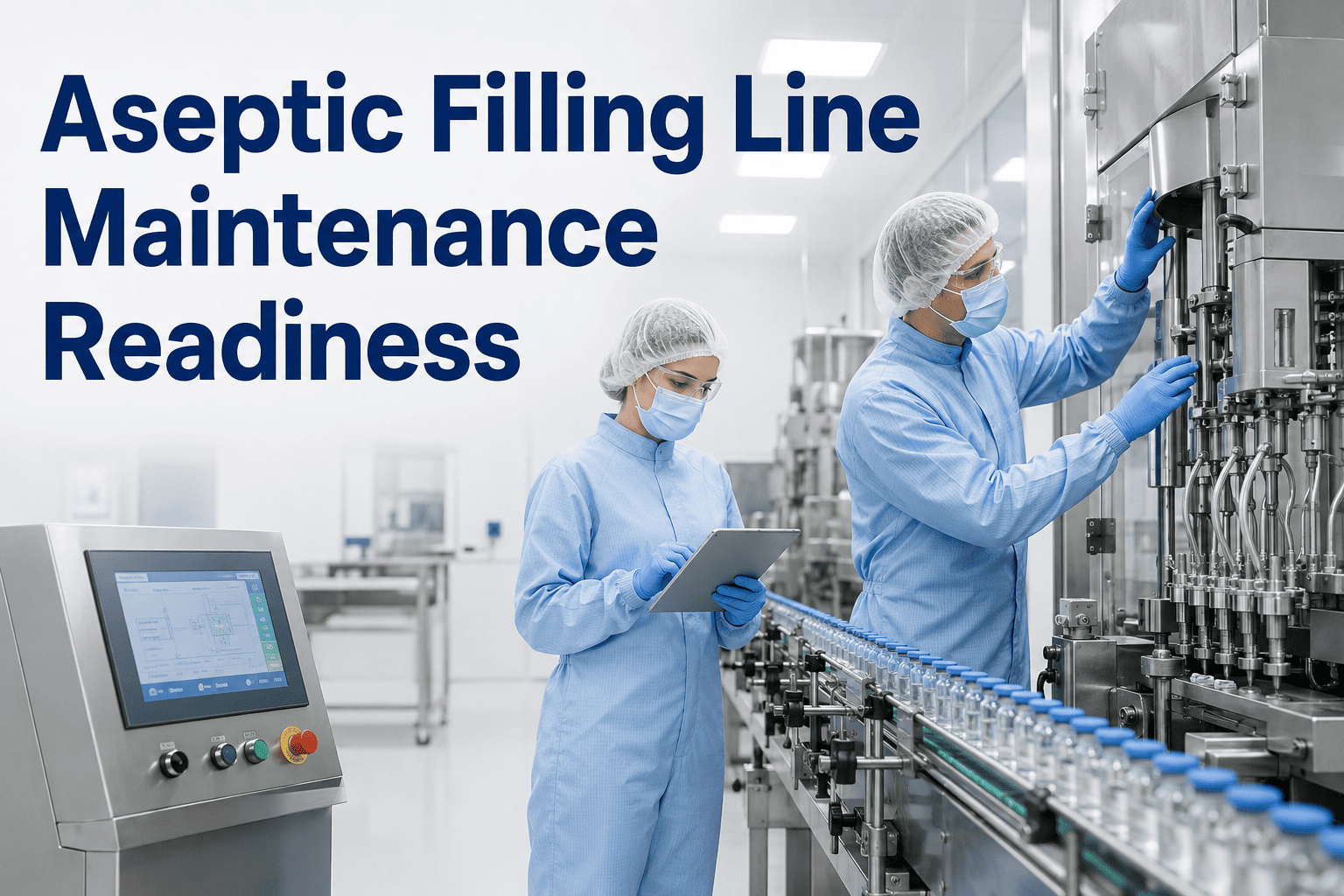
Aseptic filling lines represent the highest-risk maintenance environment in pharmaceutical manufacturing because every physical intervention on a Grade A or Grade B zone component creates a potential pathway for microbial contamination into sterile product. Unlike conventional packaging equipment where a maintenance technician can replace a bearing, reassemble the guard, and restart the line within an hour, an aseptic line intervention triggers a cascading sequence of contamination control requirements — environmental monitoring resets, sterilization cycles, line clearance verifications, and often media fill validations — that can keep a multi-million-dollar filling line idle for 24 to 48 hours. The regulatory expectation under EU GMP Annex 1 and FDA aseptic processing guidance is that every intervention must be risk-assessed before it occurs, documented as it occurs, and verified complete before the line restarts, with full traceability from the initial deviation or maintenance trigger through to QA batch release. If your facility is managing aseptic interventions through paper logs, disconnected deviation systems, and manual line clearance checklists, start a free Oxmaint account to deploy an integrated risk tracker that connects interventions to deviations and line clearance in real time, or book a 30-minute demo with our sterile manufacturing specialists to see how it works on a filling line like yours.
Sterile Manufacturing · Aseptic Filling
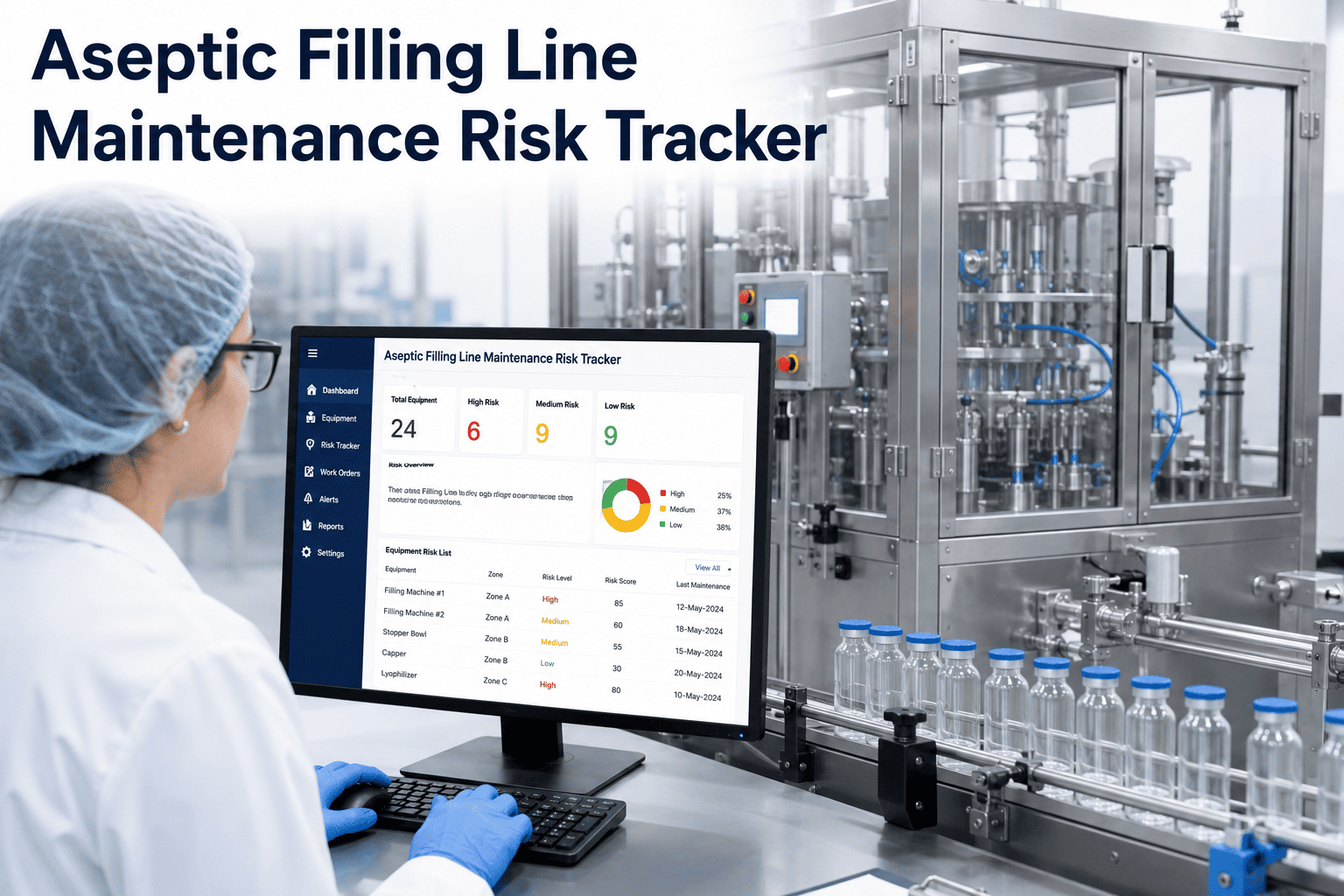
Aseptic Filling Line Maintenance Risk Tracker
Every intervention is a contamination event. Risk-classify, control, document, and verify each one with deviation-linked work orders and mandatory line clearance gates.
33
Intervention types mapped to risk tiers
5
Controlled workflow stages per intervention
48 hrs
Max downtime for critical-zone interventions
100%
Deviation-to-work-order traceability required
Aseptic Intervention Risk Tiers Explained
Not all maintenance interventions carry the same contamination risk. EU GMP Annex 1 (2022 revision) requires that interventions be categorized by their potential to compromise sterility assurance. The three-tier system below maps directly to the post-intervention controls required before line restart.
Tier 1 — Critical Risk
Grade A Breach
Examples: Pump seal replacement, filling needle removal, stopper bowl adjustment, sterile filter change
Required controls: Full SIP re-sterilization, environmental requalification (viable + non-viable), media fill or simulated intervention, QA batch disposition review
Typical restart timeline: 24–48 hours
Tier 2 — High Risk
Grade A Proximity / Grade B Breach
Examples: HVP lamp replacement, conveyor belt change, load cell calibration, RABS glove change, external sensor replacement in Grade B
Required controls: Surface sanitization, environmental monitoring reset, line clearance checklist, in-process control re-verification, possible media fill
Typical restart timeline: 8–24 hours
Tier 3 — Medium Risk
Grade C / D / External
Examples: HMI panel troubleshooting, utility connection verification, external motor replacement, control cabinet repair
Required controls: Line clearance checklist, documentation review, functional verification of affected system, QA sign-off
Typical restart timeline: 1–6 hours
Filling Line Component Risk Map
Each component on the aseptic filling line has a pre-assigned risk tier based on its zone classification and product contact status. When a work order is created for any component below, Oxmaint automatically applies the corresponding intervention controls.
| Line Component |
Zone |
Product Contact |
Risk Tier |
Most Common Intervention |
| Filling needles / nozzles |
Grade A |
Direct |
Critical |
Realignment, replacement, blockage clearance |
| Product pump (rotary lobe) |
Grade A |
Direct |
Critical |
Seal replacement, rotor inspection |
| Sterile filter housings |
Grade A |
Direct |
Critical |
Filter change, housing gasket replacement |
| Stopper feeder (bowl + rails) |
Grade A |
Indirect |
Critical |
Rail adjustment, vacuum check, bowl cleaning |
| HVP lamps (isolator) |
Grade A (isolator) |
No |
High |
Lamp replacement, ballast check |
| RABS gloves / sleeves |
Grade A (RABS) |
No |
High |
Glove change, integrity test failure |
| Infeed / outfeed conveyor |
Grade B |
No |
High |
Belt replacement, tension adjustment, sensor swap |
| Load cells / weighing system |
Grade A proximity |
No |
High |
Calibration, replacement, cable repair |
| CIP/SIP valves and piping |
Grade B |
Direct (cleaned) |
High |
Valve seat replacement, actuator repair |
| External drive motors |
Grade C / D |
No |
Medium |
Bearing replacement, coupling alignment |
| Electrical cabinets / PLC |
Grade C / D |
No |
Medium |
Component swap, firmware update, fault diagnosis |
| Utility connections (WFI, steam, air) |
Grade B (external) |
No |
Medium |
Connection leak check, filter replacement |
Expert Review
"EU GMP Annex 1 2022 fundamentally changed how regulators expect sterile manufacturing sites to manage interventions. The new requirement for a documented intervention risk assessment for every maintenance activity — not just the ones that go wrong — means facilities need a system that pre-classifies each component and each intervention type by risk tier before the intervention ever occurs. I have seen sites get cited because they could not produce a risk assessment for a routine stopper feeder adjustment that happened six months ago. The risk tracker is not optional anymore — it is the baseline expectation for any FDA or EMA inspection of an aseptic filling facility."
Dr. Maria Vasquez — GMP Consultant specializing in sterile manufacturing, former EU GMP Inspector, 17+ years in aseptic processing compliance
Pre-classify every filling line component by risk tier. Auto-generate intervention controls when work orders are created. Oxmaint maps your aseptic line components to risk tiers, links maintenance actions to deviation records, enforces line clearance gates, and produces complete intervention dossiers for inspection readiness.
Controlled Intervention Workflow: 5 Mandatory Stages
Every aseptic maintenance intervention must pass through five sequential stages. Oxmaint enforces this workflow with mandatory field completion at each gate — a stage cannot be skipped or marked complete without the required data.
1
Risk Assessment & Classification
System auto-assigns risk tier from component zone map. Maintenance supervisor reviews and confirms. Pre-intervention checklist generated based on tier. If triggered by deviation, deviation link is established at this stage.
2
Pre-Intervention Preparation
Technician gowning verification logged. Tools sterilized and logged against the work order. Environmental monitoring baseline recorded. SOP reference confirmed. Line status changed to "Intervention Pending."
3
Controlled Execution
Maintenance performed under aseptic conditions. Every action timestamped in the work order with technician identity. Observations, measurements, and any unexpected findings logged in real time via mobile. Line status changed to "Intervention in Progress."
4
Post-Intervention Verification
Risk-tier-specific controls executed: SIP cycle for Critical, sanitization and env monitoring reset for High, line clearance for Medium. All results recorded against the work order. Any failed verification triggers automatic escalation to QA.
5
QA Review & Line Release
QA reviews complete intervention dossier — risk assessment, pre-checks, execution log, post-verification results, line clearance sign-offs. QA approves line status change to "Ready for Production." If deviation was linked, deviation status is updated. Batch record annotated.
Deviation-Triggered Interventions: Traceability Requirements
When a maintenance intervention is triggered by a process deviation, the traceability chain from deviation to corrective action to batch disposition must be complete and auditable. The table below maps common aseptic deviations to their required maintenance responses and the traceability link that must exist in your system.
| Deviation Type |
Maintenance Investigation Required |
Risk Tier |
Batch Disposition Dependency |
| Grade A viable count excursion |
Isolator/RABS integrity test, HEPA DOP test, filter integrity, sanitization cycle review |
Critical |
Root cause must conclude before batch release. CAPA required if systemic. |
| Fill weight out of specification |
Load cell calibration check, pump stroke verification, check valve inspection, air elimination check |
High |
Calibration verification required. OOS investigation must rule out equipment cause. |
| Stopper visual defect increase |
Feeder bowl inspection, vacuum rail adjustment, stopper dimensional check, supplier notification |
High |
Root cause must identify equipment vs. material. Affected batches assessed for sterility assurance impact. |
| Non-viable particle alert |
HEPA filter integrity, air change rate verification, surface sampling, equipment vibration check |
Critical |
Environmental requalification must pass before batch release. Filter replacement if failed. |
| CIP cycle failure or deviation |
Spray ball inspection, valve seat check, conductivity sensor calibration, cycle time review |
High |
CIP revalidation required. Cleaning verification must pass. Previous batches assessed for potential cross-contamination. |
| SIP temperature deviation |
Steam trap inspection, temperature probe calibration, valve positioning check, heat loss survey |
Critical |
SIP cycle must be repeated successfully. Previous batches since last valid SIP may require hold and assessment. |
Line Clearance Verification Points
The line clearance checklist is the final gate between maintenance completion and production restart. Every point below must be verified and signed off independently by both a maintenance technician and a QA representative. Oxmaint enforces dual sign-off — the line status cannot change until both signatures are captured.
Physical Verification
01 All tools, fasteners, and foreign materials removed from filling zone
02 All panels, guards, and barriers reinstalled and secured
03 Product contact surfaces inspected — no damage, residue, or foreign material
04 Connections and fittings verified torqued to specification
Sterility Verification
05 SIP cycle completed and recorded for all reassembled product-contact components
06 Sterilizing-grade filter integrity test passed and documented
07 Isolator or RABS decontamination cycle completed and verified
08 Sterile barrier integrity confirmed — gloves, ports, transfer systems
Environmental Verification
09 Room pressure differentials restored and within specification
10 Air change rates verified within acceptance criteria
11 Environmental monitoring (viable + non-viable) restarted with confirmed baseline
12 Room temperature and humidity within validated ranges
Documentation & Release
13 Work order completed with all findings, measurements, and observations
14 Intervention risk assessment signed by maintenance supervisor
15 Line clearance checklist dual-signed by maintenance and QA
16 Batch record annotated with intervention details and QA release signature
Frequently Asked Questions
How does Oxmaint determine the risk tier for a specific maintenance intervention?
Each filling line component is registered with its zone classification and product contact status during initial setup. When a work order is created, Oxmaint cross-references the component profile and intervention type against a pre-configured risk matrix to assign the tier automatically.
Book a demo to see the risk classification engine applied to your filling line components.
Can the system enforce a line hold until all post-intervention checks are complete?
Yes. Oxmaint maintains a line status field that cannot be advanced from "Intervention in Progress" to "Ready for Production" until every risk-tier-specific verification step is marked complete and dual-signed by maintenance and QA.
Sign up free to configure line status hold controls for your filling lines.
How are deviation-triggered interventions linked to the original deviation record?
When a deviation is created or imported, Oxmaint prompts the user to create a linked investigation work order. The link is bidirectional and permanent — opening the deviation shows all linked maintenance actions, and each work order displays its originating deviation with current status.
Book a 30-minute session to see deviation-to-work-order traceability.
Does this support EU GMP Annex 1 2022 requirements for intervention risk assessment?
Yes. The risk tier system, pre-intervention checklists, simulated intervention tracking, and complete intervention documentation are designed to meet the specific intervention control requirements introduced in the 2022 Annex 1 revision.
Start a free account to review the Annex 1 compliance configuration.
Can we produce a complete intervention dossier for an FDA investigator on demand?
Yes. Oxmaint generates a single exportable report containing the risk assessment, pre-intervention checklist, execution log with timestamps, post-intervention verification results, environmental monitoring data, line clearance dual sign-offs, deviation linkage, and QA release — all in one document.
Book a demo to see the intervention dossier format.
How does the system handle emergency interventions during an active fill cycle?
Emergency work orders trigger the same 5-stage workflow with an expedited path. The system timestamps the production interruption, auto-assigns the risk tier, generates the minimum required checklist for that tier, and flags the affected batch for QA review. No controls are skipped — the workflow is accelerated.
Sign up free to configure emergency intervention protocols.
Can we track simulated intervention validations required before performing critical interventions?
Yes. Oxmaint includes a simulated intervention module where you define the intervention scenario, assign it to a media fill or process simulation, and record the validation outcome. Critical interventions cannot proceed until their associated simulated validation has a documented passing result.
Book a demo to see the simulated intervention tracker.
Does the system work for both isolator-based and RABS-based filling lines?
Yes. Oxmaint maintains separate risk profiles and post-intervention control sets for isolator-based, RABS-based, and open filling configurations because the barrier technology directly determines the intervention controls and environmental requalification requirements.
Start a free account to configure your filling technology type.
Eliminate Intervention Traceability Gaps on Your Aseptic Filling Lines
Risk-classified interventions, deviation-linked work orders, mandatory 5-stage workflow, dual-signed line clearance, and complete inspection-ready dossiers — deployed and configured for your sterile manufacturing operation.