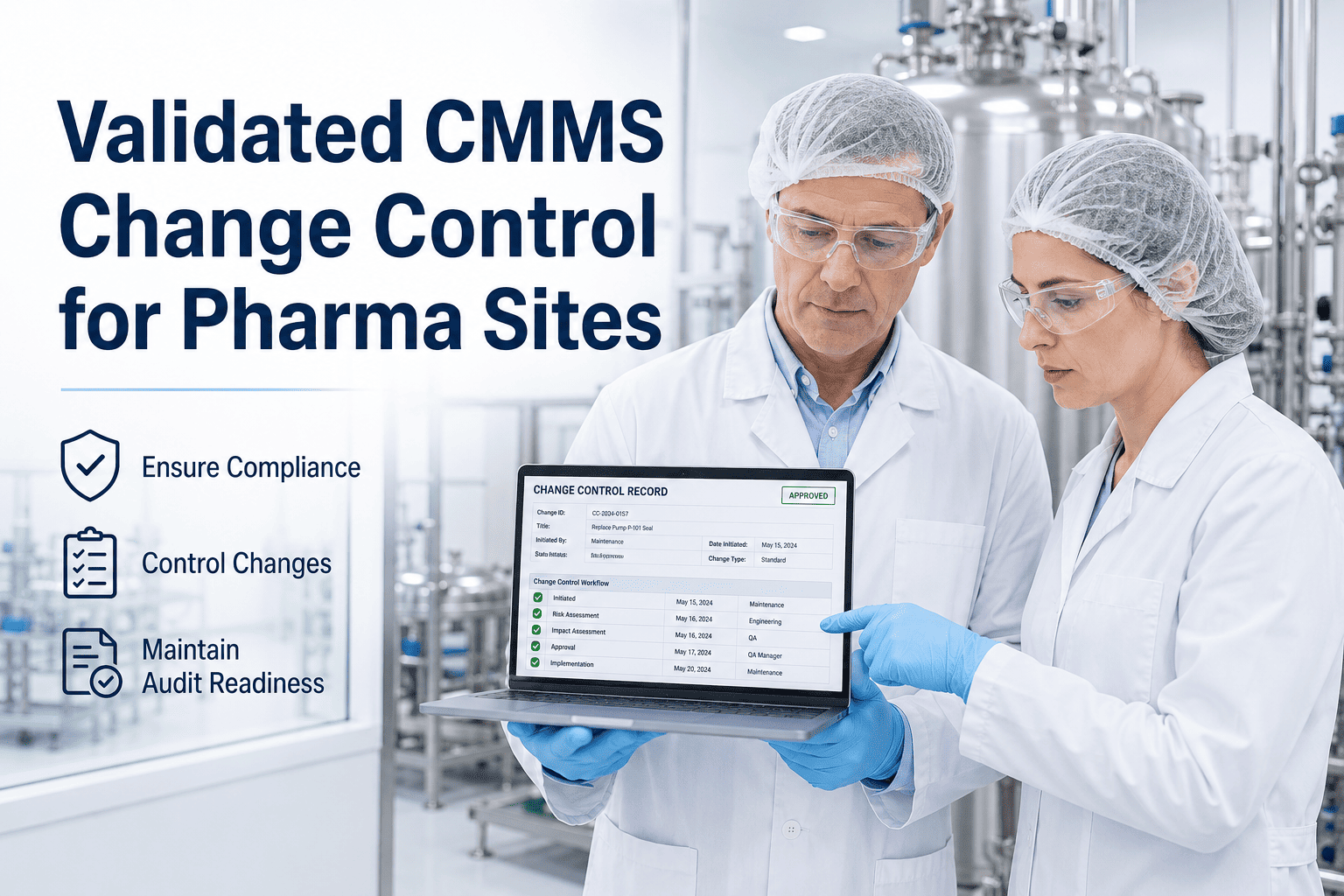
A CMMS configuration change that lacks documented approval, testing evidence, and a controlled rollout procedure is not a software update — it is an uncontrolled GMP event. OxMaint's validated CMMS embeds change control into every configuration modification, generating the approval chains, version histories, and testing records that pharma QA teams need for FDA, MHRA, and EU GMP Annex 11 inspections.
Validated CMMS Change Control for Pharma Sites
Every CMMS configuration change on a pharma site is a GxP event. Without structured change control, a modified PM template or updated approval workflow is an audit finding waiting to be discovered.
What Happens When CMMS Change Control Fails
The Six-Stage Validated Change Control Process in OxMaint
Any proposed configuration change — modified checklist, new approval role, updated PM interval, revised calibration template — begins as a formal change request with a risk classification (minor, major, critical GxP impact) assigned by the initiator.
QA reviews the change against the validated system boundary. Changes with GxP impact require a documented impact assessment confirming whether the change affects audit trail integrity, electronic signature controls, data integrity, or validation state.
Major and critical changes route through a defined approval chain — Site QA, IT, and Validation Lead at minimum. Every approval is captured as a timestamped electronic signature in the OxMaint audit trail, meeting 21 CFR Part 11.50 and EU GMP Annex 11 requirements.
GxP-impacting changes are tested in a qualified test instance before production deployment. Test evidence — pass/fail results, tester ID, date — is attached to the change record. GAMP 5 Category 4 and 5 systems require this evidence as part of re-validation documentation.
Changes are deployed to production only after final QA sign-off. OxMaint records the exact deployment timestamp, the user who executed it, and the previous configuration version — creating a complete before/after version history for every change in the system.
Every approved, tested, and deployed change is archived in OxMaint's immutable version history — filterable by change type, date, approver, and GxP impact. This record is exportable for IQ/OQ/PQ package updates and regulatory inspection responses.
CMMS Change Types, GxP Impact, and Required Controls
| Change Type | GxP Impact | Approval Required | Testing Required | Validation Update |
|---|---|---|---|---|
| PM checklist step added or removed | High | QA + Validation Lead | Full regression test | OQ update required |
| Electronic signature role assignment changed | Critical | Site QA + IT + Validation | E-signature flow test | IQ/OQ/PQ re-execution |
| Calibration interval modified | High | QA + Metrology Lead | Scheduling logic verification | OQ update required |
| User access permission updated | High | IT Security + QA | Access control test | IQ section update |
| Report template format change | Medium | QA review only | Output verification | Change note only |
| Notification email text updated | Low | Supervisor approval | Not required | None |
| Audit trail configuration modified | Critical | Site QA + IT + Validation + DI Lead | Comprehensive audit trail test | Full re-qualification |
Every CMMS configuration change at your pharma site is a GxP event. Treat it like one.
OxMaint gives pharma validation and QA teams a structured change control workflow — built into the CMMS core, not bolted on as an afterthought.
What Pharma Validation Leaders Say
FDA investigators are no longer satisfied by 'we validated the system at go-live.' The question they ask in 2024 and 2025 is: how do you control changes to the validated state? A CMMS that cannot demonstrate a documented, tested, approved change history for every configuration modification since initial validation is, from a regulatory standpoint, operating in an unvalidated state. This is not theoretical risk — it generates 483 observations.
The most defensible pharma CMMS change control programs we see share one design principle: the approval chain, testing evidence, and version archive are stored in the same system as the maintenance records themselves. Separate change logs in spreadsheets are the first thing an auditor asks to see — and the first thing that creates problems.
Validated CMMS Change Control — Common Questions
Does every CMMS change at a pharma site require formal change control?
How does OxMaint's change control integrate with IQ/OQ/PQ validation documentation?
What is the difference between EU GMP Annex 11 and 21 CFR Part 11 change control requirements?
How does OxMaint prevent unauthorized CMMS configuration changes?
Change control is not a barrier to CMMS improvement. It is the proof that your improvements are GMP-compliant.
See how OxMaint manages CMMS configuration changes with pharmaceutical-grade approval, testing, and version control — in a 30-minute demo.