Downtime on an aseptic filling line carries one of the highest price tags in pharmaceutical manufacturing — an average of $450,000 per hour in lost production and batch rejection when a piston pump seal fails, a needle misaligns, or a stopper placement drifts out of tolerance. Aseptic filling line monitoring tracks pump condition, needle path, and stopper placement force against a connected maintenance record, so a small deviation gets caught as a work order instead of a full line stop. Over two-thirds of recent FDA 483 observations in fill-finish facilities cited inadequate equipment maintenance or monitoring as the root cause — which means most stoppages were preventable. Here is what actually drives a stoppage and how a connected CMMS stops it earlier.
Every Stoppage Is a Deviation Investigation Waiting to Happen
Needle misalignment, stopper placement error, and pump seal degradation are the three most common triggers for an aseptic line stop — and all three give off warning signs before they cause one.
Three Failure Points That Stop an Aseptic Line
Each one shows a measurable signal before it forces a stoppage.
Piston and Peristaltic Pump Wear
Pump-to-pump variation and tubing relaxation shift fill volume gradually. Torque and fill-weight profiles drift before a pump fully fails.
Needle Misalignment
Position drift in the needle path increases splashing, dripping, and clogging risk. Vision-based alignment monitoring catches drift before product quality is affected.
Stopper Placement Error
Torque variation and placement force errors compromise container closure integrity, creating sterility risk that triggers an immediate hold.
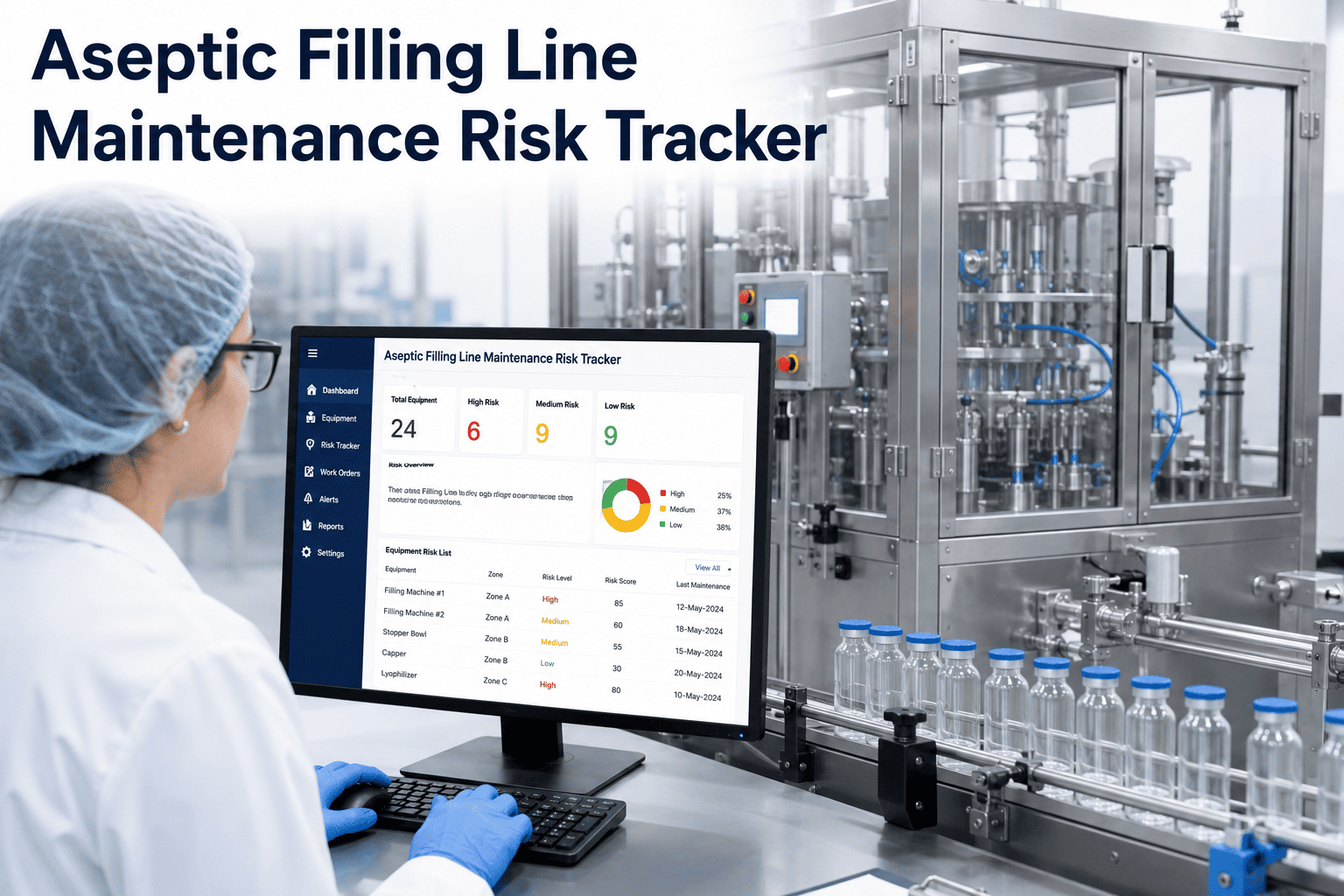
Watch Pump, Needle, and Stopper Monitoring in One Dashboard
See how OxMaint connects torque profiles, alignment sensors, and pump condition data into one work order queue before product quality is ever affected.
What Happens After a Stoppage, Step by Step
A stoppage rarely ends with the line restarting. Here is the typical chain of events it triggers.
Line stops mid-batch, often from a single sensor or alarm trigger
Deviation report opens, with full root-cause analysis required
Affected units are isolated pending sterility and fill-weight review
QA holds batch release until investigation and CAPA are closed
Reactive vs Monitored: The Practical Difference
The gap is in how early the signal reaches maintenance, not the equipment itself.
| Control Point | Reactive Approach | Sensor-Monitored Approach |
|---|---|---|
| Pump condition | Found at fill-weight failure | Trended via torque and pressure profile |
| Needle alignment | Found at visual inspection | Tracked in real time via vision integration |
| Stopper placement | Found at closure integrity test | Monitored via high-frequency force sensors |
| Audit readiness | Reconstructed after the fact | Traceable record generated automatically |
A sound control strategy detects abnormalities before they lead to a stoppage, not after. Statistical process control, sampling plans, and alarm escalation work together precisely because a single missed signal — a torque reading, a fill weight drift — is usually the only warning a line gives before it stops.
Frequently Asked Questions
Catch the Drift Before It Becomes a Stoppage
Connect pump, needle, and stopper data into one maintenance record and turn your next deviation into a routine work order instead of a line stop.