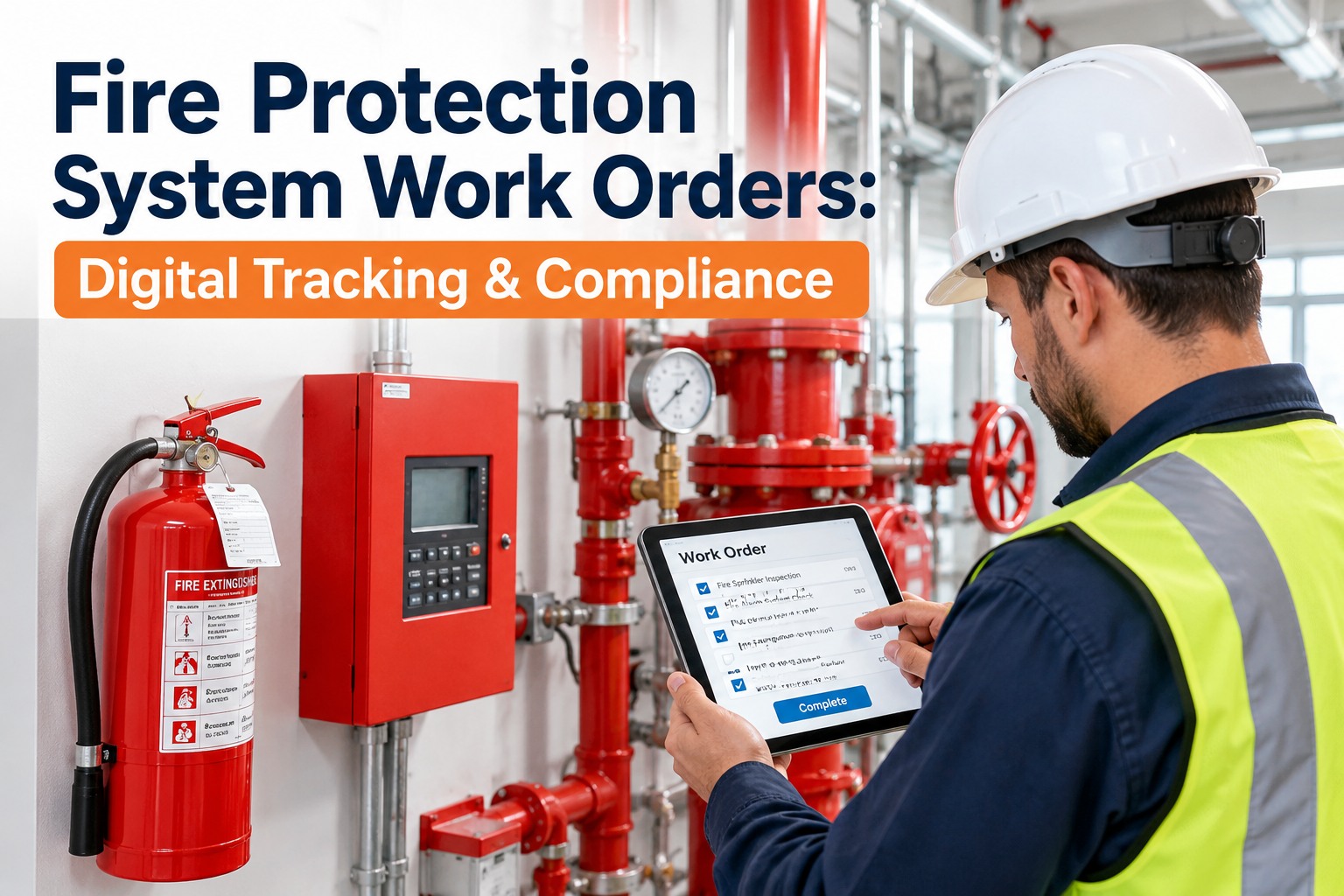
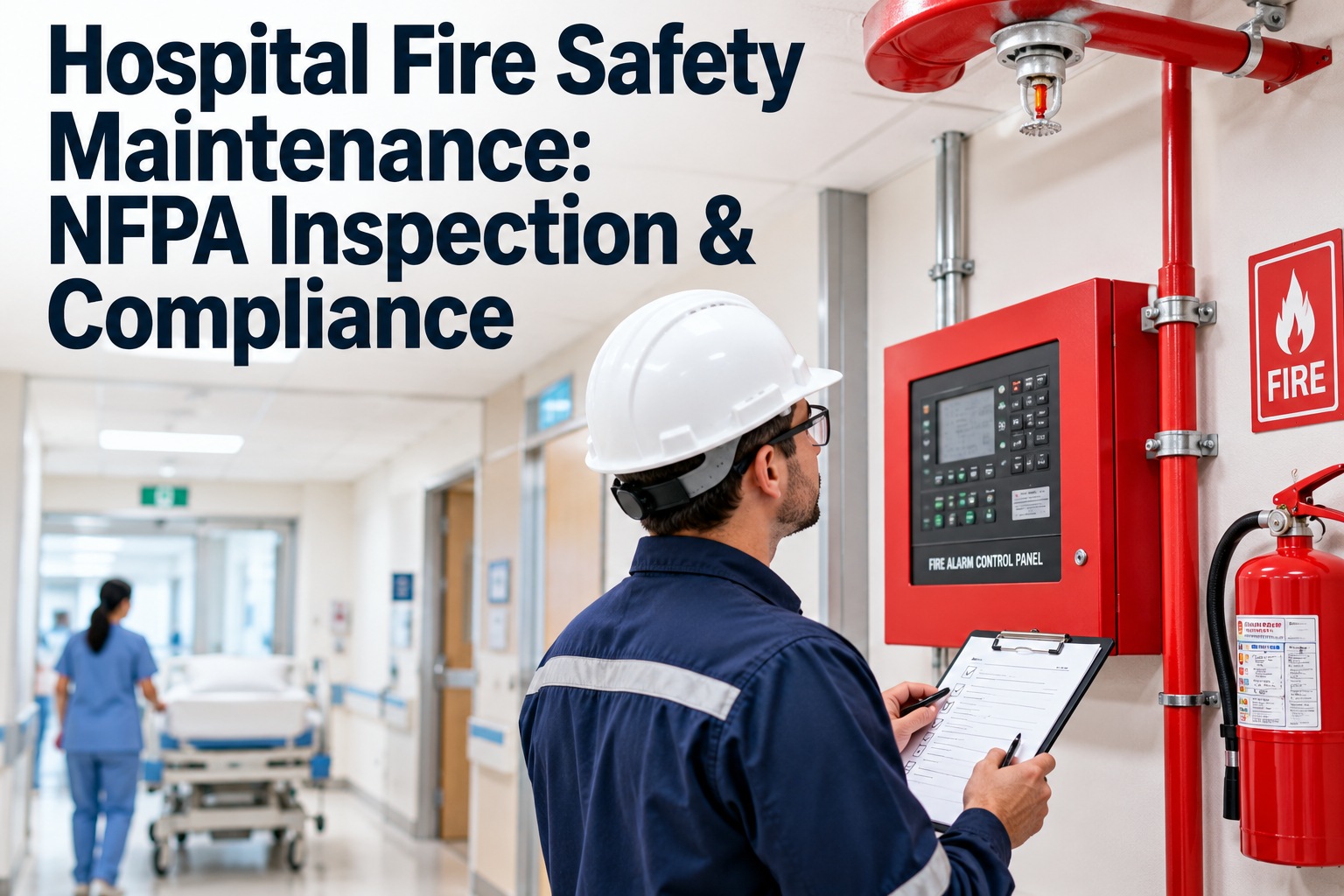
A fire protection program lives or dies on paperwork. Every sprinkler head inspected, every extinguisher weighed, every alarm panel tested, every impairment red-tagged and lifted — each one is a work order whose record determines whether the AHJ accepts the next annual report, whether the insurance underwriter re-rates the premium, and whether the hospital, hotel, warehouse or plant keeps its certificate of occupancy. A digital work order with the sign-off, photo and timestamp attached is the only version that holds up. OXMAINT AI is the AI-powered fire protection system maintenance software that runs the WO lifecycle for every fire-protection asset, keeps the NFPA cadence live, red-tags impairments, time-stamps the AHJ-ready audit trail, and converts the whole program from a binder into a system.
FIRE PROTECTION SYSTEM WORK ORDERS · DIGITAL TRACKING & COMPLIANCE · 2026
Fire Protection System Work Orders: Digital Tracking & Compliance
Seven fire-protection asset classes, three deficiency tiers, one red-tag impairment workflow. OXMAINT AI runs the whole WO lifecycle from NFPA-cadence trigger to AHJ-ready audit record on one register.
7
fire-protection asset classes
3
deficiency tiers · critical / non-critical / impairment
4
cadence windows · weekly / monthly / quarterly / annual
AHJ
audit trail that the inspector opens
The Seven Fire-Protection Asset Classes — One Register, Seven Templates
A fire-protection program lives across seven asset classes, each with its own NFPA code reference and its own WO template. OXMAINT AI holds a template per class so every inspection generates the right WO in the fire-protection maintenance software.
01
Fire sprinkler systems
Wet, dry, pre-action, deluge systems; mains, risers, heads, FDC, backflow preventers.
NFPA 25
02
Fire alarm & detection
Control panels, pull stations, smoke & heat detectors, notification devices, duct detectors.
NFPA 72
03
Fire extinguishers
Portable extinguishers — monthly visual, annual service, 6-year teardown, hydrostatic test.
NFPA 10
04
Standpipe & hose systems
Class I, II, III standpipes, hose stations, PRV valves, hose cabinets.
NFPA 14 · NFPA 25
05
Clean agent & kitchen hood
FM-200, Novec, CO₂ special-hazard systems; wet-chemical kitchen suppression.
NFPA 2001 · NFPA 17A · NFPA 96
06
Emergency lighting & exit signs
Battery-backed emergency lighting units, illuminated exit signs, egress-path lighting.
NFPA 101
07
Fire doors & dampers
Fire-rated doors, smoke dampers, fire dampers, fire-stopping penetrations.
NFPA 80 · NFPA 105
The Fire-Protection WO Lifecycle — Six Stages
A fire-protection WO is not a general maintenance WO. It carries additional stages the AHJ expects to see on the record. OXMAINT AI runs all six stages natively, pinning the audit trail at each one.
01
NFPA cadence trigger
WO auto-raised from code cadence (NFPA 25 weekly riser gauge, NFPA 10 monthly extinguisher, NFPA 72 annual alarm). No manual scheduling.
→
02
Assigned & walked
Qualified tech assigned by license level required (ITM-certified vs facility-tech); walk completed on mobile with photo capture.
→
03
Finding classified
Each finding tagged critical / non-critical / impairment per NFPA 25 definitions. Impairment auto-triggers red-tag workflow.
→
04
Repair WO raised
Each finding spawns a child repair WO with SLA by tier: critical 24-72h, non-critical 30 days, impairment immediate.
→
05
Repair verified
Verification by qualified tech different from the repairer; test record attached (flow test, functional test, retrofit sign-off).
→
06
AHJ record pinned
Signed inspection report filed; AHJ notification where required; annual summary report generation seeded.
NFPA Cadence Matrix — What's Due When
The NFPA cadence shapes the WO calendar. The matrix below captures the headline frequencies; OXMAINT AI holds the full NFPA 25 / 72 / 10 tables as policy defaults with per-site override.
Asset
Weekly
Monthly
Quarterly
Annual
Multi-year
Sprinkler risers
Gauge check
Valve supervisory
Hangers / bracing
Main drain & trip test
Internal (5 yr) · obstruction (5 yr)
Fire alarm panel
Battery visual
Device sample
100% device test
Battery capacity (annual)
Extinguishers
Visual inspection
Annual service
6-yr teardown · 12-yr hydro
Standpipe / FDC
FDC caps & threads
Hose cabinet
Flow test
5-yr hydro on hoses
Kitchen hood suppression
Visual
Semi-annual service
6-yr tank hydrostatic
Emergency lighting
30-sec test
90-min test
Fire doors & dampers
Annual function test
Damper 4-yr (hospitals) / 6-yr
The Three Deficiency Tiers — How Findings Classify
Not every finding is urgent, not every finding is routine. NFPA 25 recognizes three classifications; OXMAINT AI auto-tags findings and routes repair WOs by tier.
CRITICAL
Deficiency impairs the system but does not take it out of service
Examples: valve stuck open, pressure outside operating window, obstructed sprinkler head, inoperative notification zone.
Repair SLA: 24-72 hours · monitor until closed
NON-CRITICAL
Finding does not affect system performance but needs correction
Examples: paint on sprinkler head, missing escutcheon, extinguisher sign faded, hose cabinet latch broken.
Repair SLA: 30 days · routine backlog
IMPAIRMENT
System or portion out of service — red-tag required
Examples: control valve closed, sprinkler system drained for repair, alarm panel on bypass, kitchen suppression disabled.
Red-tag immediately · fire watch per policy · AHJ & insurer notified
The Red-Tag Impairment Workflow — What Happens When A System Goes Down
An impairment is the fire-protection event with the shortest response window and the longest paper trail. OXMAINT AI runs the whole workflow from tag issuance to tag lift as one record.
RED-TAG IMPAIRMENT TIMELINE · CONTROL VALVE CLOSED FOR REPAIR
T + 0
Red tag issued
Impairment WO opened; red physical tag applied to the valve; red flag on the asset in OXMAINT AI.
T + 15 min
Fire watch & notifications
Fire watch posted (where required); building management, security, FD monitoring vendor notified via auto email / page.
T + 1 h
AHJ & insurer notice
AHJ notification per local policy; insurer notification per the property policy (typically for impairments > 4 hours).
T + N h
Repair complete
Qualified tech returns system to service; functional test / flow test performed and recorded against the WO.
Tag lift
Red tag lifted & recorded
Red tag removed; AHJ and insurer notified of restoration; impairment WO closed with total out-of-service hours.
The Red Tag Is The Evidence — Not The Memory Of The Red Tag.
Insurers and AHJs will accept a scanned paper tag binder, but they prefer a time-stamped digital workflow. OXMAINT AI gives them the latter — and gives the facilities team one record for the whole event.
Live Fire-Protection WO Board — Facility View
The live board surfaces every open fire-protection WO ordered by deficiency tier, with any active impairment at the top in red. The facility manager, the AHJ liaison and the insurer all look at the same screen.
FIRE PROTECTION WO BOARD · HOSPITAL CAMPUS · 18:19
Zone-3 OR wing sprinklerControl valve closed for pipe repair · T+6hIMPAIRMENT · fire watch
Alarm panel ICU-4Zone 7 trouble signal · detector faultCRITICAL · WO 71422
Extinguisher ER-212Low pressure gauge · annual service dueCRITICAL · WO 71419
Kitchen hood suppressionSemi-annual service due in 14 dNON-CRITICAL · scheduled
Exit signage north stair2 signs with faded lettersNON-CRITICAL · backlog
The AHJ-Ready Audit Trail — Five Fields That Settle The Inspection
The fire marshal does not want a binder, they want five fields per WO. OXMAINT AI enforces these fields so a WO cannot close without them.
01
Code reference
The NFPA section the inspection is run against (NFPA 25-5.3.1, NFPA 72-14.4.5, etc.). On the WO template.
02
Qualified technician identity
Technician name, license number, license-level required for that specific inspection. Pinned to the sign-off.
03
Finding + photo
Each finding photographed; photo auto-timestamped and geo-tagged; linked to the asset serial, not to a free-text note.
04
Test record
Flow test gauge reading, functional-test sequence outcome, battery capacity measurement — the number, not "tested OK".
05
Supervisor sign-off
Second-pass qualified sign-off for critical and impairment WOs; countersign timestamped.
Insurance & AHJ Reporting — The Annual Summary
The AHJ annual inspection report and the insurer's annual loss-prevention review both pull from the same WO log. OXMAINT AI generates the summary with one click — it is the WO data, not a re-typed form.
AHJ
Annual inspection report
Every inspection, finding and repair for the asset class; signed by ITM-certified technician. Submitted to local fire marshal.
INSURER
Loss-prevention submission
PM compliance by asset class; impairment history with duration; corrective actions on prior-year findings.
JCI
Joint Commission (healthcare)
Life Safety chapter PM compliance; drill records; damper inspection trail; corrective action plans.
INTERNAL
Board / exec safety brief
Program health one-pager: compliance %, open critical WOs, impairment hours, outstanding capital items.
How OXMAINT AI Runs The Fire-Protection WO Program
The seven asset templates, NFPA cadence calendar, deficiency tiering, red-tag workflow, live WO board, AHJ audit trail and annual summary all live natively in the OXMAINT AI fire protection system maintenance software — open a free account and bring the fire-protection program into OXMAINT AI.
Seven Asset Templates
Sprinkler, alarm, extinguisher, standpipe, special-hazard, emergency lighting, doors / dampers — each with its NFPA-aligned WO template.
NFPA Cadence Trigger
WOs auto-raise against NFPA 25, 72, 10, 80, 101 frequency tables; nothing waits for someone to remember.
Tier-Routed Findings
Critical / non-critical / impairment tags on every finding; repair WOs auto-raised with the right SLA by tier.
Red-Tag Workflow
Impairment triggers the full workflow — red tag, fire watch, AHJ and insurer notice, restoration, tag lift — on one record.
AHJ Audit Trail
Code reference, qualified-tech identity, photo, test record and supervisor sign-off enforced before close.
Annual Report Export
AHJ, insurer, Joint Commission and internal exec reports generated from the live WO log — one source, four formats.
Frequently Asked Questions
Who has to perform fire-protection inspections?
NFPA 25 and most AHJs require ITM-certified technicians for sprinkler, standpipe, pump and alarm inspections. Monthly extinguisher visuals and emergency lighting 30-second tests can usually be done by trained facility staff. OXMAINT AI stores the license level required per WO template so the right tech is assigned at open.
How long can we red-tag a system before it becomes a problem?
Policy-dependent. Most insurance policies require notification for impairments past 4 hours and may require a fire watch; some AHJs set stricter thresholds. OXMAINT AI tracks total out-of-service hours per impairment and flags the policy threshold crossings.
What's the single highest-risk finding at AHJ inspection?
Documentation gaps on prior-year corrections. The inspector often cares less about this year's finding than whether last year's finding was actually closed with evidence. A WO log with photos and sign-offs settles that conversation; a binder of paper tickets does not.
How does this interact with the general maintenance program?
Fire-protection WOs flow through the same OXMAINT AI system as general PMs but with the fire-protection tag that forces the NFPA fields, qualified-tech identity and the tier routing. One system, one dashboard; separate compliance category for governance.
Every Head, Every Device, Every Red Tag — On One Record.
Load the fire-protection program into the OXMAINT AI fire protection system maintenance software — seven asset templates, NFPA cadence trigger, three-tier deficiency routing, red-tag workflow, AHJ-ready audit trail and annual summary export. The next inspection opens the system, not the binder.