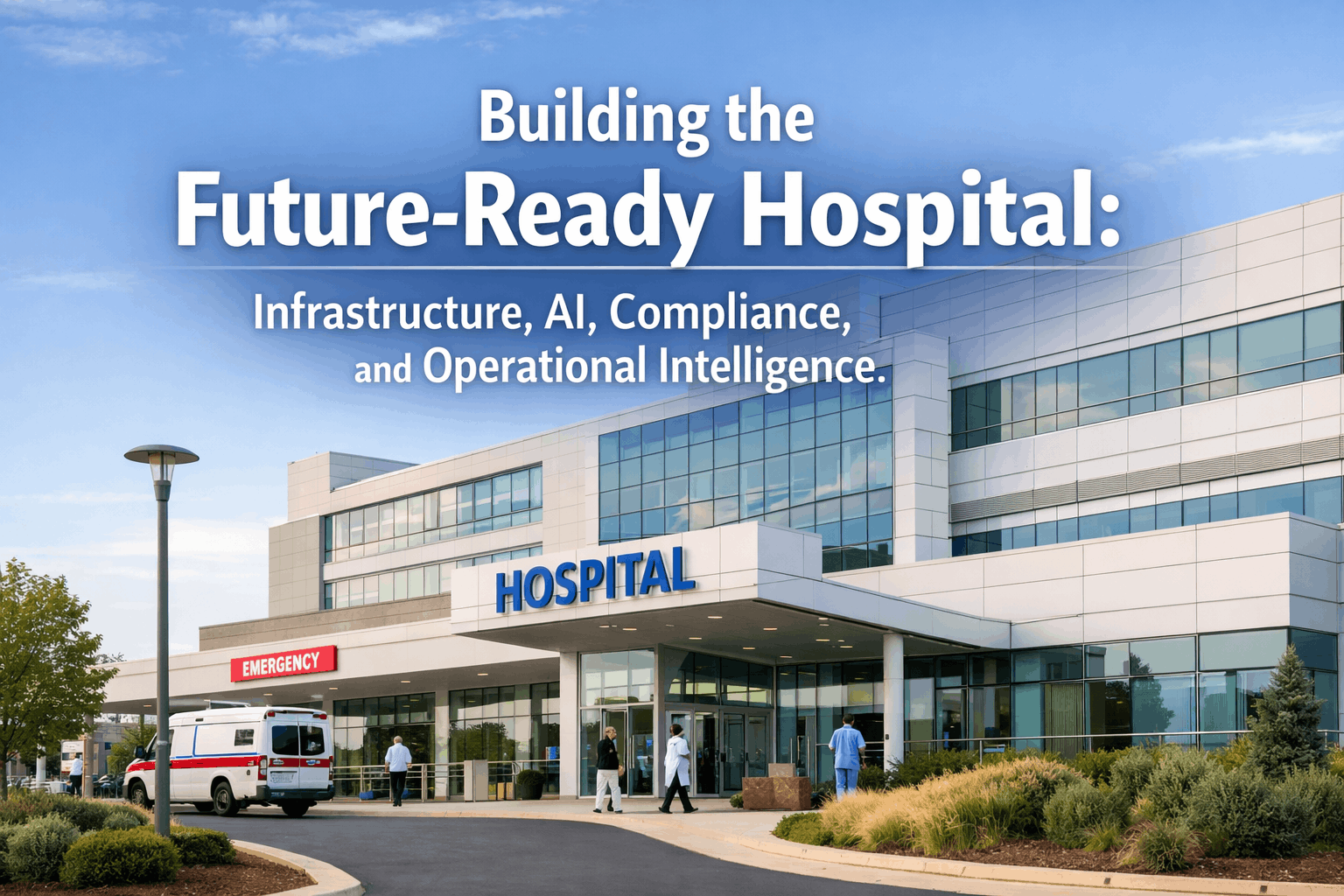
The hospital of 2030 won't be defined by its number of beds or the size of its emergency department. It will be defined by the intelligence embedded in its walls, its equipment, and its workflows. Right now, U.S. healthcare spending exceeds $5 trillion annually and is growing at roughly 8 percent per year, with hospitals absorbing over $130 billion in underpayments from Medicare and Medicaid in a single year. Meanwhile, smart hospital investments surged from $57.5 billion in 2023 to over $67 billion in 2024, signaling a decisive shift: healthcare leaders are betting their future on digital infrastructure, AI-driven operations, and compliance automation. But most organizations are still stuck somewhere between ambition and execution. They have pilot programs but no roadmap. They have data but no intelligence. The hospitals that thrive in the coming decade will be those that integrate AI-powered maintenance, automated compliance, and real-time operational analytics into a unified strategy today. If your organization is ready to start that transformation, sign up for OxMaint and build your future-ready foundation now.
What Does "Future-Ready" Actually Mean for a Hospital
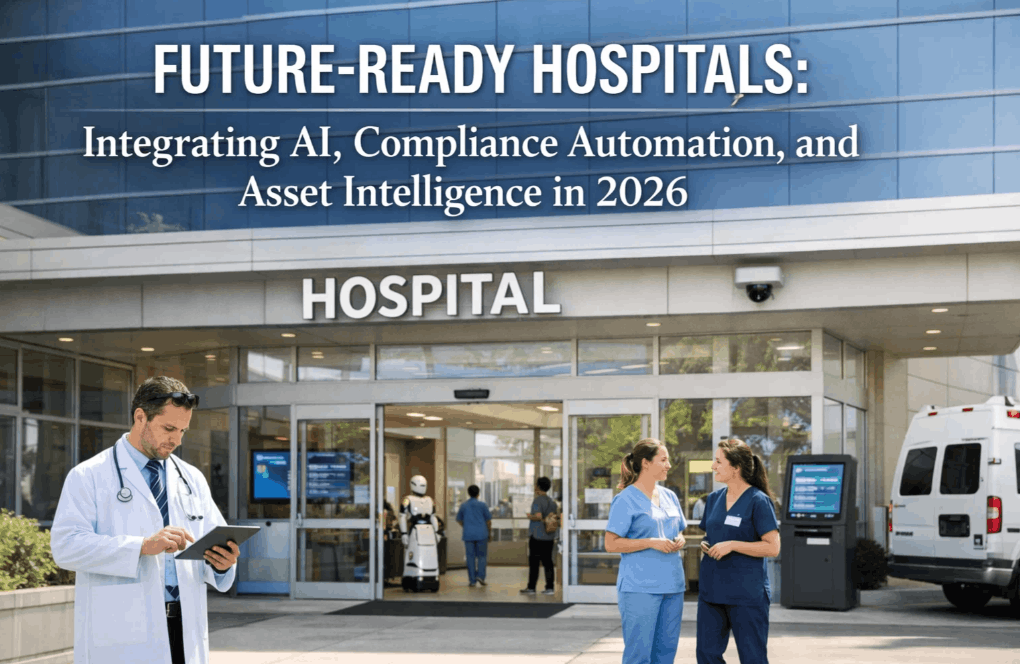
Being future-ready isn't about chasing every new technology trend. It's about building an operational foundation that can absorb change without breaking. A future-ready hospital has four foundational capabilities: intelligent infrastructure that monitors itself, AI-driven maintenance that prevents failures before they disrupt care, compliance systems that automate documentation and audit preparation, and analytics platforms that turn raw operational data into strategic decisions.
According to the American Hospital Association, smart hospitals integrate digital tools, ambient intelligence, and virtual care workflows to strengthen clinical efficiency and enhance the patient experience. Leading systems like Ochsner Health, Wellstar MCG Health, and Cedars-Sinai are already demonstrating what's possible: Wellstar reduced patient transfers from 80 percent to 35 percent, cut readmissions from 15 percent to 7 percent, and saved an estimated $454,000 per month through connected intelligence. These results come not from a single technology but from a strategic integration of systems that work together.
Pillar I — Intelligent Infrastructure: The Nervous System of Modern Hospitals
Every future-ready hospital starts with infrastructure that can think. This means embedding IoT sensors into critical equipment, building systems, and environmental controls so that data flows continuously from the physical environment into a centralized digital platform. When your MRI machine, HVAC system, sterilization unit, and backup generator are all communicating their health status in real time, you gain visibility that was impossible with manual inspections.
The global AIoT market, the convergence of artificial intelligence and Internet of Things, is expected to expand from $225.9 billion in 2025 to $896.7 billion by 2030. Healthcare is one of the fastest-growing segments because the stakes are uniquely high. A hospital isn't a factory where downtime means lost production. It's an environment where equipment failure can endanger lives. Intelligent infrastructure ensures that the gap between a problem developing and a human learning about it shrinks from days or weeks to seconds. Want to see how OxMaint makes this infrastructure actionable? Book a demo and explore the platform live.
IoT sensors embedded in or attached to medical devices, HVAC systems, electrical infrastructure, and environmental controls continuously capture vibration, temperature, pressure, humidity, usage cycles, and power consumption data.
Secure wireless protocols (Wi-Fi, Bluetooth LE, RFID, cellular) transmit sensor data to edge computing nodes or directly to cloud platforms. Modern hospital networks must support the bandwidth demands of thousands of connected devices without compromising clinical system performance.
AI and machine learning algorithms process incoming data streams, compare them against established baselines, detect anomalies, and generate predictive insights. This layer transforms raw numbers into maintenance recommendations, compliance alerts, and operational optimizations.
Automated work orders, mobile notifications, compliance reports, and dashboard updates reach the right people at the right time. This is where insight becomes action — a CMMS like OxMaint serves as the operational backbone connecting intelligence to execution.
Pillar II — AI-Powered Maintenance: From Reactive to Predictive
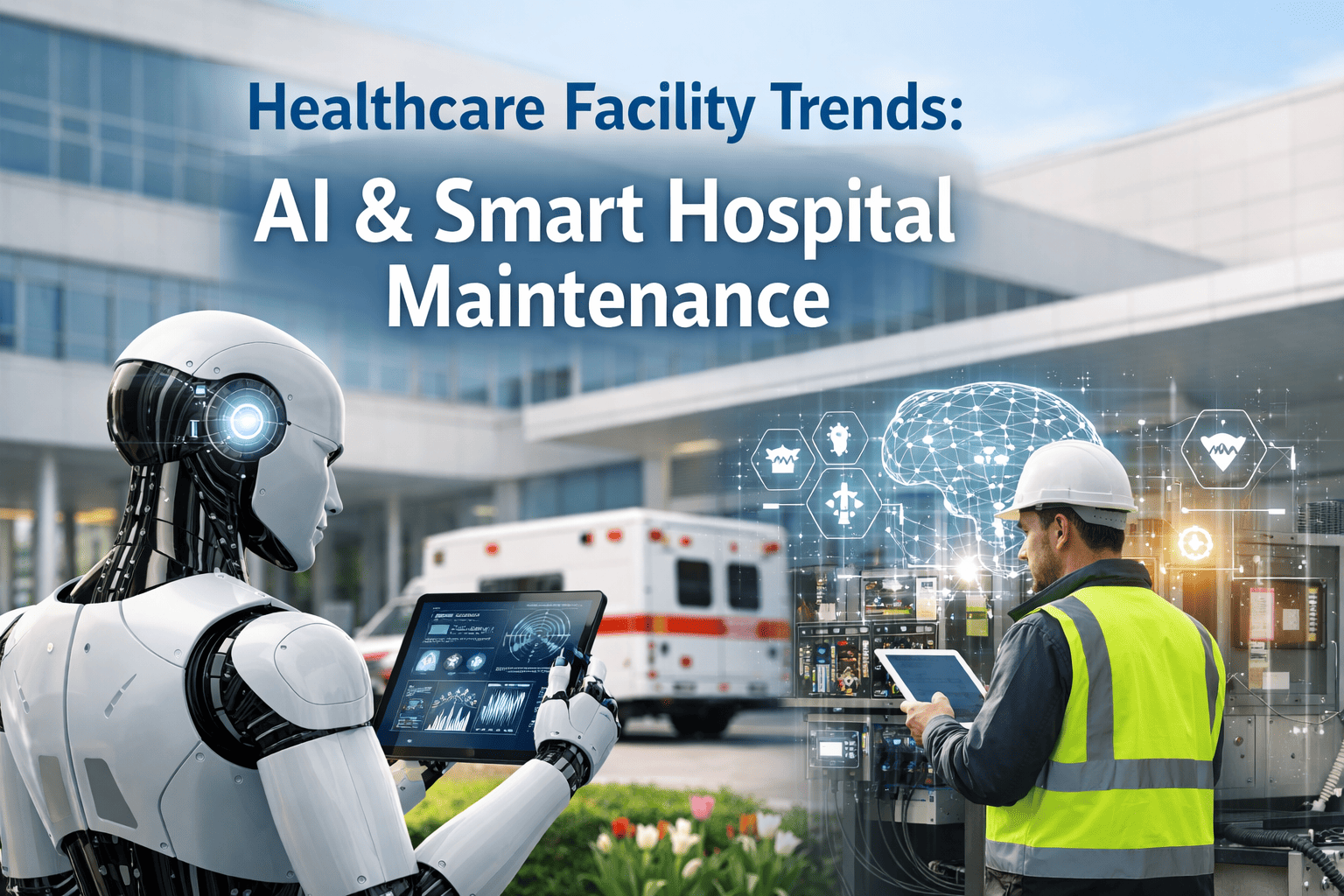
The shift from reactive to predictive maintenance is the single most impactful operational transformation a hospital can make. Traditionally, hospitals followed one of two approaches: fix equipment after it breaks (reactive) or service it on a fixed calendar regardless of actual condition (preventive). Both waste resources. Reactive maintenance costs four to six times more than planned maintenance and creates clinical emergencies. Preventive maintenance replaces functional components prematurely while still missing failures between scheduled checks.
AI-powered predictive maintenance uses machine learning models trained on historical performance data and real-time sensor inputs to identify the early signatures of equipment degradation. Research from the Deloitte Analytics Institute shows that AI-driven predictive maintenance yields 25 percent greater productivity, 25 percent lower maintenance costs, and 25 percent fewer equipment-related safety incidents. Across industries, predictive maintenance has demonstrated a 47 percent reduction in unplanned downtime events. In healthcare specifically, predictive systems can cut sudden equipment failures by up to 70 percent and reduce downtime by 30 to 50 percent.
Start Building Your Future-Ready Hospital Today
Join over 1,000 organizations using OxMaint to automate maintenance, streamline compliance, and gain real-time operational intelligence across every facility.
Pillar III — Compliance Automation: Turning Burden into Background Process
Healthcare compliance is one of the most resource-intensive aspects of hospital operations. Joint Commission, OSHA, FDA, HIPAA, and state-specific regulations demand meticulous records of every maintenance action, equipment calibration, safety inspection, and environmental test. When these records are maintained manually or across disconnected systems, audit preparation consumes weeks of staff time and creates constant anxiety about gaps that might trigger regulatory penalties.
AI and automation transform compliance from a reactive burden into a continuous background process. Automated inspection checklists, scheduled maintenance reminders, and auto-generated audit trails ensure that documentation is created at the point of work, not reconstructed days or weeks later. When a technician completes a work order on their mobile device, the compliance record is generated simultaneously with the maintenance action. When an inspection is due, the system notifies the responsible team member, tracks completion, and flags overdue items for escalation. With hospitals reporting that 34 percent of clinician time goes to administrative tasks, every hour reclaimed through automation is an hour returned to patient care. If compliance preparation is still consuming your team's bandwidth, sign up for OxMaint and automate your documentation workflows.
Pillar IV — Operational Intelligence: Data-Driven Decision Making
The final pillar of a future-ready hospital is the ability to transform operational data into strategic intelligence. Most hospitals generate enormous amounts of data from their equipment, maintenance teams, vendors, and compliance activities. But without an intelligence layer to synthesize this data, it sits in silos, reports get generated quarterly instead of in real time, and decisions are made on intuition rather than evidence.
Operational intelligence means having live dashboards that show facility managers their campus-level metrics, clinical engineers their device performance trends, and executives their network-wide KPIs, all updated in real time. It means knowing which equipment categories consume the most maintenance budget, which facilities have the highest downtime rates, where preventive maintenance compliance is lagging, and which assets are approaching end-of-life. Healthcare organizations integrating advanced analytics report an average ROI of 147 percent within three years, according to industry research. Those that embed AI within core operational processes achieve cost-to-serve reductions of up to 22 percent.
The Digital Transformation Roadmap: A Phased Approach
Building a future-ready hospital doesn't require a massive upfront overhaul. The most successful transformations follow a phased approach that builds momentum through quick wins before scaling to enterprise-level integration. Here's a practical roadmap that aligns with how leading healthcare organizations are implementing their digital strategies.
Foundation: Digitize and Centralize
Deploy a cloud-based CMMS like OxMaint across your primary facility. Migrate asset data from spreadsheets and legacy systems. Tag priority equipment with QR codes. Establish digital work order workflows to replace paper-based processes. Train maintenance teams on mobile tools. This phase alone typically reduces work order response times by 30 to 40 percent.
Intelligence: Activate Preventive and Predictive Programs
Build preventive maintenance schedules for all critical equipment. Integrate IoT sensor feeds where available. Activate AI-powered anomaly detection and predictive alerts. Begin tracking compliance metrics through automated checklists. Establish baseline KPIs for equipment uptime, maintenance costs, and response times.
Scale: Expand Across the Network
Roll out to additional facilities using standardized workflows from Phase 1 and 2. Activate cross-site dashboards and network-wide analytics. Enable asset sharing and redistribution tools between campuses. Integrate with existing hospital systems including EHR and ERP platforms. Sign up today and begin Phase 1 this week.
Optimize: Continuous Improvement and Innovation
Use analytics insights to continuously refine maintenance strategies, vendor relationships, and capital planning. Expand predictive capabilities as AI models learn from your facility's data. Evaluate emerging technologies for integration. OxMaint scales with your organization from a single campus to hundreds of locations without infrastructure changes.
Your Future-Ready Journey Starts with One Step
See how OxMaint's AI-powered CMMS platform helps hospitals eliminate unplanned downtime, automate compliance, and unlock operational intelligence that drives real results.
Frequently Asked Questions
What is a future-ready hospital and how is it different from a traditional one
A future-ready hospital is built on four integrated capabilities: intelligent infrastructure that monitors itself through IoT sensors, AI-driven maintenance that predicts and prevents equipment failures, automated compliance systems that eliminate manual documentation burden, and operational intelligence platforms that turn data into strategic decisions. Unlike traditional hospitals that rely on reactive maintenance, manual inspections, and siloed data, future-ready facilities operate proactively with real-time visibility across all systems.
How much does digital transformation cost for a hospital
The cost varies significantly based on facility size and scope, but cloud-based platforms like OxMaint eliminate the need for expensive on-premises infrastructure. Most hospitals begin with a CMMS deployment that pays for itself within the first quarter through reduced emergency repair costs and improved asset utilization. Healthcare organizations implementing strategic AI and operational intelligence report average ROI of 147 percent within three years and cost-to-serve reductions of up to 22 percent.
Can a small or mid-sized hospital become future-ready, or is this only for large networks
Future-readiness scales to every size. Small and mid-sized hospitals often see faster transformation because they have fewer legacy systems and more agile decision-making. Cloud-based CMMS platforms, subscription-based IoT sensors, and modular AI tools make advanced capabilities accessible without massive capital investment. The key is starting with a strong foundation and scaling incrementally.
How does OxMaint support the transition to a future-ready hospital
OxMaint provides the operational backbone that connects all four pillars of future-readiness. It serves as the centralized platform for asset management, work order automation, preventive and predictive maintenance scheduling, compliance documentation, vendor management, and real-time analytics. Its cloud-based architecture, mobile-first design, and multi-site capabilities make it the ideal foundation for hospitals at any stage of their digital transformation journey.
What role does AI play in hospital compliance management
AI automates the most time-consuming aspects of compliance: scheduling inspections, generating audit trails, tracking regulatory deadlines, and flagging overdue tasks. Instead of staff manually compiling documentation for Joint Commission, OSHA, or FDA audits, AI-powered systems create compliance records automatically at the point of work. This reduces preparation time from weeks to minutes and ensures no maintenance action goes undocumented.
How long does it take to see measurable results from digital transformation
Most hospitals deploying a CMMS like OxMaint see measurable improvements within the first month: faster work order response times, reduced equipment search time, and improved documentation completeness. Within three to six months, predictive maintenance and compliance automation deliver more substantial outcomes including reduced unplanned downtime, lower maintenance costs, and audit-ready status across all facilities.
What is operational intelligence and why does it matter for hospital leadership
Operational intelligence is the ability to convert real-time operational data into actionable insights for decision-makers at every level. For hospital leadership, this means having live dashboards that show equipment uptime across facilities, maintenance cost trends, compliance scores, and asset lifecycle positions. This data drives smarter capital allocation, better staffing decisions, stronger vendor negotiations, and evidence-based strategic planning rather than decisions based on anecdote or intuition.

.png)
.jpg)
.png)

