Every hospital, clinic, and healthcare network depends on a complex web of physical infrastructure and digital systems working seamlessly together. But behind the scenes, a dangerous gap is growing — one that silently threatens patient safety, operational continuity, and financial stability. Aging building systems, outdated medical equipment, and legacy IT infrastructure are converging with an unprecedented wave of cybersecurity threats to create a perfect storm of risk that many healthcare leaders are only beginning to understand.
In 2025 alone, over 700 breaches of unsecured protected health information were reported to the HHS Office for Civil Rights, affecting more than 170 million records. That means more than half the U.S. population had their health data compromised in a single year. The root cause in many cases? Legacy systems that were never designed to handle modern cyber threats, running on unsupported software and lacking basic security features. This is not just a technology problem — it is a maintenance and infrastructure management crisis.
The Legacy Infrastructure Problem Hiding in Plain Sight
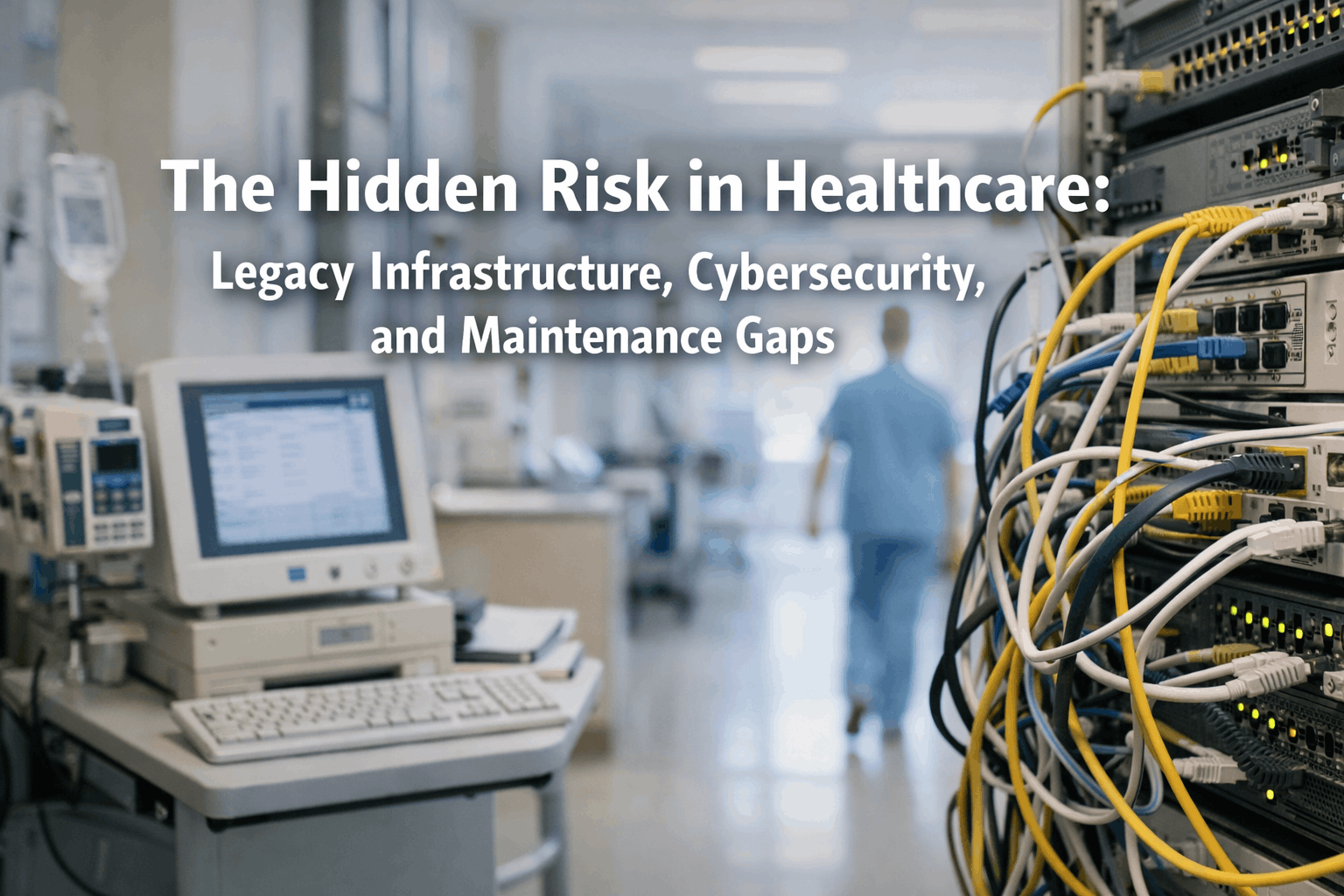
Walk through any large hospital and you will find an environment where cutting-edge surgical robots coexist with HVAC controllers from the 1990s, where brand-new MRI machines share network bandwidth with nurse-call systems running on unsupported Windows versions. This patchwork of old and new is not an exception — it is the norm. According to recent security audits, roughly one in five connected medical devices in hospitals today operate on software platforms that no longer receive security updates. Infusion pumps, medication dispensers, imaging equipment, and patient monitors often run on legacy operating systems that vendors stopped patching years ago.
The challenge is compounded by the physical infrastructure supporting these systems. Electrical panels, backup generators, cooling systems for server rooms, and building automation controllers all require proactive, well-documented maintenance to function reliably. When these physical assets are managed through fragmented spreadsheets, paper logs, or siloed department systems, small problems become invisible until they cascade into major failures. A centralized maintenance management platform like OxMaint — sign up free to start tracking every critical asset in one place — helps bridge these dangerous visibility gaps before they become emergencies.
Healthcare Infrastructure Risk Matrix
Untracked assets, unpatched devices, no audit trail — maximum exposure to downtime and breach
Known vulnerabilities tracked and scheduled for remediation with clear timelines
New equipment without documented PM schedules can still fail unpredictably
Full lifecycle tracking, predictive maintenance, automated compliance — optimal state
When Cyberattacks Meet Maintenance Gaps
Cybersecurity in healthcare is no longer limited to firewalls and antivirus software. The threat landscape has fundamentally shifted. Ransomware attackers now specifically target healthcare organizations because hospitals cannot afford downtime — they are far more likely to pay ransoms to restore operations and protect patients. In 2024, the ransomware attack on UnitedHealth Group's Change Healthcare unit affected 193 million individuals and cost hundreds of millions of dollars in a single quarter. Ascension Health's breach the same year disrupted 140 hospitals simultaneously.
What many organizations miss is how deeply intertwined cybersecurity risk is with basic infrastructure maintenance. An unpatched building management system becomes a network entry point. An unmaintained backup generator fails during a ransomware-induced power shutdown. A medical device with expired firmware becomes the vector for lateral network movement. Each of these failure points traces back to a maintenance gap — a missed inspection, an overdue firmware update, a deferred replacement that never made it into a capital plan.
The Downtime Domino Effect
Research published in JAMA found that hospitals experiencing ransomware attacks saw a 21% increase in in-hospital mortality for patients with time-sensitive conditions during system downtime. This transforms what might seem like a purely IT concern into a direct patient safety issue. The connection between proactive maintenance and cybersecurity resilience has never been clearer — and organizations that treat these as separate problems are exposing themselves to compounding risk.
Stop Managing Risk on Spreadsheets
Healthcare facilities using centralized maintenance platforms reduce unplanned downtime by up to 40% and gain complete audit trails for regulatory compliance. See how OxMaint gives you real-time visibility into every asset across your facility.
The Financial Toll Most Leaders Underestimate
Healthcare downtime is among the most expensive across all industries. Estimates suggest that medium-sized hospitals lose approximately $1.7 million per hour during an outage, while large hospital systems can hemorrhage up to $3.2 million per hour. These figures include lost revenue from canceled procedures and delayed admissions, but they only scratch the surface. The true cost includes regulatory fines — HIPAA penalties can reach millions of dollars for breaches linked to inadequate security — along with reputational damage, malpractice exposure from treatment delays, and the operational chaos of reverting to paper-based workflows.
What makes this especially frustrating is that much of this risk is preventable. Facility management costs across hospital systems rose by nearly 33% between 2019 and 2022, with utility expenses comprising over 77% of total costs and maintenance accounting for the rest. Yet many organizations continue to underinvest in preventive maintenance, treating it as a cost center rather than a risk mitigation strategy. The math is straightforward: every 1% improvement in critical equipment uptime delivers between $150,000 and $300,000 in annual value for a typical hospital. Organizations that want to start capturing that value today can sign up for OxMaint and begin tracking maintenance performance across their entire portfolio immediately.
Reactive vs. Proactive: The Cost Gap
Regulatory Pressure Is Intensifying
The regulatory environment around healthcare infrastructure security is tightening rapidly. HHS has proposed significant updates to the HIPAA Security Rule for the first time in years, with final rules expected in 2026. These proposed changes include mandatory multi-factor authentication for administrative access, mandatory encryption, network segmentation requirements, and 72-hour restoration timelines for critical systems. The Healthcare Cybersecurity Act of 2025 is moving through Congress with provisions for training, sector-specific risk management plans, and prioritized resource allocation to high-risk facilities.
For facilities managers and operations leaders, these regulatory changes mean that the days of undocumented maintenance practices are numbered. Regulators want to see audit trails, documented inspection schedules, asset inventories, and evidence of proactive risk management. Organizations that lack centralized systems to produce this documentation will face heightened scrutiny and potentially significant penalties. Those still relying on paper-based tracking or disconnected spreadsheets should book a demo with OxMaint to see how a digital-first maintenance platform simplifies compliance documentation.
2026 Healthcare Compliance Landscape
Bridging the Gap: What Centralized Maintenance Management Changes
The path forward is not about choosing between cybersecurity investment and infrastructure maintenance. It is about recognizing that these challenges share a common root: lack of visibility, lack of documentation, and lack of proactive management. When organizations implement a centralized computerized maintenance management system (CMMS), they gain the ability to track every asset in their facility from a single platform — from HVAC systems and backup generators to medical devices and building automation controllers.
This visibility transforms how organizations manage risk. Instead of discovering that a critical air handling unit in the server room has gone six months past its PM schedule only after a heat-related server failure, facilities teams receive automated alerts and escalation workflows. Instead of scrambling to produce maintenance logs during a regulatory audit, compliance documentation is generated automatically from completed work orders. Instead of relying on institutional memory to know which medical devices are running end-of-life firmware, asset profiles maintain complete lifecycle data including warranty status, firmware versions, and replacement timelines.
How a Centralized CMMS Reduces Healthcare Risk
Complete visibility into every piece of equipment, its location, condition, and maintenance history — including networked medical devices that represent cyber risk.
Never miss a critical inspection or firmware update. Calendar-based and meter-based triggers ensure maintenance happens on time, every time.
Every work order, inspection, and corrective action is automatically logged with timestamps, technician IDs, and completion evidence for audit readiness.
AI-powered insights identify assets trending toward failure before breakdowns occur, allowing planned replacements instead of emergency scrambles.
IT, facilities, biomedical engineering, and clinical leadership all see the same real-time data — eliminating the silos that let risks slip through.
Track service agreements, warranty expirations, and vendor response times to ensure external support obligations are met and documented.
Healthcare facilities that have adopted integrated predictive maintenance technologies typically achieve payback within 8 to 14 months through downtime reduction, with ongoing annual savings ranging from $800,000 to $2 million depending on facility size. The organizations seeing the best results are those that break down the traditional walls between IT security teams, facilities management, and biomedical engineering — creating a unified operational view where maintenance and cybersecurity risk are managed as interconnected concerns rather than separate departments. Ready to see this in action? Sign up for OxMaint or book a personalized demo to explore how it fits your facility.
Your Infrastructure Risk Will Not Wait
Every day without centralized maintenance visibility is another day of compounding risk. Join over 1,000 organizations already using OxMaint to protect their assets, their patients, and their bottom line.
Frequently Asked Questions
Why are legacy systems such a major risk in healthcare facilities
Legacy systems — including outdated medical devices, building automation controllers, and EHR platforms — often run on unsupported operating systems that no longer receive security patches. This creates direct entry points for cyberattacks while also increasing the probability of unexpected equipment failures. When these systems are not tracked in a centralized maintenance platform, organizations have no visibility into which assets are overdue for replacement or firmware updates.
How does poor maintenance contribute to cybersecurity breaches
Cybersecurity and physical infrastructure maintenance are deeply interconnected. An unpatched building management system can serve as a network entry point for attackers. Unmaintained backup power systems can fail during ransomware-induced shutdowns. Medical devices with expired firmware become vectors for lateral network movement. Proactive maintenance programs that track firmware versions, inspection schedules, and asset lifecycle data directly reduce cybersecurity exposure.
What does healthcare downtime actually cost
Healthcare downtime costs vary by facility size but are consistently among the highest across all industries. Estimates range from $7,900 per minute on average, with medium-sized hospitals losing approximately $1.7 million per hour and large systems losing up to $3.2 million per hour. These figures include direct revenue loss, staff overtime, regulatory fines, reputational damage, and increased clinical risk from delayed treatments and medication errors.
What regulatory changes should healthcare facilities prepare for in 2026
Major regulatory developments include proposed updates to the HIPAA Security Rule requiring mandatory multi-factor authentication, encryption, network segmentation, and 72-hour system restoration timelines. The Healthcare Cybersecurity Act of 2025 introduces sector-specific risk management plans and training mandates. FDA requirements now mandate cybersecurity plans for all connected medical devices. Facilities without documented, auditable maintenance practices will face heightened compliance risk.
How does a CMMS platform like OxMaint reduce infrastructure risk
OxMaint provides a centralized platform where every asset — from HVAC systems and generators to networked medical devices — is tracked with complete maintenance history, automated PM schedules, and real-time condition monitoring. This eliminates the visibility gaps where risk accumulates, automates compliance documentation for regulatory audits, and enables predictive analytics that identify assets trending toward failure before breakdowns occur.
What is the typical ROI timeline for implementing centralized maintenance management
Healthcare facilities deploying integrated maintenance management platforms typically achieve full payback within 8 to 14 months through reduced unplanned downtime, with ongoing annual savings of $800,000 to $2 million depending on facility size and equipment portfolio. Every 1% improvement in critical equipment uptime delivers $150,000 to $300,000 in annual value for a typical hospital.