Every hospital executive faces the same uncomfortable question during board meetings: how reliable is our facility, really? In 2026, the answer increasingly comes from a handful of maintenance KPIs displayed on real-time executive dashboards. These are not vanity metrics buried in engineering reports. They are the numbers that determine whether a hospital meets safety standards, controls spiraling operational costs, and delivers uninterrupted patient care. With equipment downtime costing hospitals thousands per minute and regulatory scrutiny intensifying, the maintenance KPIs you track directly shape the strategic decisions you make. This guide walks you through the essential metrics every hospital C-suite should monitor and explains why each one matters for your bottom line and patient outcomes.
Why Maintenance KPIs Belong on Executive Dashboards
For years, maintenance data lived in spreadsheets managed by biomedical engineering teams. Executives rarely saw it unless something went catastrophically wrong. That model is no longer sustainable. Hospital infrastructure is aging rapidly, with the average age of hospital plant rising by over 10% in just two years. Meanwhile, total hospital expenses grew 5.1% in 2024 alone, far outpacing inflation. Maintenance is no longer a background function; it is a strategic lever that directly impacts revenue, safety, and regulatory compliance.
Modern executive dashboards consolidate KPIs from clinical, financial, and operational systems into a single view. Adding maintenance metrics to that view gives hospital leaders the visibility they need to make proactive decisions rather than reactive ones. Research shows that dashboards with role-specific customization and real-time data feeds dramatically accelerate decision-making quality. If your facility still tracks maintenance performance manually, sign up for OxMaint and bring your KPI tracking into the modern era.
The 8 Maintenance KPIs That Executives Actually Need
Not every metric your maintenance team tracks belongs on the executive dashboard. The goal is to surface the KPIs that connect facility performance to strategic outcomes like patient safety, financial health, and regulatory readiness. Here are the eight that matter most in 2026.
Equipment Uptime Rate
This is the percentage of time critical medical equipment is operational and available for patient care. World-class facilities target 90% or higher availability across all assets. For hospitals, every percentage point of improvement in critical equipment uptime delivers $150,000 to $300,000 in annual value. Executives should monitor uptime rate by asset category, giving special attention to high-revenue equipment like MRI machines, CT scanners, and surgical systems.
Preventive Maintenance Compliance Rate
PM compliance measures the percentage of scheduled preventive maintenance tasks completed on time. This is a leading indicator, meaning improving it directly predicts better future outcomes like fewer breakdowns, longer equipment lifespan, and lower emergency repair costs. Best-in-class maintenance programs achieve 90% or higher PM compliance. Falling below this threshold significantly increases the risk of unexpected failures and regulatory citations.
Mean Time Between Failures (MTBF)
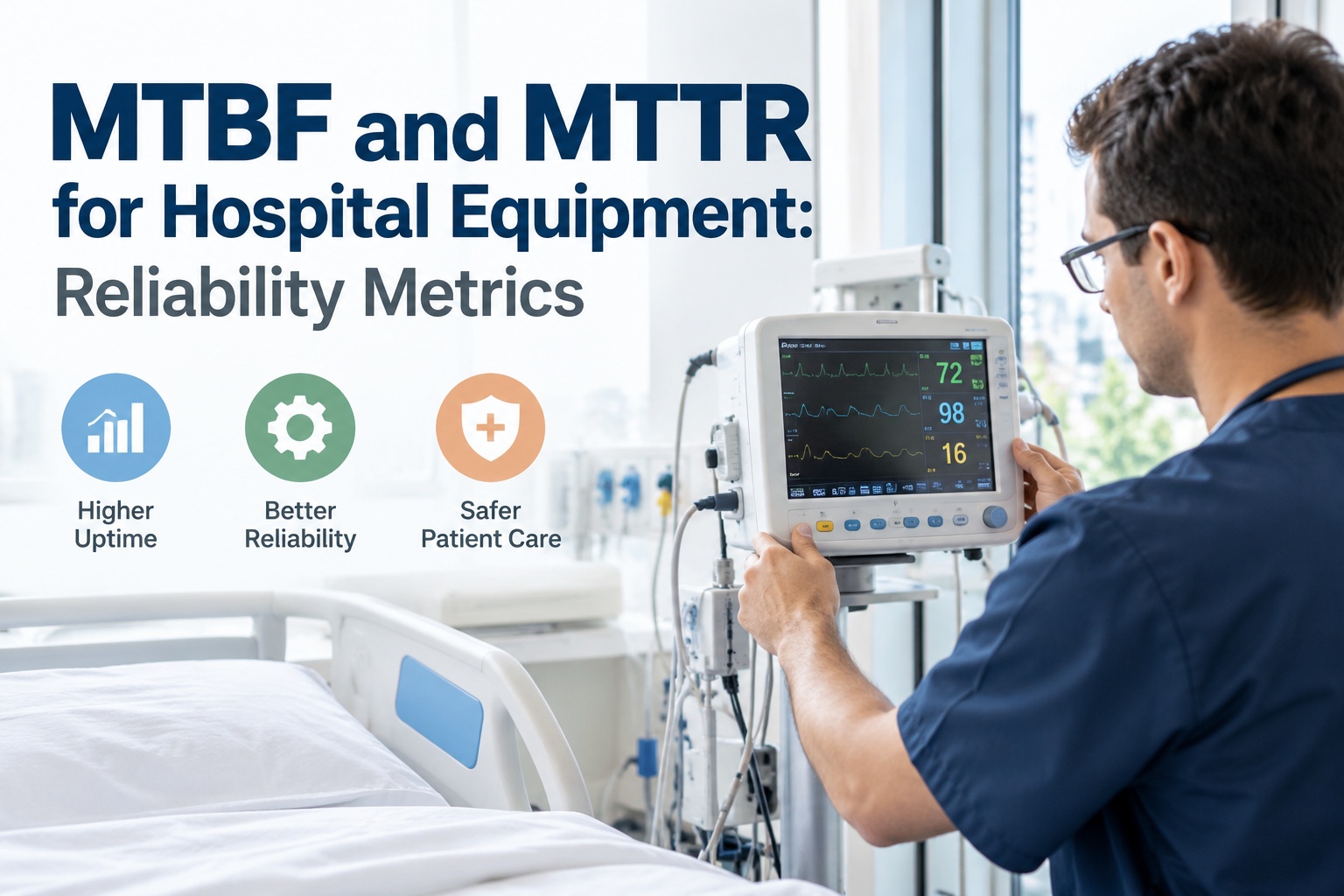
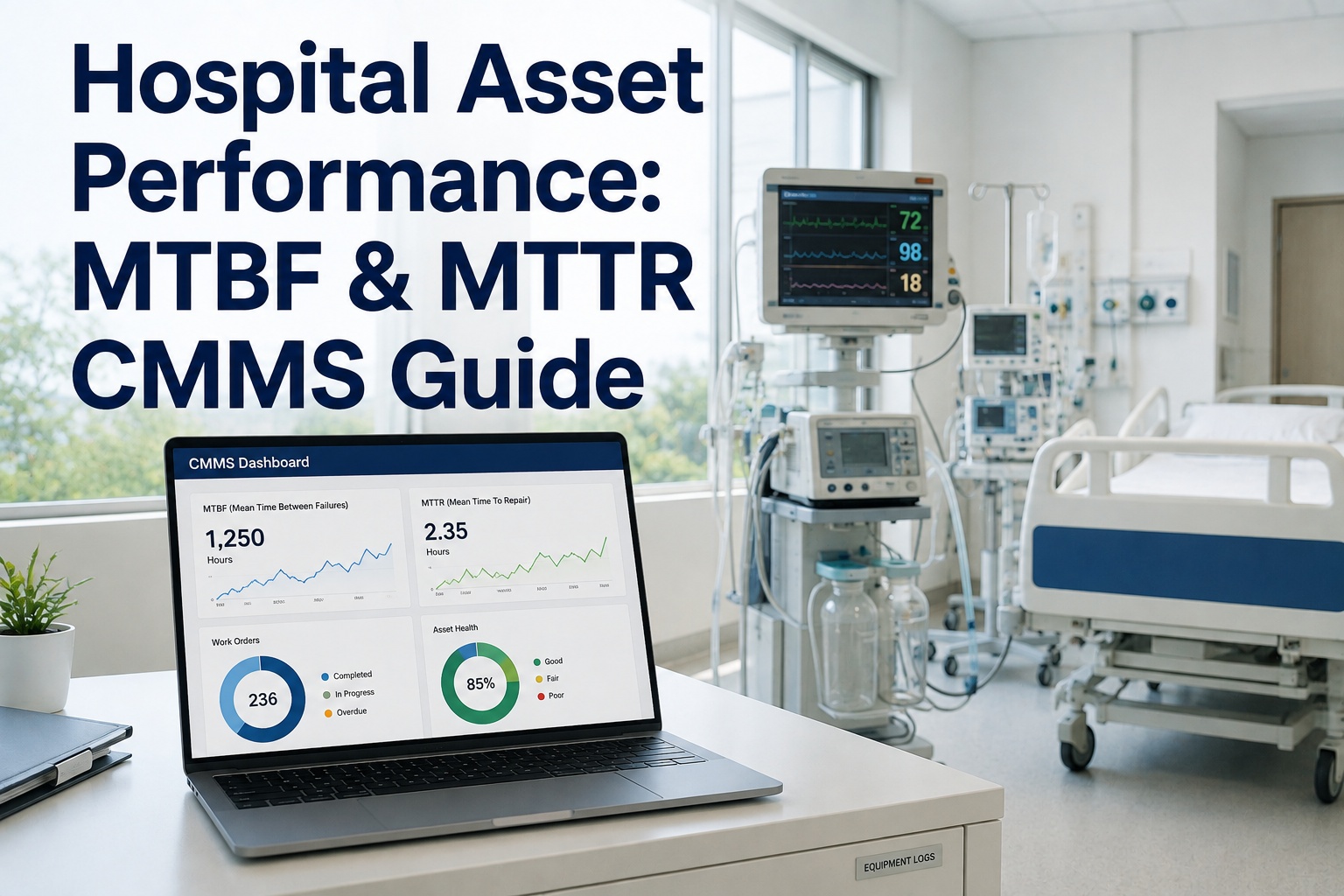
MTBF tracks the average operating time between consecutive equipment failures. It is the primary indicator of asset reliability. A rising MTBF signals that your maintenance program is working and equipment is becoming more dependable. A declining MTBF is an early warning that assets are deteriorating and may need replacement or a revised maintenance strategy. Executives should track MTBF trends quarterly for high-criticality equipment to inform capital expenditure decisions.
Mean Time to Repair (MTTR)
MTTR measures the average time from equipment failure to full restoration. Lower MTTR means faster recovery and less impact on patient care. This metric reveals the efficiency of your maintenance team, the availability of spare parts, and the clarity of your repair procedures. In hospitals, where equipment downtime can delay diagnoses and surgeries, even small improvements in MTTR deliver outsized clinical and financial value.
Planned Maintenance Percentage
This KPI measures the ratio of planned maintenance hours to total maintenance hours. A higher percentage indicates a proactive maintenance culture, while a low percentage reveals excessive reactive firefighting. Industry best practice targets 80% or higher planned maintenance. Hospitals stuck below this threshold are spending more on emergency repairs, overtime labor, and unplanned equipment rentals than their better-organized peers. To start tracking this metric automatically, sign up for OxMaint and eliminate manual spreadsheet tracking.
Maintenance Cost per Asset
Tracking total maintenance spending per asset helps executives identify equipment that is consuming disproportionate resources. When the cost-to-maintain an asset approaches or exceeds its replacement value, it is time for a capital investment conversation. This metric also surfaces hidden expenses like emergency parts procurement, third-party service contracts, and technician overtime that often go unnoticed in aggregate budget reports.
Medical Equipment Utilization Rate
Utilization measures the percentage of available hours that a piece of equipment is actually in use. Underutilized equipment represents wasted capital, while overutilized equipment faces accelerated wear and higher failure risk. For expensive imaging equipment like MRI and CT scanners, optimizing utilization is one of the highest-leverage decisions a hospital can make. This KPI directly informs equipment purchasing, scheduling, and capacity planning decisions.
Maintenance Backlog
The maintenance backlog represents the total volume of outstanding work orders that have not been completed. A growing backlog signals that your team is under-resourced, your equipment is aging faster than it can be maintained, or your scheduling process needs improvement. Executives should monitor backlog trends alongside staffing levels and budget allocation to ensure the gap does not widen to a point where patient safety is compromised.
Track All 8 KPIs From One Dashboard
OxMaint automatically calculates MTBF, MTTR, PM compliance, and more from your work order data. No spreadsheets. No guesswork.
Sign Up Free Book a DemoLeading vs. Lagging Indicators: What Executives Must Understand
One of the most common mistakes in maintenance reporting is treating all KPIs equally. In reality, maintenance metrics fall into two distinct categories, and understanding the difference is critical for making forward-looking decisions rather than just reviewing history.
These metrics predict future performance. Improving them today changes outcomes tomorrow. They tell you what your team is doing right now and whether your maintenance program is on track.
PM Compliance Rate — Are scheduled tasks being completed on time
Planned Maintenance % — How proactive is the team
Maintenance Backlog — Is the workload manageable
These metrics tell you what already happened. They cannot be changed after the fact, but they reveal whether your strategies are working and help justify budget decisions to the board.
MTBF — How reliable is the equipment
MTTR — How fast are failures resolved
Equipment Uptime Rate — What was actual availability
The most effective executive dashboards display both types side by side. Leading indicators let you steer the ship, while lagging indicators confirm whether you are heading in the right direction. A hospital where PM compliance is rising but MTBF is still flat might need to investigate the quality of its preventive tasks rather than just their completion rate.
How KPIs Connect to the Decisions That Matter
Maintenance KPIs are only valuable when they drive action. Here is how each metric directly informs the strategic decisions hospital executives face every quarter.
When these KPIs are visible in real time, executives stop relying on quarterly retrospective reports and start making decisions in the moment. That shift from reactive to proactive leadership is what separates high-performing hospital systems from those struggling with avoidable failures. Book a demo with OxMaint to see how these KPIs populate automatically from your daily maintenance operations.
Building an Executive-Ready Maintenance Dashboard
A common pitfall is trying to display too many metrics at once. Effective executive dashboards are deliberately focused. They surface the minimum number of KPIs needed to tell a complete performance story without overwhelming the viewer. Based on how leading health systems structure their dashboards, here is a practical framework for organizing your maintenance KPIs.
Display Equipment Uptime Rate and Planned Maintenance Percentage as the two headline numbers. These give an instant read on overall facility reliability and maintenance culture maturity. If both are strong, the facility is in good shape. If either dips, executives know to investigate further.
Show MTBF and MTTR as trend lines over time, ideally with quarterly comparisons. Trending matters more than absolute numbers here because it reveals direction: are things getting better or worse? Pair these with PM Compliance to connect inputs (maintenance effort) with outcomes (reliability).
Include Maintenance Cost per Asset, Utilization Rate, and Backlog as supporting metrics that provide context for budget conversations and staffing decisions. These should be accessible via drill-down rather than dominating the top-level view.
The best dashboards update in real time using data captured automatically from CMMS work orders, IoT sensors, and asset registers. Manual data entry introduces delays and errors that undermine the dashboard's value. A platform like OxMaint feeds live data into pre-built KPI dashboards, so your executives always see the most current picture. Sign up today and see your maintenance KPIs populate in real time.
Common Mistakes in Hospital Maintenance Reporting
Even hospitals that track maintenance KPIs often make mistakes that limit their usefulness for executive decision-making. The most frequent errors include tracking too many metrics without prioritizing the ones that connect to strategic outcomes, relying on lagging indicators alone without balancing them with leading metrics that predict future performance, using static monthly or quarterly reports instead of real-time dashboards that enable timely intervention, and failing to segment metrics by asset criticality so that a minor air handler failure gets the same reporting weight as a ventilator breakdown.
Another critical mistake is measuring metrics without acting on them. Every KPI review should result in concrete action items with clear owners and deadlines. If MTTR is climbing, the response might be investing in technician training, improving spare parts availability, or standardizing troubleshooting procedures. If PM compliance is dropping, it may signal that schedules are unrealistic or that staffing is insufficient. The KPI is the signal; the action is what creates the improvement. Book a demo to see how OxMaint turns KPI insights into automated action plans.
Your Maintenance Data Deserves an Executive Seat
OxMaint gives hospital leaders real-time visibility into every KPI that matters. Trusted by 1,000+ facilities across healthcare and beyond.
Sign Up Free Book a DemoFrequently Asked Questions
What are the most important maintenance KPIs for hospital executives
The eight essential KPIs are Equipment Uptime Rate, PM Compliance Rate, MTBF, MTTR, Planned Maintenance Percentage, Maintenance Cost per Asset, Medical Equipment Utilization Rate, and Maintenance Backlog. Together, these cover reliability, efficiency, financial health, and resource management across your facility.
What is a good PM compliance rate for hospitals
Best-in-class maintenance programs target 90% or higher PM compliance, meaning at least 90% of scheduled preventive maintenance tasks are completed on time. Facilities consistently below this threshold face significantly higher risks of unexpected equipment failures and regulatory non-compliance.
How often should hospital maintenance KPIs be reviewed by executives
With real-time dashboards, executives can monitor headline KPIs like uptime and PM compliance daily or weekly. Trend-based metrics like MTBF and MTTR are best reviewed monthly or quarterly to identify meaningful patterns. Budget-related KPIs like cost per asset should be reviewed quarterly alongside capital planning cycles.
What is the difference between MTBF and MTTR
MTBF measures the average operating time between failures, indicating how reliable your equipment is. MTTR measures the average time it takes to repair equipment after a failure, indicating how quickly your team can restore operations. Together they determine overall equipment availability. A high MTBF with a low MTTR is the ideal combination.
How does a CMMS help with hospital maintenance KPI tracking
A modern CMMS like OxMaint automatically calculates KPIs from work order data in real time. Every time a technician completes a task, logs a repair, or records parts usage, the system updates your dashboards instantly. This eliminates manual spreadsheet tracking, reduces data entry errors, and gives executives access to current performance data at any time.
What is the cost of not tracking maintenance KPIs in a hospital
Hospitals with poor maintenance tracking face an average of $7.5 million annually in hidden costs from unexpected equipment failures, emergency repairs, overtime labor, and patient diversions. Equipment downtime costs an average of $7,500 per minute, and a single day of system disruption can cost approximately $1.9 million. Proper KPI tracking turns these risks into preventable events.