Hospital maintenance teams are under pressure from every direction — regulators, CFOs, clinical staff, and patients. The difference between a high-performing facility and one that lurches from crisis to crisis comes down to one thing: the right metrics tracked in real time. This guide breaks down the essential hospital maintenance management KPIs every facilities director, plant manager, and VP of Operations needs to monitor, benchmark, and act on. Want to see these metrics live in your own facility? start a free trial for 30 days and explore the full KPI dashboard, or book a demo with our healthcare operations team today.
18%
Higher technician turnover in reactive maintenance environments
4.8x
Cost multiplier of emergency repairs vs scheduled maintenance
36%
Of all equipment failures are preventable with structured PM programs
3.2x
Average ROI on preventive maintenance investment within 24 months
KPI Framework
What Are Hospital Maintenance Management KPIs?
Hospital maintenance KPIs are quantifiable performance indicators that measure how effectively a facility manages its physical assets, maintenance workflows, and regulatory compliance. Unlike generic operational metrics, healthcare maintenance KPIs must account for patient safety implications, Joint Commission standards, and the direct financial impact of equipment uptime on clinical revenue. When these numbers are tracked consistently, leadership moves from guesswork to precise, defensible decisions. Explore how Oxmaint structures these KPIs live — start a free trial or book a demo to see the dashboard in action.
01
Uptime Rate
Percentage of time critical equipment is fully operational. Target: above 98% for imaging, surgical, and life-safety systems.
02
PM Compliance Rate
Ratio of completed preventive maintenance tasks to scheduled tasks within a given period. Best-in-class: above 95%.
03
MTBF
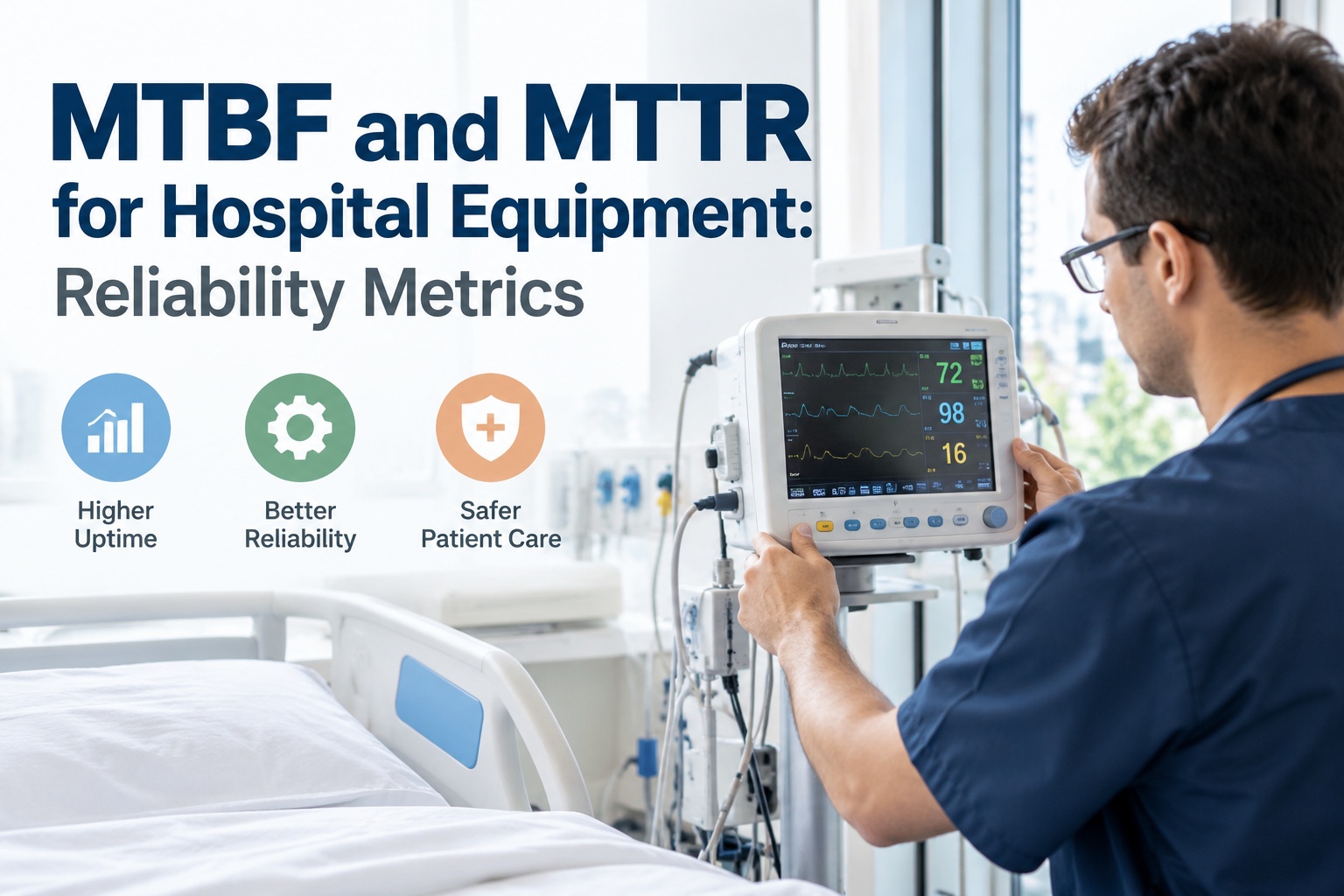
Mean Time Between Failures — measures reliability of individual assets. Rising MTBF signals effective PM. Declining MTBF signals premature degradation.
04
MTTR
Mean Time To Repair — average duration from work order creation to resolution. Benchmark: under 4 hours for clinical-critical assets.
Core Metrics
The 8 Critical KPIs for Hospital Maintenance Performance
These are the metrics that separate high-performing facility operations from those constantly firefighting. Each KPI drives a distinct improvement lever — tracking all eight gives complete operational visibility. Not tracking these today? Start a free trial and Oxmaint surfaces all eight automatically from day one, or book a demo to see the live benchmark dashboard.
KPI 01
Equipment Uptime Rate
Best-in-class: 98.5%+
Industry average: 94.2%
Tracks operational availability of clinical and building assets. A 1% drop in MRI uptime equals approximately 4–6 cancelled scans per day at $1,000–$1,500 each. Uptime is directly tied to revenue, patient satisfaction, and safety.
Formula: (Total Available Hours − Downtime Hours) / Total Available Hours × 100
KPI 02
PM Compliance Rate
Best-in-class: 95%+
Industry average: 78%
Measures the percentage of scheduled PM tasks completed on time. Joint Commission Environment of Care standards require documented PM evidence. Facilities with PM compliance below 85% routinely receive survey findings. This single metric drives more compliance risk than any other.
Formula: Completed PM Tasks / Scheduled PM Tasks × 100
KPI 03
Mean Time Between Failures
Trending up = healthy
Trending down = at-risk asset
MTBF reveals whether your PM program is actually working. Rising MTBF on a specific asset class confirms PM effectiveness. Declining MTBF is an early indicator of accelerated degradation — allowing replacement forecasting up to 12–18 months before failure occurs.
Formula: Total Operational Hours / Number of Failures
KPI 04
Mean Time To Repair
Best-in-class: under 2 hrs
Industry average: 6.4 hrs
MTTR measures response and resolution speed. Every hour of downtime on a CT scanner represents $3,500–$5,000 in deferred or lost revenue. Fast MTTR requires pre-positioned spare parts, clear technician assignment protocols, and digital work order routing — all enabled by a CMMS.
Formula: Total Repair Time / Total Number of Repairs
KPI 05
Reactive vs. Planned Ratio
Best-in-class: 80/20 planned
Average hospital: 55/45 planned
This ratio tells you whether your team is proactively maintaining assets or constantly reacting to failures. A 55/45 planned-to-reactive split is common in hospitals without a structured CMMS. Top-quartile facilities achieve 80/20 or better — with direct impact on annual maintenance spend of 25–35%.
Formula: Planned Work Orders / Total Work Orders × 100
KPI 06
Technician Productivity Rate
Best-in-class: 78%+ wrench time
Average: 48–52% wrench time
Wrench time — the percentage of shift hours spent on actual maintenance vs. searching for parts, filling out paperwork, or waiting for approvals — is shockingly low in most hospitals. Mobile CMMS platforms increase wrench time by 20–30% by eliminating paper-based delays and automating parts lookup.
Formula: Active Maintenance Hours / Total Available Hours × 100
KPI 07
Work Order Backlog Age
Best-in-class: under 7 days avg
At-risk threshold: 21+ days
A growing work order backlog is an early warning signal for under-resourcing, scheduling failures, or parts supply chain gaps. Aging backlogs create cascading compliance risk — deferred PM tasks directly drive Joint Commission findings during unannounced surveys and focused reviews.
Formula: Average age in days of all open work orders at period end
KPI 08
Cost Per Work Order
Planned avg: $340–$800
Emergency avg: $1,600–$4,800
Cost per work order quantifies the financial efficiency of your maintenance program. Facilities tracking this consistently identify their highest-cost assets and reallocate PM investment accordingly. Emergency cost premium is 4.8x planned cost — and that gap widens with each reactive cycle left unbroken.
Formula: Total Maintenance Spend / Total Work Orders Completed
Pain Points
Why Most Hospital Maintenance Teams Cannot Track These KPIs
Knowing which KPIs matter is only half the problem. The harder challenge is building the data infrastructure to track them consistently across every asset, every shift, and every site. Most healthcare facility teams are managing critical infrastructure with tools that were never designed for this level of visibility. Ready to move past manual tracking? Start a free trial or book a demo to see how Oxmaint delivers these metrics automatically.
01
Spreadsheets Cannot Produce Real-Time KPIs
Manual data entry introduces lag, errors, and version conflicts. By the time a spreadsheet reflects PM compliance, the survey window may have already opened. 62% of facilities using spreadsheets report significant PM record gaps during audits.
02
Paper Work Orders Destroy Technician Productivity Data
Without digital work order tracking, wrench time is invisible. You cannot improve what you cannot measure. Facilities relying on paper lose an average 28% of recoverable technician productivity hours every month.
03
No Asset Condition Data Means No MTBF Trending
MTBF calculation requires failure history per asset — which only exists if every work order is tied to a specific asset record. Without an asset registry, MTBF becomes a theoretical metric rather than an actionable one.
04
Multi-Site Operations Have No Unified Benchmark View
Health systems managing 5+ facilities typically have different tools per site. No cross-site KPI comparison. No portfolio-level PM compliance rate. No aggregated downtime cost reporting. Leadership makes capital decisions blind.
Take Action Now
Stop Guessing. Start Tracking Every KPI in Real Time.
Oxmaint surfaces all 8 critical hospital maintenance KPIs automatically — from uptime rate and PM compliance to MTBF trending and cost per work order. No manual compilation. No spreadsheet lag. Live dashboards from day one.
Benchmark Table
Hospital Maintenance KPI Benchmarks: Reactive vs. Best-in-Class
The gap between reactive and best-in-class performance is measurable — and financially significant at every level. This table shows the difference a structured CMMS makes across the core maintenance performance indicators. Want to close this gap at your facility? Start a free trial or book a demo and let our team model the performance gap at your specific site.
Equipment Uptime Rate
88–91%
94.2%
98.5%+
PM Compliance Rate
58–65%
78%
95%+
Mean Time To Repair
12–18 hours
6.4 hours
Under 2 hours
Planned Work Order Ratio
35–45%
55%
80%+
Technician Wrench Time
32–38%
48–52%
78%+
Work Order Backlog Age
28–45 days avg
14–18 days
Under 7 days
Cost Per Work Order
$2,200–$4,800
$1,100–$1,600
$340–$800
Annual Emergency Repair Spend
$1.2M–$2.4M
$680K–$900K
Under $180K
Oxmaint Solution
How Oxmaint Tracks and Improves Every Hospital Maintenance KPI
Oxmaint is not a generic work order tool adapted for healthcare. The platform is built around asset condition data — which means KPIs like MTBF, uptime rate, and PM compliance emerge automatically from the work your team is already doing, rather than requiring separate manual reporting. The result is a real-time performance picture that updates with every closed work order, every completed inspection, and every PM task. See it working for your team — start a free trial for 30 days or book a demo and walk through the KPI module live.
Uptime Rate
Live Asset Condition Scoring Prevents Failures
Every asset carries a live condition score. Degradation trends surface 48–72 hours before threshold breach — giving technicians a window to intervene before clinical impact occurs. Target uptime above 98.5% becomes achievable.
PM Compliance
Automated PM Scheduling Tied Directly to Asset Records
PM schedules are built from asset data — triggered by runtime hours, cycles, or intervals. Missed PMs auto-escalate before they become compliance issues. PM compliance rate rises to 95%+ without manual follow-up. Joint Commission documentation generated automatically.
MTTR
Mobile Work Orders With Integrated Parts Lookup
Technicians receive, execute, and close work orders on mobile. Parts inventory is integrated — no more searching. Digital checklists eliminate documentation delays. Average MTTR drops 60–70% in the first 6 months of deployment.
Planned Ratio
Rolling PM Calendars Shift Teams from Reactive to Proactive
With automated PM generation tied to every asset, the planned-to-reactive ratio shifts measurably within the first quarter. Facilities consistently move from 55/45 to 75/25 planned ratios within 6–9 months of full deployment.
Wrench Time
Eliminate Paper, Parts Hunting, and Approval Bottlenecks
Paper work orders, manual parts procurement, and approval delays consume up to 50% of technician shift time. Oxmaint eliminates all three friction points — recovering 20–30% of productive maintenance hours per technician per week.
CapEx Forecasting
5–10 Year Capital Plans Built From Live Asset Health Data
MTBF trends and condition scores feed directly into rolling CapEx replacement models. CFOs and directors get multi-year forecasts grounded in actual asset performance data — not estimates. Surprise CapEx requests drop by over 70%.
Compliance
Audit-Ready Documentation Available Every Day
Every PM task, inspection, and work order generates a timestamped, digitally-signed record. Joint Commission, CMS, and GMP documentation is always current and always retrievable — facilities are survey-ready on any given day, not just when a survey is announced.
Multi-Site
Portfolio-Level KPI Dashboard for Health Systems
Compare uptime rate, PM compliance, and backlog age across 3, 10, or 30+ facilities from a single view. Identify underperforming sites before they generate compliance exposure. Investor-grade reporting built in — no custom extracts required.
Measurable ROI
What Happens to KPIs After Oxmaint Deployment
Hospitals and health systems using Oxmaint consistently report measurable KPI improvements within 6–12 months. These are not projections — they are outcomes from facilities tracking the same eight metrics before and after implementation. Want these results at your facility? Start a free trial for 30 days or book a demo and let our team model the improvement trajectory for your portfolio.
34%
Reduction in unplanned failures
Within 12 months of structured PM deployment
67%
Drop in average MTTR
Mobile + integrated parts inventory
28%
Increase in technician wrench time
Eliminating paper and approval bottlenecks
95%+
PM compliance rate achieved
Automated scheduling and escalation
FAQ
Common Questions on Hospital Maintenance KPIs
What is a good PM compliance rate for a hospital?
A best-in-class PM compliance rate for a hospital is 95% or above. The industry average sits around 78%, and facilities below 85% consistently face Joint Commission Environment of Care findings during surveys. The Joint Commission's EC standards require documented evidence of scheduled maintenance for medical equipment and building systems — incomplete PM records are one of the most common sources of accreditation risk. Achieving 95%+ requires automated PM scheduling tied directly to asset records, with auto-escalation for missed tasks — which manual systems cannot reliably deliver. Facilities implementing a purpose-built hospital CMMS typically reach the 90%+ threshold within the first two quarters of deployment.
How is MTBF calculated for hospital equipment?
MTBF (Mean Time Between Failures) is calculated by dividing total operational hours by the number of failures recorded for a specific asset over a defined period. For example, if an MRI system operates 4,380 hours in a half-year period and experiences three failures, MTBF equals 1,460 hours. The critical requirement is a digital work order system that ties every corrective repair to a specific asset record — without this, MTBF cannot be calculated accurately. MTBF trending over time is more valuable than a single data point: rising MTBF confirms your PM program is working; declining MTBF is an early signal that an asset is approaching end-of-useful-life. Oxmaint calculates MTBF automatically from the work order record tied to each asset in the registry.
How does tracking maintenance KPIs reduce hospital operating costs?
Tracking maintenance KPIs reduces costs through four specific mechanisms. First, high PM compliance prevents emergency failures — and emergency repair costs run 4.8x higher than scheduled service. Second, fast MTTR limits downtime revenue loss — every hour a CT scanner is down represents $3,500–$5,000 in deferred clinical revenue. Third, tracking technician wrench time identifies where productive hours are being lost to administrative friction, enabling targeted process improvements. Fourth, MTBF trending identifies assets approaching end-of-life up to 18 months in advance, allowing CapEx planning instead of reactive replacement. Facilities with mature KPI tracking programs consistently report 25–35% reductions in annual maintenance spend compared to reactive operations.
What is a realistic timeline to see KPI improvements after implementing a hospital CMMS?
Most healthcare facilities see initial KPI movement within the first 60–90 days of CMMS deployment — particularly in PM compliance rate and work order backlog age, as these respond fastest to scheduling automation. MTTR improvements typically emerge in months 3–6, once technicians are fully using mobile work order management and integrated parts lookup. Measurable reductions in unplanned failures (MTBF improvement and uptime rate gains) generally appear in the 6–12 month window as the PM program generates sufficient maintenance history. Full ROI — including extended asset lifespan, deferred CapEx replacement, and compliance cost avoidance — typically yields 3x–5x return within 24 months. Facilities with high-value imaging equipment or large multi-site portfolios typically reach breakeven faster.
Get Started with Oxmaint
Give Your Hospital Maintenance Program the KPI Visibility It Needs
Oxmaint surfaces all eight critical hospital maintenance KPIs automatically — uptime rate, PM compliance, MTBF, MTTR, wrench time, backlog age, planned ratio, and cost per work order — from the work your team is already doing. No manual reporting. No spreadsheet lag. Live dashboards from week one. No heavy implementation. No specialist consultants. Operational in weeks.
Uptime rate and PM compliance dashboards
Automated MTBF and MTTR tracking
Joint Commission audit documentation
5-10 year CapEx forecasting



.jpg)