For hospital VPs and facility executives, maintenance data is not just an operations issue — it is a HIPAA liability, a Joint Commission survey exposure, and a board-level risk. A single OCR corrective action plan for access control failures costs over $400,000 to resolve. A TJC Requirement for Improvement citation for missing EC maintenance records costs $40,000 to $120,000 in remediation before the re-survey. The root cause in both cases is the same: maintenance records that exist on paper, in spreadsheets, or on a vendor's cloud — not under your control, not retrievable in 90 minutes, and not configured for the documentation standard your surveyor expects. Oxmaint deploys on your infrastructure — on-premise or private cloud — and closes that exposure permanently. Schedule a 30-minute briefing to see how Oxmaint deploys on hospital infrastructure with full HIPAA documentation controls.
Hospital CMMS deployments require architecture that satisfies HIPAA's technical safeguards, supports Joint Commission EC documentation, and keeps patient-adjacent data within your network boundary. Oxmaint deploys on-premise or in your private cloud — with role-based access controls, encrypted audit trails, and zero external data routing — giving compliance, legal, and IT leadership the data sovereignty assurance that SaaS-only platforms cannot provide.
Four Regulatory Exposures Your CMMS Architecture Must Address
HIPAA technical safeguard obligations apply wherever ePHI is accessible — including CMMS platforms logging work in patient care environments, biomedical device histories, and clinical HVAC records. On-premise deployment eliminates third-party processor exposure, keeping access controls, audit logs, and transmission encryption entirely within your security perimeter.
The Joint Commission requires retrievable maintenance records for life-safety systems — fire suppression, emergency power, medical gas, and clinical HVAC. Missing or unretreivable EC documentation ranks among the top three findings in TJC unannounced surveys. Oxmaint captures timestamped, supervisor-approved records at the point of work — exportable in survey-ready format in under 90 minutes.
Every PM event, corrective repair, and calibration record for patient-connected equipment must be traceable to a device, a qualified technician, and a completion date. FDA QSR and ISO 13485 place these records within the quality management system — requiring version-controlled procedures, calibration certificates, and documented corrective action for out-of-tolerance findings.
Level I trauma centers, VA hospitals, and federal-affiliated facilities require CMMS deployment on isolated network segments with no external data routing. Oxmaint supports air-gapped deployment with local data storage, offline mobile capability, and periodic one-way sync to enterprise reporting — without bidirectional cloud connectivity.
Your Maintenance Data. Your Infrastructure. Your Control.
Oxmaint on-premise gives hospital IT, compliance, and legal teams the data sovereignty controls that SaaS platforms cannot offer — deployed in 4 to 6 weeks without infrastructure redesign. Schedule a strategic briefing to review the deployment architecture for your facility.
Three Deployment Configurations for Hospital Environments
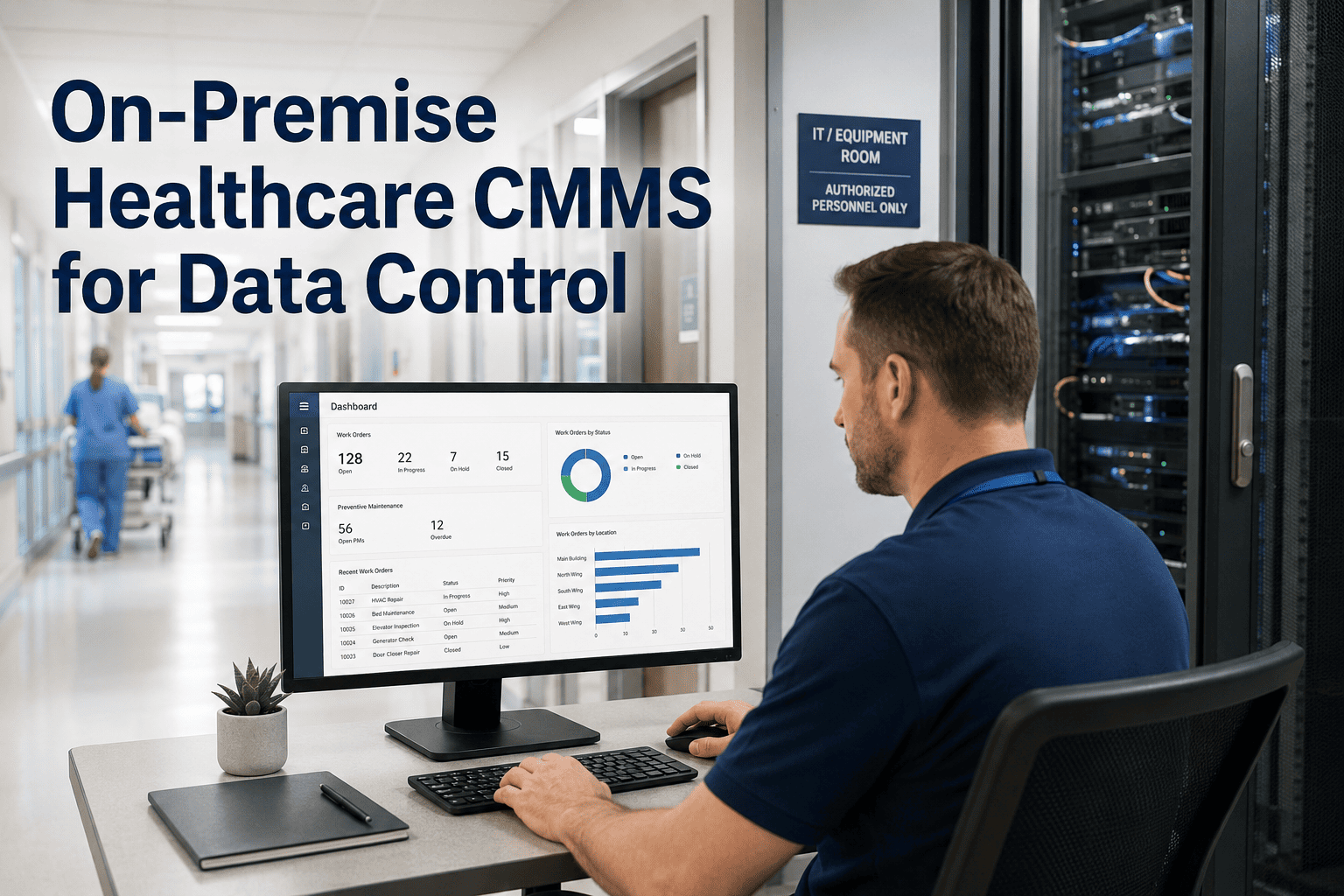
Oxmaint installed on hospital-owned servers. All data, audit logs, and records stored exclusively on your infrastructure. No external API calls, no vendor data access. Role-based access integrated with Active Directory. Backup managed under your existing data governance policies.
Oxmaint deployed within your health system's dedicated VPC — isolated from the public internet, managed under your cloud governance framework. Supports multi-facility deployments with centralized data residency for IDNs and academic medical centers.
Deployed on a network-isolated segment with no external connectivity. Mobile devices operate offline, syncing to the local server via your internal network. Designed for VA hospitals, federal health facilities, and Level I trauma centers under strict cybersecurity frameworks.
CMMS Platform Comparison — Hospital On-Premise Capability
| Capability | Oxmaint | MaintainX | UpKeep | Fiix | IBM Maximo | Infor EAM | Hippo CMMS |
|---|---|---|---|---|---|---|---|
| On-premise server deployment | Yes | No | No | No | Yes | Yes | No |
| Air-gapped network support | Yes | No | No | No | Custom | Custom | No |
| BAA execution for HIPAA | Yes | Yes | Yes | Yes | Yes | Yes | Varies |
| TJC EC documentation templates | Yes | Generic | Generic | Generic | Custom | Custom | Generic |
| Survey-ready export under 2 hours | Yes | Partial | Partial | Partial | Yes | Yes | Partial |
| Biomedical device PM traceability | Yes | Generic | Generic | Partial | Yes | Yes | Generic |
| Deployment in weeks without SI | Yes | Yes | Yes | Varies | No | No | Yes |
Outcomes from Hospital Deployments
Frequently Asked Questions
Hospital-Grade Data Control. Deployed in Weeks — Not Years.
On-premise CMMS with HIPAA access controls, TJC survey-ready exports, and biomedical PM traceability — live on your infrastructure in 4 to 6 weeks. Schedule a strategic briefing with your IT, compliance, and facilities leadership today.