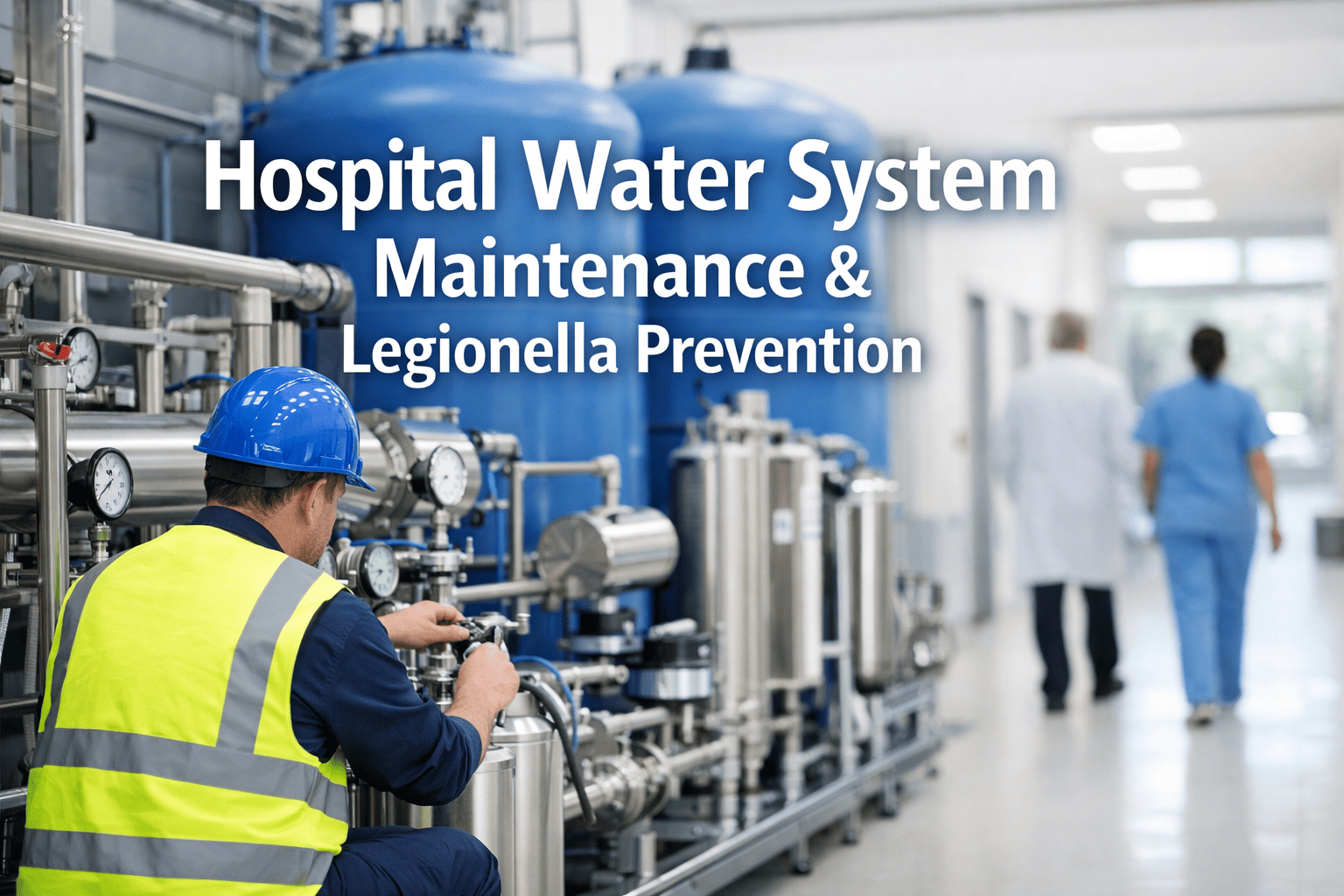
Hospital water infrastructure sits at the intersection of patient safety, regulatory compliance, and operational risk — yet it remains one of the most under-documented systems in healthcare facilities management. Legionella bacteria colonize in hot water distribution lines running below 60°C. Backflow events silently contaminate clinical hand-washing stations and sterile supply areas. Dialysis water quality drifts outside AAMI tolerance windows between manual testing cycles. These failure conditions develop in facilities with dedicated maintenance teams — not because those teams lack skill, but because hospital water systems are complex, distributed, and nearly impossible to track systematically without purpose-built digital tools. This guide covers every compliance framework governing hospital water safety in 2026, the most common documentation failures driving CMS deficiencies, and the structured maintenance approach that keeps water infrastructure compliant, safe, and audit-ready at all times. Ready to replace paper water logs with automated digital compliance? Start a free 30-day trial with Oxmaint or book a water infrastructure compliance demo with our healthcare team.
Hospital Plumbing & Water Infrastructure Maintenance
10,000+ patients die annually from Legionella in US healthcare settings. Backflow contamination events cost $500K to remediate. Dialysis water failures trigger immediate CMS action. The fix is systematic documentation — not harder work.
Turn Your Water System Records Into a Compliance Asset
Oxmaint gives hospital facilities teams a single digital platform to schedule, document, and report on every water system maintenance activity — from Legionella flush logs to backflow preventer test records — automatically mapped to the CMS and ASHRAE standards they satisfy. No binder builds. No missed test windows. No survey scrambles.
Hospital Water Infrastructure: A Professional Definition
Hospital water infrastructure maintenance is the systematic program of scheduled inspections, preventive treatments, water quality testing, and documented compliance activities that keep hospital plumbing systems safe for patients, clinical operations, and regulatory oversight. Unlike general building maintenance, healthcare water infrastructure operates under multiple regulatory frameworks simultaneously — CMS Conditions of Participation require documented Water Management Programs, ASHRAE 188 mandates risk assessment and monitoring protocols, and AAMI standards govern dialysis water purity with strict chemical and microbiological limits covering every stage of the treatment process.
The critical distinction between hospital water maintenance and standard commercial plumbing management is the patient population. Immunocompromised patients, ICU patients with compromised respiratory function, and dialysis patients with direct bloodstream exposure to treated water cannot tolerate contamination thresholds that healthy populations might encounter without consequence. A Legionella concentration posing minimal risk in an office building becomes a life-threatening event in an oncology unit — and CMS holds facilities accountable for demonstrating that documented control measures were in place before an event, not corrective actions taken after. For facilities teams ready to build an audit-proof water management program, start a free 30-day trial with Oxmaint or book a water safety compliance demo to see automated PM scheduling close documentation gaps across complex hospital water distribution systems.
4 Regulatory Standards Governing Hospital Water Safety
Every hospital water maintenance program must satisfy multiple overlapping compliance frameworks simultaneously. Each carries specific documentation requirements, testing frequencies, and reporting obligations that cannot be reliably met with paper-based tracking systems at scale.
4 Water System Failures That Generate CMS Deficiencies
These are specific, documented failure patterns that CMS and TJC surveyors identify most frequently in hospital water system reviews. All four are predictable, measurable, and entirely preventable with systematic digital maintenance management in place before a survey — not assembled in response to one.
How Oxmaint Powers Hospital Water Compliance Operations
Purpose-built for multi-site healthcare portfolios with real-time water monitoring, automated PM scheduling, and audit-ready documentation generated as your team works — not assembled the night before a survey. Start a free 30-day trial or book a live water compliance demo.
Traditional Water Management vs Oxmaint-Powered Operations
The difference between these two operating models is not incremental — it is the difference between reactive risk and controlled, documented reliability. These figures reflect real operational outcomes across hospital facilities in the USA, UK, and Australia.
| Water System Activity | Traditional Approach | Oxmaint Platform |
|---|---|---|
| Legionella Monitoring Schedule | Calendar reminders, frequent missed intervals | Auto-triggered PM tasks, zero missed windows |
| Hot Water Temperature Logging | Handwritten sheets, incomplete or lost records | Mobile digital logs, timestamped, signed, searchable |
| Backflow Preventer Testing | Manual expiry tracking, 31% of devices tested late | Auto-generated test orders issued before expiry date |
| Dialysis Water Quality Records | Paper test logs, no AAMI action-limit alerting | Digital records with automatic threshold alert system |
| Regulatory Survey Preparation | 400–600 hrs manual binder assembly per survey cycle | One-click report generation in under 30 seconds |
| CMS Water Citation Risk | 40% of facilities have documented WMP gaps | 76% fewer water-related documentation deficiencies |
| Multi-Site Compliance Visibility | Isolated per facility, no portfolio-level view | Unified real-time dashboard across all campuses |
| Corrective Action Documentation | Email chains, unlinked records, undocumented closure | Linked finding-to-closure audit trail per incident |
What Hospital Operations Teams Achieve with Oxmaint
Hospital Water Compliance: What Operations Teams Need to Know
What must a hospital Water Management Program include to satisfy CMS Conditions of Participation?
A CMS-compliant hospital Water Management Program must include: a written program document covering all water systems in scope, a formal risk assessment identifying all potential Legionella amplification and transmission hazards, documented control measures with defined acceptable limits for each identified control point, written monitoring procedures with specified testing frequencies and responsible parties, a corrective action protocol with defined response timelines for exceedances, and a documented annual program review process. CMS surveyors request the written WMP plus 12 months of associated monitoring logs at the time of survey — both must be immediately available and internally consistent. Discover how Oxmaint keeps WMP documentation always current and always retrievable — start a free 30-day trial or book a live water compliance demo to see real WMP records generated and organized automatically.
How often should hospital hot water systems be tested for Legionella, and what records are required?
ASHRAE 188 and CMS guidance call for Legionella environmental monitoring at a minimum quarterly basis for high-risk areas — including ICUs, transplant units, oncology wards, and any areas serving immunocompromised patients — with semi-annual sampling for general patient care areas and annual sampling for lower-risk zones. Required documentation for each sampling event includes: sample collection location, collection date and time, technician identity and qualifications, chain-of-custody records, laboratory accreditation documentation, quantitative Legionella test results, comparison against WMP-defined action levels, and corrective action records for any positive findings. Incomplete documentation of any single element constitutes a compliance deficiency regardless of actual water quality results at the time of sampling.
What documentation is required for hospital backflow prevention device maintenance and annual testing?
Hospital backflow prevention records must include: a complete device inventory showing device type, location, installation date, and protection category for every device in the facility; annual test reports on the standardized local authority form for each device, including pre-test and post-test readings, pass/fail status, and any repairs performed; certification documentation for the licensed tester who performed each test; records of any device repair or replacement with parts documentation and post-repair test results; and a current tracking log showing the next test due date for all devices. Facilities with more than 50 backflow preventers — common in mid-size to large hospitals — find manual tracking systems chronically unreliable for maintaining current test status across all devices simultaneously, particularly when multiple campus buildings or wings are involved.
How does Oxmaint help manage dialysis water quality compliance documentation across multiple treatment stations?
Oxmaint structures dialysis water quality compliance around the complete treatment equipment hierarchy — from incoming water pre-treatment through softeners, carbon filtration, reverse osmosis membranes, and the distribution loop to individual treatment stations. Each component has its own asset record with manufacturer-specified maintenance intervals, performance parameters, and required documentation fields loaded from AAMI standard requirements. Daily conductivity checks, monthly bacterial count and endotoxin testing, carbon filter chloramine testing, and RO membrane performance logs are all scheduled as recurring PM tasks with structured digital forms capturing every required data field. Results are automatically compared against AAMI action limits, with alert escalation triggered when values approach thresholds — giving the dialysis quality team early warning before a formal violation event. The complete documentation package is retrievable as a single organized report for any time period during CMS, TJC, or state health department surveys.
Your Hospital Water Program Is Only as Reliable as Its Documentation
Every missed temperature log, every overdue backflow test, every undocumented Legionella flush is a compliance gap that grows silently until a surveyor finds it — or a patient is affected by it. Oxmaint connects every water system maintenance activity to the regulatory standard it satisfies, generating audit-ready documentation automatically as your team works. No binder sprints. No documentation gaps. No remediation plans from preventable failures.
Start with a 30-day free trial — no heavy implementation, no extended onboarding, no commitment required. See the difference a professional asset management platform makes to your hospital water operations in the first week of use.